Ever stumbled across the words Lieu vs. Loo and wondered if they mean the same thing or belong to completely different worlds? At first glance, they may look similar enough to confuse anyone—but here’s the kicker: they have totally different meanings and are used in very different contexts.
The problem is common. Many English learners and even native speakers mix up similar-sounding words, especially when one is formal and the other is casual. And when it comes to Lieu vs. Loo, the confusion can easily lead to misunderstandings in writing or conversation.
You’re not alone if you’ve paused mid-sentence wondering which one fits. Many people struggle with these tricky word pairs, especially when switching between formal and informal English.
But don’t worry—this is actually simple once you break it down.
In this guide, you’ll learn the clear difference between Lieu vs. Loo, what each word means, when to use them, and how to remember them easily. You’ll also see real examples so you never confuse them again in writing or speech.
So if you’re ready to finally clear up the confusion between these two words, let’s dive in
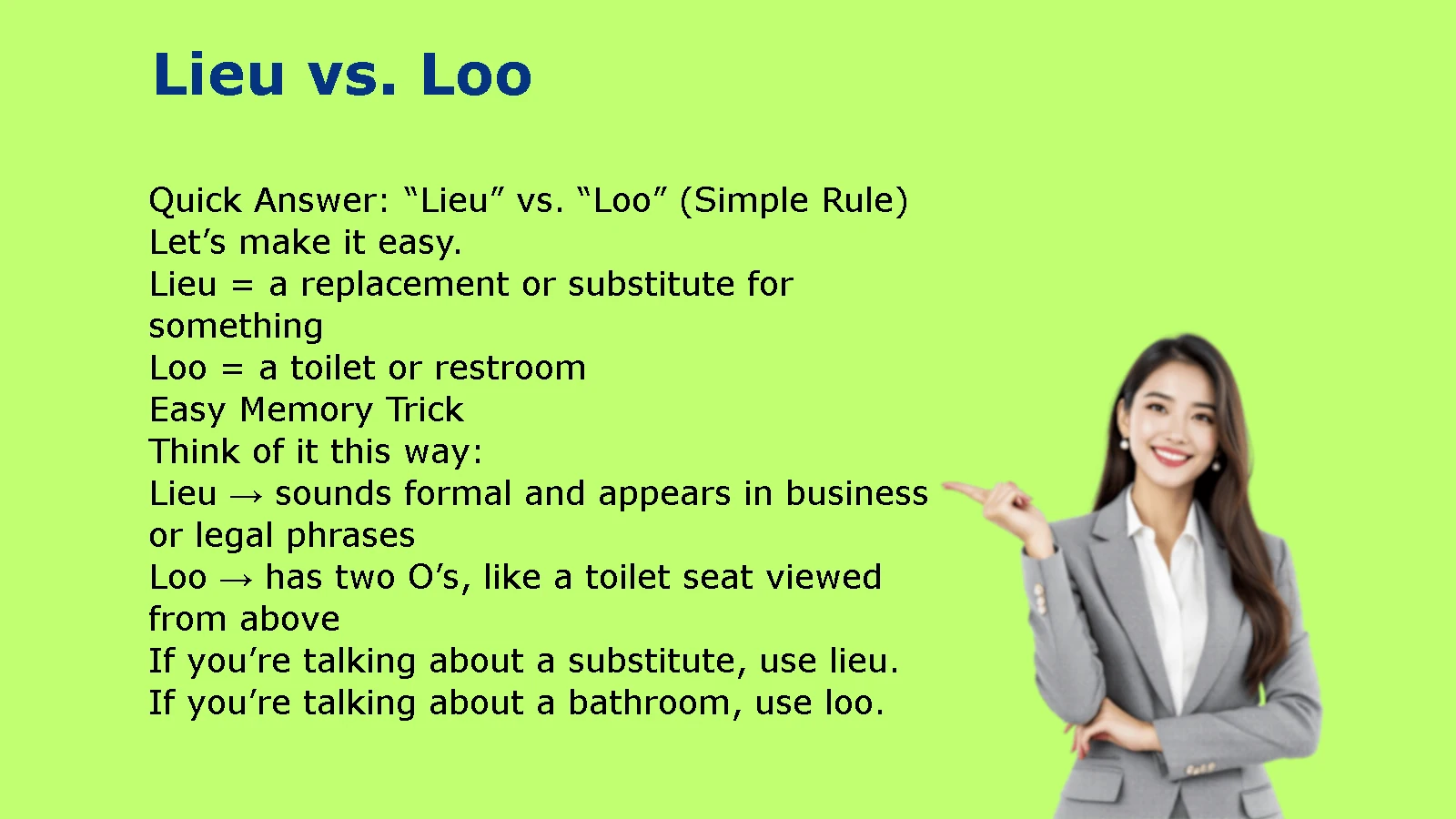
Quick Answer: “Lieu” vs. “Loo” (Simple Rule)
Let’s make it easy.
Lieu = a replacement or substitute for something
Loo = a toilet or restroom
Easy Memory Trick
Think of it this way:
- Lieu → sounds formal and appears in business or legal phrases
- Loo → has two O’s, like a toilet seat viewed from above
If you’re talking about a substitute, use lieu.
If you’re talking about a bathroom, use loo.
What Does “Lieu” Mean?
The word lieu means instead of or in place of something else.
It is most commonly used in the phrase:
“In lieu of”
This phrase means as a substitute for.
Common Examples
- Employees received extra vacation days in lieu of overtime pay.
- She donated money in lieu of sending gifts.
- We chose a video conference in lieu of an in-person meeting.
Why It Sounds Formal
Unlike everyday English words, lieu is mostly found in:
- Business communication
- Legal documents
- Professional writing
- Official announcements
That’s why you rarely hear it in casual conversation.
What Does “Loo” Mean?
Loo is an informal British English word for a toilet, bathroom, or restroom.
Common Examples
- Excuse me, where’s the loo?
- I need to use the loo before we leave.
- The restaurant has a clean loo.
Where It’s Commonly Used
You’ll hear loo frequently in:
- The United Kingdom
- Ireland
- Australia
- New Zealand
In American English, people usually say:
- Bathroom
- Restroom
- Washroom
Key Insight
Loo is casual and conversational.
Lieu is formal and professional.
Side-by-Side Comparison Table
| Word | Meaning | Part of Speech | Common Usage |
| Lieu | Substitute or replacement | Noun | Formal writing |
| Loo | Toilet or restroom | Noun | Informal speech |
Quick Example
- We accepted store credit in lieu of a refund. ✅
- We accepted store credit in loo of a refund. ❌
The Origin of “Lieu” vs. “Loo”
Understanding where these words come from makes them easier to remember.
Origin of “Lieu”
Lieu comes from Old French and originally meant place or position.
Over time, English adopted it into the phrase “in lieu of.”
Origin of “Loo”
The exact origin of loo is uncertain.
Language historians have proposed several theories, but none have been proven conclusively.
What matters is that modern English speakers understand loo to mean toilet or restroom.
How People Accidentally Confuse Them
The confusion usually comes from pronunciation.
Why It Happens
- Both words are short.
- Both contain similar vowel sounds.
- Many people have seen one word but not the other.
Common Mistake
Someone hears:
“In lieu of payment…”
But writes:
“In loo of payment…”
That creates a sentence about bathrooms instead of substitutes.
Why It Matters
In professional writing, this mistake can make documents look careless.
“Lieu” in Everyday Sentences
Here are some practical examples.
At Work
- Employees may receive time off in lieu of extra pay.
- We offered training in lieu of compensation.
At School
- Students completed an online project in lieu of an exam.
- The teacher assigned an essay in lieu of a presentation.
In Personal Life
- Donations were requested in lieu of flowers.
- We stayed home in lieu of traveling.
Key Pattern
Notice that lieu almost always follows the words:
in lieu of
“Loo” in Everyday Sentences
Now let’s look at loo.
At a Restaurant
- Could you tell me where the loo is?
- The loo is near the entrance.
While Traveling
- I need to find a loo quickly.
- Is there a public loo nearby?
At Home
- Someone is using the loo.
- The loo needs cleaning.
Key Pattern
Unlike lieu, loo usually appears by itself.
The Biggest Mistake People Make
The most common error is spelling.
Incorrect
- In loo of payment
- In loo of flowers
- In loo of compensation
Correct
- In lieu of payment
- In lieu of flowers
- In lieu of compensation
Why This Happens
People often write words based on how they sound rather than how they are spelled.
Unfortunately, lieu and loo are not interchangeable.
Real-Life Examples of “Lieu” vs. “Loo”
Let’s compare them directly.
Example 1
Correct:
- We accepted a voucher in lieu of cash.
Incorrect:
- We accepted a voucher in loo of cash.
Example 2
Correct:
- Excuse me, where is the loo?
Incorrect:
- Excuse me, where is the lieu?
Example 3
Correct:
- The company offered extra leave in lieu of overtime pay.
Correct:
- The office loo is on the second floor.
How to Avoid Confusion Every Time
Want a foolproof method?
Remember the Context
Ask yourself:
Am I talking about a substitute?
Use lieu.
Am I talking about a restroom?
Use loo.
Learn the Common Phrase
Most people encounter lieu only in:
“in lieu of”
Memorizing that phrase eliminates most mistakes.
Read the Entire Sentence
Context usually makes the correct word obvious.
What to Say Instead
If you find lieu confusing, you can often replace it with simpler wording.
Alternatives to “In Lieu Of”
- Instead of
- In place of
- As a substitute for
- Rather than
Example
Original:
- We accepted credit in lieu of cash.
Alternative:
- We accepted credit instead of cash.
Alternatives to “Loo”
Depending on your region, you can say:
- Bathroom
- Restroom
- Washroom
- Toilet
Quick Decision Guide (Use This Instantly)
When choosing between these words:
Replacement or substitute? → Lieu
Bathroom or toilet? → Loo
Professional document? → Usually lieu
Casual conversation about a restroom? → Usually loo
Simple. Reliable. Done.
FAQ: “Lieu” vs. “Loo”
Is “lieu” pronounced like “loo”?
Not exactly.
Their pronunciations are similar enough to cause confusion, but they are different words with unrelated meanings.
Can “loo” mean substitute?
No.
Loo only refers to a toilet or restroom.
Is “lieu” only used in “in lieu of”?
Almost always. Most modern English speakers encounter it in that phrase.
Is “loo” used in American English?
Rarely.
Americans usually say bathroom or restroom instead.
Which word is more formal?
Lieu is significantly more formal than loo.
Case Study: An Embarrassing Workplace Error
A new employee prepared a company announcement.
The intended sentence was:
“Employees may receive additional leave in lieu of overtime pay.”
However, the employee accidentally wrote:
“Employees may receive additional leave in loo of overtime pay.”
What Happened
- Colleagues immediately noticed the mistake.
- The message became unintentionally funny.
- The announcement had to be revised and resent.
Lesson
Words that sound alike can create major misunderstandings when spelled incorrectly.
Key Facts You Should Remember
- Lieu means a substitute or replacement.
- Lieu is most often used in the phrase “in lieu of.”
- Loo means a toilet or restroom.
- Loo is common in British English.
- The two words have completely different meanings.
- Context makes choosing the correct word easy.
Final Takeaway: The One Rule That Never Fails
The difference between “lieu” vs. “loo” is actually straightforward once you know what each word means.
Lieu belongs in formal expressions about substitutions and replacements.
Loo belongs in conversations about bathrooms and restrooms.
So remember:
Substitute or replacement → Lieu
Toilet or restroom → Loo
When in doubt, think about the context. If the sentence is discussing what takes the place of something else, choose lieu. If it’s discussing where someone goes to wash their hands or use the toilet, choose loo.
That simple rule will keep you from ever confusing these two words again.