Began vs begun is a common English grammar question because both words come from the verb begin, but they are used in different grammatical situations. If you’ve wondered whether to say “I began the work” or “I have begun the work,” the difference depends mainly on the verb tense, helping verbs, sentence structure, and context.
The began vs begun distinction comes from the three main forms of the irregular verb begin: begin is the base form, began is the simple past form, and begun is the past participle. While began is normally used to describe something that started in the past, begun usually appears with helping verbs such as has, have, or had. Related forms such as beginning, started, starting, commencement, and initiated can also appear in similar contexts but do not always work in the same grammatical structures.
In this guide, you’ll learn the difference between began and begun, when to use each form, how they work in different verb tenses, and how to use them correctly in sentences. You’ll also see clear examples, helpful tables, and common mistakes to make the distinction easier to understand.
By the end, you’ll know exactly when to use began and begun and how to choose the correct form of begin naturally and correctly in everyday and formal English.
Quick Answer: Began vs Begun
The difference between began and begun is grammatical, not a difference in basic meaning.
- Began is the simple past tense of begin.
- Begun is the past participle of begin.
- Use began when talking about a past action without a perfect auxiliary verb.
- Use begun after has, have, or had in perfect constructions.
- After did, use the base form begin, not began or begun.
Compare these sentences:
I began the project yesterday.
I have begun the project.
She had begun cooking before the guests arrived.
The basic verb pattern is:
| Verb form | Function | Example |
| begin | Base form | We begin at noon. |
| began | Simple past | We began at noon. |
| begun | Past participle | We have begun already. |
Oxford lists began as the past simple form and begun as the past participle of begin.
If you remember only one rule, remember this:
Began stands on its own as the past-tense form; begun normally works with an auxiliary verb such as has, have, or had.
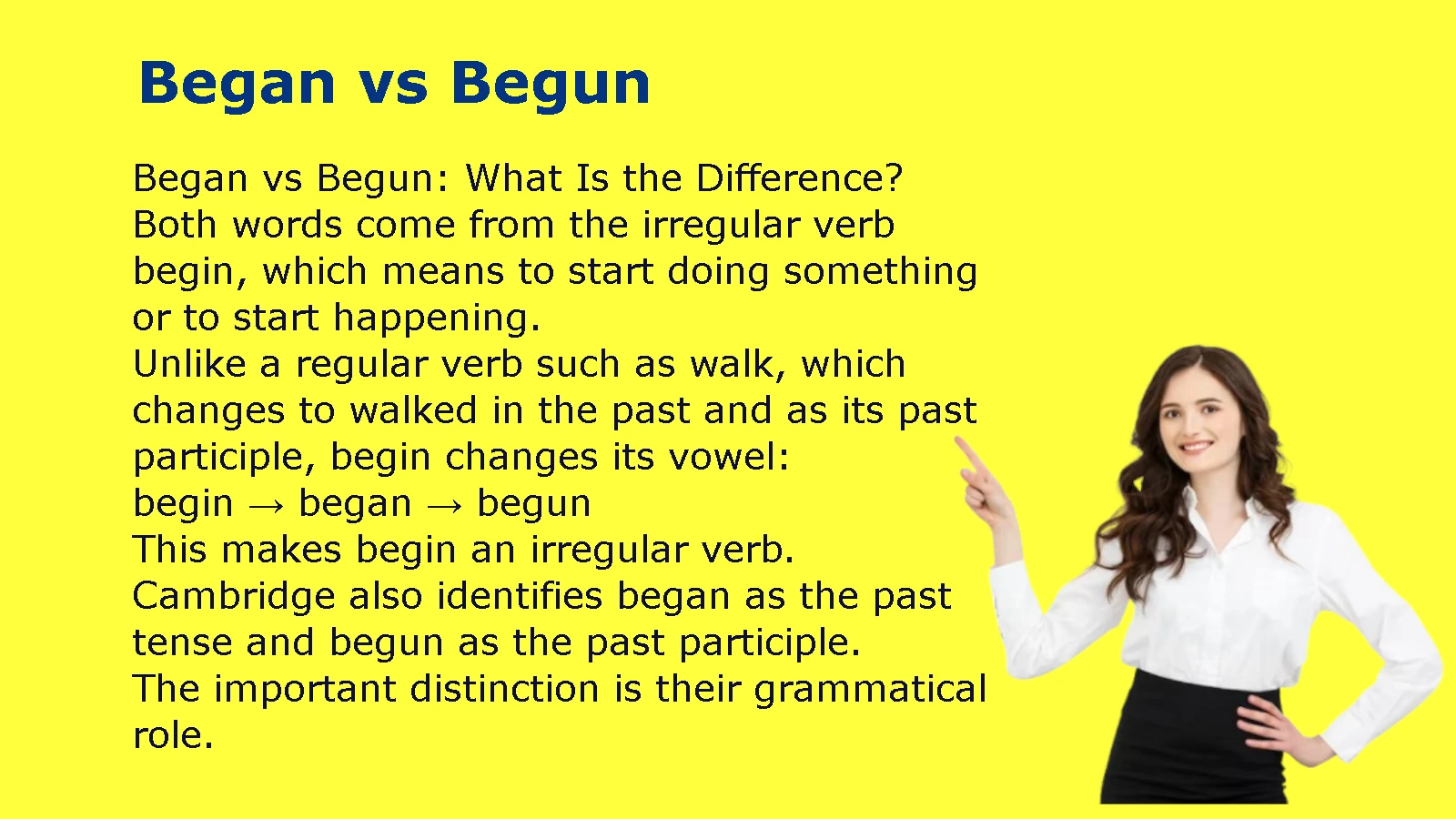
Began vs Begun: What Is the Difference?
Both words come from the irregular verb begin, which means to start doing something or to start happening.
Unlike a regular verb such as walk, which changes to walked in the past and as its past participle, begin changes its vowel:
begin → began → begun
This makes begin an irregular verb.
Cambridge also identifies began as the past tense and begun as the past participle.
The important distinction is their grammatical role.
Began is the simple past
Use began to describe something that started in the past.
For example:
- The meeting began at 9 a.m.
- She began her presentation after lunch.
- We began the journey early.
- The rain began during the night.
- His career began in 2010.
These sentences use the simple past. The verb itself carries the past tense.
Begun is the past participle
Begun does not normally function as the simple past by itself.
Instead, it is used with an auxiliary verb in perfect constructions:
- The meeting has begun.
- The meeting had begun before we arrived.
- The meeting will have begun by then.
The auxiliary carries the tense, while begun supplies the past participle.
That distinction explains why these are correct:
- She began working.
- She has begun working.
- She had begun working.
But these are incorrect in standard English:
- ❌ She has began working.
- ❌ She had began working.
- ❌ She begun working yesterday.
Began Meaning and How to Use It
Began means started or started to happen. It is the simple past form of begin. Oxford defines began specifically as the past-tense form of begin.
Use began when the sentence describes a past event directly.
Began with a specific past time
A specific past-time expression often appears with began:
- The class began at 8:00 a.m.
- The concert began last night.
- She began her new job in January.
- Construction began in 2024.
- The discussion began after lunch.
The time expression does not itself make began mandatory, but it fits naturally with the simple past when the event is presented as a completed past occurrence.
Began with a completed past event
You can also use began without an explicit time expression:
- The argument began suddenly.
- The audience began to clap.
- He began speaking.
- The children began playing.
- The story began with a mysterious letter.
Oxford notes that begin can be followed by either an infinitive or an -ing form in many constructions.
For example:
- She began to cry.
- She began crying.
Both are standard.
Begun Meaning and How to Use It
Begun is the past participle of begin. Oxford gives its grammatical form directly as “past participle of begin.”
Because begun is a participle rather than the simple past form, it normally appears with an auxiliary verb.
Begun with has
Use has begun with a singular third-person subject in the present perfect:
- The meeting has begun.
- The movie has begun.
- She has begun a new project.
- The process has begun.
- The school year has begun.
Begun with have
Use have begun with I, you, we, they, and plural subjects:
- I have begun my assignment.
- We have begun the process.
- They have begun negotiations.
- The students have begun their exams.
Begun with had
Use had begun for the past perfect:
- The movie had begun before we arrived.
- She had begun cooking when the phone rang.
- They had begun the meeting before I entered the room.
- The storm had begun by midnight.
Here, had establishes the past perfect construction, while begun is the past participle.
Begun with will have
The future perfect uses will have begun:
- By noon, the ceremony will have begun.
- By the time you arrive, the meeting will have begun.
- The construction will have begun by next month.
This construction is less common in everyday conversation, but it is grammatically standard.
Began vs Begun Grammar Rules
The easiest way to understand began vs begun is to identify the verb form required by the sentence.
Rule: Use began for the simple past
If you are simply describing something that started in the past, use began.
Correct:
The lesson began at nine.
Incorrect:
The lesson begun at nine.
The first sentence uses the simple past correctly.
Rule: Use begun after has, have, or had
When you see has, have, or had functioning as the auxiliary for a perfect construction, use begun.
Examples:
- The show has begun.
- The show had begun.
- The show will have begun.
A useful pattern is:
has/have/had + begun
Rule: Use begin after did
This rule causes another common mistake.
After did, use the base form begin.
Correct:
Did the meeting begin on time?
Incorrect:
Did the meeting began on time?
Also incorrect:
Did the meeting begun on time?
Why? Because did already carries the past tense. Adding the past form began would duplicate the tense marking.
The same principle applies to negative sentences:
The meeting did not begin on time.
Not:
❌ The meeting did not began on time.
And not:
❌ The meeting did not begun on time.
Rule: Use begun with a perfect auxiliary, not by itself
In ordinary standard constructions, begun needs grammatical support.
Compare:
- She began the assignment. ✅
- She has begun the assignment. ✅
- She had begun the assignment. ✅
- She begun the assignment. ❌
This is one of the quickest ways to distinguish the two forms.
Began vs Begun Examples
The following examples show how the forms work in different sentence structures.
| Sentence | Correct Form | Reason |
| The class ___ at 10. | began | Simple past |
| The class has ___. | begun | Present perfect |
| The class had ___ before we arrived. | begun | Past perfect |
| When did the class ___? | begin | Base form after did |
| The students ___ studying yesterday. | began | Simple past |
| The students have ___ studying. | begun | Present perfect |
| The students had ___ studying before lunch. | begun | Past perfect |
| The ceremony will have ___ by then. | begun | Future perfect |
Examples with began
- The meeting began at noon.
- She began writing her report yesterday.
- The rain began after dark.
- We began the experiment in March.
- The audience began to leave.
- He began laughing.
- The company began operations in 2018.
- The story began with a phone call.
Examples with begun
- The meeting has begun.
- The meeting had begun before I arrived.
- The students have begun their work.
- She has begun learning Spanish.
- The process has begun already.
- The repairs had begun by Monday.
- The event will have begun by the time we get there.
- Construction has begun on the new building.
Has Began or Has Begun?
The correct expression is has begun.
Has is an auxiliary verb used to form the present perfect, so it must be followed by the past participle.
The meeting has begun. ✅
The meeting has began. ❌
The same rule applies to other subjects that take has:
- She has begun.
- He has begun.
- It has begun.
- The project has begun.
Why “has began” is incorrect
The problem is that began is already the simple past form.
The present perfect requires:
has + past participle
Since begun is the past participle, the correct combination is:
has + begun
Not:
has + began
A simple comparison makes the pattern clear:
| Incorrect | Correct |
| She has began working. | She has begun working. |
| The show has began. | The show has begun. |
| Construction has began. | Construction has begun. |
| The discussion has began. | The discussion has begun. |
Had Began or Had Begun?
The correct form is had begun.
The past perfect follows this structure:
had + past participle
Therefore:
The movie had begun before we arrived. ✅
Not:
❌ The movie had began before we arrived.
More examples:
- The meeting had begun before the manager arrived.
- She had begun preparing dinner when the guests called.
- They had begun the project before the funding changed.
- The rain had begun by the time we left.
- The lecture had begun when I entered the room.
The key is simple: had requires the past participle in a past-perfect construction, and that form is begun.
Begin vs Began vs Begun
Learning all three forms together is easier than memorizing began and begun separately.
| Form | Name | Example |
| begin | Base form | I want to begin now. |
| begins | Third-person singular present | The class begins at nine. |
| began | Simple past | The class began at nine. |
| begun | Past participle | The class has begun. |
| beginning | -ing form | The class is beginning now. |
The complete core pattern is:
begin → began → begun
Present: begin
Use begin for the base form:
- I begin work at eight.
- We will begin soon.
- They want to begin immediately.
- Did you begin the assignment?
Past: began
Use began as the simple past:
- I began work at eight.
- We began yesterday.
- They began the assignment last week.
Past participle: begun
Use begun with an appropriate auxiliary:
- I have begun the assignment.
- We had begun before they arrived.
- They will have begun by then.
Began vs Begun After Helping Verbs
Helping verbs provide one of the clearest clues.
Has begun
The program has begun.
Present perfect.
Have begun
The students have begun the exam.
Present perfect with a plural subject.
Had begun
The students had begun the exam before the teacher entered.
Past perfect.
Will have begun
The students will have begun the exam by noon.
Future perfect.
Did begin
Notice the contrast:
The students did begin the exam.
Here, begin, not began or begun, follows did.
The structure is:
did + base verb
This gives you three useful patterns:
- did + begin
- has/have/had + begun
- simple past without an auxiliary + began
Began vs Begun in Questions and Negative Sentences
Questions and negatives are especially useful for seeing how English handles irregular verbs.
Questions with did
Use begin after did:
Did the concert begin at eight?
When did the meeting begin?
Why did the argument begin?
Never use began or begun directly after did in standard English.
Negative sentences with did not
The same rule applies:
The meeting did not begin on time.
The class did not begin until noon.
The ceremony did not begin as planned.
The word did carries the past tense, so the main verb returns to its base form.
Questions with has or have
When the sentence uses the present perfect, choose begun:
Has the meeting begun?
Have they begun the project?
Has construction begun yet?
Questions with had
For the past perfect:
Had the meeting begun before you arrived?
Had she begun the assignment?
Again, begun is the past participle.
“Where It All Began” or “Where It All Begun”?
The correct expression is:
Where it all began
This phrase uses began because the verb is functioning as a simple past form.
For example:
This is where it all began.
Let’s return to where it all began.
The museum tells the story of where it all began.
The expression does not require has, have, or had, so there is no reason to use the past participle begun.
“Where it all begun” is incorrect in standard English when used in this construction.
Began vs Begun vs Started
Because begin and start are close in meaning, it is useful to compare their forms.
| Verb | Simple Past | Past Participle |
| begin | began | begun |
| start | started | started |
That difference can make start easier to use because its simple past and past participle look identical.
Compare:
The meeting started at nine.
The meeting has started.
With begin:
The meeting began at nine.
The meeting has begun.
Cambridge notes that begin and start can have the same general meaning, although begin is more formal in some contexts.
Oxford similarly notes that start is more common in spoken English, while begin is often used in writing and when describing a sequence of events.
Can began and started always replace each other?
No.
In many contexts they are interchangeable:
- The meeting began at 9.
- The meeting started at 9.
Both are natural.
However, there are situations where start has uses that begin does not normally share.
For example:
Press the button to start the machine.
Standard English does not normally use begin in this machine-operation sense.
Cambridge specifically distinguishes some uses of start, including talking about machines and creating a new business.
So while began and started overlap substantially, they are not perfect substitutes in every construction.
Common Mistakes With Began and Begun
Mistake: Using “has began”
Incorrect:
❌ The project has began.
Correct:
✅ The project has begun.
Remember:
has + past participle = has begun
Mistake: Using “had began”
Incorrect:
❌ The meeting had began before noon.
Correct:
✅ The meeting had begun before noon.
Remember:
had + past participle = had begun
Mistake: Using “begun” as the simple past
Incorrect:
❌ She begun the course last month.
Correct:
✅ She began the course last month.
The simple past form is began.
Mistake: Using “began” after did
Incorrect:
❌ Did the concert began at seven?
Correct:
✅ Did the concert begin at seven?
The word did already marks the sentence as past tense.
Mistake: Using “begun” after did
Incorrect:
❌ Did the ceremony begun?
Correct:
✅ Did the ceremony begin?
The rule is:
did + base form
How to Remember Began vs Begun
A short memory system can prevent most errors.
Use the “yesterday test”
If the sentence naturally describes a simple past event, began is usually the form you need:
Yesterday, the meeting began at noon.
You can also think of expressions such as:
- yesterday
- last night
- last year
- two hours ago
- in 2020
- earlier this morning
These often appear naturally with the simple past.
Use the “has/have/had test”
If you see has, have, or had in a perfect construction, choose begun:
has begun
have begun
had begun
This is probably the most useful shortcut.
Use the “did test”
If you see did, use begin:
Did it begin?
Did they begin?
Why did she begin?
So the three-way memory trick is:
Did → begin
Simple past → began
Has/have/had → begun
Began vs Begun Pronunciation
The two forms also have noticeably different vowel sounds.
Oxford gives the pronunciations as:
- began: /bɪˈɡæn/
- begun: /bɪˈɡʌn/
The first syllable is similar, but the stressed vowel changes.
Began contains the vowel sound represented by /æ/, while begun uses /ʌ/.
That difference is useful when speaking because it makes the grammatical forms easier to distinguish.
Pronunciation comparison
| Word | IPA | Main stressed vowel |
| begin | /bɪˈɡɪn/ | /ɪ/ |
| began | /bɪˈɡæn/ | /æ/ |
| begun | /bɪˈɡʌn/ | /ʌ/ |
The stress remains on the second syllable in all three forms.
Began vs Begun in Real-World Sentences
Grammar becomes easier when you see the forms working in realistic contexts.
Workplace example
The meeting began at 10 a.m., but several team members arrived late.
Here, began is simple past.
Now change the perspective:
The meeting has begun, so please join as soon as possible.
The second sentence uses the present perfect, so begun is required.
School example
The semester began in September.
This describes a past event.
Now consider:
The new semester has begun, and students are settling into their classes.
The present perfect emphasizes that the new semester has started and is relevant now.
Project example
We began the project last Monday.
Simple past.
We have begun the project, but several tasks remain.
Present perfect.
Historical example
The organization began as a small local group.
Here, began describes its starting point in the past.
A perfect construction could also appear:
The organization had begun as a small local group before expanding nationally.
The grammar changes because the relationship between two past events changes.
A Practical Case Study: Choosing the Correct Form
Consider this short passage:
The company ___ operations in 2019. By 2021, it had ___ expanding into new markets. Today, the expansion has ___ to affect several regions.
There are three different grammatical requirements.
Sentence one
The company began operations in 2019.
The sentence uses simple past, so began is correct.
Sentence two
By 2021, it had begun expanding into new markets.
The word had signals a past-perfect construction, so begun is required.
Sentence three
Today, the expansion has begun to affect several regions.
The word has creates the present perfect, so begun is correct again.
The finished passage is:
The company began operations in 2019. By 2021, it had begun expanding into new markets. Today, the expansion has begun to affect several regions.
This illustrates why simply memorizing “began means past” is not enough. You also need to recognize the verb structure around the word.
Began vs Begun Practice Questions
Choose begin, began, or begun in each sentence.
Practice
- The lecture ___ at 10 a.m.
- The lecture has ___ already.
- The lecture had ___ before we arrived.
- When did the lecture ___?
- She ___ studying last night.
- She has ___ studying for her exam.
- The construction ___ in April.
- Construction has ___ on the new building.
- Did the ceremony ___ on time?
- The ceremony had ___ when we entered.
Answers
| No. | Answer | Explanation |
| 1 | began | Simple past |
| 2 | begun | Has + past participle |
| 3 | begun | Had + past participle |
| 4 | begin | Did + base form |
| 5 | began | Simple past |
| 6 | begun | Has + past participle |
| 7 | began | Simple past |
| 8 | begun | Has + past participle |
| 9 | begin | Did + base form |
| 10 | begun | Had + past participle |
Quick Reference: Began vs Begun
| Question | Correct Answer |
| Is began the past tense of begin? | Yes |
| Is begun the past participle? | Yes |
| Is has began correct? | No |
| Is has begun correct? | Yes |
| Is had began correct? | No |
| Is had begun correct? | Yes |
| Is I began yesterday correct? | Yes |
| Is I begun yesterday correct? | No |
| Is Did it begin? correct? | Yes |
| Is Did it began? correct? | No |
| Is Where it all began correct? | Yes |
| Verb sequence | begin → began → begun |
FAQs About Began vs Begun
Is it began or begun?
It depends on the grammatical construction.
Use began for the simple past:
She began the course last week.
Use begun as the past participle:
She has begun the course.
Is it has began or has begun?
Has begun is correct.
The meeting has begun.
Has began is incorrect because began is the simple past, while the present perfect requires the past participle begun.
Is it had began or had begun?
Had begun is correct.
The movie had begun before we arrived.
The past perfect uses had + past participle, so begun is required.
What is the past tense of begin?
The past tense of begin is began.
Present: begin
Past: began
Past participle: begun
Oxford identifies began as the past simple form of begin.
What is the past participle of begin?
The past participle is begun.
It appears in constructions such as:
- has begun
- have begun
- had begun
- will have begun
Oxford identifies begun as the past participle of begin.
Can I use begun by itself?
In ordinary standard constructions, begun generally needs an auxiliary verb when it functions as the past participle:
She has begun.
Not:
❌ She begun.
However, participles can occur in more complex structures, so the practical rule for learners is to look for the auxiliary that supports the participle.
Is “where it all began” correct?
Yes.
Where it all began is the correct standard expression.
This is where it all began.
The verb is simple past, so began is appropriate.
What is the difference between begin, began, and begun?
Begin is the base form, began is the simple past, and begun is the past participle.
I began work at eight yesterday.
I have begun work.
Is began a past participle?
No.
Began is the simple past form.
Begun is the past participle.
This distinction is the central grammatical difference between the two words.
What is the correct form after did?
Use begin:
Did the meeting begin?
Not:
❌ Did the meeting began?
Not:
❌ Did the meeting begun?
The auxiliary did is followed by the base form of the main verb.
What is the difference between began and started?
Both can mean that something started, and they are interchangeable in many contexts.
For example:
The meeting began at nine.
The meeting started at nine.
However, start has some uses that begin does not normally have, particularly with machines and certain expressions. Cambridge specifically notes these differences.
Final Rule: Begin, Began, or Begun?
The easiest way to master began vs begun is to stop treating them as interchangeable forms.
Think of the verb as a three-part pattern:
begin → began → begun
Then identify the structure:
- Begin = base form
- Began = simple past
- Begun = past participle
- Did + begin
- Has/have/had + begun
- Simple past without an auxiliary + began
For example:
I began the assignment yesterday.
I had begun the assignment before dinner.
Did you begin the assignment?
Those four sentences contain the same basic verb, but the grammar determines which form belongs in each one.
Once you recognize the difference between the simple past and past participle, the choice becomes much easier. When you see has, have, or had, think begun. When you are describing a straightforward past event, think began.
That simple pattern covers most everyday questions about began vs begun.