Hoping vs hopeing is a common spelling question that comes up when writing about wanting, expecting, or wishing for something to happen. If you’ve wondered whether the correct spelling is “hoping” or “hopeing,” the answer is straightforward: hoping is the correct spelling, while hopeing is a misspelling. The confusion usually happens when adding the -ing ending to the verb hope.
The hoping vs hopeing distinction becomes easier to understand once you know the spelling rule behind it. When a verb ends in a silent e, that final e is usually dropped before adding -ing. Therefore, hope + ing = hoping, not hopeing. The same pattern appears in words such as making, taking, writing, and using, where the final e is removed before -ing is added.
In this guide, you’ll learn whether “hoping” or “hopeing” is correct, why “hoping” drops the final e, how to use hoping in sentences, and what common spelling rule explains the difference. You’ll also see clear examples and comparisons to help you avoid this mistake in everyday and formal writing.
By the end, you’ll know exactly why hoping is the correct spelling and how to use it naturally and confidently in your writing.
Hoping vs Hopeing: Quick Answer
| Word | Correct spelling? | Meaning |
| Hoping | Yes | Wanting or wishing for something to happen |
| Hopeing | No | Incorrect spelling of hoping |
| Hopping | Yes, but different | Jumping or moving by short jumps |
Correct examples
- I am hoping for good news.
- She is hoping to get the job.
- We are hoping that everything goes well.
- They were hoping for better weather.
Incorrect examples
- I am hopeing for good news.
- She is hopeing to get the job.
- We are hopeing that everything works out.
The key point is that hopeing is not an alternative spelling of hoping. It is simply a spelling error.
Hoping vs Hopeing: What Is the Difference?
The difference is entirely about spelling because only hoping is the standard English form.
Hope is the base verb. When you form its -ing form, the final silent e is removed before -ing is added:
hope → hoping
The same spelling pattern occurs with many other verbs:
| Base verb | Correct -ing form | Incorrect form |
| hope | hoping | hopeing |
| make | making | makeing |
| write | writing | writeing |
| drive | driving | driveing |
| take | taking | takeing |
| use | using | useing |
| move | moving | moveing |
This is why hopeing can look tempting. The writer sees hope and -ing and naturally wants to combine them letter by letter. English spelling does not always work that way, though.
Why Hoping Is Correct
Hoping follows the standard spelling pattern for a verb ending in silent e.
Start with:
hope
Remove the final e:
hop
Add -ing:
hop + ing = hoping
The result contains only one e, which is the e already present in the word’s spelling before the final silent e is removed.
The pronunciation also stays connected to the original vowel sound. Hope is pronounced with a long o sound, and hoping keeps that sound.
Why Hopeing Is Incorrect
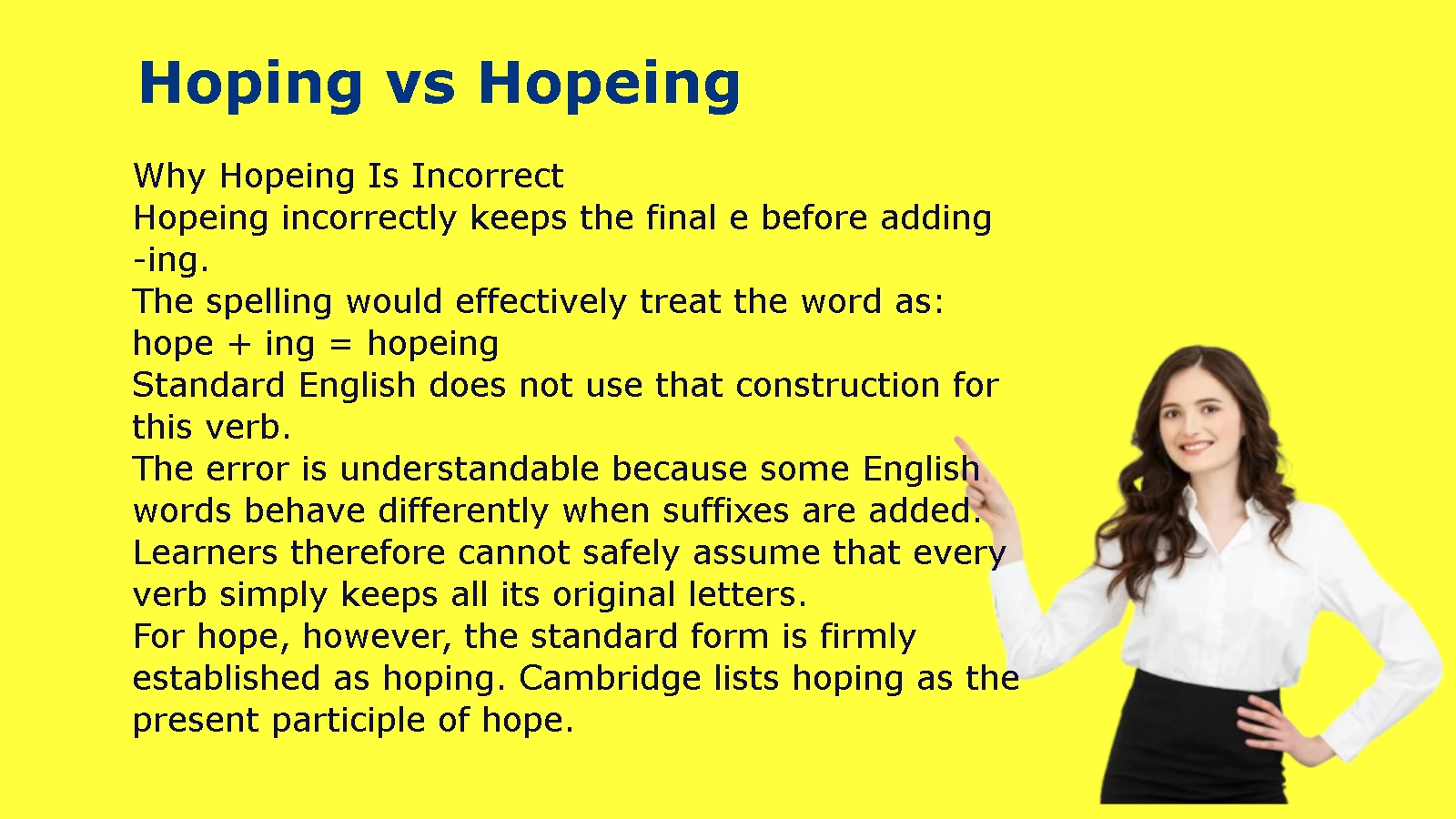
Hopeing incorrectly keeps the final e before adding -ing.
The spelling would effectively treat the word as:
hope + ing = hopeing
Standard English does not use that construction for this verb.
The error is understandable because some English words behave differently when suffixes are added. Learners therefore cannot safely assume that every verb simply keeps all its original letters.
For hope, however, the standard form is firmly established as hoping. Cambridge lists hoping as the present participle of hope.
Why Does Hope Become Hoping?
The spelling change becomes easier to remember once you understand what happens to the final e.
The Silent E Rule
Many English verbs end in a silent e:
- hope
- make
- write
- take
- drive
- use
- move
When these verbs take -ing, the final silent e is normally dropped.
| Base word | Remove final e | Add -ing | Final form |
| hope | hop | hop + ing | hoping |
| make | mak | mak + ing | making |
| write | writ | writ + ing | writing |
| take | tak | tak + ing | taking |
| drive | driv | driv + ing | driving |
This rule prevents awkward spellings such as makeing and writeing.
There are exceptions and related spelling patterns in English, so the rule should not be treated as an explanation for every possible -ing form. Still, it gives you the correct answer for hoping.
What Happens When You Add -ing to Hope
Think of the transformation in three stages:
Stage 1: Start with the verb.
hope
Stage 2: Remove the final silent e.
hop
Stage 3: Add -ing.
hoping
That gives you the correct spelling:
hope → hoping
A useful memory trick is:
Hope loses its final e before it starts hoping.
It is simple, but it works.
Hoping Meaning and Definition
Hoping means wanting something to happen or be true, usually with some expectation that it might happen.
For example:
I am hoping for a promotion.
The speaker wants a promotion and believes it is possible.
Cambridge Dictionary explains hope as wanting something to happen or be true, generally when there is some reason to think it might happen. It also gives common structures including hope for, hope that, and hope to + verb.
Hoping as the Present Participle of Hope
Grammatically, hoping is the present participle of hope.
It commonly appears with forms of be to create progressive constructions:
- I am hoping.
- She is hoping.
- They are hoping.
- He was hoping.
- We were hoping.
For example:
She is hoping to hear from the company soon.
Here, is hoping forms the present progressive.
The form can also appear in participial phrases:
Hoping to avoid traffic, we left early.
In this sentence, hoping to avoid traffic describes the reason or motivation behind leaving early.
Hoping as a Gerund
An -ing form can also function as a noun. When it does, it is called a gerund.
Purdue OWL describes a gerund as a verbal ending in -ing that functions as a noun.
For example:
Hoping for a better result kept her motivated.
Here, hoping for a better result functions as the subject of the sentence.
Compare:
She is hoping for a better result.
In the first sentence, hoping participates in a noun-like phrase. In the second, is hoping functions as part of the verb phrase.
The spelling remains exactly the same in both cases: hoping.
Examples of Hoping in Sentences
Seeing the word in different sentence structures makes the distinction clearer.
Hoping for Something
Use hoping for + noun when you are expressing a desire for a particular thing or outcome.
Examples:
- I am hoping for good news.
- She is hoping for a promotion.
- They are hoping for better weather.
- We were hoping for a larger response.
- He is hoping for an opportunity to prove himself.
The noun after for identifies what the person wants.
Hoping to Do Something
Use hoping to + base verb when someone wants to perform an action.
Examples:
- I am hoping to visit Chicago this summer.
- She is hoping to finish the project today.
- They are hoping to find a solution.
- We are hoping to hear from you soon.
- He was hoping to win the competition.
A common grammatical mistake is putting an -ing form after hope to.
Incorrect:
I am hoping to hearing from you soon.
Correct:
I am hoping to hear from you soon.
Cambridge’s grammar guidance specifically identifies hope to do as the standard pattern rather than hope to doing.
Hoping That Something Happens
You can also use hoping that + clause.
Examples:
- I am hoping that everything goes well.
- She is hoping that her application is accepted.
- We are hoping that the weather improves.
- They were hoping that the meeting would be productive.
The that can sometimes be omitted:
I am hoping everything goes well.
Both versions are natural in everyday English.
Hoping in Questions and Everyday Conversation
The word is common in ordinary conversation:
Are you hoping to get the position?
What are you hoping to achieve?
Were you hoping for something different?
I’m hoping so.
These constructions allow speakers to discuss expectations and desired outcomes without claiming that the result is certain.
Hope vs Hoping: What Is the Difference?
Hope can be the base form of the verb:
I hope you feel better soon.
It can also be a noun:
There is still hope.
Hoping, by contrast, is the -ing form:
I am hoping you feel better soon.
The two forms can sometimes express nearly the same general idea, but the grammar and emphasis differ.
| Form | Example | Function |
| hope | I hope you succeed. | Base verb |
| hoping | I am hoping you succeed. | Present participle |
| hoped | I hoped you would succeed. | Past form |
| hopes | She hopes you succeed. | Third-person singular |
| hope | There is still hope. | Noun |
Cambridge identifies hope as both a verb and a noun and gives hoped as its past simple and past participle.
Hoping vs Hopping: Why They Are Sometimes Confused
Both correct words, but they have completely different meanings.
Hoping Meaning
Hoping relates to hope.
I am hoping for good news.
It means wanting or expecting something positive to happen.
Hopping Meaning
Hopping comes from hop and means jumping or moving with short jumps.
The rabbit was hopping across the garden.
It can also describe movement from one place to another:
We went bar-hopping after dinner.
The extra p changes the word completely.
Hoping vs Hopping in Sentences
Compare these:
She is hoping to get a new job.
She wants to get a new job.
The rabbit is hopping across the field.
The rabbit is jumping in short movements.
A quick memory aid:
- hoping = wanting something
- hopping = jumping
The spelling difference matters because hope and hop are different base words.
Why People Spell Hoping as Hopeing
The error hopeing usually comes from applying a straightforward letter-by-letter approach to the word.
Someone may think:
hope + ing = hopeing
That seems logical at first glance. English spelling, however, often changes the base word when a suffix is added.
The final e in hope is silent, so it disappears before -ing.
Applying the Wrong Spelling Rule
A learner may know that many words preserve their letters when suffixes are added and assume that hope should do the same.
For example:
work + ing = working
So it may seem reasonable to assume:
hope + ing = hopeing
But hope belongs to the group of verbs that normally drop the final silent e before -ing.
Confusing Hope With Words That Keep the E
English contains enough spelling variation to make suffix rules confusing.
That is why it helps to learn common word families rather than relying exclusively on one formula.
For this word family:
| Word | Form |
| hope | Base form |
| hopes | Present tense, third-person singular |
| hoped | Past tense |
| hoping | -ing form |
| hopeful | Adjective |
| hopefully | Adverb |
| hopeless | Adjective |
| hopelessly | Adverb |
Notice that hoping is not formed in the same way as hopeful. Different suffixes can trigger different spelling patterns.
Common Mistakes With Hoping
Hopeing Instead of Hoping
This is the main spelling error.
Incorrect:
I am hopeing you can come.
Correct:
I am hoping you can come.
Hopping Instead of Hoping
This mistake changes the meaning rather than merely producing a nonstandard spelling.
Incorrect if you mean wanting:
I am hopping to get the job.
Correct:
I am hoping to get the job.
Hopping is a legitimate word, but it means jumping or moving by hops.
Using Hope and Hoping in the Wrong Context
Another common issue involves the construction that follows hope.
Incorrect:
I hope to hearing from you soon.
Correct:
I hope to hear from you soon.
Correct:
I am hoping to hear from you soon.
The pattern is:
hope to + base verb
not:
hope to + -ing verb
Cambridge explicitly lists hope to do something as the standard grammatical pattern.
How to Remember the Correct Spelling of Hoping
The easiest method is to remember one transformation:
hope → hoping
Think of the final e as temporary. Once -ing arrives, that e drops away.
You can also compare it with familiar words:
- make → making
- write → writing
- take → taking
- drive → driving
- hope → hoping
A Simple Memory Trick
Remember this sentence:
When hope starts hoping, the final e goes missing.
The sentence is deliberately memorable because it connects the spelling change to the word itself.
Another useful technique is to watch for the visual pattern:
HOP + ING = HOPING
Not:
HOPE + ING = HOPEING
If you are proofreading an article, email, essay, or application, search for hopeing. In standard English, replace it with hoping.
Hoping in American and British English
The spelling hoping is standard in both American and British English.
There is no American-versus-British spelling difference here.
| Variety | Correct form |
| American English | hoping |
| British English | hoping |
| Canadian English | hoping |
| Australian English | hoping |
The pronunciation can have regional differences, particularly in the pronunciation of the vowel in hope, but the spelling remains hoping.
That makes this a relatively straightforward spelling question compared with words that genuinely have different American and British forms.
Is Hoping a Word?
Yes. Hoping is a standard English word.
It is the present participle of hope, and it appears in ordinary spoken and written English.
Examples include:
- I am hoping for a quick response.
- She is hoping to travel next year.
- They were hoping for better results.
- He left early, hoping to avoid traffic.
Cambridge Dictionary lists hoping directly as the present participle of hope.
The word can also appear in gerund constructions:
Hoping for a better outcome motivated the team.
In this example, the -ing form participates in a noun-like phrase.
Is Hopeing Ever Correct?
No. Hopeing is not the standard spelling of the -ing form of hope.
If you mean the act of wanting or expecting something to happen, use:
hoping
not:
hopeing
For example:
Correct:
We are hoping for good weather.
Incorrect:
We are hopeing for good weather.
The same principle applies regardless of whether the sentence is casual, academic, professional, or formal.
Hoping Synonyms and Related Words
The best synonym depends on the exact context.
Possible alternatives include:
- wishing
- expecting
- anticipating
- looking forward to
- desiring
- wanting
- trusting
- longing for
- aspiring to
- praying for
These words are not interchangeable in every sentence.
For example:
I am hoping to hear from you soon.
can sometimes become:
I am looking forward to hearing from you soon.
However, the meaning shifts slightly. Looking forward to often expresses positive anticipation, whereas hoping emphasizes a desired outcome that is not certain.
Likewise:
She is hoping to win.
does not necessarily mean:
She expects to win.
Cambridge distinguishes hope from expect by noting that hope expresses a desired outcome whose occurrence is uncertain, while expect is used when someone believes something will happen.
Hoping vs Hopeing Examples at a Glance
The following examples cover some of the most common situations.
| Incorrect | Correct | Why |
| I am hopeing for good news. | I am hoping for good news. | Drop the final e before -ing. |
| She is hopeing to win. | She is hoping to win. | Hoping is the correct participle. |
| We were hopeing for rain. | We were hoping for rain. | Hopeing is not standard. |
| I am hopping to get the job. | I am hoping to get the job. | Hopping means jumping. |
| I hope to hearing from you. | I hope to hear from you. | Use hope to + base verb. |
| They are hopeing that we agree. | They are hoping that we agree. | The correct -ing form is hoping. |
Case Study: Hoping in a Professional Email
Suppose you are writing to a hiring manager:
I am hoping to hear from you regarding my application.
This sentence is grammatically correct.
A spelling error would be:
I am hopeing to hear from you regarding my application.
There are actually two useful lessons here.
First, hoping must lose the final e before -ing.
Second, hoping to hear uses the correct construction hoping to + base verb.
The same pattern works in professional communication:
I am hoping to discuss the position further.
We are hoping to receive your response by Friday.
She is hoping to schedule an interview next week.
These examples show why learning the word as part of a grammatical pattern is more useful than memorizing the spelling alone.
Facts About Hoping at a Glance
- Hoping is the present participle of hope.
- Hopeing is not the standard spelling.
- The final silent e in hope is removed before -ing.
- Hoping can occur in progressive verb phrases such as is hoping.
- An -ing form can function as a gerund when it behaves like a noun.
- Hoping for is followed by a noun or noun phrase.
- Hoping to is followed by a base verb.
- Hoping that introduces a clause.
- Hopping is a separate word related to hop, not hope.
- The spelling hoping is used in both American and British English.
FAQs About Hoping vs Hopeing
Is it hoping or hopeing?
The correct spelling is hoping.
The word hope loses its final silent e before the suffix -ing is added:
hope → hoping
Hopeing is an incorrect spelling.
Why is hoping spelled without an e?
The final e in hope is silent. When -ing is added, that final e is normally dropped.
Therefore:
hope + ing → hoping
The same pattern appears in words such as make → making and write → writing.
Is hopeing a word?
No. Hopeing is not the standard English spelling of the -ing form of hope.
Use hoping instead.
What is the difference between hoping and hopping?
Hoping means wanting or expecting something to happen.
She is hoping to get the job.
Hopping means jumping or moving by short jumps.
The rabbit is hopping across the lawn.
The extra p changes the word and its meaning.
Is hoping a verb?
Hoping is the present participle of the verb hope. It commonly appears as part of a verb phrase:
I am hoping for good news.
An -ing form can also function as a gerund when it acts as a noun:
Hoping for success kept him motivated.
Purdue OWL explains that gerunds are -ing verbals functioning as nouns.
What is the past tense of hope?
The past tense is hoped.
Examples:
I hoped you would come.
She hoped to receive an offer.
Cambridge lists hoped as the past simple and past participle of hope.
What is the -ing form of hope?
The -ing form is hoping.
The spelling transformation is:
hope → hoping
Never write hopeing when you mean the -ing form of hope.
Can hoping be used as a noun?
Yes, an -ing form can function as a gerund when it behaves like a noun.
For example:
Hoping for a better result kept her focused.
Here, the phrase hoping for a better result functions as the subject of the sentence.
What is another word for hoping?
Depending on the context, possible alternatives include wishing, wanting, anticipating, expecting, longing for, and looking forward to.
The meanings are not identical, so choose the alternative according to the sentence.
For instance:
I am hoping to hear from you.
and
I am looking forward to hearing from you.
are similar but carry slightly different shades of meaning.
Conclusion: Hoping or Hopeing?
When choosing between hoping vs hopeing, always use hoping.
The correct spelling follows a common English spelling pattern:
hope → hoping
The final silent e is removed before -ing is added. As a result, hopeing is not the standard form.
The most important distinctions to remember are:
- Hoping = correct spelling of the -ing form of hope
- Hopeing = incorrect spelling
- Hopping = a different word meaning jumping or moving by hops
- Hope to + verb = correct construction
- Hoping to + verb = correct construction
- Hoping for + noun = correct construction
- Hoping that + clause = correct construction
If you remember only one rule, make it this:
When hope takes -ing, drop the final e: hope → hoping.
That single spelling change eliminates one of the most common mistakes involving this word.
So, is it hoping or hopeing? The answer is clear: hoping is correct.