Focusing vs focussing is a common spelling question because both forms are used in English, but their usage depends largely on the variety of English you are writing. The difference comes from the spelling of the verb focus and the way its final consonant is treated when adding -ing. If you’ve wondered whether focusing or focussing is correct, the answer is closely connected to American English, British English, spelling conventions, verb forms, and regional usage.
The focusing vs focussing distinction refers to two accepted spellings of the present participle and gerund of focus. Focusing is the standard spelling in American English and is also widely used in other varieties, while focussing is traditionally used in British English and some other varieties. Both forms can be correct, but the preferred spelling depends on the English variety and the style you are following.
In this guide, you’ll learn which spelling is correct, the difference between focusing and focussing, when to use each form, and how these spellings are used in sentences. You’ll also see clear examples and explanations to help you choose the right form for American or British English.
By the end, you’ll know exactly when to use focusing and focussing and how to use both spellings naturally and correctly.
Quick Answer: Focusing or Focussing?
Use focusing when writing in American English. Use focussing when following a British English spelling convention.
| Spelling | Common regional association | Meaning | Correct? |
| focusing | American English | Giving attention to something | Yes |
| focussing | British English | Giving attention to something | Yes |
| focused | American English | Past form/adjective | Yes |
| focussed | British English | Past form/adjective | Yes |
| focuses | American English | Third-person singular | Yes |
| focusses | British English | Third-person singular | Yes |
Oxford lists focusing/focussing as the two -ing forms of focus, alongside focused/focussed and focuses/focusses.
So, neither focusing nor focussing is simply a misspelling.
For US English: focusing.
For British English: focussing is accepted.
Focusing vs Focussing: Which Spelling Is Correct?
The answer depends on the variety of English you are using.
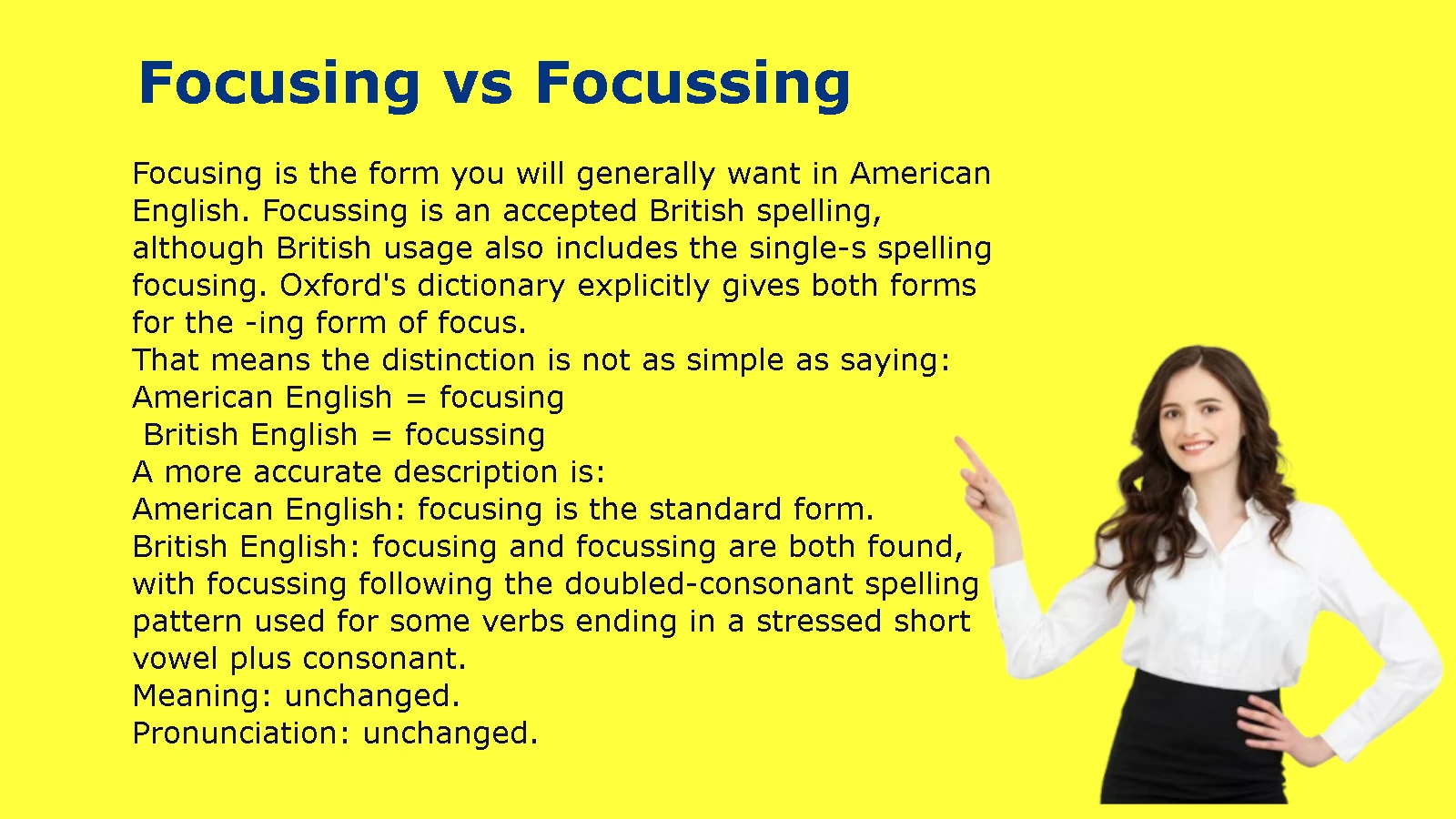
Focusing is the form you will generally want in American English. Focussing is an accepted British spelling, although British usage also includes the single-s spelling focusing. Oxford’s dictionary explicitly gives both forms for the -ing form of focus.
That means the distinction is not as simple as saying:
American English = focusing
British English = focussing
A more accurate description is:
- American English: focusing is the standard form.
- British English: focusing and focussing are both found, with focussing following the doubled-consonant spelling pattern used for some verbs ending in a stressed short vowel plus consonant.
- Meaning: unchanged.
- Pronunciation: unchanged.
Cambridge’s business dictionary likewise identifies -s- or -ss- forms for the verb focus, while Oxford lists both spellings directly.
Is Focusing Correct?
Yes. Focusing is a correct English spelling.
For example:
She is focusing on her final exam.
The word is the present participle of focus and can also function as a gerund:
Focusing on one task can improve productivity.
Is Focussing Correct?
Yes. Focussing is also a correct spelling.
For example:
She is focussing on her final exam.
The meaning is exactly the same as in the sentence using focusing.
The important point is that focussing is not an error simply because it contains two s’s.
Focusing vs Focussing at a Glance
The easiest way to remember the distinction is to compare the forms side by side.
| Feature | Focusing | Focussing |
| Base word | focus | focus |
| Ending | -ing | -ing |
| Number of s’s before -ing | One | Two |
| Meaning | Giving attention/concentration | Giving attention/concentration |
| Grammatical role | Present participle/gerund | Present participle/gerund |
| American English | Standard | Less usual |
| British English | Used | Accepted |
| Pronunciation | Same | Same |
| Meaning changes? | No | No |
Oxford’s American English dictionary gives focusing and focussing as alternative -ing forms and also records both versions of related verb forms.
Why Is It Focusing but Focussing?
The spelling difference comes from different conventions for handling a final consonant when a suffix such as -ing is added.
The base verb is:
focus
Add -ing, and you get:
focus + ing = focusing
In another spelling convention, the final s is doubled:
focus + ing = focussing
The important thing is that this is a spelling variation, not a change in the underlying word.
Why Does British English Use Focussing?
English spelling has several situations in which British usage doubles a final consonant before a suffix. The pattern is particularly noticeable when comparing forms such as:
- focused / focussed
- focusing / focussing
- focuses / focusses
Oxford records all of these alternatives for focus.
However, you should not assume that every British writer must double the s. Focusing is also used in British English.
That makes focusing a particularly safe choice when you need a spelling that is widely understood across English varieties.
Focusing Meaning and Usage
Focusing means giving attention, effort, or concentration to a particular person, subject, activity, or problem.
Cambridge defines focus as giving full attention to what you are doing or what is happening. The verb can also refer to directing attention toward something or adjusting a device so that something can be seen clearly.
For example:
The students are focusing on their assignments.
Here, focusing means concentrating their attention on their assignments.
The word can also describe an optical action:
The photographer is focusing the camera on the subject.
In this case, the verb refers to adjusting the camera so the subject appears clearly.
Focusing as a Present Participle
Focusing is the present participle of focus.
It commonly appears with forms of be to create a progressive verb:
I am focusing on the project.
They were focusing on customer needs.
The researchers are focusing on the results.
The form can also appear after certain verbs and constructions:
She kept focusing on the negative details.
Focusing as a Gerund
The same -ing form can function as a noun-like gerund.
Focusing requires practice.
Focusing on one priority can make the task easier.
In these examples, focusing names an activity rather than describing what someone is currently doing.
Focussing Meaning and Usage
Focussing has the same meaning as focusing.
For example:
The company is focussing on improving customer service.
This means the company is directing its attention and resources toward improving customer service.
The double s does not create a different definition. Oxford gives the same core definition for the verb regardless of whether the -ing form is spelled focusing or focussing.
Focussing as a Present Participle
Like focusing, focussing can appear in progressive constructions:
She is focussing on her research.
The team was focussing on the main problem.
They are focussing their efforts on improving efficiency.
Focussing as a Gerund
It can also function as a gerund:
Focussing on the essentials saves time.
Focussing your attention on one problem can make it easier to solve.
The grammatical function remains the same as focusing.
Focusing vs Focussing in American and British English
Regional spelling is the main reason people encounter both forms.
Focusing in US English
Focusing is the spelling to prefer when writing for an American audience.
Examples include:
The study is focusing on childhood education.
She is focusing her attention on the presentation.
The company is focusing on reducing costs.
American dictionaries and learner dictionaries commonly present focusing as the standard -ing form. Cambridge’s learner dictionary, for example, lists focusing as the present participle of focus.
For an American website, school assignment, business document, or publication, focusing is therefore the natural choice.
Focussing in UK English
Focussing is an accepted British English spelling.
For example:
The government is focussing on improving public transport.
The report is focussing on the causes of the problem.
British English does not make the double-s version mandatory, however. Oxford’s British English entry lists focusing and focussing as alternative forms.
Which Form Should You Use?
Choose according to the spelling system used by the rest of your writing.
Use focusing if:
- You are writing in American English.
- Your publication follows US spelling.
- Your audience is primarily American.
- Your existing content consistently uses American spelling.
Use focussing if:
- You are following a British spelling style that uses the doubled form.
- Your organization’s style guide prefers focussing.
- You are maintaining consistency with surrounding British English text.
The key principle is consistency. Do not randomly switch between regional spelling conventions.
Focusing vs Focussing Examples
The two spellings can be used in exactly the same grammatical contexts.
Examples With Focusing
- The students are focusing on their homework.
- She is focusing on the most important details.
- The company is focusing its efforts on customer satisfaction.
- He has trouble focusing when the room is noisy.
- The research team is focusing on climate-related risks.
- We should start focusing on practical solutions.
- The camera is focusing on the subject.
- She spent the afternoon focusing on her writing.
- The discussion is focusing on three major issues.
- Focusing on one task can reduce distractions.
Examples With Focussing
- The students are focussing on their homework.
- She is focussing on the most important details.
- The company is focussing its efforts on customer satisfaction.
- He has trouble focussing when the room is noisy.
- The research team is focussing on climate-related risks.
- We should start focussing on practical solutions.
- The camera is focussing on the subject.
- She spent the afternoon focussing on her writing.
- The discussion is focussing on three major issues.
- Focussing on one task can reduce distractions.
Notice that changing focusing to focussing does not change the meaning of any sentence.
Focusing or Focussing in Formal Writing
Both forms can appear in formal writing, but the appropriate choice depends on the spelling system you are following.
American Academic Writing
For American academic writing, focusing is the straightforward choice.
The study is focusing on the effects of sleep deprivation.
Using focussing in an otherwise consistently American document can look inconsistent because US spelling generally favors the single-s form.
British Academic Writing
British academic writing can use focusing or focussing, depending on the chosen style.
The study is focussing on the effects of sleep deprivation.
The important factor is adherence to the publication, university, publisher, or institutional style guide.
Professional Documents
Businesses should prioritize consistency over trying to make one spelling look more sophisticated.
If a US company uses:
- organization
- analyze
- center
- focusing
then switching to focussing would introduce a British-style spelling into an otherwise American document.
Likewise, a British publication that consistently uses British conventions may choose focussing.
Focusing or Focussing in the UK, US, Canada, and Australia
English spelling varies across countries, so geography alone does not always determine the exact form a writer will use.
| Region | Focusing | Focussing |
| United States | Common/standard | Less usual |
| United Kingdom | Used | Accepted |
| Canada | Used | Variation exists |
| Australia | Used | British-style variation occurs |
The most important distinction is between American spelling conventions and the wider set of conventions used in British-influenced varieties.
Oxford’s entries are especially useful here because they explicitly record both forms rather than treating one as a simple error.
What About Canadian English?
Canadian English contains influences from both American and British English. As a result, spelling preferences can vary by word, publication, and style guide.
If you are writing for a Canadian publication, follow its established editorial style rather than assuming that every British or American spelling rule applies automatically.
What About Australian English?
Australian English generally follows many British spelling conventions, but actual usage can vary. A publication’s style guide should take priority when one exists.
The safest approach for professional writing is simple: identify the publication’s preferred spelling system and apply it consistently.
Focusing Pronunciation
Focusing and focussing are pronounced the same way.
The additional s in focussing does not represent an additional syllable or a different sound.
Oxford gives the -ing forms with the same pronunciation, /ˈfəʊkəsɪŋ/, in its British English entry.
The American pronunciation of focus differs somewhat in its vowel sound from the British pronunciation, but that is a broader accent difference rather than a distinction between focusing and focussing. Cambridge lists US and UK pronunciations for the base verb focus.
So you should not pronounce focussing as though the double s adds another sound.
Common Words Related to Focus
The spelling variation extends beyond focusing.
| Standard/single-s form | Double-s form | Function |
| focus | focus | Base verb |
| focuses | focusses | Third-person singular |
| focusing | focussing | Present participle/gerund |
| focused | focussed | Past tense/past participle/adjective |
Oxford records all of these forms.
Focus
The base form is focus.
We need to focus on the main issue.
Focuses
Focuses is the third-person singular present form.
She focuses on customer service.
Focusses is an alternative spelling:
She focusses on customer service.
Cambridge also documents focuses as a normal verb form.
Focused
Focused is widely used as the past tense and past participle.
He focused on the task.
It can also work as an adjective:
She remained focused throughout the meeting.
Focussed
Focussed is the corresponding double-s variant.
He focussed on the task.
She remained focussed throughout the meeting.
Cambridge explicitly lists focussed as an alternative form of focused.
Focusing vs Focused vs Focuses
These forms are related but serve different grammatical purposes.
| Word | Grammatical role | Example |
| focus | Base verb | I need to focus. |
| focuses | Third-person singular | She focuses on research. |
| focused | Past tense/past participle/adjective | He focused on the problem. |
| focusing | Present participle/gerund | She is focusing on the problem. |
The same pattern applies to the double-s alternatives:
- focus
- focusses
- focussed
- focussing
Example Comparison
She focuses on grammar.
This describes a regular or current action by she.
She is focusing on grammar.
This describes an action in progress.
She focused on grammar yesterday.
This places the action in the past.
She remained focused on grammar.
Here, focused functions as an adjective describing her state.
Understanding these differences prevents a spelling question from turning into a grammar mistake.
Common Mistakes With Focusing and Focussing
Several mistakes repeatedly appear when people encounter the two spellings.
Assuming Focussing Is Always Wrong
The extra s does not automatically make the word incorrect.
Focussing is recorded as an accepted variant by major dictionaries, including Oxford and Collins.
Assuming Focusing Is Only American
That is also too simplistic.
British English uses focusing as well as focussing. Oxford explicitly lists both forms.
Mixing Spelling Systems
A document can become stylistically inconsistent when it combines different regional conventions without a reason.
For example, a writer might use:
- organization
- analyze
- color
- focussing
The final word may stand out because the other spellings strongly suggest American English.
The solution is not that focussing is inherently wrong. The solution is to maintain a consistent spelling system.
Confusing Focusing With Focused
These words are not interchangeable.
Incorrect:
She is focused on the project yesterday.
Better:
She focused on the project yesterday.
Or:
She is focusing on the project now.
The first sentence needs a past-tense construction, while the second describes an action in progress.
Adding an Extra S Everywhere
If you decide to use focussing, that does not mean every related word must automatically be doubled without considering the form and style being used.
The documented variants are specific:
- focusing / focussing
- focused / focussed
- focuses / focusses
A Practical Case Study: Choosing the Spelling for a Website
Imagine an American company publishes an article about productivity.
Its existing website consistently uses:
- organization
- center
- analyze
- color
- behavior
The article contains the sentence:
The team is focussing on improving productivity.
Although focussing is a legitimate English variant, it does not match the site’s established American spelling style.
Changing the sentence to:
The team is focusing on improving productivity.
creates consistency with the rest of the site.
Now consider a British publication whose style consistently uses:
- organisation
- centre
- analyse
- colour
- behaviour
That publication may reasonably use:
The team is focussing on improving productivity.
The Lesson
The question is not simply:
Which word is correct?
A better question is:
Which spelling fits the English variety and style of this document?
That approach gives you a more accurate answer because both forms are documented.
Focusing vs Focussing: Key Difference
The difference can be summarized in one table.
| Question | Focusing | Focussing |
| Is it a word? | Yes | Yes |
| Is it a form of focus? | Yes | Yes |
| Does it mean concentrating? | Yes | Yes |
| Is it used as an -ing form? | Yes | Yes |
| Is it used in American English? | Yes | Less usual |
| Is it used in British English? | Yes | Yes |
| Does it have a different meaning? | No | No |
| Is pronunciation different because of spelling? | No | No |
| Is it appropriate in formal writing? | Yes | Yes, depending on style |
| Should spelling be consistent? | Yes | Yes |
Oxford and Collins both support the existence of the two spellings rather than treating focussing as an outright misspelling.
Focusing vs Focussing: A Simple Rule to Remember
If you want one practical rule, use this:
Use focusing for American English, while focussing is an accepted British English variant.
There is one important qualification: British English also uses focusing. Therefore, it would be inaccurate to say that British writers must use focussing.
For most US-focused websites, American academic papers, and American business writing, focusing is the natural choice.
If you are following a British publication’s style, focussing may be preferred.
FAQs About Focusing vs Focussing
Is focusing or focussing correct?
Both are correct. Focusing is the standard form commonly used in American English, while focussing is an accepted British English variant. British English also uses focusing.
Is focusing the American spelling?
Yes. Focusing is the standard spelling used in American English.
For US English writing, it is generally the form you should choose.
Is focussing the British spelling?
Focussing is an accepted British spelling, but it is not the only British form. British English also uses focusing. Oxford lists both forms.
Do focusing and focussing mean the same thing?
Yes. They have the same meaning and grammatical function.
Both are forms of the verb focus, meaning to direct attention, effort, or concentration toward something.
Is focussing accepted in English?
Yes. Major dictionaries record focussing as an alternative form of focusing. Oxford and Collins both document it.
Why does British English use focussing?
The double-s spelling reflects a British spelling convention for this verb. The variation is part of the broader difference between single- and double-consonant forms in some English words.
It does not create a different meaning.
Should I use focusing in the US?
Yes. If you are writing in American English, focusing is the straightforward choice.
For example:
The company is focusing on customer satisfaction.
How do you pronounce focusing?
Focusing is pronounced as the -ing form of focus. The spelling focussing does not add another syllable or create a separate pronunciation. Oxford gives the same pronunciation for the two -ing variants.
Is focussing wrong in American English?
It is better described as nonstandard or less usual for American spelling, rather than claiming that the form is not an English word. Major dictionaries recognize focussing as an alternative spelling.
For an American audience, however, focusing is the appropriate default.
Which spelling should I use in academic writing?
Follow the spelling convention required by your institution, instructor, publisher, or style guide.
For American academic writing, use focusing.
For British academic writing, either may occur, but the required house style should take priority.
Focusing vs Focussing: Final Answer
Focusing and focussing are both accepted English spellings of the -ing form of focus. The main difference is spelling convention, not meaning or grammar. Oxford specifically lists focusing/focussing as alternative forms, while Cambridge and Collins also document the variation.
For American English, use focusing.
For British English, focussing is accepted, although focusing is also used.
The same pattern appears in related forms:
- focusing / focussing
- focused / focussed
- focuses / focusses
If you are unsure which one to choose, look at the spelling system used by the rest of your document. Consistency matters more than treating one legitimate variant as universally correct.
For US-focused content, the simplest choice is clear: use focusing.