Baptized and baptised are two spellings of the same word. Both mean having received the religious ceremony of baptism. Baptized is the standard spelling in American English, while baptised is more common in British English and other varieties of English.
If you’re searching for “baptized vs baptised,” “baptized or baptised,” or “baptise vs baptize,” you’re likely wondering which spelling is correct. Both forms are correct, but your choice depends mainly on the variety of English you use. American English generally uses baptized with a z, while British English generally uses baptised with an s.
| Question | Answer |
|---|---|
| What is the difference between baptized and baptised? | They have the same meaning but use different spellings. |
| Is baptized or baptised correct? | Both are correct. Baptized is preferred in American English, while baptised is common in British English. |
| Is baptized American or British English? | Baptized is the standard American English spelling. |
| Is baptised American or British English? | Baptised is the standard British English spelling. |
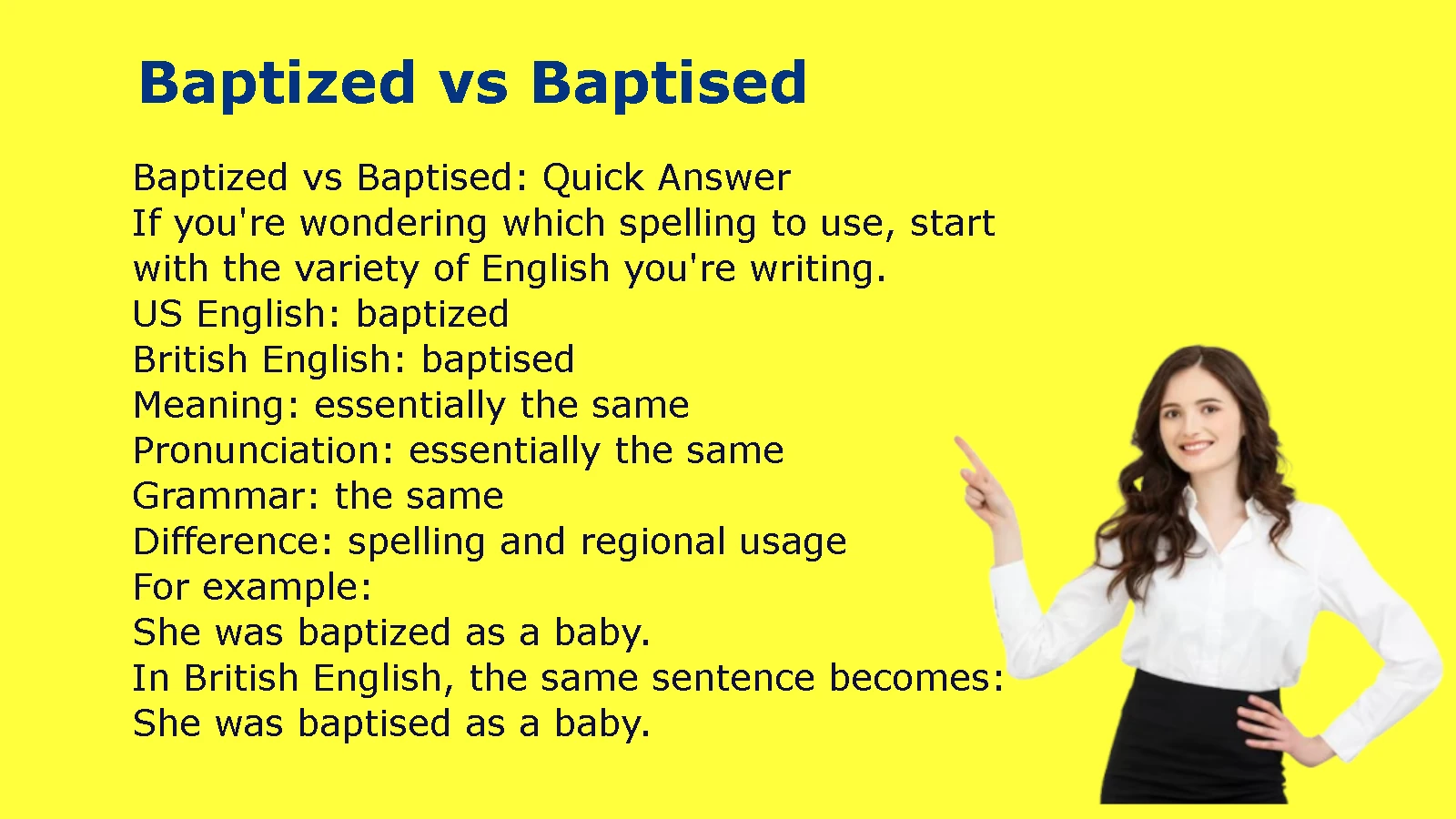
Baptized vs Baptised: Quick Answer
If you’re wondering which spelling to use, start with the variety of English you’re writing.
- US English: baptized
- British English: baptised
- Meaning: essentially the same
- Pronunciation: essentially the same
- Grammar: the same
- Difference: spelling and regional usage
For example:
She was baptized as a baby.
In British English, the same sentence becomes:
She was baptised as a baby.
Nothing about the event changes. Only the spelling does.
This distinction matters most in formal writing. If you’re writing an American article, academic paper, business document, or website, baptized is the natural choice. If you’re following British English conventions, baptised usually fits better.
One useful rule is worth remembering:
American English → baptized
British English → baptised
However, British spelling is a little more nuanced than the simple “American z, British s” rule sometimes suggests. Major dictionaries recognize baptize as a British English form as well, while baptise is specifically identified as the usual British spelling. Oxford, for example, lists baptise as the British English alternative to baptize.
What Does “Baptized” Mean?
Baptized is the past tense and past participle of the verb baptize.
In its religious sense, baptize refers to performing a baptism. Depending on the Christian tradition, baptism can involve immersion in water, pouring water, or sprinkling water. The ceremony has an important place in Christian practice and is associated with admission into the Christian community.
Cambridge defines baptize as making someone officially a member of the Christian Church through a baptism service.
For example:
- She was baptized as a baby.
- The minister baptized the child on Sunday.
- He was baptized at his local church.
- They were baptized into the Christian faith.
In each example, baptized refers to an action that has already taken place.
Baptized as a Past Tense Verb
When baptized describes an action completed in the past, it can function as the simple past form of baptize.
For example:
The priest baptized the child last Sunday.
Here, the priest performed the action.
The pattern is:
Subject + baptized + object
Another example:
The church baptized several children during the ceremony.
The verb tells you what happened and when it happened.
Baptized as a Past Participle
Baptized also works as a past participle.
You’ll often see it after forms of be:
The child was baptized on Sunday.
Or after had been:
She had been baptized as an infant.
It can also appear in adjective like constructions:
The baptized children joined their families after the service.
The grammatical function changes with the sentence, but the spelling remains baptized in American English.
Oxford lists baptized as both the past simple and past participle of baptize.
What Does “Baptised” Mean?
Baptised means the same thing as baptized. The difference is the spelling convention.
It is the British English form associated with the verb baptise.
For example:
- She was baptised as a baby.
- The priest baptised the child.
- He was baptised at the village church.
- The children were baptised last year.
These sentences communicate the same basic ideas as their American English equivalents.
Compare:
She was baptized as a baby.
and
She was baptised as a baby.
There is no meaningful difference in the event described. The first follows the standard American spelling. The second follows the usual British spelling.
Cambridge explicitly labels baptise as the usual UK form of baptize.
The Difference Between Baptized and Baptised
The clearest way to understand Baptized vs Baptised is to separate spelling from meaning.
The spelling is different
The main difference is the final part of the verb:
- baptize → baptized
- baptise → baptised
American English commonly uses -ize in this word.
British English commonly uses -ise.
That creates the two past forms:
- baptized
- baptised
The meaning stays the same
Both forms describe the same basic action.
Consider these sentences:
The baby was baptized on Sunday.
The baby was baptised on Sunday.
The reader receives the same information from both sentences.
The spelling tells you more about the writer’s preferred variety of English than about the baptism itself.
The pronunciation is essentially the same
The two spellings don’t normally create a meaningful pronunciation difference.
Dictionaries give the pronunciation of baptize as /bæpˈtaɪz/, with regional pronunciation details also listed by major dictionaries.
The s in baptised does not mean you should automatically pronounce the word with an /s/ sound. In this word, the spelling represents the same z sound heard in baptized.
That is an important detail because English spelling doesn’t always provide a simple one letter equals one sound relationship.
Baptized vs Baptised in American and British English
Regional spelling is the biggest reason readers encounter both forms.
When to use “baptized”
Use baptized when you’re writing standard American English.
For example:
The child was baptized at the church.
She was baptized when she was six months old.
His parents had him baptized as an infant.
American dictionaries list baptize with baptized as its past form. Merriam Webster also records baptised as a variant, although baptize is its main headword.
For US focused content, baptized is therefore the safest and most natural choice.
When to use “baptised”
Use baptised when you’re following the usual British English spelling.
For example:
The child was baptised at the local church.
She was baptised as an infant.
The family attended the ceremony where their son was baptised.
Oxford lists baptise as the British English alternative to baptize, while Cambridge labels baptise as the usual UK form.
Why consistency matters
Here’s where the practical issue comes in.
Imagine an article that uses:
- organised
- recognised
- realised
- colour
- centre
Then suddenly uses baptized.
The word isn’t necessarily incomprehensible or inherently incorrect. However, the spelling may look inconsistent with the rest of the article.
A consistent style feels more polished.
For a US publication, you would normally write:
- organized
- recognized
- realized
- color
- center
- baptized
For a publication using British conventions, you might see:
- organised
- recognised
- realised
- colour
- centre
- baptised
The goal isn’t to declare one system “better.” The goal is to choose a system and stick with it.
Baptize vs. Baptise vs. Baptized vs Baptised
Understanding the base verbs makes the difference much easier to remember.
| Form | American English | British English | Function |
| baptize | Standard | Also used | Base verb |
| baptise | Not the usual US form | Usual form | Base verb |
| baptized | Standard | Also recognized | Past tense/past participle |
| baptised | Not the usual US form | Usual form | Past tense/past participle |
| baptizing | Standard | Also used | Present participle |
| baptising | Not the usual US form | Usual form | Present participle |
Oxford gives the American forms baptize, baptized, and baptizing and notes baptise as a British English form.
The American pattern
The American pattern is:
baptize → baptizes → baptized → baptizing
Examples:
The church baptizes children during the year.
The church baptized three children last Sunday.
The minister is baptizing the baby.
The British pattern
The usual British pattern is:
baptise → baptises → baptised → baptising
Examples:
The church baptises children throughout the year.
The church baptised three children last Sunday.
The minister is baptising the baby.
The sentence structure hasn’t changed. The spelling pattern has.
How to Use “Baptized” in a Sentence
Using baptized correctly becomes straightforward once you identify whether it describes an action or forms part of a passive construction.
“Baptized” as an active verb
The minister baptized the child.
The subject, minister, performs the action.
Another example:
The church baptized several new members.
Again, the subject carries out the action.
“Baptized” in a passive construction
The child was baptized on Sunday.
Here, the child receives the action.
This construction is particularly common because the person receiving baptism is often more important to the sentence than the person performing the ceremony.
You can also use a perfect construction:
The child had been baptized before the family moved.
Or:
She has been baptized according to the church’s records.
The form baptized stays unchanged.
“Baptized” with a denomination or religious identity
You may also encounter constructions such as:
She was baptized Catholic as a child.
He was baptized Anglican.
The exact wording can vary according to context and the practices or terminology of a particular religious community. The important spelling point remains the same: baptized is the expected American form.
Cambridge gives the example “Were you baptized a Catholic?”, demonstrating this grammatical construction.
How to Use “Baptised” in a Sentence
The British spelling follows the same grammatical patterns.
Active example
The priest baptised the child.
The priest performs the action.
Passive example
The child was baptised on Sunday.
The child receives the action.
Perfect construction
She had been baptised before starting school.
Again, baptised functions as the past participle.
The important lesson is that switching from baptized to baptised doesn’t require rebuilding the sentence.
Compare:
| American English | British English |
| The priest baptized the child. | The priest baptised the child. |
| The child was baptized. | The child was baptised. |
| She had been baptized. | She had been baptised. |
| They were baptized last year. | They were baptised last year. |
Only the spelling changes.
Are Baptized and Baptised Pronounced the Same?
For ordinary English pronunciation, baptized and baptised are pronounced essentially the same.
The pronunciation of baptize is commonly represented as /bæpˈtaɪz/. Oxford gives the same core pronunciation for the British and American entries.
The key sound is the z sound at the end.
This can be confusing because the British spelling contains an s:
baptised
Yet that s does not mean the final sound becomes /s/.
Think of the spelling as a regional road sign. The route is different on paper, but you’re still heading toward the same destination.
Merriam Webster similarly gives baptize with pronunciations built around the bap TIZE pattern and records baptised as a variant spelling.
Why Does Baptized Have a “Z” but Baptised Have an “S”?
The difference comes from broader English spelling conventions.
English developed through centuries of contact with other languages, including Latin, French, and Greek. The verb ultimately traces back through forms such as Old French and ecclesiastical Latin to Greek baptizein, associated with dipping or immersing.
Over time, English developed different spelling preferences for certain words ending in -ize and -ise.
That gives us pairs such as:
- organize / organise
- recognize / recognise
- realize / realise
- apologize / apologise
- baptize / baptise
However, there’s an important wrinkle.
British English doesn’t simply ban “-ize”
It’s tempting to learn a rule that says:
American English uses -ize and British English uses -ise.
That’s too broad.
British English sources can use -ize spellings for many words. Oxford, for example, uses -ize in words such as organize as part of its house spelling convention. Cambridge, however, specifically identifies baptise as the usual UK form of baptize.
So the safer rule is:
Baptized is the standard US form. Baptised is the usual British form.
That statement is more accurate than trying to force every -ize/-ise word into one universal rule.
The Meaning of Baptism and the Verb “Baptize”
Although the spelling question is mainly linguistic, understanding the underlying word helps clarify why baptized is used in different contexts.
A baptism is a Christian rite involving water. Different Christian traditions practice baptism in different ways, including immersion, pouring, or sprinkling.
Merriam Webster defines baptism as a Christian sacrament marked by ritual use of water and describes it as an act of admission into the Christian community. It also records broader uses involving purification, initiation, or naming.
The verb baptize can therefore describe more than the narrow idea of a particular ceremony.
Merriam Webster lists several senses, including:
- administering baptism
- cleansing or purifying spiritually
- initiating someone
- giving someone a name at baptism or christening
It also records the broader figurative sense of undergoing an experience that initiates or tests someone.
That last point is useful because baptize occasionally appears outside strictly religious writing.
For example, English has the expression “baptism of fire,” which refers to a difficult first experience or ordeal.
The spelling remains baptize/baptized in American English and baptise/baptised in the usual British form.
Baptized vs Baptised: Examples in Context
Context makes the distinction easier to see.
Example: Family announcement
American English:
Our daughter was baptized at St. Mary’s Church on Sunday.
British English:
Our daughter was baptised at St Mary’s Church on Sunday.
The event is the same. The spelling reflects the chosen English variety.
Example: Church record
American English:
The church records show that James was baptized in 1998.
British English:
The church records show that James was baptised in 1998.
Example: Historical writing
American English:
The child was baptized shortly after birth.
British English:
The child was baptised shortly after birth.
Historical documents can make spelling choices especially interesting because older records may use forms that don’t match modern editorial conventions.
Example: Academic writing
Suppose an American researcher is discussing historical church records. The paper may quote the original spelling exactly when necessary, but the researcher’s surrounding prose can still follow US English.
That distinction matters:
The original record states that the child was “baptised.”
The quoted material preserves the source. The surrounding article can continue using baptized if it follows American style.
That is a useful editorial principle: don’t silently alter quoted material simply to make it match your preferred spelling.
Case Study: Choosing the Right Spelling for a US Website
Imagine a US English website publishing an article about family traditions.
The writer has two options:
The baby was baptised in May.
or:
The baby was baptized in May.
For a US audience, baptized is the better default.
Now imagine the same article is being prepared for a British publication. The editor might choose:
The baby was baptised in May.
Neither version changes the underlying fact. The publication’s language style determines the preferred spelling.
What the editor should check
Before publishing, the editor can look at nearby spelling choices:
- Is it color or colour?
- Is it organize or organise?
- Is it center or centre?
- Is it recognize or recognise?
- Is it baptized or baptised?
A consistent pattern provides a strong clue about which form belongs in the article.
Case Study: A British English Article Using “Baptized”
Now reverse the situation.
Suppose a British publication normally uses:
- colour
- centre
- organised
- recognised
An editor encounters:
The child was baptized in 2010.
The spelling isn’t likely to confuse readers. British dictionaries recognize baptize as a form used in British English. Oxford explicitly lists baptise as the British English form, while Cambridge calls it the usual UK form.
Still, if the publication’s house style normally uses -ise, changing the word to baptised would make the article more consistent.
This is why “correct” and “preferred for a particular style” aren’t always identical concepts.
Common Mistakes With Baptized and Baptised
Several misconceptions come up repeatedly.
Mistake: Thinking “baptised” is a misspelling
It isn’t.
Baptised is an established English spelling and the usual British form of the word.
Merriam Webster lists baptised as a variant of baptized, while Cambridge identifies baptise as the usual UK form.
Mistake: Thinking “baptized” is always wrong in British English
That’s also too strong.
British dictionaries recognize baptize. Oxford lists baptize and notes that British English also uses baptise.
So it’s better to say:
Baptised is the usual British spelling, while baptized is the standard American spelling.
That’s more precise.
Mistake: Assuming the words have different meanings
They don’t have different basic meanings.
Compare:
She was baptized as an infant.
She was baptised as an infant.
The regional spelling changes. The basic meaning remains the same.
Mistake: Pronouncing the “s” in baptised as /s/
The spelling can tempt learners into this mistake.
The word is generally pronounced with a z sound at the end, not an s sound. Major dictionaries represent the pronunciation of baptize with /z/.
Mistake: Treating baptize and baptism as the same part of speech
They aren’t.
| Word | Part of speech | Example |
| baptize | Verb | They baptize their children. |
| baptized | Verb form | She was baptized. |
| baptism | Noun | The baptism took place Sunday. |
| baptismal | Adjective | The baptismal ceremony began at noon. |
Knowing the word family prevents more than spelling mistakes. It also helps you choose the right grammatical form.
Baptized or Baptised Catholic: Which Is Correct?
Both can be correct.
The choice depends on the English variety.
American English
She was baptized Catholic as a baby.
British English
She was baptised Catholic as a baby.
The religious denomination does not determine the spelling.
In other words, Catholic doesn’t require baptized, and another Christian denomination doesn’t require baptised. The English variety does the heavy lifting.
Cambridge itself gives an example using “baptized a Catholic.”
Baptized vs Baptised: Side by Side Examples
| American English | British English |
| She was baptized as a baby. | She was baptised as a baby. |
| The priest baptized the child. | The priest baptised the child. |
| He was baptized last year. | He was baptised last year. |
| They had their daughter baptized. | They had their daughter baptised. |
| The children were baptized together. | The children were baptised together. |
| She had been baptized before moving. | She had been baptised before moving. |
| The church baptized several children. | The church baptised several children. |
| He was baptized Catholic. | He was baptised Catholic. |
Notice what stays the same: sentence structure, meaning, and pronunciation.
Only the spelling convention changes.
Is Baptized or Baptised Correct?
Both are correct.
The appropriate choice depends mainly on the English variety you’re following.
Use “baptized” for US English
If your audience expects American English, choose baptized.
This is particularly appropriate for:
- US websites
- American school assignments
- American business publications
- US news and editorial content
- American academic writing
- General US English
Use “baptised” for British English
If your publication follows British English, baptised is the usual choice.
This applies especially when the surrounding text uses British spellings such as:
- colour
- centre
- organise
- recognise
- travelled
Again, don’t turn this into a rigid rule that says every British writer must use -ise. English spelling conventions contain plenty of exceptions and style differences.
Which Is More Common: Baptized or Baptised?
The answer depends on where the English is being used.
In American English, baptized is the normal form.
In British English, baptised is the usual form, although baptized is also recognized.
That regional distinction is more useful than trying to identify one spelling as universally “correct.”
Major dictionaries support this distinction. Cambridge marks baptise as the usual UK form, while Merriam Webster lists baptised as a variant of baptized.
How to Remember Baptized vs Baptised
A simple memory trick can help.
Think:
American English → Z → baptized
British English → S → baptised
You can connect the word to other familiar spelling pairs:
| American | British |
| realize | realise |
| organize | organise |
| recognize | recognise |
| apologize | apologise |
| baptized | baptised |
But remember that this is a memory aid, not a universal rule for every -ize/-ise word.
The safest approach is still to check the preferred style of the dictionary, publication, or organization you’re writing for.
Frequently Asked Questions About Baptized vs Baptised
Is baptized or baptised correct?
Both spellings are correct. Baptized is the standard American English form, while baptised is the usual British English form.
Is baptized American or British?
Baptized is the standard American English spelling. British English also recognizes baptize and related -ized forms, but baptise/baptised is the usual British spelling.
Is baptised British or American?
Baptised is the usual British English spelling. It is not the standard preferred form in American English.
Does baptized mean the same as baptised?
Yes. They have the same basic meaning. The difference is primarily regional spelling.
Can you use baptised in American English?
Readers in the United States will generally understand baptised, but baptized is the standard choice when deliberately following US English.
Can you use baptized in British English?
Yes. Baptized is recognized in British English, but baptised is the usual British form according to Cambridge and Oxford’s treatment of the word.
Are baptized and baptised pronounced differently?
They are generally pronounced the same. The spelling difference doesn’t normally create a meaningful difference in pronunciation.
Is baptize or baptise the correct spelling?
Both are established forms. Baptize is the standard US spelling, while baptise is the usual British spelling.
What is the past tense of baptize?
The past tense is baptized.
The priest baptized the child.
What is the British past tense of baptise?
The usual British form is baptised.
The priest baptised the child.
Is baptized a verb?
Yes. Baptized is the past tense and past participle of the verb baptize. It can also appear in constructions where the past participle functions in an adjective like way.
What is the noun form?
The noun is baptism.
For example:
The baptism took place on Sunday.
The related adjective is baptismal:
The baptismal ceremony began at noon.
Final Verdict: Baptized vs Baptised
The Baptized vs Baptised debate is really a question of English spelling conventions rather than meaning.
Baptized is the standard form for American English.
Baptised is the usual form for British English.
Both describe the same basic action, and the pronunciation is essentially the same. The main distinction appears on the page.
| If you’re writing… | Use… |
| US English | baptized |
| British English | baptised |
| A US academic paper | baptized |
| A US website | baptized |
| A British publication | baptised |
| A British style guide that permits -ize forms | Follow its stated house style |
The best rule is therefore simple:
Writing in US English? Use “baptized.” Writing in British English? “Baptised” is the usual choice.
Once that distinction is clear, there’s no real mystery left. The two spellings are different regional forms of the same word, much like many other spelling pairs that developed as English evolved on opposite sides of the Atlantic.