A flaxseed is a small, nutrient-rich seed that comes from the flax plant and is commonly used as a food ingredient, dietary addition, or source of plant-based nutrients. If you’ve come across the word “flaxseed” and wondered what it means, how it is used, or why it is often mentioned in discussions about healthy foods, the term is closely connected to seeds, nutrition, fiber, plant-based foods, cooking, baking, and dietary ingredients.
The flaxseed meaning refers to the seed of the flax plant, which is also known as linseed in many contexts. Flaxseeds are available in forms such as whole seeds, ground flaxseed, and flaxseed meal, and they can be added to foods such as oatmeal, smoothies, bread, cereals, and baked goods. The word can also appear in phrases such as flaxseed oil, ground flaxseed, flax seeds, and flaxseed meal, depending on the context.
In this guide, you’ll learn what “flaxseed” means, where flaxseeds come from, how the word is used in sentences, what flaxseed looks like, and how “flaxseed” differs from related terms such as “linseed,” “chia seeds,” and “flaxseed meal.” You’ll also see clear examples to make the meaning easy to understand.
By the end, you’ll know exactly what flaxseed means and how to use this common food and plant-related term naturally and correctly.
Quick Answer: What Does Flaxseed Mean?
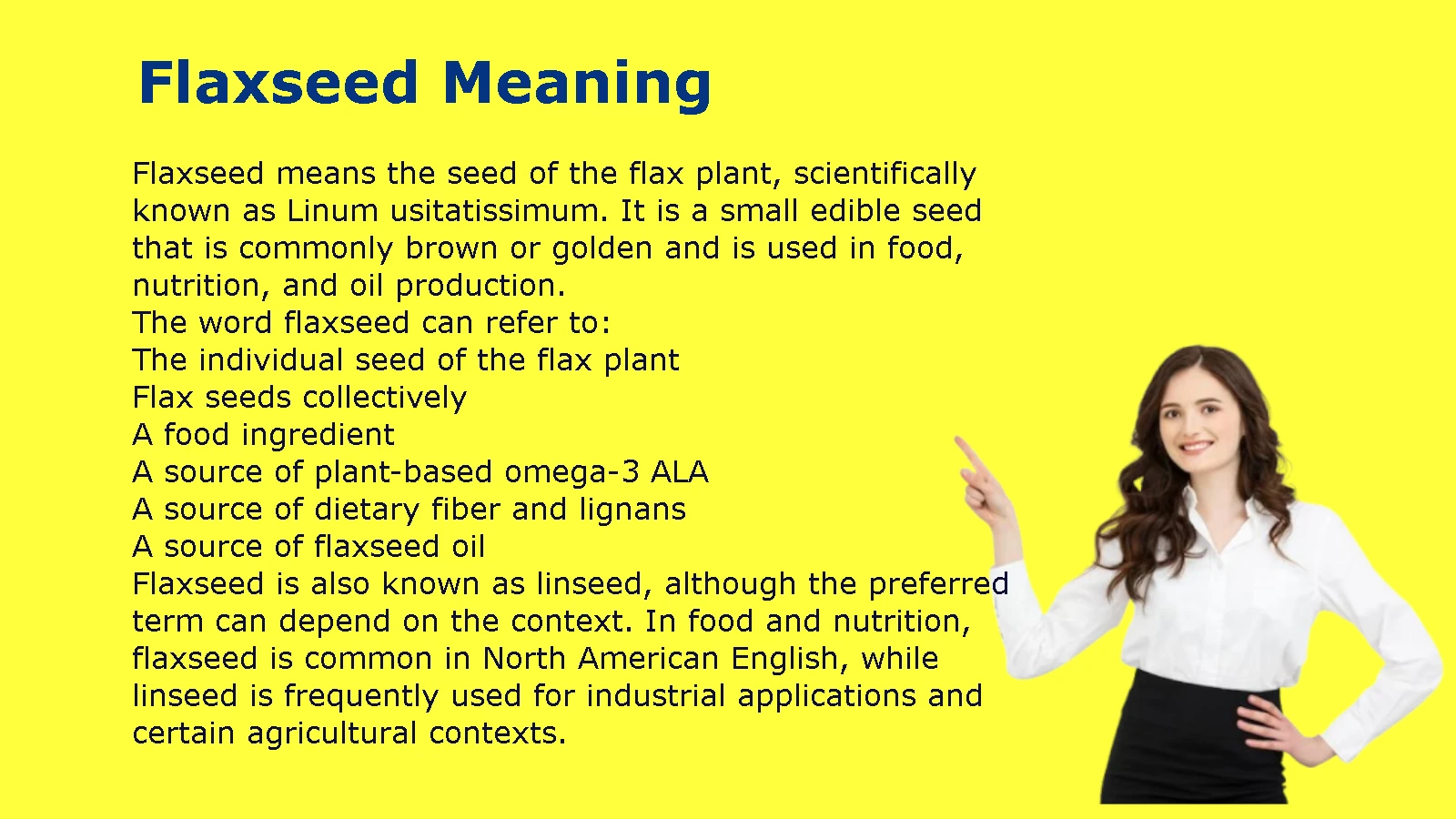
Flaxseed means the seed of the flax plant, scientifically known as Linum usitatissimum. It is a small edible seed that is commonly brown or golden and is used in food, nutrition, and oil production.
The word flaxseed can refer to:
- The individual seed of the flax plant
- Flax seeds collectively
- A food ingredient
- A source of plant-based omega-3 ALA
- A source of dietary fiber and lignans
- A source of flaxseed oil
Flaxseed is also known as linseed, although the preferred term can depend on the context. In food and nutrition, flaxseed is common in North American English, while linseed is frequently used for industrial applications and certain agricultural contexts.
Flaxseed Meaning in One Sentence
Flaxseed is the small edible seed of the flax plant, used as a food ingredient and a source of fiber, ALA omega-3 fatty acid, and lignans.
What Does Flaxseed Mean?
The noun flaxseed refers to the seed produced by the flax plant.
The scientific name of the plant is Linum usitatissimum. The same plant has been cultivated for both its fiber and seeds. Its fiber can be used to make linen, while its seeds can be used for food and oil.
That distinction is important because flaxseed is not the same thing as flax fiber.
The plant produces seeds after flowering. These seeds can then be harvested and used in different ways. Some are sold as whole seeds, while others are milled or processed into oil.
What Does Flaxseed Mean in English?
In everyday English, flaxseed simply means a seed from the flax plant.
For example:
- “I added ground flaxseed to my oatmeal.”
- “This bread contains flaxseed.”
- “Flaxseed is a source of plant-based omega-3 ALA.”
- “She uses flaxseed gel in her hair routine.”
The word is a compound noun, combining flax and seed.
Is Flaxseed a Seed or a Grain?
Flaxseed is a seed, not a grain.
It comes from the flax plant rather than from a cereal crop such as wheat, rice, oats, barley, or corn.
This distinction matters when discussing nutrition. Flaxseed has a nutritional profile that includes substantial amounts of fat, fiber, protein, and bioactive compounds, rather than the starch-dominant profile associated with many cereal grains. USDA information reports approximately 41 grams of fat, 28 grams of fiber, and 20 grams of protein per 100 grams of ground flaxseed.
Flaxseed in Simple English
If you want the easiest possible explanation, think of flaxseed as a tiny edible seed that comes from the flax plant.
It has been used for centuries for different purposes. The plant itself can provide fiber for textiles, while its seeds can provide food and oil. Historical records also describe flaxseed’s use as food and for traditional purposes.
Today, flaxseed commonly appears in:
- Bread
- Crackers
- Cereals
- Oatmeal
- Smoothies
- Yogurt
- Granola
- Energy bars
- Baked goods
- Salad toppings
- Plant-based recipes
Ground flaxseed is particularly easy to mix into foods because it has a finer texture than whole seeds.
What Is Flaxseed Made From?
Flaxseed is not a manufactured ingredient made from several substances. It is the seed itself.
The seed naturally contains several components, including:
- Fat
- Alpha-linolenic acid (ALA)
- Dietary fiber
- Protein
- Lignans
- Other plant compounds and micronutrients
Research reviews describe flaxseed as particularly notable for its ALA, dietary fiber, and lignans.
The Flax Plant
Flax is an annual plant that can be grown for either fiber or seed production. Varieties grown mainly for oil and seed production can differ from varieties selected primarily for fiber.
The scientific name is:
Linum usitatissimum
Other common names include:
- Flax
- Flaxseed
- Linseed
The plant has small flowers and produces the seeds that become the flaxseed sold for food or other purposes.
Flaxseed vs. Flax Seeds vs. Linseed
These terms are closely related, but their usage can differ.
| Term | Basic meaning | Common context |
| Flaxseed | Seed of the flax plant | Food and nutrition |
| Flax seeds | Plural wording for flaxseed | Everyday English and food |
| Linseed | Another name for flaxseed | Agriculture and industrial contexts |
| Flaxseed oil | Oil extracted from flaxseed | Nutrition and food products |
| Linseed oil | Oil from flaxseed | Often used in industrial contexts |
The USDA and other agricultural sources identify flaxseed with Linum usitatissimum. FAO-related material also identifies linseed as the seed of the flax plant.
Is Flaxseed the Same as Flax Seeds?
Yes, in ordinary food-related usage, flaxseed and flax seeds generally refer to the same seed.
The difference is mainly grammatical.
Flaxseed is commonly used as a mass noun:
Add one tablespoon of flaxseed to the smoothie.
Flax seeds emphasizes individual seeds or uses the plural form:
The recipe calls for two tablespoons of flax seeds.
Both expressions can describe the seeds of Linum usitatissimum.
Is Flaxseed the Same as Linseed?
Botanically, flaxseed and linseed come from the same plant.
However, the terms can signal different contexts.
Food manufacturers commonly use flaxseed when referring to edible products. Linseed is also widely used in agricultural and industrial contexts, particularly when discussing oil or flax varieties intended for non-food applications.
That does not mean every product labeled “linseed” should automatically be treated as a food product. Always check the product’s intended use and labeling.
What Does Flaxseed Look Like?
Flaxseed is small, flat, and oval-shaped. Common varieties include brown and golden flaxseed.
The color difference does not automatically mean one type is dramatically more nutritious than the other. USDA material notes that both golden and brown varieties are available and reports little nutritional difference between them.
You may encounter flaxseed in several forms:
Whole Flaxseed
Whole seeds retain their outer structure and are commonly sprinkled over foods or incorporated into recipes.
Ground Flaxseed
Ground or milled flaxseed has been mechanically broken down into a powder-like meal.
This form is popular because it mixes easily into foods. USDA research information has noted that whole flaxseed can pass through the digestive tract less completely than ground flaxseed, which can affect how much of its nutrients and bioactive compounds are available.
Flaxseed Oil
Flaxseed can also be pressed to produce oil.
The oil is especially rich in ALA, the plant-based omega-3 fatty acid associated with flaxseed. However, flaxseed oil does not provide all of the components found in the whole seed, particularly its fiber.
What Are the Main Uses of Flaxseed?
Flaxseed has both food and non-food uses.
Food Uses
People commonly add flaxseed to:
- Oatmeal
- Smoothies
- Yogurt
- Cereals
- Breads
- Muffins
- Pancakes
- Granola
- Salads
- Homemade energy bars
Ground flaxseed can also be incorporated into recipes as a plant-based ingredient.
Nutritional Uses
Flaxseed is particularly interesting nutritionally because it combines fiber, ALA, protein, and lignans in one seed.
Oil Production
Flaxseed can be pressed to produce flaxseed oil.
The oil is a concentrated source of ALA. USDA nutrient data lists approximately 7.26 grams of ALA in one tablespoon of cold-pressed flaxseed oil.
Industrial Uses
Flax also has a long industrial history.
The plant’s fiber can be used to produce linen, while flaxseed oil has been used in products such as paints, varnishes, printing inks, and other industrial materials.
This is one reason the terms flaxseed and linseed can appear in very different contexts.
Flaxseed Benefits and Nutritional Meaning
The phrase flaxseed benefits usually refers to the nutritional properties associated with eating flaxseed.
Three components receive particular attention:
ALA: An essential omega-3 fatty acid.
Fiber: Flaxseed contains substantial dietary fiber.
Lignans: Flaxseed is a notable dietary source of lignans, a type of plant compound.
These components help explain why flaxseed has become popular as a functional food.
Flaxseed and Fiber
Fiber is one of the most important nutritional features of whole or ground flaxseed.
USDA material reports about 28 grams of fiber per 100 grams of ground flaxseed.
Flaxseed also contains mucilage, a gel-forming material that interacts with water. This property has contributed to its traditional use as a source of dietary fiber and as a laxative.
Flaxseed and Lignans
Flaxseed contains lignans, including secoisolariciresinol diglucoside (SDG).
After consumption, gut microorganisms can convert some flaxseed lignans into other compounds, including enterolactone and enterodiol.
Research into lignans is ongoing. Their biological activity makes them an important area of nutrition research, but it would be misleading to turn preliminary findings into guarantees that flaxseed prevents or treats specific diseases.
Flaxseed and Heart Health
Flaxseed has also been studied in relation to cholesterol and cardiovascular health.
NCCIH notes that research on flaxseed preparations and cholesterol has produced mixed results, although some studies suggest possible benefits from certain preparations such as whole or milled flaxseed. Flaxseed oil has not consistently produced the same effects.
That distinction matters because whole flaxseed, ground flaxseed, flaxseed lignans, and flaxseed oil are not nutritionally identical products.
What Does Flaxseed Mean for Hair?
The search phrase flaxseed meaning for hair usually refers to the use of flaxseed in hair-care routines, especially flaxseed gel.
When flaxseed is heated or soaked in water, it can release a gel-like substance known as mucilage. This gel can be used as a styling product.
People commonly use flaxseed gel to:
- Define curls
- Add hold
- Reduce the need for conventional styling gels
- Create a smoother styling texture
- Coat the hair during styling
However, flaxseed gel should not automatically be described as a proven hair-growth treatment.
There is a major difference between saying that flaxseed can form a useful styling gel and claiming that applying it will make hair grow faster. The latter requires specific clinical evidence.
So, when someone searches for flaxseed for hair, the most accurate interpretation is usually about flaxseed gel and hair care, rather than a guaranteed treatment for hair loss.
Flax Seeds Benefits for Women
The search phrase flax seeds benefits for female often reflects interest in flaxseed’s nutritional properties and its lignans.
Flaxseed contains lignans that have weak estrogen-like activity and are therefore sometimes described as phytoestrogens. Researchers have investigated how these compounds interact with hormone-related processes.
However, online discussions often go further than the evidence supports.
A more accurate way to describe flaxseed for women is:
- It provides dietary fiber.
- It supplies ALA omega-3.
- It provides plant protein.
- It contains lignans.
- It can be included as part of a balanced diet.
- Research is continuing into its effects on specific health outcomes.
NCCIH notes that research on flaxseed and cholesterol has shown different results depending on the type of flaxseed preparation, with some effects appearing stronger in women in certain studies.
That finding should not be turned into a universal claim that flaxseed provides a particular benefit to every woman.
Flax Seeds Benefits for Men
The phrase flax seeds benefits for male generally points to the same core nutritional components.
Men can obtain:
- ALA omega-3
- Dietary fiber
- Plant protein
- Lignans
- Other nutrients and plant compounds
Flaxseed has also been investigated in studies involving men’s health, including research related to prostate health. However, research in this area does not justify presenting flaxseed as a treatment or guaranteed preventive measure for prostate disease.
The most defensible interpretation is therefore nutritional: flaxseed can be part of a balanced diet for men just as it can for women.
How Much Omega-3 Is in Flaxseed?
One of the most common reasons people search for omega-3 in flaxseed per 100g is to compare flaxseed with other omega-3 foods.
The key point is that flaxseed primarily provides alpha-linolenic acid (ALA).
ALA, EPA, and DHA are all omega-3 fatty acids, but they are not the same compound.
| Omega-3 | Main food sources |
| ALA | Flaxseed, flaxseed oil, chia, some vegetable oils |
| EPA | Fish and seafood |
| DHA | Fish, seafood, and certain algae-based products |
The NIH explains that ALA is an essential fatty acid because the body cannot produce it. The body can convert ALA into EPA and DHA, but the conversion occurs only in very small amounts.
This is an important distinction.
Calling flaxseed a source of plant-based omega-3 ALA is accurate. Saying that flaxseed provides the same amount or type of omega-3 as oily fish would be inaccurate.
USDA nutrient data reports approximately 7.258 grams of ALA per tablespoon of cold-pressed flaxseed oil.
The amount in whole or ground flaxseed differs because the oil is only one component of the whole seed.
Whole Flaxseed vs. Ground Flaxseed
Both forms come from the same seed, but their physical properties differ.
| Feature | Whole flaxseed | Ground flaxseed |
| Texture | Firm, small seeds | Fine meal or powder |
| Convenience | Easy to sprinkle | Easy to mix |
| Digestion | Outer structure remains intact | More of the seed is exposed |
| Common use | Toppings and baking | Smoothies, oatmeal, baking |
| Storage | Relatively stable as whole seed | More vulnerable to oxidation |
Ground flaxseed is particularly convenient for recipes.
USDA guidance has also noted that grinding the seed makes its nutrients and bioactive compounds more accessible than eating the seed completely intact.
Because flaxseed contains a substantial amount of unsaturated fat, storage matters. Ground flaxseed is commonly kept in a cool environment, and USDA material has recommended refrigeration or freezing to help maintain its quality.
How to Use Flaxseed in Food
You do not need complicated recipes to use flaxseed.
Common options include:
- Stirring ground flaxseed into oatmeal
- Adding it to a smoothie
- Mixing it into yogurt
- Sprinkling it over cereal
- Adding it to homemade bread
- Including it in muffins
- Mixing it into pancake batter
- Adding it to a salad
A simple example is:
Add a spoonful of ground flaxseed to oatmeal, yogurt, or a smoothie.
The goal is not to turn every meal into a flaxseed recipe. It is simply an easy way to incorporate a nutrient-rich seed into foods you already eat.
Flaxseed Examples in Sentences
Here are natural examples showing how flaxseed is used in English:
- Flaxseed is commonly added to smoothies and oatmeal.
- I bought ground flaxseed for baking.
- This bread contains flaxseed and sunflower seeds.
- Flaxseed oil is a concentrated source of ALA.
- She uses flaxseed gel to style her curls.
- The recipe calls for two tablespoons of ground flaxseed.
- Flaxseed is a plant source of omega-3 ALA.
- Brown and golden flaxseed are both commonly available.
- Whole flaxseed can be ground before being added to food.
- The nutrition label lists flaxseed among the ingredients.
These examples demonstrate that the word generally functions as a noun.
Is “Flaxseed” One Word?
Yes. “Flaxseed” is commonly written as one word.
The compound noun combines:
flax + seed = flaxseed
You will also see flax seeds written as two words, particularly when referring to multiple individual seeds.
For example:
Correct and common:
Flaxseed contains ALA.
Also common:
The recipe contains ground flax seeds.
The spelling flaxseed is especially common when talking about the ingredient or food as a general substance.
Flaxseed Synonyms and Related Terms
Flaxseed does not have many perfect synonyms, but several closely related terms appear in dictionaries, food labels, and agricultural contexts.
Flax
it can refer to the plant itself, rather than specifically to its seed.
Flax Seeds
This is the plural expression for the seeds of the flax plant.
Linseed
Linseed is another name for flaxseed and is especially common in agricultural and industrial contexts.
Flaxseed Oil
This is oil extracted from flaxseed. It is particularly rich in ALA but does not contain the fiber found in whole flaxseed.
Milled Flaxseed
This means flaxseed that has been mechanically ground.
Ground Flaxseed
This is the common food-related term for milled flaxseed.
These terms overlap, but they should not be treated as interchangeable in every sentence.
Flaxseed Meaning in Different Contexts
The meaning stays fundamentally the same, but the emphasis changes depending on context.
Flaxseed in Food
In a recipe, flaxseed usually means an edible seed used as an ingredient.
Add ground flaxseed to the muffin mixture.
Flaxseed in Nutrition
In nutrition, flaxseed usually refers to a food containing ALA, fiber, protein, and lignans.
Flaxseed is a plant-based source of ALA.
Flaxseed in Hair Care
In hair care, the term often refers to flaxseed gel, which is made from the mucilage released by flaxseed.
She uses flaxseed gel to define her curls.
Flaxseed in Agriculture
In agriculture, flaxseed or linseed can refer to the seed crop produced by flax.
Linseed in Manufacturing
In industrial contexts, linseed oil can refer to oil used in products such as paints, varnishes, and printing materials.
Flaxseed vs. Chia Seeds
Flaxseed and chia seeds are often compared because both are plant foods associated with ALA omega-3 and dietary fiber.
They are not the same seed, however.
| Feature | Flaxseed | Chia seeds |
| Plant | Linum usitatissimum | Salvia hispanica |
| Seed type | Flax seed | Chia seed |
| Plant omega-3 | ALA | ALA |
| Fiber | High | High |
| Common forms | Whole, ground, oil | Whole, ground |
| Common use | Baking, oatmeal, smoothies | Puddings, smoothies, cereals |
One practical difference is that flaxseed is often ground before consumption, while chia seeds are commonly consumed whole.
The two can both fit into a balanced diet, but they have different textures and culinary properties.
Common Misunderstandings About Flaxseed
Flaxseed Is Not a Grain
Flaxseed is a seed from a flowering plant. It is not wheat, rice, oats, or another cereal grain.
Flaxseed Is Not the Same as Flax Fiber
The same plant can provide both fiber and seeds, but flaxseed refers specifically to the seed.
Flaxseed Oil Is Not the Same as Whole Flaxseed
Oil concentrates the fat component, particularly ALA, while whole flaxseed also contains fiber, protein, lignans, and other compounds.
ALA Is Not the Same as EPA or DHA
Flaxseed is rich in ALA, but it is not a direct dietary source of the large amounts of EPA and DHA found in many fish and seafood products. The body’s conversion of ALA into EPA and DHA is limited.
Flaxseed Is Not a Guaranteed Treatment
Online articles sometimes present flaxseed as a cure for numerous conditions.
That goes beyond the evidence.
NCCIH notes that research on flaxseed and its preparations varies in quality and that more research is needed for several proposed health applications.
A Practical Example: Understanding a Food Label
Imagine a bread label that lists flaxseed among its ingredients.
What does that tell you?
It means the product contains seeds from the flax plant. Depending on how the product is made, those seeds may be whole, ground, or incorporated into another ingredient.
Now consider a bottle labeled flaxseed oil.
That is a different product. The oil provides ALA but does not provide the same amount of fiber as whole flaxseed.
This simple distinction prevents a common misunderstanding: the name of the plant product does not tell you that every form has the same nutritional profile.
Safety and Important Considerations
Flaxseed is widely used as a food, but more is not automatically better.
NCCIH notes that higher amounts of flaxseed or flaxseed oil supplements can cause digestive symptoms such as bloating, fullness, and diarrhea. It also identifies potential concerns about interactions with anticoagulant or antiplatelet medicines.
NCCIH specifically states:
“Don’t eat raw or unripe flaxseeds.”
People taking medications or considering concentrated flaxseed supplements should discuss their use with a healthcare professional.
Pregnancy and breastfeeding also deserve additional caution because NCCIH says the available safety information is limited or inconclusive for some forms and situations.
These considerations apply particularly to supplements and concentrated preparations. They should not be confused with ordinary culinary use of flaxseed as a food ingredient.
Quick Facts About Flaxseed
| Fact | Details |
| Meaning | Seed of the flax plant |
| Scientific name | Linum usitatissimum |
| Also called | Linseed |
| Common colors | Brown and golden |
| Main plant omega-3 | Alpha-linolenic acid (ALA) |
| Notable compounds | Fiber, lignans, protein, ALA |
| Common food form | Ground flaxseed |
| Oil form | Flaxseed oil |
| Industrial term | Linseed is common in some non-food contexts |
| Plant use | Seed and fiber production |
Frequently Asked Questions About Flaxseed
What does flaxseed mean in English?
Flaxseed means the seed of the flax plant, Linum usitatissimum. It is commonly eaten as a whole or ground seed and is also processed to make flaxseed oil.
What is flaxseed used for?
Flaxseed is used as a food ingredient, nutritional source, and source of oil. It is commonly added to oatmeal, smoothies, bread, baked goods, yogurt, and cereals.
Is flaxseed the same as flax seeds?
Yes. Flaxseed and flax seeds generally refer to the same seeds. The first is commonly used as a compound noun, while the second emphasizes the plural form.
Is flaxseed the same as linseed?
They come from the same plant, Linum usitatissimum. The word linseed is especially common in agricultural and industrial contexts, while flaxseed is widely used in food and nutrition.
What are the benefits of flaxseed?
Flaxseed provides ALA omega-3, dietary fiber, protein, and lignans. Research has investigated possible effects on several health outcomes, but the strength of evidence differs by product and condition.
What does flaxseed do for hair?
Flaxseed is commonly used to make flaxseed gel, a gel-like styling product that can help provide hold and curl definition. Claims that flaxseed itself guarantees hair growth are not established by this use.
Is flaxseed a source of omega-3?
Yes. Flaxseed is an important plant source of ALA, an essential omega-3 fatty acid. It does not provide EPA and DHA in the same way that fish and seafood do.
Is flaxseed a grain or a seed?
Flaxseed is a seed. It comes from the flax plant and is botanically different from cereal grains such as wheat, rice, and oats.
Is ground flaxseed better than whole flaxseed?
Ground flaxseed is often easier to incorporate into foods, and grinding exposes more of the seed’s contents to digestion. Whole flaxseed is also useful, particularly as a topping or ingredient.
What is flaxseed oil?
Flaxseed oil is oil extracted from flaxseed. It is particularly rich in ALA omega-3 fatty acid, but unlike whole flaxseed, it does not provide the same dietary fiber content.
What does flaxseed mean for women?
For women, flaxseed has the same basic meaning: it is the seed of the flax plant. Searches about women often focus on its fiber, ALA, and lignans and research into hormone-related and cardiovascular outcomes.
What does flaxseed mean for men?
For men, flaxseed is likewise a nutrient-rich seed containing ALA, fiber, protein, and lignans. Research has examined flaxseed in several areas of men’s health, but it should not be presented as a treatment for a specific medical condition without appropriate evidence.
Conclusion: What Does Flaxseed Mean?
Flaxseed means the seed of the flax plant, Linum usitatissimum. It is a small seed commonly available in brown or golden varieties and is used as a food, nutritional ingredient, and source of oil.
Its nutritional importance comes largely from its combination of ALA omega-3 fatty acid, dietary fiber, protein, and lignans. Flaxseed oil is especially rich in ALA, while whole and ground flaxseed provide additional components that oil does not.
The word can also appear as flax seeds or linseed, although the preferred term depends on the context. In food and nutrition, flaxseed is especially common. In agriculture and industrial applications, linseed appears frequently.
If you came to this page because of a specific search such as flaxseed meaning for hair, flax seeds benefits for female, flax seeds benefits for male, or omega-3 in flaxseed, the key is to separate the basic definition from the specific use. Flaxseed is a real food with a well-established nutritional profile, but individual health claims should be judged according to the quality of the available evidence rather than marketing language.