Have you ever wondered whether feen or fein is the correct spelling? You’re not alone. These two words sound similar, and the spelling can be confusing, especially when you encounter feen in slang, social media posts, or informal conversations.
Fein is a German word and surname, while feen can appear in specific names or contexts. The correct spelling depends on the intended word and meaning.
Feen is the commonly recognized spelling when referring to the slang term meaning to crave something intensely or have a strong desire for it. Fein is generally not the standard spelling of this slang word. However, fein may appear in other contexts, such as a surname or proper name, so the intended meaning matters.
| Spelling | Correct? | Meaning / Use |
| Feen | ✅ Correct in slang | To crave or strongly desire something |
| Fein | ❌ Not the standard slang spelling | May occur as a surname or proper name |
The confusion is understandable because feen and fein are pronounced similarly in many contexts. People may search for feen or fein, feen vs fein, how to spell feen, or what does feen mean when they come across the word online and want to confirm its spelling.
The key point is simple: if you mean the slang term for having an intense craving or desire, use feen. Fein is not the standard spelling for that slang usage.
In this guide, you’ll learn the complete difference between Feen or Fein, including their meaning, spelling, pronunciation, origin, and usage. You’ll also learn what feen means in slang, why fein is often confused with it, and how to use feen correctly in informal English sentences.
Feen or Fein: Quick Answer
If you are asking which spelling to use in standard English, neither feen nor fein should replace fiend when you mean the standard noun.
Here is the simplest distinction:
| Word | Meaning or use | Standard English? |
| Fiend | An evil person or spirit; someone intensely interested in something; an addict | Yes |
| Feen | Informal/slang form associated with craving or strong desire; also an Irish dialect word meaning “man” | Context-dependent |
| Fein | Informal online spelling associated with intense desire or craving; also a separate German word | Not the standard spelling of fiend |
| Feign | To pretend or fake something | Yes, but completely different |
For example:
- Standard: “She is a coffee fiend.”
- Slang: “She is feening for coffee.”
- Informal spelling: “He’s a feen for sneakers.”
- Different word: “He tried to feign surprise.”
Dictionary.com gives fiend both noun meanings and a slang verb meaning “to desire greatly,” while noting feen as an alternative form of that verb.
So, if you are writing an essay, article, professional email, or other formal text, fiend is generally the safest choice for the standard word.
What Does Feen Mean?
In modern informal usage, feen can mean to crave, want, or desire something very strongly.
It is particularly common in casual language, online communication, and slang. Someone might say:
“I’m feening for pizza.”
The intended meaning is usually:
“I really want pizza.”
The expression can be serious, exaggerated, humorous, or simply conversational. The context tells you how strong the desire really is.
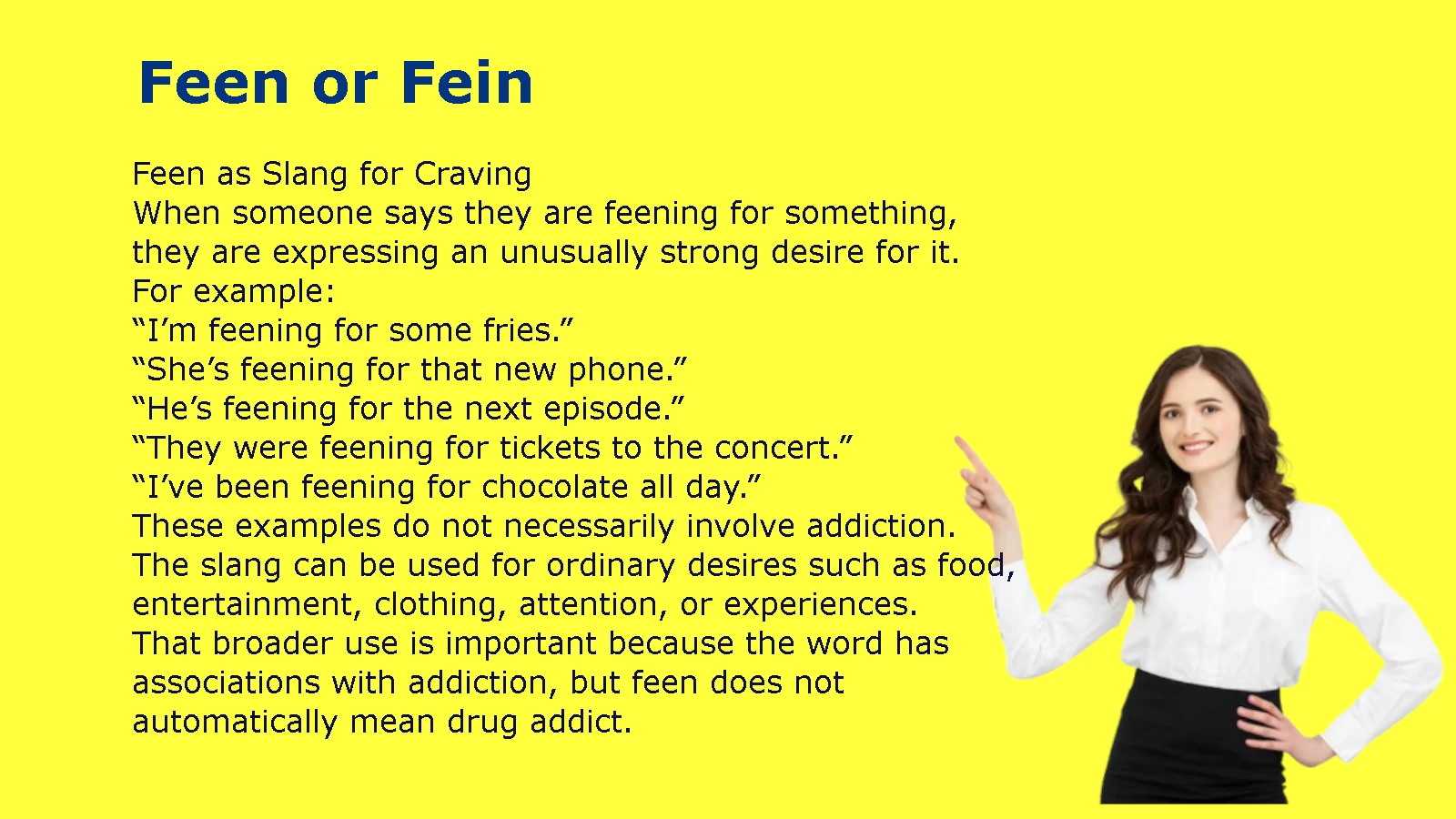
Feen as Slang for Craving
When someone says they are feening for something, they are expressing an unusually strong desire for it.
For example:
- “I’m feening for some fries.”
- “She’s feening for that new phone.”
- “He’s feening for the next episode.”
- “They were feening for tickets to the concert.”
- “I’ve been feening for chocolate all day.”
These examples do not necessarily involve addiction. The slang can be used for ordinary desires such as food, entertainment, clothing, attention, or experiences.
That broader use is important because the word has associations with addiction, but feen does not automatically mean drug addict.
Feen as a Noun
In informal usage, a person may also be called a feen when they seem intensely interested in or constantly craving something.
For example:
- “He’s a coffee feen.”
- “She’s a sneaker feen.”
- “My brother is a gaming feen.”
- “He’s a gym feen.”
In formal English, however, fiend can perform this role:
- “He’s a coffee fiend.”
- “She’s a crossword fiend.”
- “He’s a fitness fiend.”
The standard dictionary word fiend is established in this sense. Oxford describes fiend as an informal noun for a person who is very interested in something, giving crossword fiend as an example.
What Does Fein Mean?
The answer to “What does fein mean?” depends heavily on context.
In current informal online usage, fein can appear as a slang spelling associated with intense desire, craving, or obsession. Some people use it in essentially the same way that others use feen or fiend/fiending in slang.
For example:
- “I’m fein for some tacos.”
- “He’s fein for that game.”
- “She’s fein for attention.”
These are informal constructions. They should not be treated as evidence that fein has become the standard English spelling of fiend.
There are also completely different meanings of fein. For example, fein is an established German adjective with meanings related to fine, delicate, refined, or excellent, depending on context. Therefore, seeing fein does not automatically mean the writer is using English slang.
This is one reason context matters so much.
Is Fiend the Correct Spelling?
Yes, fiend is the standard English spelling.
The word has several established meanings. Oxford lists fiend as a very cruel or unpleasant person, an informal term for someone highly interested in something, and an evil spirit.
Collins similarly gives meanings including an evil spirit, a wicked person, someone intensely interested in something, and an addict.
For example:
- “He is a fiend for cards.”
- “She is a fitness fiend.”
- “He was portrayed as a cruel fiend.”
- “The novel’s villain is a supernatural fiend.”
The spelling fiend is therefore appropriate in standard writing.
Why Fiend Can Mean Someone Who Craves Something
The modern informal meaning did not appear out of nowhere.
The word originally had a very different sense. Its Old English ancestor fēond meant an enemy or foe. Over time, its meaning became associated with the Devil, demons, and wicked people. Later, fiend developed the informal sense of someone intensely devoted to or addicted to something.
The American Heritage Dictionary includes both the noun sense and an informal verb sense. It defines a fiend as someone addicted to something or absorbed in an activity and also records feen as a slang form of the verb meaning “to crave.”
That history explains why today’s slang can move between forms such as fiend, feen, feening, and fiending.
Feen vs Fein vs Fiend
The three spellings are easy to confuse, but they do not have exactly the same status.
| Feature | Feen | Fein | Fiend |
| Standard English spelling | No, for the slang craving sense | No, for the slang craving sense | Yes |
| Informal/slang use | Yes | Yes | Yes |
| Associated with craving | Yes | Often | Yes |
| Can describe an enthusiast | Informally | Informally | Yes |
| Can mean an evil person or spirit | No in the modern slang sense | No | Yes |
| Suitable for formal writing | Usually no | Usually no for slang | Yes |
| Has unrelated meanings | Yes, dialect use | Yes, including German fein | Yes, several established English senses |
The most important point is that fiend is the standard English word.
Feen can function as slang, and fein can appear as an informal online spelling, but neither should be treated as a universal replacement for fiend.
Feen or Fein in Texting and Social Media
Texting changes spelling habits because people often write words according to how they sound rather than according to formal dictionary conventions.
That is one reason forms such as feen and fein can appear in online conversations.
A person might write:
“I’m feenin for some food rn.”
The sentence is casual and expressive. The writer is emphasizing a strong craving.
Another person might write:
“Bro is fein for that new game.”
Here, fein is being used informally to communicate intense desire or enthusiasm.
Neither sentence follows the conventions of formal edited English.
Why Informal Spellings Spread Online
Internet language regularly creates alternate spellings for several reasons:
- People write words the way they pronounce them.
- Informal communities develop their own conventions.
- Music and entertainment can popularize unusual spellings.
- Social media rewards short, recognizable expressions.
- A nonstandard spelling can signal tone or group identity.
- Repetition can make a slang spelling familiar even when it is not standard.
This does not mean every alternative spelling becomes a standard English word. Usage and standardization are different things.
A spelling can be common in comments and still be inappropriate in an academic paper.
What Does Feen Mean on TikTok?
On TikTok and other social platforms, feen or fein may be used to express intense desire, obsession, excitement, or craving.
For example, someone might comment:
“He’s feening for that drop.”
The commenter may simply mean that the person really wants the product.
Likewise:
“I’m feening for the next episode.”
This normally means:
“I really want the next episode.”
The expression can be deliberately exaggerated. Calling someone a “feen” for a particular food does not necessarily make a literal claim about addiction.
FE!N and the Popularity of the Spelling
Another reason people search for fein is the stylized title “FE!N”, a Travis Scott song featuring Playboi Carti from UTOPIA. The track’s title uses an exclamation mark rather than the ordinary spelling of an English word. Copyright and song-registration records identify the song as “Fe!N” and credit Travis Scott and Playboi Carti.
That stylized title has made the spelling especially recognizable online.
However, the title FE!N should not be used as proof that fein is the standard English spelling of fiend. A song title can intentionally use creative spelling.
This distinction is useful:
FE!N is a stylized title.
Fiend is the standard English word.
Feen and fein can occur as informal slang spellings.
What Does Feen Mean When Talking About Drugs?
This is an important part of the feen meaning because the slang has a connection with intense craving and addiction.
In drug-related contexts, feen, feening, or fiending can refer to an intense craving for a substance.
For example:
“He was feening for another dose.”
In that context, the word suggests a serious craving rather than an ordinary desire for food or entertainment.
Dictionary.com records the slang verb fiend as meaning “to desire greatly” and gives examples involving drug craving. The same entry identifies feen as an alternative slang form of that verb.
Does Feen Always Mean Drug Addiction?
No.
This is one of the most common misunderstandings.
The word can be used in a serious drug-related context, but it is also used casually for everyday cravings.
Compare:
| Example | Likely meaning |
| “I’m feening for pizza.” | Strong food craving |
| “She’s feening for that new game.” | Strong desire or enthusiasm |
| “He’s feening for attention.” | Strong desire for attention |
| “He was feening for the drug.” | Serious substance craving |
The surrounding context changes the interpretation.
Calling someone a coffee feen is normally playful. Calling someone a drug fiend has a much more serious meaning.
Is Feen a Real Word?
The answer requires a little precision.
Feen is a real recorded word, but its status and meaning depend on the context.
Dictionary.com and Collins record feen as an Irish dialect word meaning man.
At the same time, Dictionary.com records feen as a slang alternative to the verb fiend in the sense of desiring something greatly.
So it would be inaccurate to say simply:
“Feen is not a word.”
A more accurate statement is:
Feen is an established dialect word and also occurs as a slang form associated with fiend and intense desire. However, it is not the standard spelling to use when you mean the ordinary English noun fiend.
That distinction is much more useful for writers.
Feen vs Fiend: What Is the Difference?
The difference is primarily one of standardness, grammatical role, and context.
Fiend
Fiend is the established standard English word.
It can refer to:
- An evil spirit
- A demon or devil
- A cruel or wicked person
- Someone intensely interested in an activity
- Someone addicted to something
Examples:
- “He is a crossword fiend.”
- “She is a chocolate fiend.”
- “The story’s villain was a fiend.”
- “He became known as a gambling fiend.”
Feen
Feen is used informally as slang associated with strong desire or craving.
It can appear as:
- A noun in informal speech
- A slang verb
- Part of expressions such as feening for
Examples:
- “I’m feening for tacos.”
- “He’s a sneaker feen.”
- “She’s feening for the new album.”
The formal equivalent might use craving, desiring, wanting, enthusiastic about, or fiend depending on the sentence.
Feen or Fein: Which One Should You Use?
Use the spelling that fits your purpose.
For formal writing
Use fiend when you mean the standard English word.
For example:
“She is a crossword fiend.”
Do not replace it with:
“She is a crossword fein.”
For academic writing
Avoid slang unless you are discussing slang itself.
Instead of:
“The student is a feen for historical novels.”
Write:
“The student is an avid reader of historical novels.”
If your topic specifically concerns slang, then feen can be discussed as slang.
For texting
Informal spellings such as feen may be appropriate if they reflect the speaker’s normal style.
For example:
“I’m feening for pizza rn.”
The use is intentionally casual.
For social media
Feen, fein, and related forms can appear in casual posts and comments.
The spelling can be part of the tone.
For dialogue
An author may deliberately use feen to represent a character’s informal speech.
However, the spelling should serve a purpose. Using slang simply because it looks trendy can make dialogue feel forced.
Common Examples of Feen
Here are natural examples showing the slang sense.
Feen for Food
- “I’m feening for a burger.”
- “She’s been feening for ice cream all day.”
- “We’re all feening for some late-night pizza.”
for Entertainment
- “I’m feening for the next episode.”
- “He’s a feen for video games.”
- “She’s feening for the new season.”
for Attention
- “He’s always feening for attention.”
- “She was feening for a reply.”
- “They’re feening for likes.”
Feen for Products
- “I’m feening for those new sneakers.”
- “He’s a feen for expensive watches.”
- “She’s been feening for that phone since it launched.”
These examples show why feen does not have to involve drugs. The basic idea is intense desire.
Common Examples of Fein
Because fein is less standardized as English slang, examples should be treated as informal rather than as model formal English.
- “I’m fein for some fries.”
- “He’s fein for that new game.”
- “She’s fein for the concert.”
- “Bro is fein for attention.”
- “They’re fein for the latest release.”
If you are writing for a broad audience, craving, wanting, obsessed with, or fiending for may be clearer.
For example:
Informal:
“I’m fein for tacos.”
Clearer standard alternative:
“I’m craving tacos.”
Another informal alternative:
“I’m fiending for tacos.”
Feen vs Fein vs Feign vs Fiend
One extra word causes even more confusion: feign.
Although it sounds somewhat similar, feign has an entirely different meaning.
| Word | Meaning | Example |
| Feen | Informal slang associated with craving | “I’m feening for coffee.” |
| Fein | Informal spelling sometimes associated with craving; also has other meanings | “He’s fein for the game.” |
| Feign | Pretend or fake | “She tried to feign surprise.” |
| Fiend | Standard English noun/verb associated with evil, obsession, addiction, or intense desire | “He is a coffee fiend.” |
Feign Is Not a Spelling Variant of Feen
This is worth remembering.
If you write:
“He feigned for pizza.”
you have not written a standard version of feen or fiend. Feign means to pretend.
For example:
“He feigned illness to avoid work.”
The person is pretending to be ill.
By contrast:
“He was feening for pizza.”
means he strongly wanted pizza.
The meanings are completely different.
Why Do People Spell Fiend as Feen or Fein?
Spelling often changes when words move from formal writing into speech and slang.
The pronunciation of fiend is /fiːnd/, while feen represents a pronunciation without the final d. Informal speakers and writers can reshape words in ways that reflect pronunciation, community usage, or stylistic preference.
The history of fiend itself is long. Its Old English ancestor fēond meant “enemy” or “foe,” and the word is related to Germanic forms meaning enemy or hater.
Modern slang uses the word differently. Dictionary.com explicitly records the slang verb fiend and gives feen as an alternative form meaning “to desire greatly.”
This makes the relationship between feen and fiend more than a simple spelling mistake.
At the same time, it would be misleading to say that every occurrence of feen is simply a misspelling of fiend. The documented Irish dialect meaning of feen is separate, and online slang can develop its own conventions.
The Origin of Fiend
The history of fiend is particularly interesting because its earliest meaning was much closer to enemy than to modern slang.
The Old English word was fēond, derived from a verb meaning to hate. Etymological sources connect it with related Germanic words, including German Feind.
Over centuries, the meaning narrowed and changed.
A simplified historical path looks like this:
Old English fēond
→ enemy or foe
→ devil or demon
→ wicked or cruel person
→ person intensely devoted to or addicted to something
The later sense is visible in expressions such as drug fiend, dope fiend, and fresh-air fiend. Etymonline dates the “devotee” sense to the 19th century, while Collins records the modern informal meanings.
That semantic development helps explain why fiend can sound negative in one sentence but almost playful in another.
Compare:
“The villain was a fiend.”
with:
“She is a crossword fiend.”
The first describes a wicked person. The second describes someone who loves crossword puzzles.
Feen and Fiend: A Practical Case Study
Consider this sentence:
“I’m a chocolate feen.”
A reader familiar with internet slang may understand the intended meaning immediately: the writer loves chocolate and craves it frequently.
Now change it to:
“I’m a chocolate fiend.”
This is standard English. The meaning is still clear: the person is extremely fond of chocolate.
Now consider:
“He was feening for the drug.”
The context makes the craving sense much more serious.
Finally:
“He tried to feign interest.”
This has nothing to do with craving. It means he pretended to be interested.
The spelling alone is not enough. Context determines meaning.
Common Mistakes With Feen and Fein
Mistake: Using Fein as the Standard Spelling of Fiend
If you mean the standard English noun, write:
fiend
not:
fein
Mistake: Assuming Feen Always Means Drugs
The slang can describe ordinary cravings.
Someone can be:
- A food feen
- A coffee feen
- A gaming feen
- A sneaker feen
- An attention feen
The context determines whether the expression is harmless exaggeration or something more serious.
Mistake: Confusing Feen With Feign
Feign means to pretend.
Feen in slang can refer to craving.
They are not interchangeable.
Mistake: Treating Every Fein as English Slang
The spelling fein can have meanings unrelated to English slang. In German, fein is an established word with meanings such as fine, delicate, refined, or excellent depending on context.
Therefore, always consider where you encountered the word.
Mistake: Calling Feen Simply a Misspelling
That explanation is too broad.
Modern slang uses feen as a recorded alternative form of the slang verb fiend, and dictionaries also record a separate Irish dialect meaning.
A better explanation is:
Feen can be a slang form associated with fiend and intense desire, while also having a separate dialect meaning.
Feen or Fein in Formal Writing
If your goal is clear, professional English, avoid using feen or fein as slang unless you are specifically discussing the terms.
Choose a standard alternative instead.
| Informal expression | Clear standard alternative |
| “I’m feening for coffee.” | “I’m craving coffee.” |
| “He’s a gaming feen.” | “He’s a gaming enthusiast.” |
| “She’s fein for attention.” | “She strongly wants attention.” |
| “He’s a sneaker feen.” | “He’s a sneaker enthusiast.” |
| “They’re feening for tickets.” | “They really want tickets.” |
This does not mean slang is bad English. It means register matters.
A text message between friends and a university essay have different language requirements.
When Should You Use Feen, Fein, or Fiend?
Use fiend for the standard English word.
Choose feen when you intentionally use the informal slang spelling.
Use fein only when the context specifically calls for that spelling or when you mean a different word.
Write feign when you mean to pretend or fake something.
Here is the shortcut:
Formal → fiend
Slang craving → feen/feening may appear
Informal online spelling → fein may appear
Pretend → feign
Feen or Fein FAQs
Is it feen or fiend?
Fiend is the standard English spelling. Feen is also recorded as a slang form of the verb fiend meaning to desire greatly, and it has a separate Irish dialect meaning.
Is feen a real word?
Yes. Feen is recorded in dictionaries as an Irish dialect word meaning “man,” and Dictionary.com also records it as a slang alternative form of the verb fiend meaning to desire greatly.
Is fein a real English word?
Fein can appear in informal online slang, but it is not the standard English spelling of fiend. It can also represent the German word fein, so its meaning depends on context.
What does feen mean in slang?
In slang, feen can mean to crave or desire something intensely. For example, “I’m feening for pizza” means “I really want pizza.”
Does feen mean addicted?
Not necessarily. It can describe a strong craving for food, entertainment, attention, or other things. In drug-related contexts, however, it can describe an intense substance craving.
What does fein mean on TikTok?
In informal TikTok and social media usage, fein can refer to intense desire, craving, or obsession. It is a nonstandard slang spelling rather than the standard spelling of fiend.
Is FE!N the same as feen?
FE!N is a stylized title used for a Travis Scott song featuring Playboi Carti. The title is not the standard English spelling of fiend.
What does fiend mean?
Fiend can mean an evil spirit, demon, or wicked person. Informally, it can also mean someone who is extremely interested in something or addicted to something.
Is feen a misspelling of fiend?
It can function as an informal slang form related to fiend, especially in the sense of craving something greatly. However, it is not accurate to call every occurrence of feen a simple spelling mistake because dictionaries record additional dialect and slang uses.
What is the difference between feen and feign?
Feen can be slang for craving or desiring something. Feign means to pretend or fake something.
For example:
- “I’m feening for coffee.” = I really want coffee.
- “He feigned interest.” = He pretended to be interested.
What is the difference between feen and fein?
Both spellings can appear in informal online language associated with craving or intense desire, but neither is the standard spelling of the English noun fiend. Fein can also have unrelated meanings, including its use as a German word.
Final Answer: Feen or Fein?
If you are asking which spelling is correct in standard English, the answer is fiend.
Fiend is the established English word for an evil or cruel person, an evil spirit, or, informally, someone who is intensely interested in or addicted to something.
Feen has a legitimate place in language too. It can be an informal slang form associated with craving or intense desire, and dictionaries also record it as an Irish dialect word meaning “man.”
Fein appears in modern online slang and can carry a similar craving-related sense, but it is not the standard English spelling of fiend. It can also refer to the German word fein, so context matters.
The easiest rule to remember is:
Fiend is the standard English spelling. Feen and fein are informal/context-dependent forms.
So, if you’re writing an essay, professional email, article, or other formal text, choose fiend. If you’re interpreting a text message, TikTok comment, song title, or casual conversation, feen or fein may be intentional slang rather than a simple typo.