Vertexes and vertices are both plural forms of vertex, meaning a point where two or more lines, edges, or sides meet. Vertices is the more common and traditional plural, especially in geometry and mathematics, while vertexes is also correct and sometimes used in general or technical contexts.
| Question | Answer |
| What does vertex mean? | A vertex is a point where two or more lines, edges, or sides meet. |
| What is the plural of vertex? | The plural forms are vertices and vertexes. |
| Is vertexes or vertices correct? | Both vertexes and vertices are correct plural forms of vertex. |
| What is the difference between vertices and vertexes? | There’s little difference in meaning. Vertices is more common, particularly in geometry, while vertexes is also accepted. |
Vertexes vs Vertices at a Glance
Here’s the simplest way to understand the difference:
| Word | Number | Meaning | Recommended use |
| vertex | Singular | One point, corner, or meeting point | One |
| vertices | Plural | Two or more points, corners, or meeting points | Preferred in most mathematical writing |
| vertexes | Plural | Two or more points, corners, or meeting points | Correct alternative |
The basic pattern is:
One vertex → two or more vertices or vertexes
For example:
- One vertex of the triangle is labeled A.
- A triangle has three vertices.
- A polygon can have many vertices.
- The computer model contains thousands of vertexes.
Cambridge explicitly identifies both vertices and vertexes as plurals of vertex. Oxford does the same.
That means the question isn’t really “Which one is correct?” Both are. The more useful question is “Which one should you use?”
For mathematics, vertices is usually the safest choice.
English has several words with competing or unusual plural forms. For example, you can also compare [stadiums vs stadia] to see how different plural patterns developed.
What Is a Vertex?
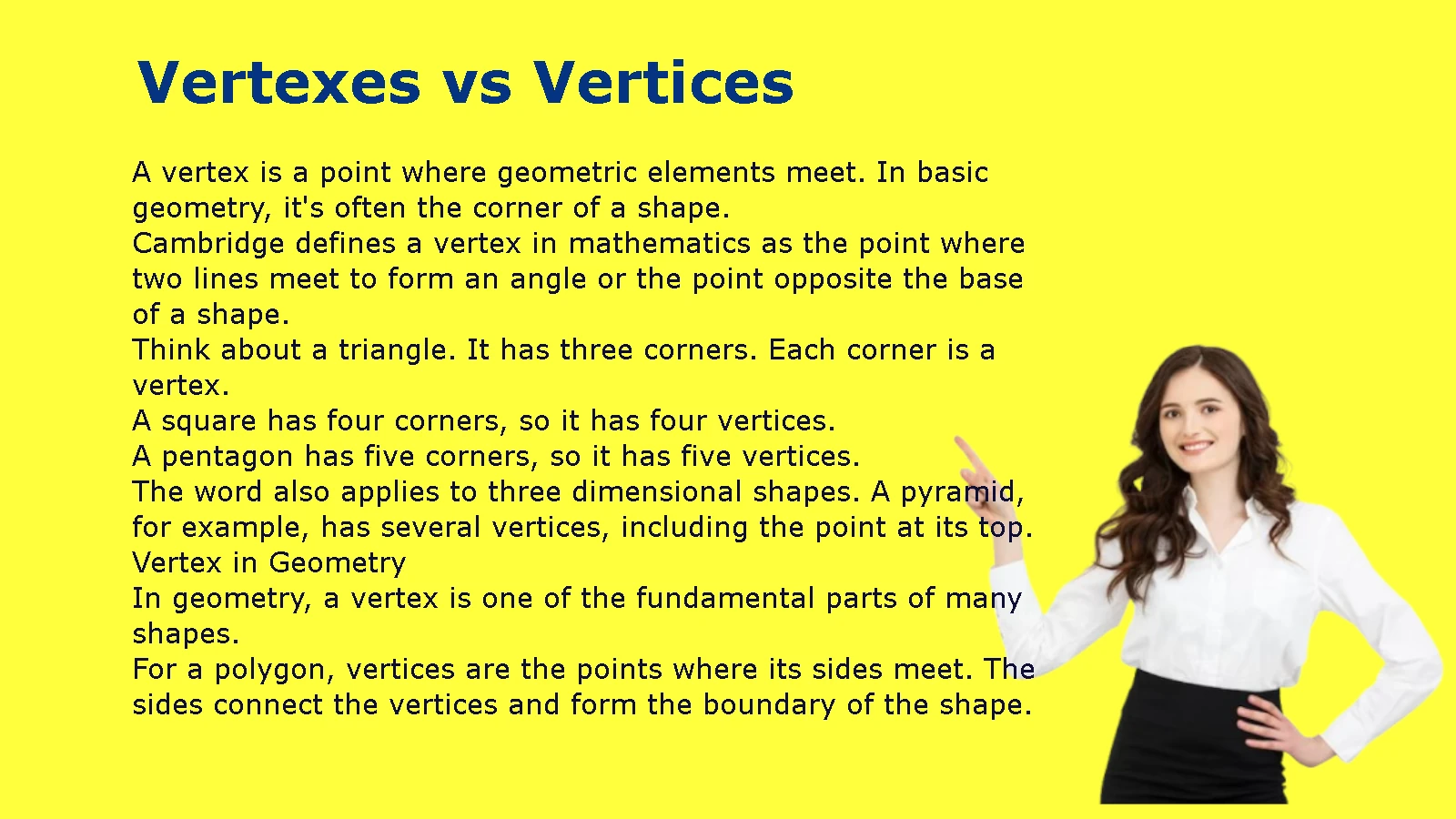
A vertex is a point where geometric elements meet. In basic geometry, it’s often the corner of a shape.
Cambridge defines a vertex in mathematics as the point where two lines meet to form an angle or the point opposite the base of a shape.
Think about a triangle. It has three corners. Each corner is a vertex.
A square has four corners, so it has four vertices.
A pentagon has five corners, so it has five vertices.
The word also applies to three dimensional shapes. A pyramid, for example, has several vertices, including the point at its top.
Vertex in Geometry
In geometry, a vertex is one of the fundamental parts of many shapes.
For a polygon, vertices are the points where its sides meet. The sides connect the vertices and form the boundary of the shape.
Consider these common shapes:
| Shape | Number of vertices |
| Triangle | 3 |
| Quadrilateral | 4 |
| Pentagon | 5 |
| Hexagon | 6 |
| Heptagon | 7 |
| Octagon | 8 |
| Nonagon | 9 |
| Decagon | 10 |
This relationship makes the plural especially important in mathematical explanations.
For example:
A hexagon has six vertices.
Here, vertices is plural because the sentence refers to six separate points.
A useful rule follows:
If you’re talking about one corner, use “vertex.” If you’re talking about several corners, use “vertices” or “vertexes.”
Vertex in Three Dimensional Geometry
The concept doesn’t stop with flat shapes.
Three dimensional objects also have vertices. A cube, for example, has 8 vertices. Its vertices are the points where its edges meet.
A rectangular prism also has 8 vertices.
A tetrahedron has 4 vertices.
A triangular prism has 6 vertices.
These examples show why the word matters in geometry. A vertex isn’t simply another name for a corner in casual speech. It has a specific geometric role.
Vertex in Graph Theory
The word vertex also has an important meaning outside traditional geometry.
In graph theory, a vertex is an individual point or node in a graph. Edges connect vertices to one another.
For example, imagine a simple network:
A ─── B
│ │
│ │
C ─── D
The letters A, B, C, and D represent vertices. The connecting lines represent edges.
So you might write:
The graph contains four vertices and four edges.
Cambridge’s examples include technical uses of vertices for points in graphs and networks.
This usage appears in areas such as:
- Graph theory
- Computer science
- Network analysis
- Algorithms
- Data structures
- Computer graphics
- Computational geometry
In these fields, vertices is an especially familiar form.
What Is the Plural of Vertex?
The plural of vertex is:
vertices
It can also be:
vertexes
Both forms are recognized in modern English dictionaries. Cambridge lists vertices and vertexes as plural forms of vertex. Oxford lists vertices followed by vertexes as well.
So the complete pattern looks like this:
| Singular | Plural |
| vertex | vertices |
| vertex | vertexes |
The spelling vertice is not the standard singular form.
That distinction matters because people sometimes assume that vertices must come from a singular form such as vertice. It doesn’t.
The singular is vertex.
The traditional plural is vertices.
The regularized plural is vertexes.
Is Vertexes Correct?
Yes, vertexes is correct.
This is the first question many readers have when they see the word.
Cambridge has a dedicated dictionary entry for vertexes and defines it simply as the plural of vertex. Its examples include technical contexts involving graphs, meshes, triangles, and geometric structures.
So this sentence is grammatically correct:
The polygon has eight vertexes.
There’s no spelling error in that sentence.
Likewise:
The software adjusts the positions of the vertexes.
That’s also valid.
However, correct doesn’t always mean preferred.
In mathematical writing, vertices tends to feel more natural because it is the established traditional form that readers see frequently in textbooks, research, technical explanations, and mathematical discussions.
For example:
The polygon has eight vertices.
Most mathematics readers would find that version immediately familiar.
That doesn’t make vertexes wrong. It simply makes vertices the more conventional choice in many technical settings.
Is Vertices Correct?
Yes. In fact, “vertices” is the traditional plural of “vertex.”
Cambridge lists vertices as a plural of vertex, while Oxford gives vertices as the primary plural and vertexes as an alternative.
You’ll encounter vertices throughout mathematical language:
- The vertices of a triangle
- The vertices of a polygon
- The vertices of a polyhedron
- The vertices of a graph
- The coordinates of the vertices
- The distance between two vertices
- The degree of a vertex
For example:
The coordinates of the four vertices are listed below.
Here, vertices works naturally because the sentence discusses four geometric points.
Another example comes from graph theory:
Each pair of vertices is connected by an edge.
The plural form is not optional in this context because each pair refers to multiple individual points across the graph.
Vertexes vs Vertices: What’s the Difference?
The short answer is:
There is no difference in basic meaning.
Both words are plural forms of vertex. Both refer to two or more vertices.
The distinction mainly involves form, tradition, and context.
Vertices
Vertices is the traditional plural form. It’s particularly common in:
- Mathematics
- Geometry
- Graph theory
- Computer science
- Academic writing
- Technical documentation
- Scientific writing
If you’re writing a math textbook, research paper, educational article, or technical explanation, vertices is usually the safest option.
Vertexes
Vertexes is an accepted alternative plural.
It can appear in technical writing as well. Cambridge’s corpus examples show vertexes being used in contexts involving graph models, meshes, polygons, and geometric structures.
So don’t treat the word as an error simply because it looks less familiar.
The Practical Difference
The difference can be summarized like this:
Vertices is the traditional and generally preferred technical form. Vertexes is a valid alternative plural.
If consistency matters, choose one form and use it consistently throughout the same piece of writing.
For example, if a technical document uses vertices on page one, suddenly switching to vertexes on page five can make the terminology look inconsistent.
Why Does Vertex Become Vertices?
At first glance, vertex → vertices looks unusual.
Why doesn’t English simply add -es and produce vertexes?
The answer comes from the history of the word.
Oxford traces vertex to Latin. Its word origin is linked to the Latin vertex, which relates to ideas including a whirl, crown of the head, or top, and ultimately to vertere, meaning “to turn.”
English has borrowed many words from Latin and retained older plural patterns for some of them.
That’s why English contains pairs such as:
- vertex → vertices
- index → indices
- matrix → matrices
- appendix → appendices
At the same time, English often regularizes borrowed words.
That’s where vertexes comes in.
Instead of retaining the traditional plural pattern, English speakers can treat vertex more like an ordinary English noun and add -es:
vertex → vertexes
Both patterns exist in modern English.
This isn’t unusual. English contains many nouns with competing traditional and regular plural forms.
Why Is the Plural Not “Vertice”?
A common mistake is to assume that if the plural is vertices, the singular must be vertice.
It isn’t.
The correct relationship is:
vertex → vertices
Not:
vertice → vertices
The word vertice may look logical if you’re trying to reverse engineer the plural, but English doesn’t form the word that way.
Compare:
| Incorrect assumption | Correct form |
| vertice → vertices | ❌ |
| vertex → vertices | ✅ |
| vertex → vertexes | ✅ |
Remembering the singular first makes the pattern much easier.
One vertex. Two vertices.
Vertex vs. Vertices
The difference between vertex and vertices is simply singular versus plural.
| Singular | Plural |
| one vertex | two vertices |
| a vertex | several vertices |
| this vertex | these vertices |
| each vertex | all vertices |
Consider these examples:
The triangle has one marked vertex.
The triangle has three vertices.
Each vertex has a label.
The labels identify all four vertices.
Notice how the surrounding words change as well.
A singular noun usually takes singular determiners and verbs:
Each vertex is labeled.
A plural noun takes plural forms:
The vertices are labeled.
That grammar becomes important in longer technical sentences.
Vertexes vs Vertices in Mathematics
Mathematics is where the choice between these forms matters most.
A mathematical writer will generally encounter vertices far more naturally than vertexes. Cambridge’s dictionary examples for vertices include polygons, graphs, paths, edges, and other technical concepts.
For example:
The triangle has three vertices.
The polygon’s vertices are labeled clockwise.
The graph contains 20 vertices.
The coordinates of the vertices determine the shape.
Each pair of adjacent vertices is connected by an edge.
In these contexts, vertices fits established mathematical terminology.
Geometry
Use vertices when discussing:
- Polygons
- Polyhedra
- Angles
- Cones
- Pyramids
- Coordinate geometry
- Three dimensional shapes
Graph Theory
Use vertices when discussing:
- Graphs
- Nodes
- Edges
- Paths
- Degrees
- Networks
- Connected graphs
Computer Graphics
Computer graphics also uses the concept extensively.
A three dimensional model can contain thousands or millions of points used to construct its surfaces. These points are commonly described as vertices.
For example:
The mesh contains 40,000 vertices.
The term is closely connected with edges and faces, which describe other components of a three dimensional geometric model.
This makes vertices particularly natural in technical computing contexts.
When Should You Use Vertices?
Choose vertices when you want the conventional mathematical or technical form.
It’s especially useful when writing for an audience that already knows mathematical terminology.
Use “vertices” for:
- Math textbooks
- Geometry lessons
- Academic papers
- Technical documentation
- Graph theory explanations
- Computer graphics discussions
- Scientific writing
- Educational websites
- Formal mathematical descriptions
For example:
The algorithm identifies the vertices of the polygon before calculating its area.
That sentence sounds natural because vertices is deeply established in mathematical terminology.
When Should You Use Vertexes?
Use vertexes when you want the accepted regular English plural or when a particular style guide, publication, organization, or technical system uses it.
There’s nothing grammatically defective about it.
For example:
The program stores the positions of all vertexes in the mesh.
Cambridge’s examples demonstrate that vertexes does occur in specialized technical contexts, including graph models and geometric meshes.
The key point is consistency.
If your document uses vertexes, you don’t need to rewrite every instance simply because vertices is more traditional.
However, if you’re starting a new mathematical article and have no house style to follow, vertices is usually the cleaner choice.
Vertexes vs Vertices: Examples
Seeing the forms in context makes the distinction easier to remember.
| Context | Example |
| One triangle corner | The point A is a vertex of the triangle. |
| Several triangle corners | The triangle has three vertices. |
| Polygon | The polygon has six vertices. |
| Graph theory | The graph contains ten vertices. |
| Computer graphics | The model uses thousands of vertices. |
| Alternative plural | The model contains thousands of vertexes. |
Both plural forms can refer to the same collection of points.
Example: A Triangle
A triangle contains three sides and three vertices.
Point A is a vertex of the triangle.
Once the sentence refers to all three points:
A triangle has three vertices.
You could also write:
A triangle has three vertexes.
The second sentence is grammatically valid, although vertices is more conventional in mathematical writing.
Example: A Cube
A cube has eight vertices.
Each vertex is where three edges meet.
Then:
The cube’s eight vertices form its corners.
The singular and plural forms work together naturally.
Example: A Graph
Imagine a graph containing six nodes.
The graph has six vertices connected by nine edges.
Here, vertices refers to the six points in the graph.
The same idea can be expressed with vertexes:
The graph has six vertexes connected by nine edges.
Again, the meaning doesn’t change.
Common Mistakes With Vertex and Vertices
Most mistakes happen because writers mix up singular and plural forms or assume that vertice is the singular.
Mistake: Using Vertex After a Plural Number
Incorrect:
A pentagon has five vertex.
Correct:
A pentagon has five vertices.
You could also use:
A pentagon has five vertexes.
The important point is that five requires a plural noun.
Mistake: Using Vertices for One Point
Incorrect:
Point A is a vertices of the triangle.
Correct:
Point A is a vertex of the triangle.
One point means one vertex.
Mistake: Using Vertice as the Singular
Incorrect:
Point A is one vertice.
Correct:
Point A is one vertex.
There is no need to invent a singular vertice just because the plural is vertices.
Mistake: Incorrect Subject Verb Agreement
Incorrect:
The three vertices is connected by lines.
Correct:
The three vertices are connected by lines.
Because vertices is plural, it normally takes a plural verb.
Compare:
The vertex is labeled A.
The vertices are labeled A, B, and C.
Vertexes vs Vertices vs. Vertice
These three forms can cause unnecessary confusion, so here’s the distinction in one place.
| Form | Correct? | Function |
| vertex | Yes | Singular |
| vertices | Yes | Traditional plural |
| vertexes | Yes | Alternative plural |
| vertice | No, not the standard singular | Avoid |
The correct pattern is:
vertex → vertices
or:
vertex → vertexes
The incorrect pattern is:
vertice → vertices
Once you memorize that small distinction, most usage problems disappear.
A Simple Case Study: Describing a Pentagon
Suppose a geometry problem asks you to describe a five sided polygon.
You might begin with:
A pentagon has five vertices.
The word vertices tells the reader that you’re referring to all five corner points.
Next, you might discuss one of them:
Vertex A lies at the upper left corner of the pentagon.
Then you return to the group:
The remaining vertices are labeled B, C, D, and E.
Notice the pattern:
- vertex = one
- vertices = more than one
If you chose the alternative plural, you could write:
A pentagon has five vertexes.
That’s correct too. However, switching between vertices and vertexes without a reason would be unnecessary.
This illustrates a useful principle for technical writing:
Once you’ve chosen a terminology pattern, keep it consistent.
Why “Vertices” Is Usually the Better Choice
Both forms are correct, but mathematical writing isn’t just about grammatical correctness. Convention matters.
Readers build expectations from the terminology they encounter repeatedly.
A student who has studied geometry will almost certainly recognize phrases such as:
- vertices of a triangle
- vertices of a polygon
- adjacent vertices
- coordinates of the vertices
- vertices and edges
Because vertices is deeply established in these fields, it creates less friction for the reader.
That’s why vertices is generally the better default for:
textbooks, academic writing, educational content, mathematical explanations, and technical documentation.
Meanwhile, vertexes remains a valid alternative.
There’s no need to label it as an error.
How to Remember Vertexes vs Vertices
A simple memory trick can make this distinction stick.
Think:
One vertex. Several vertices.
The word changes more than a regular plural because it comes from a word with a traditional Latin based plural.
Then remember the backup:
Vertexes is also correct.
So you have two valid paths:
vertex
/ \
/ \
vertices vertexes
traditional alternative
If you’re writing mathematics, choose the left branch most of the time.
Frequently Asked Questions About Vertexes vs Vertices
Is “vertexes” a correct word?
Yes. Vertexes is a recognized plural of vertex. Cambridge lists it as a plural and provides technical examples of its use.
Is “vertices” correct?
Yes. Vertices is the traditional plural of vertex and is widely used in mathematics and related technical fields. Cambridge and Oxford both list it.
What is the plural of vertex?
The plural can be vertices or vertexes.
Which is better, vertices or vertexes?
For mathematics, geometry, graph theory, and other technical writing, vertices is generally the better default because it’s the traditional form and is especially familiar in those contexts.
Is vertex singular or plural?
Vertex is singular.
For example:
The triangle has one vertex at point A.
Is vertices singular or plural?
Vertices is plural.
For example:
The triangle has three vertices.
Is vertexes singular or plural?
Vertexes is plural.
For example:
The polygon has several vertexes.
What is the singular of vertices?
The singular is vertex.
Not vertice.
Is “vertice” a word?
Vertice is not the standard English singular form of vertices. In ordinary English mathematical usage, use vertex.
Can you use vertexes in a math paper?
Yes. Vertexes is a recognized plural. However, vertices is generally the more conventional choice in mathematical writing.
Do vertices and vertexes have different meanings?
No. They are two plural forms of the same noun and refer to the same concept.
What is the plural of vertex in geometry?
Both vertices and vertexes are possible. Vertices is the conventional mathematical choice.
How many vertices does a triangle have?
A triangle has 3 vertices.
How many vertices does a square have?
A square has 4 vertices.
How many vertices does a cube have?
A cube has 8 vertices.
Can vertex refer to something other than a geometric corner?
Yes. In graph theory, a vertex can refer to a point or node in a graph. The word also has a broader meaning related to the highest point or top of something. Cambridge and Oxford both recognize this broader sense.
Vertexes vs Vertices: Quick Reference
If you only need the answer, use this table:
| Question | Answer |
| What is the singular? | vertex |
| What is the traditional plural? | vertices |
| Is vertexes correct? | Yes |
| Is vertices correct? | Yes |
| Is vertice the singular? | No |
| Which plural is best for math? | vertices |
| Do vertices and vertexes mean different things? | No |
| Can vertexes appear in technical writing? | Yes |
Final Verdict: Vertexes vs Vertices
The debate over Vertexes vs Vertices is easier to settle than it first appears.
Both are correct.
Vertex is the singular form.
Vertices is the traditional plural and the form generally preferred in mathematical and technical writing.
Vertexes is an accepted alternative plural that follows the regular English plural pattern.
So, when you’re writing about a polygon, graph, pyramid, cube, or computer generated model, this is the safest rule to remember:
One vertex. Two or more vertices.
And if you encounter vertexes, don’t mark it as a spelling mistake. It’s a legitimate plural too. The choice comes down largely to convention and consistency.
For most math related writing, vertices is the best default.