Plow vs plough is a classic American and British English spelling difference. If you’ve seen both forms and wondered whether they describe different tools or actions, the answer is simple: they mean the same thing.
Plow is the standard spelling in American English, while plough is the standard spelling in British English. Both can function as a noun or a verb. They also have the same basic pronunciation, /plaʊ/.
For example:
- American English: The farmer will plow the field.
- British English: The farmer will plough the field.
The difference is mainly regional spelling. It doesn’t represent a difference in the basic meaning of the word. Merriam Webster identifies plough as the chiefly British spelling of plow, while Cambridge lists plow as the US spelling of plough.
So, if you’re writing for an American audience, choose plow. If you’re following British English conventions, choose plough.
Plow vs Plough: Quick Difference
| Feature | Plow | Plough |
| Main variety | American English | British English |
| Part of speech | Noun and verb | Noun and verb |
| Basic meaning | Farm tool or the act of turning soil | Farm tool or the act of turning soil |
| Pronunciation | /plaʊ/ | /plaʊ/ |
| Past tense | plowed | ploughed |
| Present participle | plowing | ploughing |
| Common snow related form | snowplow | snowplough |
The easiest rule to remember is:
Plow = American English
Plough = British English
Both forms have a long history in English. The spelling difference developed as English spelling conventions diverged across regions rather than because the words acquired different meanings.
What Does Plow Mean?
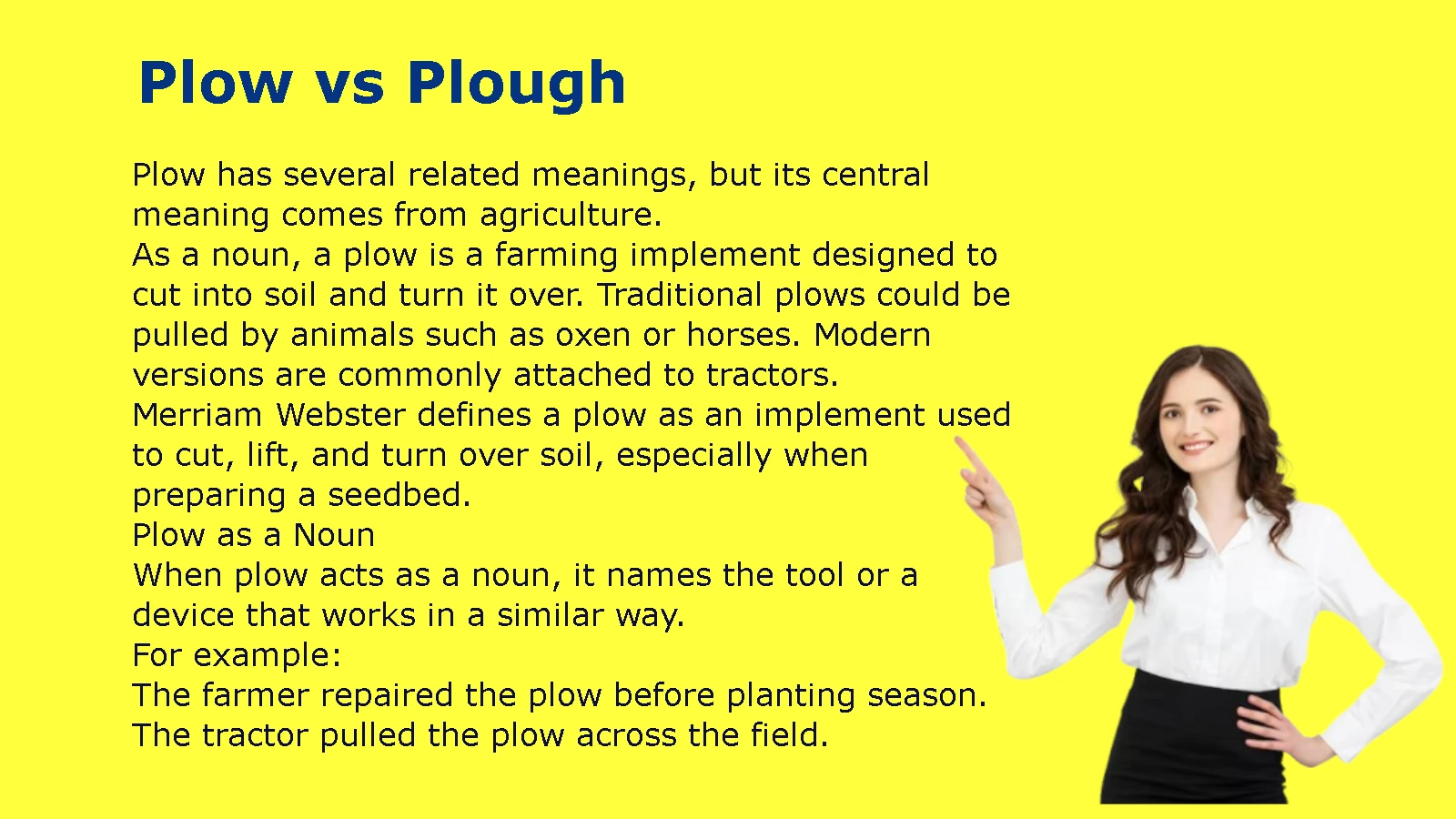
Plow has several related meanings, but its central meaning comes from agriculture.
As a noun, a plow is a farming implement designed to cut into soil and turn it over. Traditional plows could be pulled by animals such as oxen or horses. Modern versions are commonly attached to tractors.
Merriam Webster defines a plow as an implement used to cut, lift, and turn over soil, especially when preparing a seedbed.
Plow as a Noun
When plow acts as a noun, it names the tool or a device that works in a similar way.
For example:
- The farmer repaired the plow before planting season.
- The tractor pulled the plow across the field.
- The old plow stood behind the barn.
- The farmer replaced one of the blades on the plow.
The word also appears in names for equipment that clears or moves material rather than soil. A snowplow, for instance, pushes snow away from roads and other surfaces.
Plow as a Verb
As a verb, plow means to work, break up, or turn soil with a plow.
For example:
- Farmers plow their fields before planting.
- The tractor plowed the field in the spring.
- They plowed a deep furrow through the soil.
The verb has also developed broader meanings. Something can plow through an obstacle, move forcefully through water, or continue through a large amount of work with determination.
For instance:
- The ship plowed through the waves.
- She plowed through the paperwork before lunch.
- The car plowed into the fence.
Merriam Webster records agricultural, snow clearing, movement, financial, and figurative uses of the verb.
What Does Plough Mean?
Plough carries the same basic meanings as plow. The important difference is spelling.
In British English, plough is the usual form. Oxford Learner’s Dictionaries lists plough as British English and plow as the North American equivalent.
Plough as a Noun
A plough is a piece of farming equipment used to dig into and turn over soil, usually before seeds are planted.
For example:
- The farmer attached the plough to the tractor.
- The old plough needed a new blade.
- The horses pulled the plough across the field.
The noun can refer to traditional equipment as well as modern agricultural machinery.
Plough as a Verb
As a verb, plough means to work or turn soil with a plough.
For example:
- The farmer will plough the field tomorrow.
- They ploughed the land before planting.
- The tractor ploughed a straight furrow.
British English also uses plough in several figurative expressions. The spelling changes, but the underlying meaning remains the same.
Is Plow or Plough Correct?
Both are correct.
The correct choice depends on the variety of English you’re using.
Use plow when following American English spelling conventions. Use plough when following British English conventions.
This works much like other regional spelling pairs:
- color / colour
- favor / favour
- honor / honour
- center / centre
- traveled / travelled
The important point is consistency. If you begin an article in American English and use plow, don’t randomly switch to plough later unless you’re discussing the British spelling itself.
Which Spelling Should You Use?
| Writing situation | Preferred spelling |
| US English | plow |
| British English | plough |
| American school assignment | plow |
| British school assignment | plough |
| American business writing | plow |
| British publication | plough |
| Comparing US and UK English | plow and plough |
Neither spelling is inherently more correct. Your audience determines which form will look natural.
Plow vs Plough in American English
In American English, plow is the standard form.
You’ll encounter it in farming, weather reports, road maintenance, technical writing, literature, and everyday conversation.
Consider these examples:
- The farmer plowed the field.
- The county sent a snowplow to clear the road.
- The tractor is plowing the land.
- The ship plowed through the water.
- She plowed through the book in two days.
Merriam Webster gives the American verb forms as plowed, plowing, and plows.
That means American English doesn’t normally add the u found in plough.
American English Examples
The farmer will plow the field after the rain stops.
The city used a snowplow to clear the highway.
He plowed through the report before the meeting.
Each sentence follows standard American spelling.
Plow vs Plough in British English
In British English, plough is the usual spelling.
You’ll see forms such as:
- plough
- ploughs
- ploughed
- ploughing
- snowplough
- ploughman
- ploughshare
For example:
The farmer will plough the field tomorrow.
The road crew used a snowplough after the storm.
She ploughed through the paperwork.
Collins lists the British forms ploughs, ploughing, and ploughed, and identifies plow as the American form.
Plow vs Plough Examples in Sentences
Seeing the two forms side by side makes the distinction much easier.
| American English | British English |
| The farmer will plow the field. | The farmer will plough the field. |
| The tractor pulled the plow. | The tractor pulled the plough. |
| They plowed the land yesterday. | They ploughed the land yesterday. |
| The farmer is plowing the field. | The farmer is ploughing the field. |
| A snowplow cleared the road. | A snowplough cleared the road. |
| The ship plowed through the waves. | The ship ploughed through the waves. |
| She plowed through the documents. | She ploughed through the documents. |
Notice something important: the meaning doesn’t change.
Only the spelling changes to match the regional variety of English.
Plowed vs Ploughed
The past tense creates another noticeable spelling difference.
Plowed is the standard American form.
Ploughed is the standard British form.
American English
- I plowed the field yesterday.
- They plowed the land before planting.
- The snowplow plowed the road.
British English
- I ploughed the field yesterday.
- They ploughed the land before planting.
- The snowplough ploughed through the snow.
This distinction follows the same regional pattern as the base words.
| American | British |
| plow | plough |
| plowed | ploughed |
| plowing | ploughing |
| plows | ploughs |
There isn’t a difference in tense or grammatical function. Both forms represent the same verb.
Plowing vs Ploughing
Plowing and ploughing are present participle or gerund forms of the same verb.
Use plowing in American English:
The farmer is plowing the field.
Use ploughing in British English:
The farmer is ploughing the field.
The spelling difference becomes especially useful when writing about farming because agricultural texts often use several forms of the word in the same paragraph.
For example, an American article might say:
The farmer plowed the field in early spring. After plowing, the soil was ready for planting.
A British article would normally use:
The farmer ploughed the field in early spring. After ploughing, the soil was ready for planting.
The grammar stays the same. Only the regional spelling changes.
Snowplow vs Snowplough
The same spelling difference appears in snowplow and snowplough.
A snowplow is equipment used to push or clear snow from roads, driveways, runways, and other surfaces.
In American English:
The snowplow cleared the highway.
In British English:
The snowplough cleared the highway.
Both words describe equipment designed to move snow. Oxford Learner’s Dictionaries lists snowplough as the British form and identifies the North American form as snowplow.
Snowplow vs Snowplough at a Glance
| American English | British English |
| snowplow | snowplough |
| snowplows | snowploughs |
| snowplowed | snowploughed |
| snowplowing | snowploughing |
The same regional rule applies to the compound forms.
Plow vs Plough Pronunciation
Despite their different spellings, plow and plough are pronounced the same in standard English.
The pronunciation is /plaʊ/.
The sound is the same one you hear in words such as:
- now
- cow
- how
- brown
The letters gh in plough don’t produce a separate consonant sound in modern English pronunciation.
This is one reason the spelling can confuse English learners. The written forms look substantially different, yet the spoken forms are essentially identical.
Oxford Learner’s Dictionaries gives plough the pronunciation /plaʊ/.
So you don’t need to learn two pronunciations. You only need to recognize two spellings.
Why Are Plow and Plough Spelled Differently?
The difference comes from the long history of English spelling.
Both spellings have existed for centuries. Historical English didn’t have one perfectly fixed spelling system, and words could appear in different written forms.
Over time, regional conventions became more established. Plough became the dominant spelling in England, while plow became the preferred American form.
Historical sources also connect the word to Middle English and Old English forms. Merriam Webster gives the first known use of the noun plow as dating to the 12th century, while the verb sense dates to the 15th century.
The spelling difference therefore isn’t a modern invention. It reflects centuries of English development and regional standardization.
A useful way to think about it is this: English spelling didn’t split into two versions overnight. Different communities gradually settled on different conventions.
Plow vs Plough: Parts of Speech
Both plow and plough can work as nouns and verbs.
| Function | American English | British English |
| Noun | plow | plough |
| Verb | plow | plough |
| Third person singular | plows | ploughs |
| Past tense | plowed | ploughed |
| Past participle | plowed | ploughed |
| Present participle | plowing | ploughing |
As a Noun
The word refers to a tool or machine:
The plow needs repair.
The plough needs repair.
As a Verb
The word describes the action:
Farmers plow the fields.
Farmers plough the fields.
The grammatical role doesn’t change with the regional spelling.
Plow Through vs Plough Through
One of the most useful figurative expressions is plow through.
It means to work through, move through, or complete something with sustained effort. The expression often suggests that the task is large, difficult, or tiring.
For example:
I need to plow through these reports before Friday.
A British writer would typically use:
I need to plough through these reports before Friday.
The image behind the expression is easy to understand. A plow moves through soil even when the ground offers resistance. Likewise, someone who plows through a mountain of paperwork keeps moving until the task is finished.
Plow Into vs Plough Into
Another established use is plow into.
It can describe something moving forcefully into another object.
For example:
The car plowed into the barrier.
In British English, the corresponding form is:
The car ploughed into the barrier.
The phrase can also have a figurative meaning involving a forceful or energetic action.
For instance:
She plowed into the project as soon as she received approval.
The spelling depends on the English variety, not the meaning.
Plow Ahead vs Plough On
The verb also appears in expressions about persistence.
Plow ahead can mean to continue with something despite obstacles or uncertainty.
For example:
Despite the delays, the team decided to plow ahead with the plan.
British English may use related expressions such as plough on:
Despite the delays, the team decided to plough on with the plan.
These expressions reinforce the central image associated with plowing: moving forward through resistance.
Plow vs Plough: Practical Case Studies
Case Study: A US Farming Article
Imagine you’re writing an agricultural article for an American publication.
You might write:
Farmers typically plow their fields before planting certain crops. Modern tractors can pull large plows across extensive fields, allowing farmers to prepare the soil efficiently.
Using plow, plows, and other American forms keeps the article consistent with US English.
Writing plough in the middle of this passage would look unusual unless you’re specifically discussing British terminology.
Case Study: A UK Farming Article
Now imagine the same subject appears in a British publication.
The wording would normally become:
Farmers typically plough their fields before planting certain crops. Modern tractors can pull large ploughs across extensive fields, allowing farmers to prepare the soil efficiently.
The information hasn’t changed. The spelling has.
Case Study: A Global Website
A website might have readers from both the United States and the United Kingdom.
In that situation, the best approach isn’t to switch randomly between spellings. Instead, choose a primary style and state the alternative when it matters.
For example:
Plow is the standard American spelling, while plough is the British spelling. Both words have the same meaning and pronunciation.
That one sentence removes the confusion for readers from either variety.
Common Mistakes With Plow and Plough
Because the two spellings look different, readers sometimes assume that they have different meanings. They don’t.
Here are the most common mistakes to avoid.
Mistake: Thinking Plow and Plough Describe Different Tools
They don’t.
A plow and a plough can refer to the same type of agricultural implement. The spelling reflects regional English.
Mistake: Assuming Plough Is Wrong in American English
Plough is not meaningless or incomprehensible in American English. It is simply the chiefly British spelling. Merriam Webster explicitly labels plough as a chiefly British spelling of plow.
However, if you’re following standard US English, plow is the natural choice.
Mistake: Assuming Plow Is Wrong in British English
The reverse is also worth noting. Plow is the American spelling.
If you’re writing specifically for a British audience, plough will generally fit the expected spelling convention better.
Mistake: Mixing Forms
Consider this sentence:
The farmer plowed the field before ploughing it again.
The sentence mixes American and British forms.
A consistent American version would use plowed and plowing.
A consistent British version would use ploughed and ploughing.
Mistake: Thinking the Pronunciation Changes
The extra letters in plough don’t create a different modern pronunciation.
Both forms are pronounced /plaʊ/.
Plow vs Plough vs Plowman vs Ploughman
The regional spelling difference also appears in related words.
In American English, you’ll find plowman.
In British English, ploughman is the traditional corresponding form.
The same principle applies to plowshare and ploughshare, terms associated with the cutting component of a plow or plough.
The spelling changes because the base word changes.
| American English | British English |
| plowman | ploughman |
| plowshare | ploughshare |
| snowplow | snowplough |
However, not every related word should be converted mechanically. Established compounds and historical terms can have their own usage patterns, so a dictionary or relevant style guide remains useful when precision matters.
Plow vs Plough: How to Remember the Difference
The simplest memory trick is:
Plough has a U, and U can remind you of the United Kingdom.
So:
Plough → UK → British English
Plow → US → American English
This isn’t an explanation of the word’s history. It’s simply a convenient spelling trick.
Another approach is to pair the word with familiar regional spelling differences:
- color → colour
- favor → favour
- honor → honour
- plow → plough
Once you recognize the pattern, plow vs plough becomes much easier to remember.
Is Plow American or British?
Plow is primarily the American English spelling.
It is the form you’ll normally want when writing for readers in the United States.
For example:
The farmer will plow the field tomorrow.
Cambridge identifies plow as the US spelling of plough.
Is Plough American or British?
Plough is primarily the British English spelling.
For example:
The farmer will plough the field tomorrow.
British dictionaries use plough as the standard form, while identifying plow as the North American equivalent.
Are Plow and Plough the Same Thing?
Yes.
Plow and plough are alternative regional spellings of the same word. Both can refer to agricultural equipment or the action of turning soil.
They can also appear in figurative expressions involving forceful movement or persistent effort.
Is Snowplow or Snowplough Correct?
Both are correct.
Use snowplow in American English.
Use snowplough in British English.
For example:
- US: The snowplow cleared the road.
- UK: The snowplough cleared the road.
The same regional spelling distinction applies to the compound.
Does Plow Mean the Same as Plough?
Yes.
In their ordinary modern uses, plow and plough have the same basic meaning.
The difference is primarily spelling:
plow = American English
plough = British English
Do Plow and Plough Sound the Same?
Yes. Both are normally pronounced /plaʊ/.
The spelling looks different, but the pronunciation doesn’t change simply because plough contains gh.
What Is the Past Tense of Plow?
The American past tense is plowed.
The British past tense is ploughed.
| English variety | Past tense |
| American English | plowed |
| British English | ploughed |
Both forms describe the same past action.
What Is the Past Tense of Plough?
The past tense of plough is ploughed.
For example:
The farmer ploughed the field before planting.
The American equivalent is:
The farmer plowed the field before planting.
Which Should You Use: Plow or Plough?
Choose the spelling that matches your audience and style guide.
Quick Decision Guide
| If you’re writing for… | Use |
| American readers | plow |
| British readers | plough |
| US school or college work | plow |
| UK school or college work | plough |
| American news or business content | plow |
| British news or business content | plough |
| A comparison of both varieties | plow vs plough |
Plow vs Plough: Key Facts
Here are the most important facts to keep in mind:
- Plow is the standard American spelling.
- Plough is the standard British spelling.
- Both words have the same basic meaning.
- Both can function as nouns and verbs.
- Both are normally pronounced /plaʊ/.
- Plowed is the American past tense.
- Ploughed is the British past tense.
- Plowing is the American present participle.
- Ploughing is the British present participle.
- Snowplow is the American form.
- Snowplough is the British form.
- The spelling difference reflects regional English conventions rather than a difference in the underlying concept.
Plow vs Plough: Final Answer
So, plow vs plough isn’t really a battle between two different words. It’s a regional spelling difference.
Plow is the standard American English spelling.
Plough is the standard British English spelling.
Both refer to the same agricultural tool and the action of working soil with it. They also share the same basic pronunciation. The distinction becomes more noticeable in related forms such as plowed vs ploughed, plowing vs ploughing, and snowplow vs snowplough.
If you’re writing for an American audience, stick with plow. If you’re writing for a British audience, choose plough. Most importantly, keep your spelling consistent from beginning to end.