Have you ever written “throne” when you meant “thrown” and wondered which word is correct? While Throne or Thrown may look and sound almost identical, these two words have completely different meanings and uses. One is connected to royalty, while the other describes something being tossed or moved through the air.
Throne is a noun that refers to a special chair used by a king, queen, or other ruler. Thrown is the past participle of throw, meaning something was tossed, hurled, or moved with force.
Examples:
- The king sat on his golden throne.
- She had thrown the ball across the yard.
The confusion is understandable. People often search for throne vs thrown, throne or thrown, thrown meaning, throne meaning, or how to use throne and thrown in a sentence because both words have the same pronunciation but different spellings and meanings. And here’s the kicker: using the wrong one can completely change your sentence.
In this guide, you’ll learn the difference between Throne and Thrown, their meanings, definitions, pronunciations, correct usage, and examples in sentences. You’ll also discover an easy way to remember which word to use and see how throne and thrown differ in everyday English.
Throne vs. Thrown: Quick Difference
| Word | Meaning | Part of Speech | Example |
| Throne | A special seat associated with a ruler or the position of being a ruler | Noun | The king sat on the throne. |
| Thrown | The past participle of throw | Verb form | The ball was thrown across the field. |
Both words have the same pronunciation in standard American English: /θroʊn/. Merriam Webster lists thrown as a homophone of throne, while Cambridge gives the US pronunciation of throne as /θroʊn/.
That makes throne and thrown homophones. Homophones are words that sound alike but have different meanings and spellings.
Here’s the key distinction:
- Throne is about royalty, rulership, or a special seat.
- Thrown is about throwing something or someone.
- Throne is primarily a noun.
- Thrown is a past participle.
- You can pronounce them the same, but you can’t use them interchangeably.
What Does “Throne” Mean?
A throne is a special chair traditionally associated with a ruler, especially a king or queen. Cambridge defines it as the special chair used by a ruler and also uses the throne to mean the state or position of being a ruler.
The word can therefore have both a literal and a figurative meaning.
In the literal sense, a throne is a physical seat.
The queen sat on the golden throne.
In the figurative sense, the word can represent someone’s position as a monarch or leader.
The prince is next in line to the throne.
Here, the prince isn’t simply waiting for a particular chair. He’s waiting to become king.
Throne as a Noun
Throne functions primarily as a noun.
It names:
- A ceremonial seat for a monarch
- A ruler’s position of authority
- A monarchy or rulership in certain contexts
- A position of power in figurative language
For example:
The king approached the throne.
The word throne names the physical seat.
Now consider:
She was the rightful heir to the throne.
In this sentence, throne represents the position of royal authority rather than merely a piece of furniture.
That distinction matters because English often uses physical objects to represent larger ideas. A crown can represent monarchy. A flag can represent a nation. A throne can represent royal authority.
Examples of “Throne”
Here are several natural examples:
- The king sat on the throne.
- The queen entered the throne room.
- The prince is next in line to the throne.
- The ruler refused to give up the throne.
- The ancient throne stood at the center of the hall.
- The young monarch ascended to the throne.
- His uncle tried to seize the throne.
- The royal family gathered around the throne.
- She became heir to the throne.
- The king eventually abdicated the throne.
Notice how none of these sentences describes something being tossed. That’s your first major clue.
If the sentence involves royalty or rulership, throne is usually the word you need.
What Does “Thrown” Mean?
Thrown is the past participle of throw.
Merriam Webster gives the principal forms of the verb as throw, threw, thrown, throwing. It defines throw with meanings that include propelling something through the air, causing something to fall, and putting something into a particular position or condition.
The most important forms to remember are:
| Verb Form | Example |
| Throw | I throw the ball. |
| Threw | I threw the ball yesterday. |
| Thrown | I have thrown the ball. |
This is an important distinction. Thrown is not the simple past tense of throw.
The simple past is threw.
The past participle is thrown.
Thrown in a Literal Sense
In its most familiar use, thrown describes something that someone has tossed or propelled.
For example:
Sarah has thrown the ball.
The package was thrown over the fence.
Someone had thrown a stone into the water.
The child was thrown from the swing.
In each sentence, something moves because of an action involving throw.
Merriam Webster also gives thrown in contexts where something is caused to fall or is put into a particular condition.
That means thrown has a much broader range than simply tossing a ball.
Thrown in a Figurative Sense
English also uses thrown in many expressions where nobody literally tosses anything.
Consider:
The unexpected question threw me off.
Nobody picked you up and tossed you across the room. The expression means that something confused, distracted, or unsettled you.
Likewise:
The announcement threw the team into chaos.
Again, nothing flew through the air. The sentence uses throw figuratively to describe a sudden change in someone’s situation.
Common expressions include:
- thrown off
- thrown off balance
- thrown into confusion
- thrown into chaos
- thrown out
- thrown away
- thrown under the bus
- thrown for a loop
The exact meaning depends on the expression and the surrounding context.
Throne or Thrown: Why Are They Confused?
The main reason is simple: they sound the same.
The words throne and thrown are homophones. Merriam Webster specifically lists thrown among the homophones of throne.
When you hear someone say:
“The king sat on the throne.”
you can’t determine the spelling from pronunciation alone.
You need the context.
That’s why this confusion often appears in:
- School assignments
- Text messages
- Social media posts
- Emails
- Captions
- Transcripts
- Speech to text
- Creative writing
Speech recognition can make the problem even more obvious. If software hears “throne” and “thrown” correctly but doesn’t understand the surrounding context, the wrong spelling can slip into a transcript.
Why Context Solves the Problem
Look at these two sentences:
The prince inherited the throne.
The prince had thrown the ball.
The words sound identical when spoken. Yet the surrounding words make the intended meaning obvious.
The first sentence deals with royal authority.
The second describes an action.
Think of context as a road sign. When pronunciation gives you two possible spellings, context points you in the right direction.
Throne vs. Thrown Grammar
The grammatical difference makes these words easier to separate.
Throne is generally a noun.
Thrown is a past participle.
That means they don’t normally fill the same grammatical role.
| Word | Grammatical Role | Example |
| Throne | Noun | The king approached the throne. |
| Thrown | Past participle of throw | The ball has been thrown. |
How “Throne” Works in a Sentence
As a noun, throne can appear after articles and possessive words.
Examples:
- the throne
- a throne
- his throne
- her throne
- the king’s throne
- the royal throne
You can also use it after prepositions:
- on the throne
- beside the throne
- near the throne
- behind the throne
- before the throne
For example:
The guards stood beside the throne.
How “Thrown” Works in a Sentence
Because thrown is a past participle, it commonly appears with auxiliary verbs such as have, has, had, is, was, and been.
Examples:
She has thrown the ball.
He had thrown the keys onto the table.
The ball was thrown across the room.
The package has been thrown into the truck.
This gives you a useful test.
If you can replace the word with a form of throw, you’re probably dealing with thrown, not throne.
Throw, Threw, and Thrown: What’s the Difference?
One of the most common mistakes surrounding throne or thrown is actually a third word: threw.
The three forms work differently.
| Form | Function | Example |
| Throw | Present/base form | I throw the ball every afternoon. |
| Threw | Simple past | I threw the ball yesterday. |
| Thrown | Past participle | I have thrown the ball already. |
Merriam Webster identifies threw as the past tense of throw and lists thrown as the past participle.
“Throw” in the Present
Use throw for the base form and present tense.
I throw the ball to my brother.
They throw the ball back and forth.
“Threw” in the Past
Use threw when the action happened in the past.
She threw the ball yesterday.
He threw the keys onto the desk.
“Thrown” as a Past Participle
Use thrown with an auxiliary verb or in a passive construction.
She has thrown the ball.
He had thrown the paper away.
The ball was thrown by the pitcher.
A quick memory rule works well:
Throw → Threw → Thrown
Don’t write “I have threw the ball.”
Write:
I have thrown the ball.
And don’t write “I thrown the ball yesterday.”
Write:
I threw the ball yesterday.
Common Expressions With “Throne”
Because throne represents both a physical seat and royal authority, it appears in several established expressions.
Heir to the Throne
An heir to the throne is someone expected to become monarch.
The prince is heir to the throne.
The phrase focuses on succession and future rulership.
Ascend to the Throne
To ascend to the throne means to become a monarch.
The young king ascended to the throne after his father’s death.
Cambridge uses ascend to the throne and come to the throne to describe becoming a ruler.
Claim the Throne
To claim the throne means to assert a right to become ruler.
Several relatives competed to claim the throne.
The phrase can also appear in historical and fictional contexts involving disputes over succession.
Abdicate the Throne
To abdicate the throne means to give up the position of monarch.
The king decided to abdicate the throne.
Here again, throne represents the office or position of rulership.
Throne Room
A throne room is a room containing a monarch’s throne and traditionally used for formal royal occasions.
The ambassador waited in the throne room.
Common Expressions With “Thrown”
Unlike throne, thrown belongs to the family of expressions built from the verb throw.
Thrown Off
Thrown off can mean confused, distracted, disturbed, or caused to lose a normal rhythm.
The unexpected question threw me off.
The change in schedule threw her off.
Thrown Off Balance
This expression can describe either literal physical imbalance or a figurative loss of stability.
The sudden push threw him off balance.
The unexpected news threw the company off balance.
Thrown Into Chaos
This means that something suddenly causes disorder or confusion.
The storm threw the town into chaos.
Thrown Out
Thrown out can mean physically removed, rejected, or discarded.
The security guard threw him out of the building.
She threw the old papers out.
The precise meaning comes from context.
Thrown Under the Bus
This familiar idiom means blaming, sacrificing, or betraying someone to protect yourself.
He threw his coworker under the bus to avoid taking responsibility.
There’s no actual bus involved. The expression is figurative.
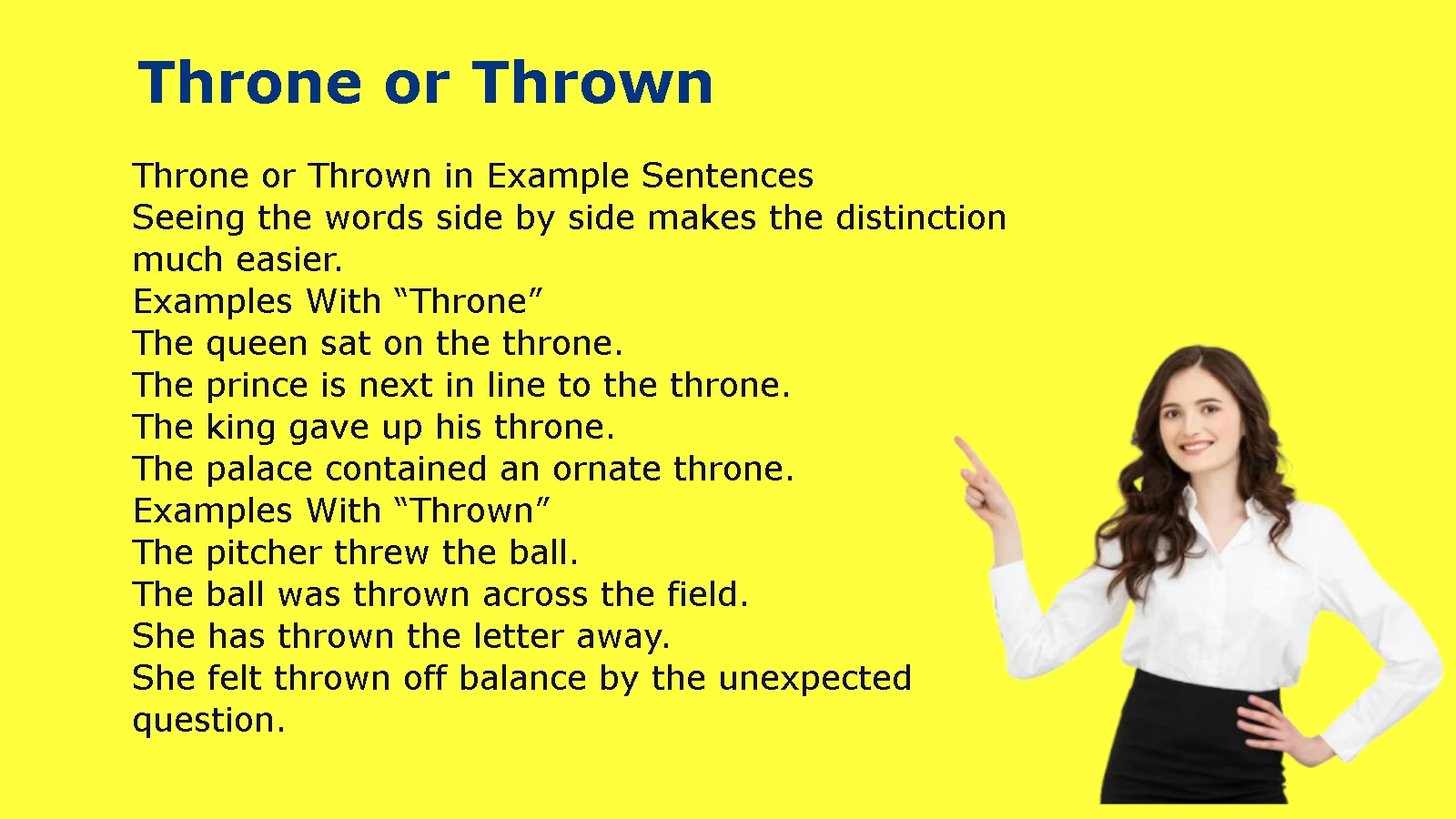
Throne or Thrown in Example Sentences
Seeing the words side by side makes the distinction much easier.
Examples With “Throne”
- The queen sat on the throne.
- The prince is next in line to the throne.
- The king gave up his throne.
- The palace contained an ornate throne.
- She hoped to inherit the throne.
- The ruler stood beside the throne.
- The royal guards surrounded the throne.
- His claim to the throne was disputed.
- The young monarch ascended to the throne.
- The ceremony took place in the throne room.
Examples With “Thrown”
- The pitcher threw the ball.
- The ball was thrown across the field.
- She has thrown the letter away.
- He had thrown the keys onto the table.
- The rider was thrown from the horse.
- Someone threw a stone into the river.
- The sudden change threw everyone off.
- The news threw the team into confusion.
- The package had been thrown over the fence.
- She felt thrown off balance by the unexpected question.
The pattern becomes obvious: throne belongs to the world of seats, rulers, and authority. Thrown belongs to the world of actions and the verb throw.
Common Mistakes With Throne and Thrown
Because the pronunciation doesn’t help, spelling mistakes can easily sneak into otherwise correct sentences.
“The King Sat on the Thrown”
Incorrect:
The king sat on the thrown.
Correct:
The king sat on the throne.
Why?
The sentence refers to a royal seat. Therefore, you need throne.
“The Ball Was Throne”
Incorrect:
The ball was throne across the field.
Correct:
The ball was thrown across the field.
Here, the sentence describes the action of throwing. The correct past participle is thrown.
“He Is Heir to the Thrown”
Incorrect:
He is heir to the thrown.
Correct:
He is heir to the throne.
An heir is connected to a position of royal succession, not to something being tossed.
“She Was Throne From the Horse”
Incorrect:
She was throne from the horse.
Correct:
She was thrown from the horse.
The sentence describes an action that caused her to fall from the horse.
“The Queen Was Thrown”
This sentence can be correct.
The queen was thrown from the carriage.
Here, thrown functions as part of a passive construction based on throw.
However:
The queen sat on the throne.
Here, throne is the noun referring to the royal seat.
The spelling depends entirely on the intended meaning.
A Simple Test for Throne or Thrown
When you’re unsure whether to use throne or thrown, ask one question:
Is the sentence about royalty or throwing?
If it’s about a royal seat, ruler, or position of authority, choose throne.
If it’s about the verb throw, choose thrown when the grammar calls for the past participle.
Choose “Throne” If You Mean:
- A royal seat
- A monarch’s position
- Royal authority
- Succession
- A position of power
Choose “Thrown” If You Mean:
- Tossed
- Propelled
- Cast
- Caused to fall
- Put suddenly into a condition
- Confused or disrupted through the figurative use of throw
This test won’t solve every grammatical question by itself, but it will eliminate the basic throne vs. thrown confusion almost instantly.
Throne vs. Thrown: Pronunciation
In US English, throne is pronounced /θroʊn/. Cambridge gives this pronunciation for American English, and Merriam Webster lists thrown as a homophone of throne.
The words contain the same basic sound sequence:
th + r + long o + n
They also rhyme with familiar words such as:
- phone
- stone
- known
- bone
- loan
- grown
That’s why pronunciation doesn’t distinguish them.
You can say:
“The king sat on the throne.”
and
“The ball was thrown.”
The final spoken word sounds the same in both sentences.
The spelling is where the distinction lives.
Throne or Thrown: A Memory Trick
Here’s a quick way to lock the difference into your memory:
THRONE has royalty. THROWN has THROW.
Look at the spelling:
THRONE
It contains the idea of a royal throne.
Now look at:
THROWN
You can see THROW + N.
That gives you a useful mental shortcut:
Throw → threw → thrown
If you’re describing something that someone has tossed, propelled, or caused to fall, you’re dealing with throw and its forms.
If you’re talking about a king’s or queen’s seat or position, you’re dealing with a throne.
A Real World Context Test
Imagine you’re reading this sentence:
The prince was finally ready to take his place on the ___.
Which word belongs there?
Throne.
The phrase refers to royal succession.
Now change the sentence:
The prince had ___ the ball toward his brother.
Which word belongs there?
Thrown.
The sentence refers to an action.
The pronunciation gives you no clue. The meaning of the sentence does.
This is why learning commonly confused words through context works better than memorizing isolated spellings. Instead of remembering two disconnected definitions, connect each word to a mental scene.
Throne: picture a monarch sitting in a ceremonial chair.
Thrown: picture a ball flying through the air.
Two words. Two completely different pictures.
Throne vs. Thrown: Quick Comparison
| Feature | Throne | Thrown |
| Pronunciation | /θroʊn/ | /θroʊn/ |
| Meaning | Royal seat or position of rulership | Past participle of throw |
| Main grammatical role | Noun | Past participle |
| Related word | Royalty, ruler, monarchy | Throw, threw, throwing |
| Example | The king sat on the throne. | The ball was thrown. |
| Refers to an action? | No | Yes |
| Refers to royalty? | Usually | No |
| Homophone of the other? | Yes | Yes |
Throne or Thrown: Practice Quiz
Test yourself before checking the answers.
Fill in each blank with throne or thrown.
- The king sat on the royal ______.
- The ball was ______ across the field.
- She is next in line to the ______.
- He had ______ the keys onto the table.
- The prince hoped to inherit the ______.
- The rider was ______ from the horse.
- The queen entered the ______ room.
- The sudden announcement had ______ everyone off balance.
- The ruler refused to surrender the ______.
- The package was ______ over the fence.
Answers
- throne
- thrown
- throne
- thrown
- throne
- thrown
- throne
- thrown
- throne
- thrown
If you got all ten right, you’ve got the central distinction down.
Throne or Thrown FAQs
Is “throne” and “thrown” the same word?
No. Throne and thrown are two different words.
They are homophones, meaning they have the same pronunciation but different meanings and spellings. Merriam Webster lists thrown as a homophone of throne.
What is the difference between throne and thrown?
Throne is a noun that refers to a special seat associated with a ruler or to the position of being a ruler.
Thrown is the past participle of throw.
For example:
The queen sat on the throne.
The ball was thrown across the room.
Is thrown the past tense of throw?
Not exactly.
Threw is the simple past tense of throw.
Thrown is the past participle.
The basic forms are:
throw → threw → thrown
Merriam Webster identifies threw as the past tense and lists thrown as the past participle.
Are throne and thrown homophones?
Yes. Throne and thrown are homophones because they have the same pronunciation but different meanings and spellings.
How do you spell the royal seat?
The correct spelling is throne.
The king sat on the throne.
How do you spell the past participle of throw?
The correct spelling is thrown.
She has thrown the ball.
Is it “sit on the throne” or “sit on the thrown”?
The correct expression is sit on the throne.
Throne means the special seat associated with a ruler.
Is it “was thrown” or “was throne”?
The correct expression is was thrown when you’re using the verb throw in a passive construction.
The ball was thrown across the field.
Was throne isn’t the normal construction when you mean that something was tossed.
Can “throne” refer to something other than a chair?
Yes. Throne can also refer to the position or state of being a ruler. For example, someone can be next in line to the throne without the phrase meaning that they’re literally next to a chair.
What is an easy way to remember throne vs. thrown?
Remember:
Throne = royalty.
Thrown = throw.
If a king or queen is involved, throne is likely the word you need. If something has been tossed, propelled, or affected by the verb throw, use thrown where the grammar requires the past participle.
Final Takeaway: Throne vs. Thrown
The difference between throne and thrown becomes simple once you separate meaning from sound.
Throne is a noun. It refers to a special seat for a ruler and can also represent the position or authority of a monarch.
Thrown is the past participle of throw. It describes an action involving tossing, propelling, causing something to fall, or placing something into a condition.
They sound the same, but they belong to completely different parts of the language.
Keep this one line in mind:
A king sits on a throne, but a ball gets thrown.
Once that distinction sticks, you’ll rarely have to second guess throne or thrown again.