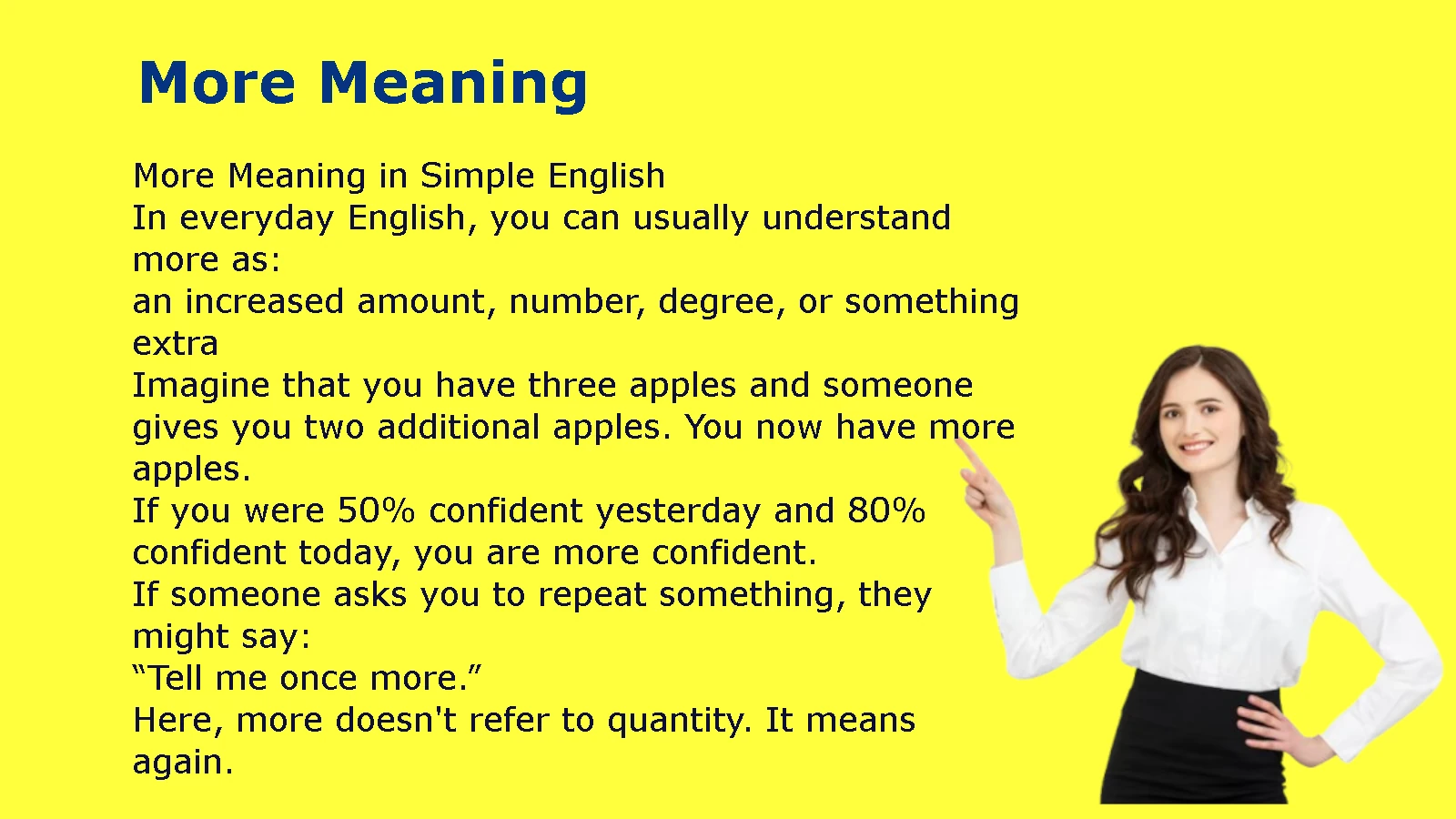
The more meaning refers to a greater amount, number, degree, or extent of something. It can function as a determiner, pronoun, adverb, or noun, depending on how it appears in a sentence. For example, “I need more time” refers to an additional amount, while “She works more carefully” indicates a greater degree of an action. Related terms such as additional, extra, greater, further, increased, and another can overlap with “more,” but they do not always work in the same contexts.
The word “more” is a common English word used to describe an additional amount, a greater degree, or something beyond what has already been mentioned. If you’ve come across “more” and wondered what it means, how it is used, or why its meaning can change depending on the sentence, the term is closely connected to quantity, comparison, addition, degree, increase, and preference.
In this guide, you’ll learn what “more” means, how to use it in sentences, the different meanings of “more,” and how it works in comparisons and everyday English. You’ll also see clear examples to make each meaning easy to understand.
By the end, you’ll know exactly what more means and how to use this versatile English word naturally and correctly.
What Does “More” Mean?
The basic meaning of more is “a greater amount or number” or “an additional amount or number.” We use the word when something increases in quantity, degree, extent, or intensity.
Cambridge defines more as referring to a larger or extra number or amount. It also explains that more helps form the comparative form of many adjectives and adverbs.
Consider these examples:
- “I need more water.”
- “We need more chairs.”
- “He wants more money.”
- “She needs more time.”
- “This approach is more effective.”
The underlying idea is the same: the amount, number, or degree becomes greater.
The Definition of More
The word more can express several closely related ideas:
| Meaning | Example | What it expresses |
| Greater quantity | “I need more water.” | A larger amount |
| Greater number | “We need more employees.” | A larger number |
| Additional | “Give me more information.” | Something extra |
| Greater degree | “She is more confident.” | Increased quality or intensity |
| Further | “We need more discussion.” | Additional consideration |
| Again | “Say it once more.” | Another time |
The exact meaning depends on the words around more.
For example, “more water” means an additional or greater amount of water. “More confident” does not mean that there are additional confident people. Instead, it means a greater degree of confidence.
More Meaning in Simple English
In everyday English, you can usually understand more as:
an increased amount, number, degree, or something extra
Imagine that you have three apples and someone gives you two additional apples. You now have more apples.
If you were 50% confident yesterday and 80% confident today, you are more confident.
If someone asks you to repeat something, they might say:
“Tell me once more.”
Here, more doesn’t refer to quantity. It means again.
That flexibility is one reason more appears in so many different English sentence patterns.
More as the Opposite of Less
In many situations, more contrasts with less.
- more money → less money
- more time → less time
- more water → less water
- more effort → less effort
- more expensive → less expensive
However, the choice between less and fewer depends on the noun.
We normally use fewer with plural countable nouns:
- fewer books
- fewer students
- fewer mistakes
We normally use less with uncountable nouns:
- less water
- less money
- less time
So you might say:
“I need more time, not less.”
But:
“We need more employees, not fewer.”
More Pronunciation and Word Forms
Understanding the more meaning is only part of learning the word. Pronunciation and grammatical classification also matter, especially for English learners.
How to Pronounce More
In American English, more is commonly pronounced /mɔr/. Cambridge gives the American pronunciation as /mɔr/ or /moʊr/ in its pronunciation information, while Oxford gives the American form as /mɔr/.
A simple approximation is:
more = “mor”
The vowel is similar to the vowel sound in words such as door for many American English speakers, although exact pronunciation varies by accent.
Is More One Syllable or Two?
More has one syllable.
You pronounce it as one sound rather than separating it into two syllables.
For example:
- more → 1 syllable
- morning → 2 syllables
- moreover → 3 syllables
What Is the Origin of More?
The history of more goes back to Old English māra. The word has Germanic roots and is related to words in other Germanic languages, including Dutch meer and German mehr.
Its historical development is consistent with its modern comparative meaning: something greater in amount, number, or degree.
The word is therefore not a recent invention or slang term. It has been part of English for well over a thousand years.
What Part of Speech Is More?
One reason the meaning of more can seem complicated is that more doesn’t belong to just one grammatical category.
It can function as a determiner, pronoun, or adverb. Some traditional grammar descriptions may also use terms such as adjective or quantifier depending on the grammatical framework being used. Modern learner dictionaries commonly identify more as a determiner, pronoun, and adverb.
More as a Determiner
A determiner comes before a noun and helps specify it.
Examples:
- “I need more information.”
- “She bought more books.”
- “We need more time.”
- “There are more people outside.”
In these sentences, more tells us that the quantity is greater.
Importantly, more can work with both plural countable nouns and uncountable nouns:
“We need more chairs.”
Here, chairs are countable.
“We need more information.”
Here, information is uncountable.
Cambridge specifically notes that more can be used with plural countable nouns and uncountable nouns.
More as a Pronoun
Sometimes the noun following more is obvious, so you don’t need to repeat it.
For example:
“Would you like more?”
The sentence could mean:
“Would you like more coffee?”
But coffee is already understood, so the noun disappears.
Other examples include:
- “I can’t eat any more.”
- “She wants more.”
- “We need more.”
- “Give me more.”
This use makes everyday English shorter and more natural.
More as an Adverb
More can also modify a verb, adjective, or adverb.
For example:
“You should study more.”
Here, more modifies the verb study and means to a greater extent or for a greater amount of time.
It can also appear before adjectives:
“This book is more interesting.”
And before adverbs:
“She spoke more carefully.”
Oxford explains that more forms the comparative of many adjectives and adverbs, particularly those that do not normally take the -er ending.
How to Use More in a Sentence
The word more is extremely versatile, but a few patterns account for most everyday uses.
More With Countable and Uncountable Nouns
Use more + plural countable noun when you mean a greater number.
Examples:
- more books
- more students
- more cars
- more questions
- more opportunities
“We need more chairs for the meeting.”
Use more + uncountable noun when you mean a greater amount.
Examples:
- more water
- more money
- more information
- more time
- more advice
“I need more information before I make a decision.”
This distinction matters because English learners sometimes try to make uncountable nouns plural.
For example:
Incorrect: “I need more informations.”
Correct: “I need more information.”
The word information is already uncountable, so more information expresses an increased amount without adding an -s.
More Before Adjectives and Adverbs
More frequently creates comparative structures.
Examples:
- more useful
- more expensive
- more important
- more interesting
- more carefully
- more slowly
- more effectively
For example:
“This method is more effective than the old one.”
The word more tells us that the degree of effectiveness is higher.
This is particularly common with longer adjectives and adverbs:
“The second explanation was more detailed.”
“She completed the task more carefully the second time.”
More Than for Comparisons
One of the most important structures is:
more + adjective/adverb/noun + than
Examples:
- “This car is more expensive than that one.”
- “She works more efficiently than I do.”
- “I have more experience than he does.”
- “The project requires more time than we expected.”
The word than introduces the thing being compared.
Compare:
“John has more money.”
This tells us John has a greater amount, but it doesn’t say compared with whom.
Now:
“John has more money than Peter.”
The comparison becomes explicit.
More Of for Specific People or Things
You will often see more of before a determiner, pronoun, possessive, or other specific reference.
Examples:
- more of the cake
- more of that
- more of my time
- more of them
- more of her work
Cambridge explains that of is used after more when it comes before articles, demonstratives, possessives, or pronouns.
Compare:
“I want more cake.”
This refers generally to an additional amount of cake.
But:
“I want more of the cake.”
This refers to a specific cake that has already been identified.
That small distinction can change the meaning.
More vs. Most: What’s the Difference?
More and most are related, but they aren’t interchangeable.
The simplest distinction is:
- more = a greater amount or degree, usually in a comparison
- most = the greatest amount or degree within a group
When to Use More
Use more when comparing two things or when describing an increase.
“Sarah is more experienced than Tom.”
“This option is more affordable than the other one.”
“We need more time.”
The comparison may be explicit or implied.
When to Use Most
Use most when you mean the greatest degree or quantity in a particular group.
“Sarah is the most experienced person on the team.”
“This is the most affordable option.”
“He received the most votes.”
The basic pattern is:
more → comparison
most → highest degree in a group
More vs. Most Examples
| More | Most |
| John is more careful than Mike. | John is the most careful person here. |
| This book is more interesting than that one. | This is the most interesting book here. |
| We need more information. | She provided the most information. |
| She has more experience than I do. | She has the most experience on the team. |
A useful way to remember the difference is to think of a scale.
More moves upward in comparison:
A → B
Most identifies the top point:
A → B → C → highest
More vs. Much vs. Many
These three words often appear together in grammar questions because they all relate to quantity.
| Word | Main use | Example |
| More | A greater/additional quantity or number | “I need more water.” |
| Much | A large amount of an uncountable noun | “I don’t have much time.” |
| Many | A large number of countable nouns | “She has many books.” |
More vs. Much
Use much when discussing an amount, particularly in questions and negative sentences:
“How much money do you need?”
“I don’t have much time.”
Use more when you mean a greater or additional amount:
“I need more money.”
“We need more time.”
The distinction becomes obvious when you compare the questions and answers:
“How much water do you want?”
“I want more water.”
Much asks about the amount. More indicates that the amount should increase.
More vs. Many
Use many with plural countable nouns:
“How many students are there?”
“There aren’t many students here.”
Use more when you want an additional or greater number:
“We need more students.”
“More students joined the program this year.”
So:
many = a large number
more = a greater/additional number
A Quick Comparison
Consider these four sentences:
- “How much money do you have?”
- “I don’t have much money.”
- “She has more money than I do.”
- “She has many friends.”
Each word performs a different grammatical job.
Learning these distinctions makes your English more precise and natural.
Synonyms and Alternatives for More
The best synonym for more depends heavily on context. You can’t replace it with the same word every time.
Synonyms for Additional Quantity
Useful alternatives include:
- additional
- extra
- further
- added
- another
Examples:
“We need additional information.”
“Can I have an extra chair?”
“The company needs further evidence.”
These words are similar, but they aren’t always interchangeable.
For example, additional information sounds natural in formal writing, while extra information often sounds more conversational.
Synonyms for a Greater Degree
When more modifies an adjective or describes intensity, alternatives can include:
- greater
- higher
- stronger
- increased
- enhanced
For example:
“The new system provides greater accuracy.”
“The company experienced higher demand.”
“The medication produced a stronger effect.”
The best choice depends on the noun or adjective involved.
Synonyms for More in Formal and Academic Writing
Academic writing often favors words such as:
- additional
- further
- greater
- increased
- to a greater extent
- increasingly
For example:
Everyday:
“We need more research.”
More formal:
“Further research is required.”
However, don’t replace more simply to sound sophisticated. Clear writing is usually better than unnecessarily complicated writing.
Choosing the Right Synonym
Consider the difference between these sentences:
“We need more information.”
“We need additional information.”
All three can work, but their tone and context differ slightly.
More is the simplest and most general.
Additional emphasizes something being added.
Further often suggests continuation or additional investigation.
Choosing the right word means considering the relationship between the words around it, not just finding a dictionary synonym.
Common Expressions and Phrases With More
The word more appears in many common expressions. Understanding these phrases gives you a deeper grasp of the meaning of more in natural English.
More and More
More and more means increasingly.
The expression shows a continuing increase.
Another example:
“The problem became more and more difficult.”
Here, the difficulty increased over time.
Cambridge and Oxford both identify more and more as a phrase meaning an increasing amount or degree.
More or Less
More or less has two common meanings.
It can mean approximately:
“The repair will cost $500, more or less.”
It can also mean almost or to some extent:
“I’ve more or less finished the project.”
Oxford identifies both meanings: approximately and almost.
Once More
Once more means again.
“Please read the sentence once more.”
“Let’s try once more.”
This is one of the clearest examples of more moving away from its basic quantity meaning.
Here, it doesn’t mean “a greater amount.”
It means another time.
More Than
More than has several uses.
The basic comparative use is:
“She has more experience than I do.”
But more than can also emphasize something:
“I’m more than happy to help.”
In this context, it means very willing or extremely happy, not simply “happier than.”
Oxford notes that more than can be used for emphasis in expressions such as “more than happy.”
No More and Not Anymore
These expressions can mean that something has stopped or that no additional amount is wanted.
“There is no more coffee.”
This means no additional coffee is available or wanted.
Not anymore generally means not now or no longer:
“I don’t work there anymore.”
In American English, anymore is commonly written as one word when it means “no longer.” In other contexts, any more can refer to an indefinite additional quantity.
Oxford distinguishes this adverbial use of any more as meaning “any longer.”
More in Example Sentences
The easiest way to understand the meaning of more is to see it working in different contexts.
More in Everyday Conversation
Here are common conversational examples:
- “Can I have more coffee?”
- “I need more time.”
- “Do you want more?”
- “Tell me more about your trip.”
- “We should talk more often.”
- “Could you explain that once more?”
Notice how more changes meaning depending on its position.
In “more coffee,” it refers to quantity.
In “talk more,” it refers to extent or frequency.
More in Professional Writing
In workplace communication, more often appears when discussing resources, time, information, or performance.
Examples:
“The team needs more information before making a decision.”
“The project requires more time than originally estimated.”
“The new process is more efficient than the previous one.”
“The company needs more employees during the busy season.”
A professional writer may sometimes replace more with additional or further when the context calls for a more formal tone.
More in Academic Sentences
Academic writing frequently uses more to establish comparisons.
Examples:
“The second method was more effective than the first.”
“The results provide more evidence for the proposed theory.”
“Participants in the second group reported more positive outcomes.”
“The study requires more data before a definitive conclusion can be reached.”
The word can also combine with adverbs:
“The participants responded more quickly after receiving the additional training.”
More in Questions and Negative Sentences
Questions:
- “Would you like more?”
- “Do you need more information?”
- “Can we have more time?”
- “Who wants more food?”
Negative sentences:
- “I don’t need any more.”
- “We don’t have any more tickets.”
- “She doesn’t want any more coffee.”
These patterns occur constantly in natural English.
Common Mistakes When Using More
Although more looks simple, several mistakes occur frequently.
Using More and Most Interchangeably
Don’t use more when you mean the highest degree in a group.
Incorrect:
“She is the more talented student in the class.”
Correct:
“She is the most talented student in the class.”
Use more for comparison:
“She is more talented than her brother.”
Use most for the highest degree within a group:
“She is the most talented student in the class.”
Using More With the Wrong Adjective Form
A common mistake is using more with an adjective that already has the comparative -er ending.
Incorrect:
“This is more easier.”
Correct:
“This is easier.”
Likewise:
Incorrect: “more faster”
Correct: “faster”
But some adjectives naturally use more:
“more interesting”
“more expensive”
The general rule is not simply “never use more with short adjectives.” English has exceptions and variation. The safest approach is to learn the standard comparative form of the adjective you’re using.
Using More When Longer Is Better
English learners sometimes translate “more time” too literally when describing duration.
For example:
“Would you like to stay a bit longer?”
is generally more natural than:
“Would you like to stay a bit more?”
Cambridge specifically recommends longer when talking about additional duration.
However, more can still work in other time-related structures:
“I need more time.”
So the distinction is important:
- more time = an additional amount of time
- stay longer = remain for a greater duration
Confusing More With More Of
Compare:
“I want more cake.”
and:
“I want more of the cake.”
The first is a general quantity of cake.
The second refers to a specific cake already identified in the conversation.
Likewise:
“I need more information.”
but:
“I need more of the information you mentioned earlier.”
The presence of of helps identify a specific portion or source.
Forgetting That More Can Stand Alone
You don’t always need a noun after more.
For example:
“Would you like more?”
is perfectly grammatical when the context makes the missing noun obvious.
The implied meaning might be:
“Would you like more food?”
or:
“Would you like more coffee?”
The noun is understood, so English speakers often leave it out.
A Practical Case Study: How “More” Changes Meaning
Consider this short conversation:
Alex: “Would you like more coffee?”
Sam: “No, thanks. I can’t drink any more.”
Alex: “Would you like more time to finish your work instead?”
Sam: “Actually, yes. Give me ten more minutes.”
The same word appears several times, but its function changes.
“More coffee” means an additional quantity of coffee.
“Any more” refers to an additional quantity after a limit has been reached.
“More time” means an additional amount of time.
“Ten more minutes” means ten additional minutes.
This illustrates an important point: you shouldn’t memorize only one translation or definition for more. Instead, learn the concept of increase or addition and then look at what more modifies.
More Meaning at a Glance
The following table summarizes the major uses:
| Use | Meaning | Example |
| Quantity | A greater amount | “I need more water.” |
| Number | A greater number | “We need more workers.” |
| Addition | Something extra | “Give me more information.” |
| Comparison | Greater degree | “She is more confident.” |
| Comparative adverb | To a greater extent | “He works more carefully.” |
| Repetition | Again | “Say it once more.” |
| Increasing trend | Increasingly | “It happens more and more often.” |
| Approximation | Approximately | “It costs $100, more or less.” |
The central idea remains remarkably consistent: something is being added, increased, extended, or compared at a higher level.
Frequently Asked Questions About More Meaning
What does more mean in simple words?
More means a greater amount, number, degree, or quantity, or something additional. For example, “more food” means an additional or greater amount of food, while “more interesting” means interesting to a greater degree.
What is the opposite of more?
The most common opposite of more is less. However, fewer is normally used with plural countable nouns. For example, “less water” contrasts with “more water,” while “fewer books” contrasts with “more books.”
Is more a noun, verb, or adjective?
More does not function as a verb. Modern learner dictionaries commonly classify it as a determiner, pronoun, and adverb, depending on how it appears in a sentence. For example, “more books” uses it as a determiner, while “I want more” uses it as a pronoun.
What is the difference between more and most?
More generally expresses a greater amount or degree in a comparison, while most commonly expresses the greatest amount or degree in a group.
For example:
“John is more experienced than Mike.”
But:
“John is the most experienced person on the team.”
What are synonyms for more?
Depending on context, synonyms and alternatives include additional, extra, further, greater, increased, higher, and another. The best choice depends on what more means in the sentence.
How do you use more in a sentence?
Use more to describe a greater or additional amount, number, or degree.
Examples:
“I need more time.”
“She has more experience than I do.”
“This option is more expensive.”
“Please explain it once more.”
Final Takeaway: The Meaning of More
The word more looks simple, but it performs several important jobs in English. Its core meaning revolves around increase, addition, comparison, and greater degree.
You can use it with nouns:
“more money”
with adjectives:
“more useful”
with adverbs:
“more carefully”
with verbs:
“study more”
and independently as a pronoun:
“I want more.”
It also appears in familiar expressions such as more and more, more or less, once more, more than, and any more.
The easiest way to remember the more meaning is to ask one question:
Is the sentence talking about something additional, greater, or increased?
If so, more may be the word you need.
Once you understand that central idea, the different grammatical uses become much easier to recognize. You can then distinguish more from most, much, many, less, and fewer with far greater confidence.













