A fetish is a strong and unusual interest in a particular object, body part, activity, or idea, especially when that interest has a sexual connection. If you’ve come across the word “fetish” and wondered what it means, how it is used, or why people use the term in different contexts, the word can have both sexual and nonsexual meanings depending on the situation.
The fetish meaning refers to an intense or unusual attraction to a specific object, body part, material, activity, or concept. In a sexual context, a fetish can describe a strong sexual interest in something that isn’t typically considered sexual. The word can also have broader meanings, such as an excessive attachment to or fascination with a particular thing. Related terms include fetishism, fixation, obsession, fascination, kink, preference, and attraction, although these words don’t always mean exactly the same thing.
In this guide, you’ll learn what “fetish” means, how the word is used in different contexts, what fetishism means, and how “fetish” differs from related terms such as “kink,” “fixation,” and “obsession.” You’ll also see clear examples to help you understand the word and use it naturally and correctly.
By the end, you’ll know exactly what fetish means, how its meaning changes with context, and why the term can refer to more than just a sexual interest.
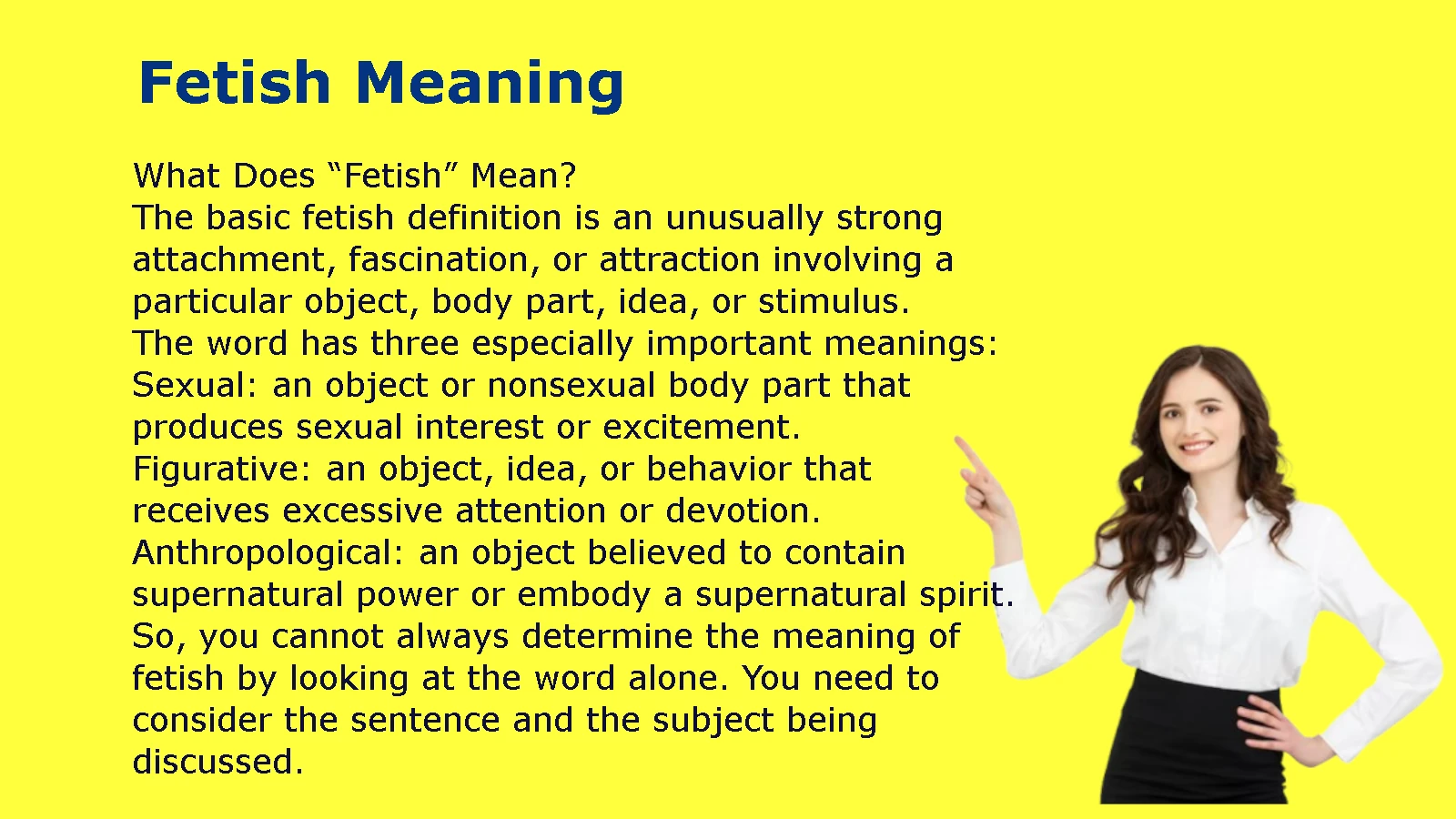
What Does “Fetish” Mean?
The basic fetish definition is an unusually strong attachment, fascination, or attraction involving a particular object, body part, idea, or stimulus.
The word has three especially important meanings:
- Sexual: an object or nonsexual body part that produces sexual interest or excitement.
- Figurative: an object, idea, or behavior that receives excessive attention or devotion.
- Anthropological: an object believed to contain supernatural power or embody a supernatural spirit.
So, you cannot always determine the meaning of fetish by looking at the word alone. You need to consider the sentence and the subject being discussed.
Fetish meaning in simple terms
In simple language, a fetish is something that receives an unusually strong level of attention, fascination, or attraction.
The sexual meaning is the one most people think of today, but it isn’t the only meaning.
For example:
“He has a fetish for perfectly organized desks.”
In this sentence, fetish could simply mean an almost excessive fascination with organization.
Compare that with:
“The researcher studied the psychology of sexual fetishism.”
Here, the word clearly has a sexual and psychological meaning.
The same word can therefore move between ordinary conversation, psychology, cultural criticism, anthropology, and sexual-health discussions.
Fetish as a noun
Fetish is primarily a noun.
You might encounter it in sentences such as:
- “The shoe became a fetish.”
- “She described it as a sexual fetish.”
- “The historian examined the use of fetish objects.”
- “The company has a fetish for luxury.”
The intended meaning changes with the surrounding words.
Fetish as a verb: fetishize
The related verb fetishize means to treat something as an object of excessive or disproportionate fascination.
For example:
- “The advertisement fetishizes youth.”
- “The campaign fetishizes wealth.”
- “The critic argued that the film fetishizes physical appearance.”
Fetishization is the corresponding noun.
This usage is especially common in cultural criticism, media studies, sociology, and discussions of objectification. It does not necessarily refer to sexual fetishism.
Fetish meaning in a sexual context
In sexual psychology, a fetish generally refers to a material object or nonsexual body part that produces sexual interest or excitement. The American Psychological Association gives examples such as shoes, undergarments, animal fur or hide, feet, and locks of hair.
The key idea is sexual significance.
A person may like a particular object without having a fetish involving it. Likewise, someone can find a body part attractive without that interest necessarily fitting the clinical concept of fetishistic disorder.
That distinction becomes especially important when discussing mental health.
What Is a Sexual Fetish?
A sexual fetish is a particular sexual interest in which an object, material, or specific non-genital body part becomes a significant focus of sexual arousal.
The interest can vary considerably from person to person.
For one individual, a particular object might add excitement to sexual activity. For another, the object may occupy a much more central role in sexual fantasy or arousal.
This is why the word fetish shouldn’t be treated as a simple checklist. Human sexuality is more complicated than a collection of categories.
What can someone have a fetish for?
Sexual fetish interests can involve many different kinds of stimuli.
| Category | Examples |
| Objects | Shoes, accessories, or personal objects |
| Materials | Leather, latex, or particular fabrics |
| Clothing | Specific garments or styles |
| Body parts | Feet, hair, or other non-genital body parts |
| Sensory qualities | Texture, appearance, sound, or smell |
| Situations | Highly specific circumstances associated with sexual arousal |
The APA specifically defines fetish in relation to material objects and nonsexual body parts that can arouse sexual interest or excitement.
The DSM-5-TR similarly describes fetishistic disorder as involving recurrent and intense sexual arousal from nonliving objects or a highly specific focus on non-genital body parts.
Common examples of fetishes
Some commonly discussed fetish interests involve:
- Feet
- Shoes
- Particular clothing
- Leather
- Latex
- Hair
- Specific accessories
- Objects associated with a person’s body
Feet and footwear receive particular attention in psychological literature. The APA describes foot fetishism as a form of fetishism involving sexual excitement associated with feet or shoes and notes that feet and shoes are among the more common varieties discussed.
However, “common” doesn’t mean universal, and research findings can depend heavily on how participants are recruited and how researchers define the category.
Fetish vs. sexual preference
A sexual preference is a broad term for something someone particularly likes.
A fetish is generally more specific.
For example, someone may prefer a particular style of clothing because they find it attractive. Another person may experience a much stronger and recurring sexual association with that specific type of clothing.
The boundary isn’t always perfectly sharp in everyday conversation.
That’s why it is better to avoid casually diagnosing yourself or someone else simply because they have a strong preference.
What Is the Psychological Meaning of Fetish?
The psychological meaning of fetish is narrower than many casual uses of the word.
In clinical terminology, the relevant diagnosis is fetishistic disorder, which is classified among the paraphilic disorders in DSM-5-TR. It involves recurrent and intense sexual arousal associated with nonliving objects or a highly specific focus on non-genital body parts.
But there’s an important difference between an interest and a disorder.
What is a fetishistic interest?
A fetishistic interest refers to a recurring sexual interest involving a particular object, material, or body part.
That description alone doesn’t establish a psychiatric disorder.
Modern diagnostic frameworks don’t simply say, “This interest is unusual, therefore it is an illness.” Instead, clinicians look at whether the pattern causes clinically significant distress or impairment and whether other diagnostic criteria are met.
This shift is important because sexual interests exist along a broad spectrum.
What is fetishistic disorder?
The DSM-5-TR gives specific criteria for fetishistic disorder.
The diagnostic pattern must involve:
- Recurrent and intense sexual arousal from nonliving objects or a highly specific focus on non-genital body parts
- Fantasies, urges, or behaviors associated with that arousal
- A duration of at least six months
- Clinically significant distress or impairment in social, occupational, or other important areas of functioning
The DSM also excludes certain situations from this particular diagnosis, including objects limited to clothing used in cross-dressing and devices specifically designed for tactile genital stimulation.
This gives us a useful distinction:
| Situation | Does it automatically mean fetishistic disorder? |
| A person has a particular sexual interest | No |
| The interest is uncommon | No |
| The person has a consensual interest that causes no significant impairment | No |
| The pattern causes clinically significant distress or impairment | It may meet diagnostic criteria |
| The behavior harms or risks harming another person | It requires serious clinical and ethical consideration |
When does a fetish become a problem?
A fetishistic interest can become clinically significant when it causes substantial distress or interferes with important areas of life.
For example, imagine two hypothetical situations.
Case study: consensual interest
Alex has a strong sexual interest in a particular material. Alex’s consenting partner knows about it and is comfortable incorporating it into their relationship. The interest doesn’t interfere with Alex’s work, relationships, or daily life.
The existence of that interest alone would not establish fetishistic disorder.
Case study: significant impairment
Now imagine Jordan has recurrent urges related to a particular object that cause severe distress and interfere with relationships and everyday functioning. Jordan feels unable to manage the urges and seeks professional help.
That situation is clinically different. A qualified professional could evaluate whether the person meets diagnostic criteria and whether treatment or support would be useful.
The important lesson is simple:
An unusual sexual interest is not automatically a psychiatric disorder.
Does having a fetish mean something is wrong with you?
No.
Having a fetishistic interest doesn’t automatically mean a person is mentally ill, damaged, or abnormal in a clinical sense.
The APA’s explanation of paraphilia makes an important distinction: under DSM-5 and DSM-5-TR, a paraphilia becomes a paraphilic disorder when it causes distress or impairment or involves harm or risk of harm to others.
That distinction helps separate personal variation from clinically significant problems.
Common Types of Fetishes
There is no single universally accepted list of fetish types.
Instead, researchers and clinicians generally discuss categories based on the object, body part, material, or stimulus involved.
Object and material fetishes
Some fetishistic interests focus on nonliving objects.
The object may have significance because of its appearance, texture, smell, association with a particular person, or personal history.
Examples can include:
- Footwear
- Particular garments
- Leather
- Latex
- Certain accessories
- Personal objects
The object itself isn’t inherently sexual. Its sexual significance comes from the person’s learned or personal association with it.
Body-part fetishes
Another category involves a strong focus on a particular non-genital body part.
Feet are a well-known example. Hair can also become a focus of fetishistic interest.
The DSM-5-TR specifically recognizes highly specific focus on non-genital body parts within the diagnostic description of fetishistic disorder.
Clothing-related fetishes
Clothing can become sexually significant for a variety of reasons.
Potentially important features include:
- Visual appearance
- Texture
- Smell
- Association with a particular person
- Personal memories
- Cultural meaning
- The circumstances in which the clothing is worn
But simply enjoying a certain type of clothing isn’t enough to establish a fetish.
Preference and fetish are not synonyms.
Sensory and situational interests
Some sexual interests are strongly tied to sensory characteristics.
These may include:
- Texture
- Appearance
- Smell
- Sound
- Movement
Other interests may be associated with highly specific situations.
This is one reason online lists of “all types of fetishes” should be treated cautiously. Human sexuality doesn’t always fit into clean categories.
Why fetish interests vary so widely
There isn’t one scientifically established explanation that accounts for every fetish.
Researchers have explored mechanisms involving:
- Learning
- Conditioning
- Association
- Memory
- Personal experiences
- Psychological development
- Biological factors
- Cultural influences
Different people can arrive at similar interests through very different developmental pathways.
Why Do People Develop Fetishes?
The question “Why do people have fetishes?” has no single universally accepted answer.
Human sexual interests develop through complex interactions between individual psychology, learning, experience, biology, and culture.
Psychological and developmental factors
One long-standing idea is that a particular object or body part can become associated with sexual arousal through experience.
The association may become stronger over time.
For example, if a neutral stimulus repeatedly appears alongside emotionally or sexually significant experiences, the brain may begin treating the stimulus as meaningful.
That doesn’t mean every fetish can be traced to one childhood event.
In fact, making that claim would go far beyond what the evidence supports.
Conditioning and learned associations
Conditioning is one theory researchers have used to explain some fetishistic interests.
The basic idea is straightforward:
Neutral stimulus + repeated association with arousal → stronger sexual significance
This is a useful theoretical model, but human sexuality isn’t a laboratory equation.
People aren’t machines that respond identically to repeated pairings.
Personal experiences and preferences
Personal experiences may also shape sexual interests.
Imagine two people encountering the same object.
One considers it completely ordinary.
The other associates it with attraction, intimacy, confidence, or an emotionally powerful memory.
The object itself hasn’t changed. Its meaning to the individual has.
That illustrates why sexual interests are deeply personal.
Why there is no single explanation for every fetish
It is tempting to search for a simple formula such as:
one childhood experience = one adult fetish
But human development rarely works that neatly.
A better explanation recognizes several possible influences:
- Individual temperament
- Learning and association
- Personal experience
- Emotional memory
- Cultural environment
- Relationship history
- Biological and psychological differences
Historical theories sometimes made much stronger claims than modern evidence can support. Alfred Binet, for example, proposed in the late 19th century that fetishistic associations could develop around early sexual experiences. His theory was historically influential, but it should not be treated as a universal explanation for modern fetishistic interests.
Fetish vs. Kink: What’s the Difference?
Fetish and kink overlap, but they aren’t identical terms.
In everyday conversation, kink is generally broader.
A kink can involve a sexual activity, fantasy, dynamic, preference, or interest that falls outside what a person considers conventional sexual behavior.
A fetish is more specifically associated with a particular object, material, or body part.
What does “kink” mean?
Kink is an umbrella term.
It can describe a wide variety of sexual interests and practices. It doesn’t necessarily involve an object or body part.
That means someone can have a kink that isn’t a fetish.
How a fetish differs from a kink
The easiest way to understand the distinction is to compare their scope.
| Term | General meaning |
| Fetish | Specific sexual interest associated with an object, material, or body part |
| Kink | Broad category of unconventional sexual interests or practices |
| Preference | Something a person particularly likes |
| Fantasy | An imagined scenario or idea |
| Fixation | Strong preoccupation with something |
The boundaries aren’t absolute.
Someone might call a particular fetish a kink, and that isn’t necessarily contradictory.
Can a fetish also be a kink?
Yes.
In broad informal usage, a fetish can be considered a type of kink.
The difference is mainly one of specificity.
Kink covers a wide territory. Fetish generally points to a more specific focus.
Fetish vs. fantasy vs. preference
These terms are especially easy to mix up.
A fantasy is something you imagine.
A preference is something you tend to like.
A fetish is a specific pattern of sexual significance or arousal associated with a particular object, material, or body part.
Someone can have a fantasy without wanting to act on it. Likewise, someone can have a preference without having a fetish.
The modern sexual meaning is only one chapter in the history of the word.
The term originally had a religious and anthropological meaning associated with objects believed to possess supernatural or magical power. The APA dictionary continues to recognize this historical meaning.
Fetish in anthropology and religion
European writers historically used fetish to describe certain objects associated with religious and magical practices, particularly in discussions of West African societies.
Modern scholarship treats many of those historical classifications much more critically.
Why?
Because European observers sometimes used broad labels to describe diverse religious traditions that did not necessarily share the characteristics implied by the word fetish.
So when reading older anthropology, it’s important to understand the historical context and limitations of the terminology.
Fetish as an object believed to have supernatural power
In its older sense, a fetish could be understood as an object believed to embody spiritual power or exert magical influence.
This meaning predates the modern sexual definition by centuries.
Charles de Brosses played an important role in developing the concept of fétichisme in 18th-century European intellectual history. Later writers adapted the concept for psychology and sexuality. Historical research describes Binet’s 1887 work as a major turning point in the development of sexual fetishism as a sexological concept.
How the word’s meaning changed over time
The word’s history can be simplified like this:
Portuguese feitiço → magical or enchanted object → European concept of fetishism → anthropological theory → sexual psychology → modern everyday usage
The shift wasn’t instantaneous.
Different writers gave the word different meanings, and some historical theories about fetishism reflected the scientific and cultural assumptions of their time.
Fetish Meaning in Everyday Language
The word fetish appears frequently in conversations that have nothing to do with clinical psychology.
Context determines what it means.
“He has a fetish for…”
Consider:
“He has a fetish for expensive watches.”
The sentence could mean that he has an intense fascination with expensive watches. It doesn’t necessarily mean the speaker is describing sexual attraction.
This is a common example of figurative usage.
“Fetishize” and “fetishization”
Fetishize means to treat something as an object of excessive fascination or importance.
For example:
- “The brand fetishizes luxury.”
- “The film fetishizes youth.”
- “The campaign fetishizes physical appearance.”
The word can also be used in discussions of race, gender, culture, beauty, consumerism, and media.
In these contexts, fetishization often refers to reducing people or characteristics to objects of exaggerated fascination or desire.
Fetish meaning on social media
Social media has made the word even more flexible.
People may describe:
- A hobby as a fetish
- A particular food as a fetish
- An organizational habit as a fetish
- A strong preference as a fetish
Often, the speaker is being humorous or exaggerating.
That informal use shouldn’t be confused with the technical meaning found in psychology.
When “fetish” is being used figuratively
A quick context guide can help:
| Context | Likely meaning |
| Sexual-health article | Specific sexual interest |
| Psychology | Sexual or clinical terminology |
| Anthropology/history | Supernatural or religious object |
| Social media | Strong or exaggerated fascination |
| Cultural criticism | Excessive fascination or objectification |
| Advertising | Disproportionate emphasis on a quality or object |
Is Having a Fetish Normal?
The answer depends on what you mean by normal.
If normal means “experienced by everyone,” then very few individual sexual preferences would qualify.
Human sexuality varies widely.
A particular sexual interest does not automatically constitute a mental disorder. The APA distinguishes paraphilia from paraphilic disorder, with the latter involving distress, impairment, or harm-related criteria.
When a fetish is simply a sexual interest
A fetishistic interest may simply be one part of someone’s sexuality.
The important questions include:
- Does the person experience significant distress?
- Does the interest interfere with everyday functioning?
- Is everyone involved a consenting adult?
- Are other people’s boundaries respected?
- Does the behavior create meaningful harm or risk?
Those questions are much more informative than asking whether the interest is unusual.
Consent and healthy sexual behavior
Regardless of the particular interest, consent matters.
A person’s sexual interest never gives them permission to involve another person without that person’s agreement.
Healthy consensual sexual behavior requires respect for boundaries.
Consent should be:
- Freely given
- Informed
- Specific
- Ongoing
- Reversible
This is especially important because some fetishistic interests involve objects belonging to other people or circumstances where another person’s participation could otherwise be assumed.
When an interest may cause distress or interfere with life
Professional support may be useful when an interest:
- Causes substantial distress
- Interferes with work or relationships
- Feels uncontrollable
- Creates persistent anxiety
- Leads to unsafe behavior
- Becomes difficult to manage
- Involves nonconsenting people
The DSM-5-TR specifically requires clinically significant distress or impairment for fetishistic disorder.
When to consider talking to a professional
An online article cannot diagnose fetishistic disorder.
If a person is distressed by their sexual interests or feels unable to manage associated behaviors, a qualified mental-health professional can assess the situation.
Professional help isn’t necessarily about eliminating an unusual preference. Depending on the circumstances, it may focus on:
- Managing distress
- Improving relationships
- Understanding compulsive patterns
- Establishing healthy boundaries
- Reducing risky behavior
- Addressing anxiety or shame
Fetish Meaning: Examples in Sentences
Examples make the different meanings of fetish much easier to recognize.
Sexual-context examples
- “The book examines the psychology of sexual fetishism.”
- “The researcher studied fetishistic interests involving particular objects.”
- “The article explains the difference between a fetish and a kink.”
- “The therapist emphasized that an interest alone does not establish a disorder.”
Everyday or figurative examples
- “He has a fetish for vintage watches.”
- “The designer has a fetish for perfectly symmetrical furniture.”
- “The company seems to have a fetish for expensive technology.”
In these examples, fetish can mean an unusually strong fascination rather than a sexual interest.
Anthropological examples
- “The historian examined the traditional concept of the fetish.”
- “The book discusses fetish objects in the history of anthropology.”
- “The artifact was described in older literature as a fetish.”
These examples use the word in its historical or anthropological sense.
Examples of “fetish” used incorrectly
A common mistake is treating every unusual preference as a fetish.
For example:
“I love coffee, so coffee is my fetish.”
That statement may be playful, but it doesn’t establish a sexual fetish.
Likewise:
“She likes leather jackets, so she has a leather fetish.”
That’s an assumption.
Someone can simply like leather jackets.
The presence of a preference doesn’t tell you whether the preference is sexual, let alone whether it meets a clinical definition.
Fetish Synonyms and Related Words
No single synonym perfectly replaces fetish because the word has several meanings.
Kink
Kink is a broad term for unconventional sexual interests or practices.
It overlaps with fetish but isn’t limited to objects or body parts.
Preference
A preference is something a person favors.
It’s much broader than fetish.
Fixation
A fixation is an intense preoccupation with something.
It doesn’t have to be sexual.
Obsession
An obsession generally suggests persistent or intrusive preoccupation.
The word can have a stronger psychological or negative connotation than fetish.
Fetishization
Fetishization refers to treating something as an object of exaggerated fascination or importance.
It is commonly used in cultural and social criticism.
Fantasy
A fantasy is an imagined scenario or idea.
A fantasy doesn’t necessarily represent something a person wants to experience in real life.
Here’s the distinction at a glance:
| Word | Basic meaning |
| Fetish | Specific sexual interest or intense fascination |
| Kink | Broad unconventional sexual interest |
| Preference | Something someone particularly likes |
| Fixation | Strong preoccupation |
| Obsession | Persistent or intrusive preoccupation |
| Fantasy | Imagined scenario or desire |
| Fetishization | Treating something as an object of exaggerated fascination |
The History and Origin of the Word “Fetish”
The origin of fetish is much older than its modern sexual meaning.
The word’s early history is connected to the Portuguese term feitiço, which referred to a charm, enchantment, or magically powerful object. The concept eventually passed into French as fétiche and then into English as fetish.
French and Portuguese origins
The Portuguese word feitiço is generally connected to the Latin facticius, meaning something made or artificial.
The original European concept therefore had nothing specifically to do with sexual attraction.
It concerned objects that people believed possessed special or supernatural power.
The connection to supernatural objects
During the 18th century, European thinkers began using fetishism as a broader theory for understanding religion and belief.
Charles de Brosses was especially influential in this development. His concept described religious devotion directed toward material objects believed to have mysterious power.
That historical meaning eventually influenced later theories about sexuality.
How the sexual meaning developed
The sexual meaning emerged in the late 19th century.
French psychologist Alfred Binet published Le fétichisme dans l’amour in 1887, a work that became an important milestone in the history of sexual psychology. Historical scholarship describes the publication as a turning point in the development of the theory of sexual fetishism.
Binet discussed sexual attraction centered on particular body parts, psychological qualities, and objects such as shoes and lingerie.
His theories reflected the scientific thinking of his era and should therefore be understood historically rather than treated as a complete modern explanation of fetish development.
The concept continued to evolve as sexology and psychiatry developed.
Fetish vs. Fetishistic Disorder
This is perhaps the most important distinction in the entire topic.
Fetish can describe a sexual interest.
Fetishistic disorder is a specific psychiatric diagnosis.
The DSM-5-TR describes fetishistic disorder as involving recurrent and intense sexual arousal from nonliving objects or a highly specific focus on non-genital body parts, accompanied by clinically significant distress or impairment. The pattern must persist for at least six months.
That means:
Fetish ≠ automatically a mental disorder.
The distinction also reflects a broader principle in modern mental-health diagnosis: unusual does not automatically mean disordered.
Key Facts About Fetish Meaning
Here are the most important facts to remember:
- Fetish has multiple meanings.
- In sexual psychology, it can refer to an object or nonsexual body part associated with sexual excitement.
- The term can also describe excessive fascination in everyday or figurative language.
- Historically, fetish referred to an object believed to possess supernatural or magical power.
- A sexual fetish is not automatically a psychiatric disorder.
- DSM-5-TR describes fetishistic disorder using specific clinical criteria.
- Those criteria include a pattern lasting at least six months and clinically significant distress or impairment.
- Fetish and kink overlap, but kink is generally broader.
- A preference is not necessarily a fetish.
- A fantasy is not necessarily a fetish.
- The modern sexual meaning developed in the late 19th century.
- Alfred Binet’s 1887 work was an important milestone in the history of sexual fetishism.
- The word ultimately traces through Portuguese feitiço and French fétiche.
- Consent and respect for boundaries are essential when any sexual interest involves another person.
Frequently Asked Questions About Fetish Meaning
What is the simple meaning of fetish?
The fetish meaning depends on context. In sexual usage, it generally refers to a strong sexual interest or arousal associated with a particular object, material, or specific non-genital body part. In other contexts, it can mean an intense fascination or historically refer to a supernatural object.
What does fetish mean sexually?
A sexual fetish generally refers to a particular object, material, or non-genital body part that becomes strongly associated with sexual interest or excitement. The presence of such an interest alone does not mean someone has fetishistic disorder.
Is a fetish the same as a kink?
Not exactly. Kink is broader and can refer to many unconventional sexual interests or practices. A fetish usually has a more specific focus on an object, material, or body part, although the two terms can overlap in casual conversation.
Is having a fetish normal?
Having a particular sexual interest does not automatically mean that something is psychologically wrong. Modern diagnostic frameworks distinguish between a sexual interest and a paraphilic disorder, which involves additional clinical criteria such as significant distress or impairment.
What is the difference between a fetish and a preference?
A preference is something a person particularly likes, while a fetish generally describes a more specific sexual association with an object, material, or body part. The two concepts can overlap, but they aren’t exact synonyms.
Where does the word “fetish” come from?
The word ultimately comes through French fétiche from Portuguese feitiço, a term associated with magical or enchanted objects. Its original meaning was connected with supernatural power, while the sexual meaning developed much later, becoming particularly important in late-19th-century sexology.













