The desideratum vs desiderata distinction is simple: “desideratum” refers to one thing that is needed or desired, while “desiderata” refers to two or more things. For example, you might describe reliable information as a desideratum for a research project, but call accuracy, clarity, and consistency the desiderata of effective writing. Because these words come from Latin, their forms follow a traditional singular and plural pattern. Using the correct form also helps maintain proper subject verb agreement and grammatical accuracy.
A desideratum is something that is needed, desired, or considered essential, while desiderata is the plural form of the word. If you’ve come across the terms “desideratum” and “desiderata” and wondered which one to use, the difference comes down to singular and plural agreement, meaning, and sentence structure. These terms are often used in formal writing, academic discussions, philosophy, professional communication, and descriptions of important goals or requirements.
In this guide, you’ll learn the difference between desideratum and desiderata, how to use each word in sentences, how singular and plural agreement works, and which form is appropriate in different contexts. You’ll also see clear examples and comparisons to help you understand how these terms work in everyday and formal writing.
By the end, you’ll know exactly when to use desideratum or desiderata and how to maintain correct singular and plural agreement in your sentences.
What Is the Difference Between Desideratum and Desiderata?
Desideratum is a singular noun that describes one thing that is needed, wanted, or considered desirable. Desiderata is the traditional plural form, used when referring to several such things. Both words often appear in formal writing when discussing requirements, goals, missing resources, or qualities needed to achieve a particular result.
For example, you might write, “A reliable internet connection is a desideratum for remote work.” If you want to describe several requirements, you could write, “Reliable internet, suitable equipment, and flexible hours are desiderata for remote work.”
The distinction is similar to the difference between criterion and criteria. The first refers to one standard, while the second refers to multiple standards.
Desideratum Meaning and Definition
Desideratum means something that is needed, desired, or regarded as essential but is not yet available, achieved, or fully satisfied. It is a singular noun that commonly appears in academic, philosophical, professional, and formal contexts.
The word often describes a missing condition that would make a situation better or help someone reach a goal. It does not always refer to an urgent necessity. Sometimes, it describes an ideal quality that would be valuable to have.
For example, a school may have adequate classrooms and qualified teachers, but modern science laboratories may remain a desideratum. The laboratories are not necessarily required for every lesson, yet their presence would improve the school’s educational facilities.
Consider these original examples:
- Education: “Individual feedback remains a desideratum in large online classes.”
- Business: “A transparent pricing policy is a desideratum for building customer trust.”
- Research: “A larger and more diverse sample is a desideratum for improving the study’s findings.”
- Technology: “Better battery life is a major desideratum for users of portable devices.”
- Public policy: “Affordable housing is an important desideratum for a growing city.”
In each example, desideratum refers to one desired condition or quality. The word gives the sentence a formal tone and emphasizes that something valuable is still needed or would improve the existing situation.
Desiderata Meaning and Definition
Desiderata is the plural of desideratum. It refers to multiple things that are wanted, needed, or considered desirable. Writers often use it when discussing a collection of requirements, objectives, ideal qualities, or improvements.
Unlike a word such as wish, which can describe a personal hope, desiderata often suggests a more organized set of goals or expectations. It is especially useful when describing the features that a plan, project, system, or institution should ideally possess.
For example, a company developing a new mobile application might identify privacy protection, fast loading times, and accessibility as its main desiderata. These are separate qualities, but together they describe what the company wants the application to achieve.
Here are more examples:
- Education: “Practical experience, clear instruction, and regular feedback are important desiderata for a successful training program.”
- Business: “Low operating costs and reliable customer support were the client’s main desiderata.”
- Research: “Accurate measurements and repeatable results are essential desiderata for the experiment.”
- Home design: “Natural light, storage space, and energy efficiency were the family’s principal desiderata.”
- Government: “Transparency, fairness, and public accountability remain important desiderata in public administration.”
Notice that the examples refer to several desired qualities rather than one. This is why the plural form is appropriate.
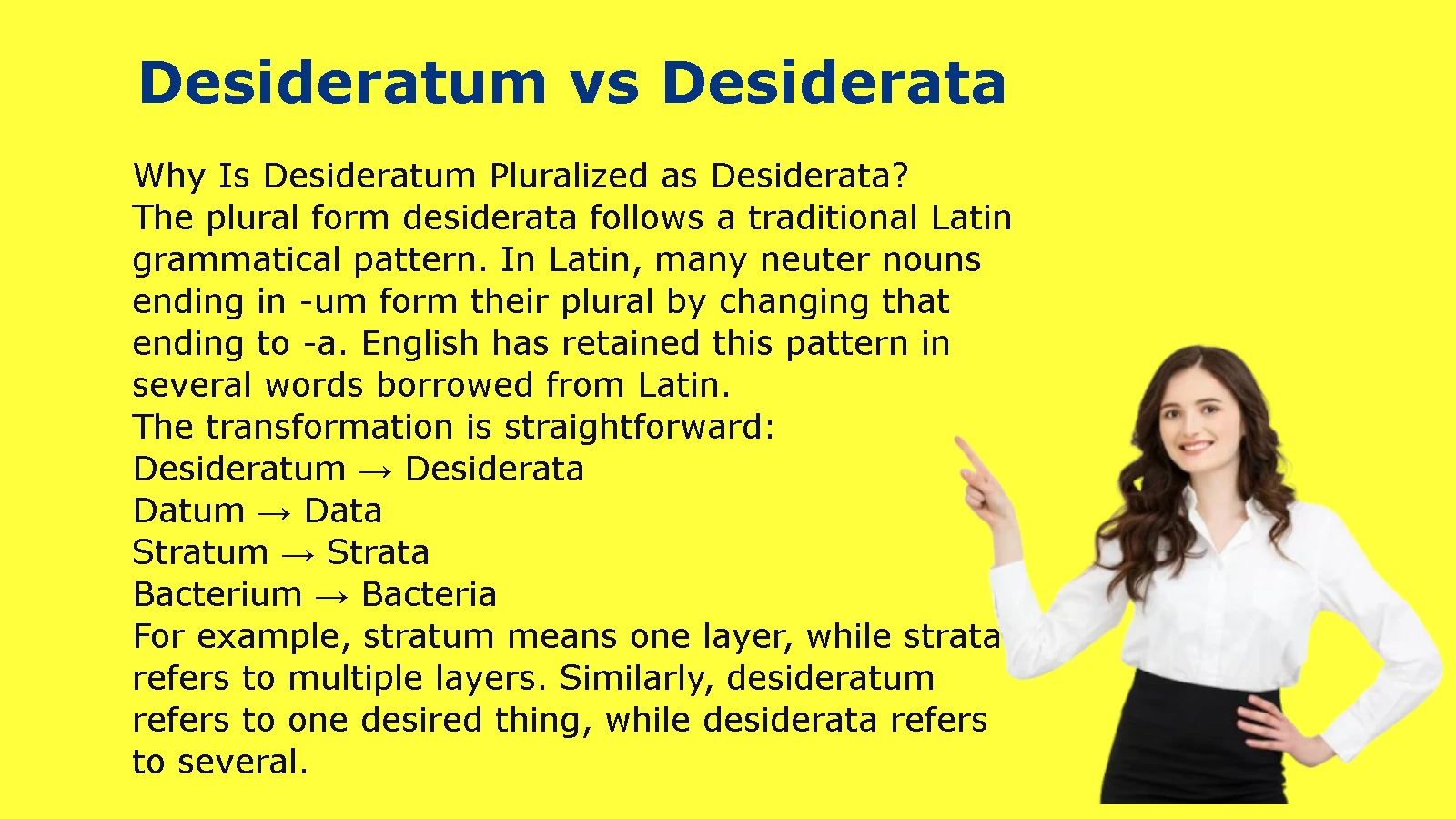
Why Is Desideratum Pluralized as Desiderata?
The plural form desiderata follows a traditional Latin grammatical pattern. In Latin, many neuter nouns ending in -um form their plural by changing that ending to -a. English has retained this pattern in several words borrowed from Latin.
The transformation is straightforward:
- Desideratum → Desiderata
- Datum → Data
- Stratum → Strata
- Bacterium → Bacteria
For example, stratum means one layer, while strata refers to multiple layers. Similarly, desideratum refers to one desired thing, while desiderata refers to several.
This pattern explains why the standard formal plural is not formed simply by adding -s. Although English sometimes regularizes borrowed words, the traditional plural remains the preferred choice in formal academic and professional writing.
It is also useful to remember that these Latin plurals do not all behave identically in modern English. For example, data is often treated as a mass noun in everyday usage, while desiderata generally retains its plural meaning.
Desideratum vs Desiderata: Quick Comparison Table
The easiest way to understand the difference is to compare the two words side by side.
| Feature | Desideratum | Desiderata |
| Grammatical number | Singular | Plural |
| Part of speech | Noun | Noun |
| Meaning | One desired or needed thing | Multiple desired or needed things |
| Latin pattern | Neuter noun ending in -um | Traditional plural ending in -a |
| Common contexts | Research, business, philosophy, planning | Research requirements, project goals, lists of priorities |
| Example | “Accuracy is a desideratum.” | “Accuracy and clarity are desiderata.” |
A Simple Rule for Choosing the Correct Word
Use desideratum when discussing one desired quality, requirement, or objective. Use desiderata when discussing two or more.
Compare these sentences:
- Singular: “A clear communication policy is a desideratum for the organization.”
- Plural: “A clear communication policy and consistent employee training are desiderata for the organization.”
The first sentence identifies one desired condition. The second identifies two.
You can also test your choice by replacing the word with a simpler phrase. If “one desired thing” fits, choose desideratum. If “several desired things” fits, choose desiderata.
How to Use Desideratum and Desiderata in a Sentence
Both words are most useful when you want to describe something desirable or necessary in a precise, formal way. The best choice depends on the number of things you mean and the context in which you are writing.
Desideratum Examples in Academic and Professional Writing
In academic writing, desideratum can identify a missing piece of evidence, a research requirement, or a quality that would strengthen a study. In professional writing, it can describe a feature that would improve a process or help an organization reach its objectives.
Here are several original examples with explanations.
Research example: “A longer observation period is a desideratum for understanding the project’s long-term effects.”
This sentence identifies one improvement that would make the research more informative.
Business example: “A dependable supply chain is a desideratum for maintaining consistent production.”
The sentence presents supply chain reliability as one important condition for the business.
Education example: “Personalized instruction is a desideratum in classrooms where students have different learning needs.”
Here, the word identifies a desirable teaching practice.
Technology example: “Stronger protection against data loss is a desideratum for the new backup system.”
The sentence emphasizes one feature that the system should ideally provide.
Public administration example: “Clearer communication between departments is a desideratum for improving public services.”
This example identifies a specific improvement that could help an institution perform better.
These examples show that desideratum is especially effective when the desired condition is important but not yet fully achieved.
Desiderata Examples in Everyday and Formal Contexts
Although desiderata sounds formal, it can describe ordinary preferences and practical requirements. It works particularly well when a sentence lists several features or conditions that someone wants.
Consider these examples:
Hiring: “Professional experience, strong writing skills, and attention to detail were the employer’s main desiderata.”
The sentence identifies three qualities sought in a candidate.
Home buying: “A quiet neighborhood, a short commute, and a spacious kitchen were the couple’s principal desiderata.”
The plural noun groups several preferences into one clear description.
Product development: “Affordable pricing, simple navigation, and dependable performance are the team’s main desiderata for the next release.”
The sentence summarizes several goals for a product.
Academic research: “Reliable data, a representative sample, and a transparent method are desiderata for a strong research project.”
The word groups three qualities that support good research.
Event planning: “Suitable seating, accessible entrances, and clear signage were the organizers’ essential desiderata.”
The sentence describes several practical requirements for an event.
Environmental planning: “Clean water, healthy soil, and protected habitats are important desiderata for sustainable development.”
The plural form is appropriate because the sentence refers to several desired outcomes.
How Desideratum and Desiderata Work in Real Writing
Imagine that a university is preparing a plan to improve its online learning system. The committee identifies three areas for improvement: accessibility, faster loading times, and stronger student data protection.
A report could express these priorities in two ways:
- “Better accessibility is a desideratum for the university’s online learning system.”
- “Accessibility, faster loading times, and stronger data protection are desiderata for the university’s online learning system.”
Both sentences are correct. The first highlights one goal, while the second presents a group of goals.
This example demonstrates an important point: the correct word depends on what the sentence describes, not simply on how formal the writing sounds.
A writer should not choose desiderata merely because it sounds more academic. The plural form is appropriate only when the meaning calls for more than one desired thing.
Common Grammar Mistakes to Avoid
The difference between desideratum and desiderata is simple once you understand their meanings. However, several mistakes can make formal writing less accurate.
Using Desiderata for a Single Requirement
Incorrect: “A reliable internet connection is one of the most important desiderata for remote work.”
This sentence is potentially inconsistent because it presents one item as a single desideratum while using the plural noun as though it referred to that one item.
Better: “A reliable internet connection is one of the most important desiderata for remote work.”
In this construction, the plural can be correct because the phrase “one of the most important” refers to one item within a larger group of desired qualities. If the intention is to identify only one requirement, a clearer alternative is “A reliable internet connection is an important desideratum for remote work.”
The key is to distinguish between one item in a list and the list as a whole.
Adding an Unnecessary -S to Form the Plural
In traditional formal usage, the standard plural of desideratum is desiderata, not desideratums. Some writers may use regularized forms by analogy with ordinary English nouns, but desiderata is the established choice for academic and professional writing.
For example:
- Preferred: “The report lists the project’s main desiderata.”
- Avoid in formal writing: “The report lists the project’s main desideratums.”
When writing a research paper, formal report, or academic essay, choose the traditional Latin plural.
Confusing Desiderata With the Poem
Not every use of desiderata refers to a literary work. The word can appear in a business plan, a research proposal, a job description, or a list of design requirements.
For example, “The team documented its desiderata before developing the software” uses the ordinary plural noun. It does not refer to the poem.
Capitalization can help distinguish a title from a general noun, although context is often the clearest guide.
Treating Desideratum as a Verb
Both desideratum and desiderata are nouns. They name desired things rather than actions.
Incorrect: “The committee desideratum better communication between departments.”
Correct: “Better communication between departments is a desideratum for the committee.”
In the corrected sentence, the word identifies the desired improvement.
What Is the Meaning of the Desiderata Poem?
Desiderata is also the title of a well-known prose poem by Max Ehrmann, an American writer and poet. Written in 1927, the work presents advice about living with calmness, kindness, dignity, and self-respect.
The title uses the plural form of desideratum. In this literary context, it suggests a collection of things worth desiring or principles worth following. The title therefore fits the poem’s broad collection of reflections on how to live a meaningful life.
Who Wrote Desiderata?
Max Ehrmann wrote Desiderata in 1927. The work became widely recognized for its practical, reflective guidance about human behavior, personal values, and the challenges of everyday life.
Its popularity helped make the word desiderata familiar to readers who might otherwise encounter it only in formal writing. As a result, some people recognize the word as a poem title before they learn its grammatical role.
However, the poem’s title does not change the word’s ordinary meaning. In grammar, desiderata remains the traditional plural of desideratum.
What Is the Desiderata Poem About?
The poem encourages readers to approach life with patience, self-respect, and consideration for others. Its themes include:
- Inner peace: Maintaining composure amid noise, conflict, and uncertainty.
- Kindness: Treating people respectfully without losing sight of personal boundaries.
- Self-acceptance: Recognizing one’s value while remaining aware of personal limitations.
- Perspective: Understanding that difficulties are part of life and do not define a person’s entire experience.
- Hope: Continuing to recognize the possibilities for goodness and meaning, even during challenging periods.
The poem’s title connects these themes to the idea of desirable qualities or guiding principles. Instead of naming one particular goal, it brings together multiple aspirations for a thoughtful and balanced life.
For example, a reader might regard patience as one desideratum for a better life. When patience, compassion, honesty, and resilience are considered together, they can be described as desiderata.
This distinction links the poem’s literary meaning to the word’s grammatical meaning.
Desideratum vs Desiderata: Synonyms and Related Words
Understanding synonyms can help you choose simpler language when a formal word might make a sentence harder to read. However, desideratum and desiderata carry a particular sense of something desired or needed, often because it is missing or would improve an existing situation.
Synonyms for Desideratum
Common alternatives for desideratum include:
| Synonym | Meaning | Example |
| Requirement | Something that must be met or provided | “A valid license is a requirement for the role.” |
| Necessity | Something essential or urgently needed | “Clean drinking water is a necessity.” |
| Prerequisite | Something needed before another step can occur | “Basic training is a prerequisite for the position.” |
| Essential | Something extremely important or necessary | “Clear instructions are essential for the task.” |
| Objective | A result someone aims to achieve | “Improving customer retention is an objective.” |
| Ideal | A standard or condition considered desirable | “A quiet workspace is ideal for focused work.” |
These terms overlap, but they are not identical.
A requirement is often mandatory. A necessity is something essential. A prerequisite must generally be satisfied before another action can take place. A desideratum, by contrast, may be a highly desirable quality without being an absolute condition.
For example, a degree may be a requirement for a particular position, while extensive mentoring opportunities may be a desideratum for an applicant choosing between employers.
Related Latin Plurals: Desiderata, Data, Strata, and More
The relationship between desideratum and desiderata becomes easier to remember when you compare them with other Latin-derived words.
| Singular | Plural | Meaning |
| Desideratum | Desiderata | A desired thing; desired things |
| Datum | Data | One piece of information; multiple pieces of information |
| Stratum | Strata | One layer; multiple layers |
| Bacterium | Bacteria | One bacterial organism; multiple organisms |
| Curriculum | Curricula | One course of study; multiple courses of study |
These words share historical Latin patterns, but modern English usage varies. For instance, curriculums is also an accepted plural in English, and data is frequently used as a mass noun in everyday communication.
For desideratum, the traditional plural desiderata is the safest choice in formal writing. Knowing this pattern can also help you recognize and use other Latin-derived terms accurately.
Frequently Asked Questions About Desideratum vs Desiderata
Is Desiderata Singular or Plural?
Desiderata is traditionally plural. It refers to two or more desired things, requirements, or qualities. Its singular form is desideratum, which describes one thing that is needed or wanted.
What Is the Plural of Desideratum?
The standard traditional plural of desideratum is desiderata. It follows the Latin pattern in which many neuter nouns ending in -um change that ending to -a in the plural.
Can You Say Desideratums?
Desideratums is an uncommon regularized plural, but desiderata is the preferred traditional form in formal, academic, and professional writing. If you want to maintain a conventional scholarly style, use desiderata when referring to multiple desired things.
What Does Desideratum Mean in Simple English?
A desideratum is something a person or group wants or needs, especially something valuable that is missing or has not yet been achieved. For example, better lighting might be a desideratum in an office that currently has dark workspaces.
Is Desiderata Always a Reference to the Poem?
No. Desiderata is the plural form of desideratum and can refer to multiple requirements, goals, or desired qualities. It is also the title of Max Ehrmann’s famous prose poem. The surrounding context tells you which meaning is intended.
What Is Another Word for Desideratum?
Depending on the sentence, possible alternatives include requirement, necessity, prerequisite, essential, and desired objective. The best synonym depends on whether the intended meaning is something mandatory, something urgently needed, or something desirable but not essential.
What Is the Difference Between Desiderata and Desideratum in Academic Writing?
In academic writing, desideratum identifies one desired condition, missing resource, or research requirement. Desiderata refers to several such conditions or requirements. For example, a larger sample might be a desideratum, while a larger sample, improved measurement, and longer follow-up might be the study’s desiderata.
Final Takeaway: Choose the Correct Form of Desideratum vs Desiderata
The distinction between Desideratum vs Desiderata is straightforward: desideratum is singular, and desiderata is the traditional plural. Both words describe things that are desired, needed, or considered valuable, especially in formal, academic, philosophical, and professional contexts.
Use desideratum when referring to one requirement or goal. Choose desiderata when referring to several. Remember that the plural form also appears in the title of Max Ehrmann’s famous poem, but it does not refer exclusively to that literary work.
When editing your next essay, research paper, project proposal, or professional report, check whether you are describing one desired quality or a group of them. This small grammatical choice can make your writing more precise and polished.
Keep improving your vocabulary by exploring other commonly confused words and Latin-derived singular and plural forms. Understanding these patterns will help you write with greater accuracy and confidence.













