The corrigendum vs corrigenda distinction is simple: “corrigendum” refers to one correction or correction notice, while “corrigenda” refers to multiple corrections or a list of corrections. For example, you might publish a corrigendum to correct an error in a research paper, but issue corrigenda to address several errors in a report. The plural verb “are” agrees with corrigenda, while the singular verb “is” agrees with corrigendum. The regular plural form “corrigendums” is also sometimes used, although corrigenda is the traditional Latin plural.
A corrigendum is a correction issued for an error in a published document, book, report, or academic paper, while corrigenda is the plural form of corrigendum. If you’ve come across the terms “corrigendum” and “corrigenda” and wondered which one to use, the difference comes down to singular and plural agreement, grammar, and context. These terms are closely connected to proofreading, academic publishing, editorial corrections, manuscripts, journal articles, and official documents.
In this guide, you’ll learn the difference between corrigendum and corrigenda, how to use each word in sentences, how singular and plural agreement works, and when to choose the correct form in academic and professional writing. You’ll also see clear examples to help you avoid common grammar mistakes.
By the end, you’ll know exactly when to use corrigendum or corrigenda and how to maintain correct subject verb agreement when writing about corrections.
Corrigendum vs Corrigenda: What Is the Difference?
Corrigendum refers to one correction in a published work, while corrigenda refers to two or more corrections. Both words describe information issued to correct errors in an existing publication or document. The main difference is grammatical number, not meaning. The correct choice depends on how many corrections you are discussing and the terminology used by the relevant publisher or institution.
For example, an academic journal might publish a corrigendum to correct one incorrect figure in a research paper. If the same paper contains several errors that require correction, the journal may publish a list of corrigenda.
Consider these sentences:
- The author submitted a corrigendum to correct an incorrect equation.
- The editor reviewed the corrigenda before approving the revised document.
- The journal published a corrigendum explaining an error in the study’s results.
- The research team identified three corrigenda that needed to be addressed.
In each example, the word describes a correction or corrections to previously published material.
What Does Corrigendum Mean?
A corrigendum is a correction notice or an item that needs to be corrected in a published work. It is a singular noun traditionally used in academic publishing, books, official documents, and other formal writing.
The word comes from the Latin corrigere, meaning “to correct.” The form corrigendum conveys the idea of something that needs correction.
Writers use the term when a single error requires a formal correction. The error might involve a factual statement, a mathematical calculation, a reference, a figure, a name, or another detail that affects the accuracy of a document.
For example, imagine that a researcher publishes a paper about renewable energy. After publication, the researcher discovers that a table incorrectly identifies the efficiency of a solar panel as 18% instead of 16%.
The journal might publish a corrigendum identifying the incorrect value and providing the correct one.
Examples of corrigendum in a sentence:
- The journal issued a corrigendum to correct the temperature reported in the experiment.
- The author requested a corrigendum after discovering an incorrect citation in the published article.
- The university released a corrigendum to clarify the admission deadline in its official notice.
- The publisher added a corrigendum to correct the spelling of a contributor’s name.
Notice that each sentence refers to a correction notice or correction item in the singular.
What Does Corrigenda Mean?
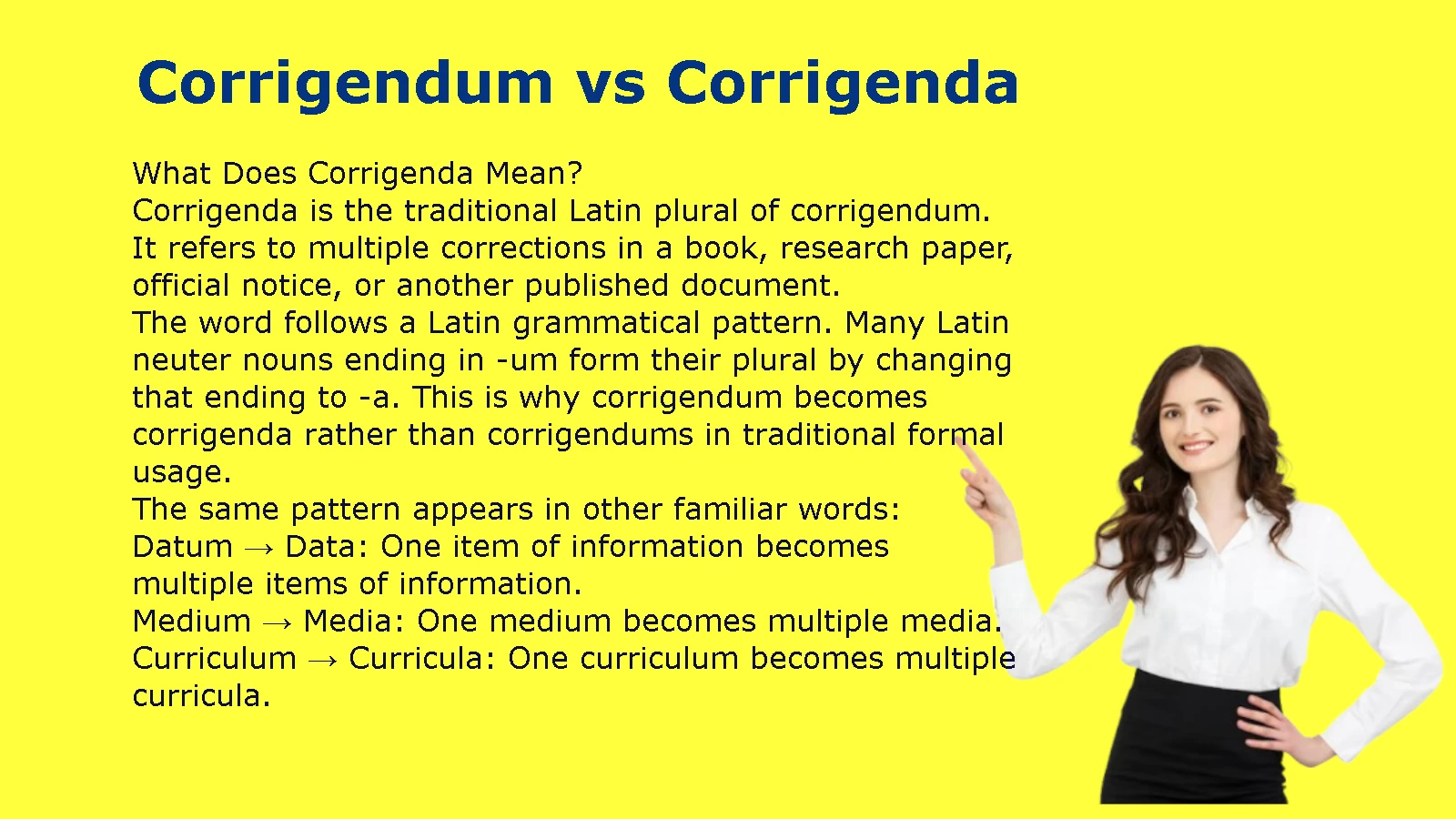
Corrigenda is the traditional Latin plural of corrigendum. It refers to multiple corrections in a book, research paper, official notice, or another published document.
The word follows a Latin grammatical pattern. Many Latin neuter nouns ending in -um form their plural by changing that ending to -a. This is why corrigendum becomes corrigenda rather than corrigendums in traditional formal usage.
The same pattern appears in other familiar words:
- Datum → Data: One item of information becomes multiple items of information.
- Medium → Media: One medium becomes multiple media.
- Curriculum → Curricula: One curriculum becomes multiple curricula.
- Corrigendum → Corrigenda: One correction becomes multiple corrections.
English usage can vary for some Latin-derived words, but corrigenda remains the established plural for formal academic and editorial writing.
Examples of corrigenda in a sentence:
- The editor prepared a list of corrigenda to correct errors in the final chapter.
- The journal published several corrigenda addressing inaccurate figures in a research article.
- The legal department reviewed the corrigenda before distributing the revised agreement.
- The author submitted two corrigenda to correct the publication’s references and captions.
In these sentences, the plural form signals that the document contains multiple corrections.
Corrigendum vs Corrigenda at a Glance
The following table summarizes the key differences.
| Feature | Corrigendum | Corrigenda |
| Grammatical number | Singular | Plural |
| Meaning | One correction | Multiple corrections |
| Word origin | Latin | Latin |
| Traditional ending | -um | -a |
| Typical use | One correction notice or item | Several correction notices or items |
| Example | The journal issued a corrigendum. | The journal issued two corrigenda. |
Easy rule to remember: If you are referring to one correction, use corrigendum. If you are referring to multiple corrections, use corrigenda.
However, a correction notice may contain several individual corrections. In that situation, the publication might still be called a single corrigendum because you are referring to one notice, even though the notice addresses multiple errors. The correct grammatical choice depends on whether you mean the notice itself or the individual correction items.
Corrigendum vs. Erratum: What Is the Difference?
A corrigendum and an erratum both refer to corrections made to published material. In traditional publishing usage, corrigendum often refers to an error introduced by the author, while erratum often refers to an error introduced during printing or publishing. Their plural forms are corrigenda and errata, respectively. However, many publishers use these terms more broadly or follow their own correction policies.
Understanding this distinction helps researchers, authors, editors, and legal professionals choose suitable terminology.
When Should You Use Corrigendum?
Traditionally, use corrigendum when an author discovers an error in their work after publication and needs to correct it formally.
The mistake may have occurred during research, drafting, data analysis, proofreading, or manuscript preparation. It might not have been intentional, but it still needs to be corrected so readers can rely on accurate information.
Common examples include:
- An author reports an incorrect numerical value in a table.
- A research paper contains a missing or inaccurate reference.
- A diagram uses the wrong label for a scientific process.
- A published article contains an incorrect description of a method.
- A book lists the wrong year for a historical event.
Example:
“The authors published a corrigendum to correct the sample size reported in Table 2.”
This sentence identifies an author-related correction to information that appeared in a published work.
A corrigendum should clearly identify the original statement, explain what was incorrect, and provide the correct information. If the error affects the study’s conclusions, the correction may also need to explain how the conclusions change.
The correction process depends on the publication. Some journals require authors to submit a formal request, while others review the proposed correction through an editorial process.
What Does Erratum Mean?
An erratum is a correction notice for an error in a published work. In traditional publishing, the term is often associated with a mistake introduced by the publisher, printer, or typesetter rather than the author.
Such errors can occur when a manuscript is converted into its final published form. Text may be omitted, symbols may change, figures may become distorted, or page elements may appear incorrectly.
For example, an editor might approve a manuscript containing a sentence about a medication dosage. During typesetting, a symbol could be omitted, changing the meaning of the sentence. The publisher would need to correct the published version and alert readers.
Examples of erratum in a sentence:
- The publisher issued an erratum to correct a missing word in the printed edition.
- An erratum clarified that a mathematical symbol had been displayed incorrectly.
- The journal released an erratum after discovering that a figure had been cropped during production.
- The editor requested an erratum to correct a formatting error in the published table.
The plural of erratum is errata.
Corrigendum vs. Erratum vs. Corrigenda vs. Errata
| Term | Grammatical number | Traditional use | Example |
| Corrigendum | Singular | One correction, often for an author-related error | The author issued a corrigendum. |
| Corrigenda | Plural | Multiple corrections, often for author-related errors | The author submitted two corrigenda. |
| Erratum | Singular | One correction, often for a publisher-related error | The publisher published an erratum. |
| Errata | Plural | Multiple corrections, often for publisher-related errors | The book included a list of errata. |
The important distinction is that Corrigendum vs Corrigenda concerns singular and plural forms, while corrigendum vs. erratum concerns the terminology used for different types of corrections.
These distinctions are related, but they answer different questions.
For instance, if a publisher introduces three errors while preparing a book for printing, the traditional plural term is errata. If an author discovers three errors in the submitted manuscript after publication, corrigenda may be appropriate.
Still, you should not assume that every publisher follows this distinction. Some academic journals use correction, corrigendum, or erratum according to their own editorial policies, regardless of who introduced the error.
How to Use Corrigenda in Research Papers and Legal Documents
Corrigenda are useful when a published document contains errors that require a formal record of correction. They help readers identify the original material, understand the mistake, and locate the accurate information without losing the history of the publication.
The details of a correction notice depend on the type of document and the organization responsible for issuing it.
Corrigendum in Academic Publishing
In academic publishing, a corrigendum allows authors and journals to correct errors in a published research paper while maintaining a connection to the original article.
A correction notice usually identifies the original paper and explains the relevant error. It may include the article title, authors, publication details, DOI, incorrect text, corrected text, and an explanation of the change.
A DOI, or Digital Object Identifier, is a persistent identifier used to identify a digital publication. Linking a correction notice to the original article helps readers find the relevant information.
For example, suppose a paper reports that 240 participants completed a survey, but the correct number was 204. If the mistake is identified after publication, the authors and journal may issue a correction notice.
A suitable notice might state:
Corrigendum: The participant count reported in the original article was incorrect. The correct number is 204, not 240. This correction updates the participant count in the published text.
This example illustrates the basic structure of a correction notice. An actual journal notice may require more detail, including the exact location of the error and whether the correction affects the study’s findings.
A well-prepared academic corrigendum should:
- Identify the original article clearly.
- State the incorrect information.
- Provide the corrected information.
- Explain the significance of the correction when necessary.
- Follow the journal’s correction and publication policies.
- Link to the original article when the publishing platform supports it.
A corrigendum does not automatically mean that an entire study is invalid. A spelling mistake or incorrect reference may have little effect on the research findings. However, an error in the data, statistical analysis, or interpretation may require a more substantial correction or another editorial action.
The appropriate response depends on the seriousness of the error and its effect on the reliability of the publication.
Corrigenda in Legal and Government Documents
In legal and government writing, a corrigendum can formally correct information in a previously issued document. It may appear in a government gazette, public notice, tender announcement, administrative circular, contract-related document, or other official publication.
The purpose is to make the correction clear without necessarily reissuing the entire original document.
For example, a government department might publish a tender notice with an incorrect submission deadline. It could issue a corrigendum identifying the original notice and stating the corrected deadline.
A sample notice might read:
Corrigendum to Tender Notice: In the original notice, the submission deadline was stated as 15 November. The correct deadline is 22 November. All other terms remain unchanged unless otherwise specified.
This is an illustrative example, not a legally sufficient notice for every jurisdiction or contract.
In legal and administrative settings, the exact procedure matters. A correction may need to follow statutory rules, procurement requirements, contractual terms, or instructions from the issuing authority.
Before relying on a corrigendum, readers should check:
- The title and date of the original document.
- The issuing department or authority.
- The exact wording of the correction.
- The effective date, if one is specified.
- Whether other provisions remain unchanged.
- Whether the correction requires additional approval or publication.
A corrigendum should not be treated as a way to change any provision without proper authority. Its legal effect depends on the applicable rules and the nature of the document being corrected.
Practical Rules for Choosing the Correct Word
Use these steps when writing about corrections in academic, legal, or professional documents.
Step 1: Decide what you are counting.
Are you referring to one correction notice, several correction notices, or individual errors within a notice? The answer affects your choice of singular or plural form.
Step 2: Choose the grammatical form.
- One item: corrigendum
- Multiple items: corrigenda
Step 3: Check the publication’s terminology.
A journal may use correction notice instead of corrigendum. A government department may prescribe a specific heading for official amendments. Follow the relevant style guide or institutional rules.
Step 4: Describe the correction precisely.
Identify the incorrect statement and provide the replacement information. Avoid vague wording such as “some details have been changed” when readers need to know exactly what changed.
Step 5: Preserve the connection to the original document.
Include the original title, publication date, reference number, DOI, or other identifier as appropriate.
Following these steps makes correction notices easier to understand and reduces confusion for readers.
Is Corrigendums Correct in English?
Corrigenda is the established traditional plural of corrigendum and is the preferred form in formal academic, editorial, and legal writing. Although English sometimes regularizes Latin-derived nouns by adding -s, you should not assume that corrigendums is accepted by every dictionary, publisher, or style guide. For professional writing, corrigenda is the safest choice.
Why Corrigenda Is Preferred
English has borrowed many words from Latin, and some retain their original plural forms. The plural corrigenda follows the same traditional pattern as data and curricula.
Using the established plural is especially helpful in formal documents because editors, researchers, and legal professionals expect consistent terminology.
Compare these sentences:
Preferred:
- The editor prepared a list of corrigenda for the revised edition.
- The journal published two corrigenda to address errors in the original paper.
- The committee reviewed the proposed corrigenda before releasing the notice.
Not recommended in formal writing:
- The editor prepared a list of corrigendums.
- The journal published two corrigendums.
- The committee reviewed the corrigendums.
The regularized form may be understandable to some readers, but the traditional form avoids unnecessary uncertainty.
If you are preparing a thesis, journal article, legal notice, or official publication, use corrigenda unless the relevant style guide explicitly directs you otherwise.
Common Mistakes to Avoid
Writers sometimes confuse the grammatical form, the meaning, or the context in which a correction term should be used.
Here are the most common mistakes and how to fix them.
| Common mistake | Correct approach | Explanation |
| Treating corrigenda as singular | Use corrigendum for one item | Corrigenda is the traditional plural. |
| Writing corrigendums in a formal paper | Prefer corrigenda | It follows the established Latin plural. |
| Confusing corrigendum with erratum | Check the publication’s terminology | The traditional distinction relates to the source of the error. |
| Assuming every correction is a corrigendum | Follow the relevant policy | Some publications use the broader term correction notice. |
| Issuing a vague correction | Identify the error and replacement text | Readers need to know precisely what changed. |
| Assuming a corrigendum automatically invalidates a paper | Assess the nature of the error | Minor corrections may not affect the findings. |
One additional point deserves attention: the number of errors is not always the same as the number of correction notices.
Suppose a journal publishes one correction notice that fixes four typographical errors. You can refer to the notice as a corrigendum if that is the journal’s chosen terminology. You would use corrigenda when referring to multiple correction items or multiple notices, depending on the context.
This distinction prevents you from applying the singular and plural rule too mechanically.
Conclusion: Remember the Difference Between Corrigendum and Corrigenda
The difference between Corrigendum vs Corrigenda comes down to grammatical number. Corrigendum is the singular form used for one correction, while corrigenda is its traditional plural, used for multiple corrections.
The related term erratum traditionally describes a correction associated with a publisher or printer error, and its plural is errata. However, publishing practices vary, so always check the terminology used by the relevant journal, editor, or issuing authority.
Keep these rules in mind:
- One correction: Corrigendum
- Multiple corrections: Corrigenda
- One erratum: Erratum
- Multiple errata: Errata
When preparing your next research paper, book, or official document, choose the correct grammatical form, identify each error clearly, and follow the applicable correction policy. These small details help you communicate accurately and maintain professional standards.
Frequently Asked Questions
Is Corrigenda Singular or Plural?
Corrigenda is the traditional plural of corrigendum. Use corrigendum when referring to one correction and corrigenda when referring to multiple corrections. For example, “The journal issued a corrigendum” is singular, while “The journal issued two corrigenda” is plural.
What Is the Plural of Corrigendum?
The traditional plural of corrigendum is corrigenda. It follows the Latin pattern in which many neuter nouns ending in -um change to -a in the plural. In formal academic and legal writing, corrigenda is the preferred form.
What Is the Literal Meaning of Corrigendum?
Corrigendum comes from the Latin verb corrigere, meaning “to correct.” It refers to something that needs correction. In modern publishing, the word usually describes a formal notice or item used to correct an error in a previously published work.
What Is the Difference Between Corrigendum and Erratum?
Traditionally, a corrigendum addresses an error introduced by an author, while an erratum addresses an error introduced during publishing or printing. Their plurals are corrigenda and errata. However, individual publishers may use these terms differently, so check the relevant editorial policy.
Can I Write Corrigendums Instead of Corrigenda?
For formal academic, editorial, and legal writing, use corrigenda rather than corrigendums. The traditional plural is widely established and follows the original Latin grammatical pattern. Always follow a publisher’s specific style guide if it prescribes a different form.
Does a Corrigendum Change the Original Publication Date?
A corrigendum generally does not replace the original publication date. Instead, the correction notice may receive its own publication date and be linked to the original document. This allows readers to distinguish the original publication from the later correction while preserving the publication record.