Customization and customisation have the same meaning: adapting a product, service, design, or experience to meet specific needs or preferences. The difference is American English uses “customization,” while British English uses “customisation.” Both spellings are correct, but your choice should match your audience and writing style.
These spelling variations also affect related words, including customize and customise, customized and customised, and customizable and customisable. Understanding these forms helps you write consistently in business documents, product descriptions, website content, and everyday communication. It also helps you distinguish customization from personalization, understand customized design, and interpret phrases such as “customize your order.”
Customization vs Customisation: What’s the Difference?
Customization is the standard American English spelling, while customisation is the standard British English spelling. Both words describe the process of changing something to suit particular requirements. The spelling changes with the variety of English, not the meaning.
For example, an American company might advertise product customization, while a British retailer might offer product customisation. Both phrases describe the same service.
| Feature | American English | British English |
| Noun | Customization | Customisation |
| Verb | Customize | Customise |
| Past tense | Customized | Customised |
| Adjective | Customizable | Customisable |
| Common usage | US publications and businesses | UK publications and businesses |
| Meaning | Adapting something to specific needs | Adapting something to specific needs |
Customization Is the American English Spelling
Customization is the preferred spelling in standard American English. American writers use the letter z in words such as customize, organize, and realize.
You will commonly see customization in American product listings, software settings, business proposals, and marketing materials.
Here are some original examples:
- The software allows extensive customization of the dashboard.
- Customers can request customization before placing an order.
- Our design team offers website customization for small businesses.
- Product customization lets buyers select their preferred colors and materials.
American businesses generally use customized products and customizable settings for the same reason. Keeping these spellings consistent makes content look natural to US readers.
Customisation Is the British English Spelling
Customisation is the standard British English spelling. British English commonly uses s in words that American English often spells with z, including customise, organise, and personalise.
This spelling is common in British business communications, educational writing, product descriptions, and customer service materials.
Examples include:
- Our website offers several customisation options.
- The customer requested customisation of the original design.
- We provide furniture customisation for homes and offices.
- You can choose your preferred settings through the customisation menu.
The same convention often applies in other English varieties influenced by British spelling, including Australian and New Zealand English. However, individual organizations may follow their own style guides.
Customization vs Customisation at a Glance
The easiest way to remember the difference is to focus on the final part of the word.
- Customization: Uses z, following the usual American spelling.
- Customisation: Uses s, following the usual British spelling.
The distinction is similar to organization versus organisation and realize versus realise. In each pair, the spelling differs, but the meaning remains the same.
Consider these two sentences:
- US English: “We offer complete product customization.”
- UK English: “We offer complete product customisation.”
Neither sentence is incorrect. The best choice depends on the audience and the spelling convention you want to follow.
Customisation or Customization: Which Spelling Should You Use?
Choose customization for standard American English and customisation for standard British English. If you write for an international audience, follow your organization’s preferred style guide and apply the same spelling throughout the page, website, or document.
When to Use Customization
Use customization when writing for an American audience or following a US English style guide.
Typical situations include:
- American business websites: “Explore our customization services.”
- Software documentation: “Open the customization menu to change your settings.”
- E-commerce product pages: “Product customization is available at checkout.”
- Marketing materials: “Discover customization options for your new laptop.”
- US academic writing: Use the spelling required by the institution or publication.
For example, an American online store might display a heading such as “Customization Options for Your New Desk.” It could then offer different wood finishes, sizes, and drawer configurations.
The spelling should remain consistent in the supporting text. Use customize, customized, and customizable rather than switching to British variants without a reason.
When to Use Customisation
Use customisation when writing for a British audience or following a UK English style guide.
Common examples include:
- British retail websites: “Choose from our customisation options.”
- UK software guides: “Open the customisation panel.”
- Business proposals: “We provide product customisation for commercial clients.”
- Customer support pages: “Contact our team to discuss customisation requirements.”
- UK educational writing: Follow the spelling rules specified by the institution.
Imagine a British furniture company selling made-to-order desks. Its product page could say, “Our desk customisation service lets you choose the size, finish, and storage options.”
The same company should normally use customise, customised, and customisable elsewhere on its website.
Should You Mix British and American Spellings?
You should generally avoid mixing British and American spelling conventions in the same piece of writing unless you have a specific reason to do so.
Inconsistent spelling can make an article look poorly edited. It may also confuse readers who expect a consistent regional style.
For example, this sentence mixes conventions:
“The software offers extensive customisation, and users can customize every dashboard.”
A consistent British version would be:
“The software offers extensive customisation, and users can customise every dashboard.”
A consistent American version would be:
“The software offers extensive customization, and users can customize every dashboard.”
Practical tip: Before publishing a website, select a language variety and check related words together. Do not review only the main keyword. Search for customisation, customize, customised, and customizable to catch inconsistencies.
What Is the Spelling of Customised and Customized?
Customised is the standard British English spelling, while customized is the standard American English spelling. Both forms describe something that someone has adapted to meet particular needs. The difference follows the same s versus z pattern found in customisation and customization.
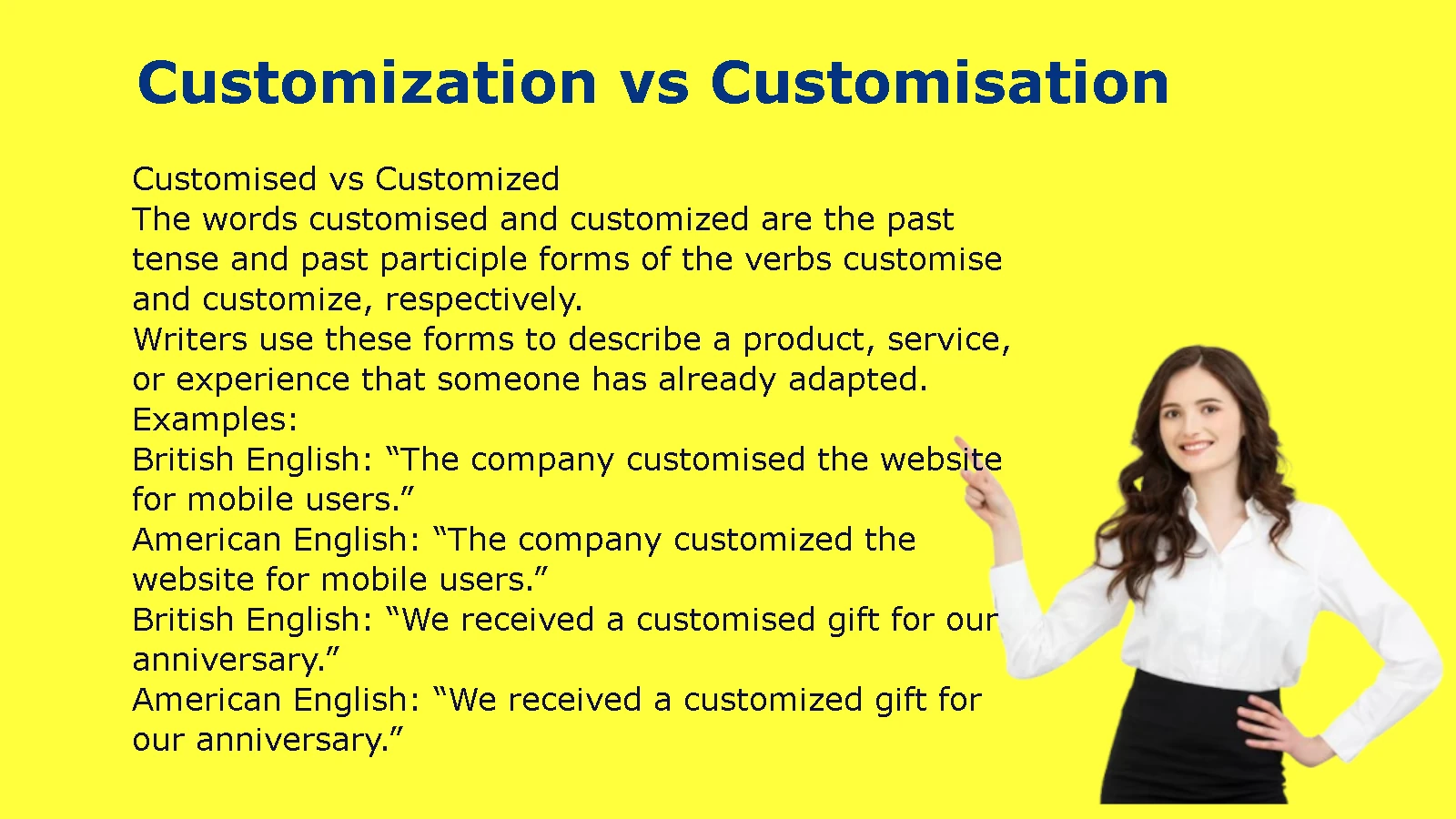
Customised vs Customized
The words customised and customized are the past tense and past participle forms of the verbs customise and customize, respectively.
Writers use these forms to describe a product, service, or experience that someone has already adapted.
Examples:
- British English: “The company customised the website for mobile users.”
- American English: “The company customized the website for mobile users.”
- British English: “We received a customised gift for our anniversary.”
- American English: “We received a customized gift for our anniversary.”
Both versions communicate the same idea. The spelling changes to match the regional convention.
The word can also function as an adjective. For instance, a customised package describes a package adapted to particular requirements. In American English, the equivalent phrase is a customized package.
Customise vs Customize
Customise is the British English verb, while customize is the American English verb. Both mean to modify something so it better suits a person’s needs, preferences, or specifications.
Use the verb when describing an action or a choice someone can make.
Examples:
- UK: “You can customise the layout before saving the file.”
- US: “You can customize the layout before saving the file.”
- UK: “Customers may customise their orders online.”
- US: “Customers may customize their orders online.”
The correct form also depends on the grammatical context.
| Form | British English | American English |
| Base verb | Customise | Customize |
| Third-person singular | Customises | Customizes |
| Present participle | Customising | Customizing |
| Past tense | Customised | Customized |
| Past participle | Customised | Customized |
For example, write “She customises the dashboard” in British English and “She customizes the dashboard” in American English.
Customisable vs Customizable
Customisable is the usual British English spelling, while customizable is the usual American English spelling. Both adjectives describe something that users can change or adapt to their requirements.
For example, a customisable website may let users change the colors, layout, or menu options. A customizable website offers the same flexibility.
Here are more examples:
- UK: “The application includes customisable notification settings.”
- US: “The application includes customizable notification settings.”
- UK: “Choose a customisable template for your business.”
- US: “Choose a customizable template for your business.”
Do not confuse customisable with customised. The first means that something can be changed. The second usually means that someone has already changed it.
Compare these sentences:
- “The software is customisable.” This means users can modify it.
- “The software is customised.” This means someone has adapted it.
That distinction matters in product descriptions because it tells customers whether a feature is available or already configured.
Customisation Word Forms Compared
The following table brings the common forms together so you can choose the right spelling and grammatical form.
| Word form | British English | American English | Meaning |
| Noun | Customisation | Customization | The process of adapting something |
| Verb | Customise | Customize | To adapt something |
| Past tense | Customised | Customized | Adapted something in the past |
| Past participle | Customised | Customized | Used in perfect tenses and passive constructions |
| Present participle | Customising | Customizing | Adapting something |
| Adjective | Customisable | Customizable | Capable of being adapted |
These forms work together in ordinary writing. For example, a British company might say, “We customise our products, offer further customisation, and provide customisable options.”
An American company would typically write, “We customize our products, offer further customization, and provide customizable options.”
The message stays the same, but the spelling follows one consistent convention.
What Does Customisation Mean in Business?
Customisation in business means adapting a product, service, or customer experience to meet specific requirements. Companies may let customers choose product features, change software settings, request different dimensions, or select a service package that suits their needs.
Businesses use customisation to offer greater flexibility without necessarily creating an entirely new product for every customer.
Definition of Customisation in Business
In business, customisation describes the process of modifying an existing offering or configuring a product or service around particular requirements.
A clothing company, for example, might let customers select fabric, size, and embroidery. A software provider might allow businesses to configure dashboards, user permissions, and notifications.
The key idea is adaptation to specific requirements.
Customisation can take several forms:
- Product customisation: Changing a product’s features, materials, colors, or dimensions.
- Service customisation: Adjusting a service package to suit a customer’s needs.
- Software customisation: Modifying settings, interfaces, workflows, or integrations.
- Process customisation: Adapting a business process to meet specific operational requirements.
- Customer experience customisation: Allowing users to adjust how they interact with a service.
The level of customisation can vary. Selecting a color from a menu is a simple form. Designing a complex software workflow for a particular organization requires more extensive work.
Examples of Customisation in Different Industries
Customisation appears in many industries because customers rarely have identical requirements.
| Industry | Example of customisation | Potential benefit |
| E-commerce | Choosing colors, sizes, or engraving | A product that better fits customer preferences |
| Software | Changing dashboards and permissions | A more suitable working environment |
| Manufacturing | Adjusting dimensions or materials | Equipment suited to a specific application |
| Fashion | Selecting fabric, fit, or embroidery | Clothing that meets individual requirements |
| Marketing | Adjusting messages for customer segments | More relevant communication |
| Furniture | Choosing finishes, materials, and storage | Furniture suited to a room or purpose |
| Education technology | Adjusting learning settings and content options | A learning experience suited to different needs |
Consider a small company purchasing customer relationship management software. A standard dashboard might display sales figures, support tickets, and marketing reports. However, the company may need only sales figures and support tickets.
The provider could offer customisation that lets the company hide irrelevant panels and create a dashboard around its workflow. The software remains the same product, but the company can use it more effectively.
Benefits and Limitations of Business Customisation
Customisation can improve the customer experience, but it also introduces costs and operational complexity. Businesses should evaluate both sides before offering extensive options.
Potential benefits include:
- Better customer fit: Buyers can select features that meet their needs.
- Product differentiation: Custom options can help a business stand out from competitors.
- Customer satisfaction: Customers may value having greater control over their purchases.
- More relevant experiences: Adjustable services can suit different workflows or preferences.
- Commercial opportunities: Some customers may pay more for specialized configurations or premium options.
However, customisation also creates challenges.
- Higher production costs: Different configurations may require extra labor, materials, or technical work.
- More complex inventory: Businesses may need to manage additional components and product variations.
- Longer delivery times: Made-to-order products can take longer to manufacture or prepare.
- Support requirements: Highly customized products may require more detailed customer assistance.
- Maintenance difficulties: Extensive software modifications can make future updates more complicated.
Practical example: Imagine a furniture retailer that offers 30 fabric colors, five leg finishes, and three sizes. This creates 450 possible configurations before accounting for any other options. The retailer must manage those combinations carefully to avoid stock and delivery problems.
A business does not need to offer unlimited choices to deliver useful customisation. A carefully selected set of options may provide most of the customer benefit while keeping production manageable.
What Does Customized Design Mean?
Customized design means adapting a design to meet specific requirements, preferences, or specifications. It may involve modifying an existing template or creating a design around a client’s needs. Common examples include customized websites, logos, furniture, clothing, and interior spaces.
Customized Design Definition
A customized design is a design that has been changed or developed to suit a particular purpose or client.
The changes might involve appearance, dimensions, functionality, materials, or content. A business might customize its website to match its branding, while a homeowner might request a dining table with specific dimensions.
The term does not always mean that the designer created everything from scratch. A designer may begin with an existing layout and modify it extensively.
For example, a small business might purchase a website template and change its colors, navigation, images, and page structure. That could be described as customized design.
By contrast, a client who commissions an original logo based on a detailed creative brief may receive a custom-designed logo.
Examples of Customized Design
Customized design serves both practical and aesthetic purposes.
Website design: A business may adjust a website’s layout, typography, colors, and navigation to fit its brand and audience.
Logo design: A designer may develop a logo around a company’s name, industry, values, and visual identity.
Furniture design: A customer may request a desk with a particular height, wood finish, or storage arrangement.
Clothing design: A garment may be altered to fit particular measurements or preferences.
Interior design: A designer may adapt a room’s lighting, storage, materials, and layout to suit its occupants.
Packaging design: A business may customize a package’s size, artwork, or compartments to suit its product.
Here are two example sentences:
- “The company commissioned a customized design for its new website.”
- “The designer created a customised layout for the client’s home office.”
The first sentence follows American spelling, while the second follows British spelling.
Customized Design vs Custom Design
The phrases customized design and custom design overlap, but they can emphasize different things.
Custom design often highlights a design created specifically for a client or purpose. Customized design often emphasizes changes made to an existing design or configuration, although businesses do not always use the terms this precisely.
| Phrase | Typical emphasis | Example |
| Custom design | Created for a specific purpose or client | An original logo developed for a new brand |
| Customized design | Adapted to meet specific requirements | A website template modified to match a brand |
| Standard design | Uses a ready-made, largely unchanged solution | An off-the-shelf website theme |
These are practical distinctions, not strict industry-wide definitions. A designer may describe an original project as a customized design, and another may use custom design for a modified template.
When hiring a designer, ask what the service includes. Clarify whether you will receive an original concept, modifications to an existing design, or a combination of both.
What Does Customize Order Mean?
“Customize your order” means choosing or changing available product or service options before completing a purchase. Depending on the business, those options might include size, color, ingredients, materials, engraving, accessories, or configuration.
What Does “Customize Your Order” Mean?
When an online store displays a “Customize Your Order” option, it invites you to make selections that affect what you receive.
For example, a customer ordering a birthday cake might choose its size, flavor, filling, frosting, and message. Someone buying a laptop might select the memory capacity, storage, keyboard layout, or other available specifications.
A restaurant might allow customers to remove ingredients or choose additional toppings. A gift shop might offer engraving or personalized packaging.
In each case, the customer selects from available options rather than accepting a single fixed configuration.
A checkout process might look like this:
- Select the product.
- Choose the available size, color, or configuration.
- Add any optional features or special instructions.
- Review the final selections and price.
- Submit the order.
Not every product supports customization. If the options are unavailable, the customer may need to contact the seller to request a special arrangement.
Customized Order vs Custom Order
A custom order often refers to a product made according to a customer’s specifications. A customized order may refer to an existing product or standard order that the customer has modified.
For example, a tailor making a suit to a customer’s measurements may describe it as a custom order. A customer choosing a standard suit and adding personalized embroidery may place a customized order.
| Term | Common meaning | Example |
| Custom order | An order made to particular specifications | A table built to fit a narrow space |
| Customized order | An order modified through available options | A laptop configured with additional memory |
| Standard order | An order placed without special modifications | A desk purchased in its standard size and finish |
Businesses sometimes use these expressions interchangeably. Always check the seller’s description to understand what changes are available and whether special terms, fees, or delivery times apply.
Examples of Customizable Orders
Here are several examples of how customization works during ordering:
- Food: Selecting toppings, removing ingredients, or choosing portion sizes.
- Clothing: Choosing measurements, fabric, color, or embroidery.
- Electronics: Selecting storage, memory, accessories, or configurations.
- Furniture: Choosing dimensions, wood finishes, upholstery, or handles.
- Gifts: Adding a name, date, message, or engraved design.
A clear product page should explain which options customers can change, how those choices affect the price, and whether the finished product can be returned.
For example, a retailer could write: “Customize your order by selecting the finish, dimensions, and optional storage accessories before checkout.”
This wording tells customers what the customization process involves rather than leaving them to guess.
Customized vs Personalized: What’s the Difference?
Customization usually involves changing features or settings to meet selected requirements. Personalization usually involves tailoring a product or experience to a particular person, often using personal details, preferences, or behavior. The terms overlap, but they do not always describe the same process.
What Does Customized Mean?
Something is customized when someone adapts it to specific requirements.
The changes may be selected directly by the customer or configured by a business. They do not necessarily depend on personal data.
For example, a customer might customize a bicycle by choosing its frame color, handlebar type, and accessories. Those choices determine the product’s configuration.
In software, customization might allow users to rearrange dashboard panels, change notification settings, or select a preferred interface layout.
The emphasis is on changing the available features or configuration.
What Does Personalized Mean?
Something is personalized when it has been tailored to a particular individual.
Personalization may involve a person’s name, purchase history, stated preferences, location, or previous interactions. In digital services, it may also involve algorithms that recommend content or products based on user behavior.
Examples include:
- A mug printed with someone’s name.
- An online store recommending products based on previous purchases.
- An email greeting a customer by name.
- A streaming service suggesting films based on viewing history.
- A learning platform adjusting recommendations based on a student’s progress.
Personalization can happen without the customer actively selecting every change. A system might use available information to adapt the experience automatically.
Customized vs Personalized Examples
The clearest way to distinguish these terms is to compare what changes and why.
| Situation | Customization | Personalization |
| Laptop | The buyer selects memory and storage | The store recommends a laptop based on previous browsing |
| Gift | The buyer chooses the material and color | The gift includes the recipient’s name |
| Website | The user changes the dashboard layout | The website displays content based on browsing history |
| Email marketing | A business chooses a template and layout | The email includes relevant recommendations for a specific customer |
| Education | A learner selects display settings | The platform recommends lessons based on learning progress |
| Clothing | The customer selects fabric and measurements | The garment includes a name or personal message |
The distinction is not absolute. A personalized gift may also be customized, and a customized software platform may also provide personalized recommendations.
Can Something Be Both Customized and Personalized?
Yes. A product or service can be both customized and personalized when it combines selected features with details specific to an individual.
Imagine an online gift shop that lets customers choose a mug’s shape, color, and finish. Those choices are customization. The customer can also add the recipient’s name and a personal message, which adds personalization.
A software company could offer a similar combination. Users might customize their dashboard layout while the platform personalizes recommendations based on their activity.
For businesses, the distinction helps clarify product features and marketing claims. Instead of using the words interchangeably, explain what customers can change and what the business tailors to them.
How Do You Pronounce Customisation?
The pronunciation of customisation is broadly similar to that of customization. Both words share the same core pronunciation, although individual speakers and regional accents may differ slightly. The main difference between the two forms is spelling rather than meaning or pronunciation.
Customisation Pronunciation in British English
In British English, customisation is commonly pronounced with the stress on the fourth syllable, the same main stress pattern used in customization.
A broad IPA transcription is /ˌkʌstəmaɪˈzeɪʃən/. Pronunciation can vary by accent, so this transcription represents a common form rather than every British speaker’s exact pronunciation.
The word has five syllables:
- cus
- tom
- i
- sa
- tion
The strongest stress falls on the syllable containing the “zay” sound. When learning the word, say it slowly first, then bring the syllables together at a natural speaking pace.
Customization Pronunciation in American English
American English commonly uses the pronunciation /ˌkʌstəmaɪˈzeɪʃən/ for customization as well.
Although British and American accents differ in many ways, this word generally retains the same core sound pattern in both varieties.
The final spelling does not require a different pronunciation. The British form customisation and the American form customization can sound alike.
How to Use Customisation in a Sentence
Reading the word in context can help you understand its meaning and grammatical role.
Business example: “The company offers customisation services for commercial clients.”
Here, customisation is a noun describing a service.
Software example: “Users can customise the dashboard to display relevant information.”
Here, customise is a verb describing an action.
Product example: “The retailer sells customised gifts for birthdays and weddings.”
Here, customised describes gifts that someone has adapted.
American English example: “The application provides customizable settings for every user.”
Here, customizable describes settings that users can change.
Practicing the related forms together helps reinforce both their meaning and their spelling.
Common Mistakes When Using Customisation and Customization
The most common mistakes involve mixing regional spellings, confusing related word forms, or treating customization and personalization as identical concepts. You can avoid these errors by identifying your audience, checking the grammar, and using the terms consistently.
Using Customisation in American English Without a Style Reason
Using customisation in American English is not a spelling error in every possible context. However, it may look inconsistent in content that otherwise follows US spelling conventions.
For example, a US website that uses color, organize, and customisation mixes spelling styles.
If the site targets American customers, customization is usually the more appropriate choice. If the website follows British English, customisation fits alongside words such as colour and organise.
Mixing Customised and Customized
Writers sometimes use customised in one paragraph and customized in another without realizing that the words represent different regional conventions.
To correct this issue, check all related forms together.
A consistent British sentence reads: “The customer customised the product and selected several customisable features.”
A consistent American version reads: “The customer customized the product and selected several customizable features.”
Consistency matters more than choosing one spelling as universally correct.
Confusing Customization With Personalization
Customization and personalization can overlap, but they often describe different activities.
Choosing the color of a product is customization. Adding a person’s name or adapting recommendations based on their previous behavior is personalization.
When describing a business service, explain the actual feature rather than relying on the label alone. Clear descriptions help customers understand what the product offers.
Choosing Between Customisable and Customizable
Use customisable for standard British English and customizable for standard American English.
Remember the difference between the adjective and the past-tense form:
- Customisable/customizable: Something can be changed.
- Customised/customized: Something has been changed or adapted.
For example, “The platform has customisable settings” means users can adjust those settings. “The platform has customised settings” suggests someone has already configured them.
Frequently Asked Questions
Is Customisation UK or US Spelling?
Customisation is the standard British English spelling. American English generally uses customization. Both words have the same meaning, and the difference follows the spelling convention used in each variety of English.
Is Customisable or Customizable Correct?
Both spellings are correct. Customisable is the usual British English form, while customizable is the usual American English form. Both describe something that can be adapted to meet specific requirements.
Is Customised Spelled With an S or a Z?
Both spellings are correct, depending on the variety of English. British English generally uses customised, while American English uses customized. Choose the form that matches the rest of your writing.
What Is the Difference Between Customization and Personalization?
Customization involves changing features or settings to meet selected requirements. Personalization involves tailoring a product or experience to an individual, often using personal details or preferences. A single product can offer both.
What Does Customisation Mean in Business?
Customisation in business means adapting products, services, processes, or customer experiences to meet particular requirements. Examples include configurable software, made-to-order furniture, and product options that allow customers to select materials or features.
How Do You Pronounce Customisation?
A common British English pronunciation is represented by the IPA /ˌkʌstəmaɪˈzeɪʃən/. The word has five syllables, with the main stress on the fourth. Regional accents may produce small differences.
Conclusion: Choose the Right Spelling for Your Audience
The difference between customization vs customisation comes down to regional spelling conventions. American English generally uses customization, while British English uses customisation. Both forms describe the process of adapting something to specific needs.
The same pattern applies to related words: customize and customise, customized and customised, and customizable and customisable. Once you choose a regional convention, use it consistently throughout your writing.
Keep these practical rules in mind:
- Use customization for standard American English.
- Use customisation for standard British English.
- Distinguish customization from personalization when describing business services.
- Explain what customers can change when discussing customized designs or orders.
- Check all related word forms before publishing your content.
If you are editing a website, reviewing a product description, or preparing a business document, start by identifying your intended audience. Then apply the matching spelling throughout the page. This simple step makes your writing clearer, more consistent, and more natural for your readers.
Next step: Review your existing content for customisation, customize, customised, and customizable. Replace inconsistent forms with the appropriate regional spellings, and consider linking related articles about British vs American spelling, word meanings, and commonly confused English terms.













