Victimize vs victimise is a spelling difference between American and British English, but both words have the same meaning: to treat someone unfairly, harm them, exploit them, or make them a target of mistreatment. Victimize is the standard American English spelling, while victimise is common in British English. Both forms are correct in their respective spelling systems.
Understanding victimize definition, victimized synonyms, victimizer meaning, and the antonym of victimize helps you use the word accurately in everyday conversations, academic writing, workplace discussions, and formal documents. The phrase “victimize yourself” also has a related but distinct meaning that deserves careful explanation because experiencing genuine harm is not the same as adopting a victim mentality.
Victimize vs Victimise: What Is the Difference?
Victimize and victimise mean the same thing. The difference lies in regional spelling preferences. American English generally uses victimize, while British English commonly uses victimise. Both forms describe treating someone unfairly, harming them, or taking advantage of them.
| Feature | Victimize | Victimise |
| Spelling system | American English | British English |
| Meaning | To harm or treat someone unfairly | To harm or treat someone unfairly |
| Pronunciation | The same in ordinary usage | The same in ordinary usage |
| Past tense | Victimized | Victimised |
| Present participle | Victimizing | Victimising |
| Noun | Victimization | Victimisation |
| Person who causes harm | Victimizer | Victimiser |
The main difference is the letter z in American spelling and s in the British form. The distinction does not change the word’s definition, grammatical function, or basic meaning.
For example:
- American English: The company must not victimize employees who report misconduct.
- British English: The company must not victimise employees who report misconduct.
Both sentences communicate the same message.
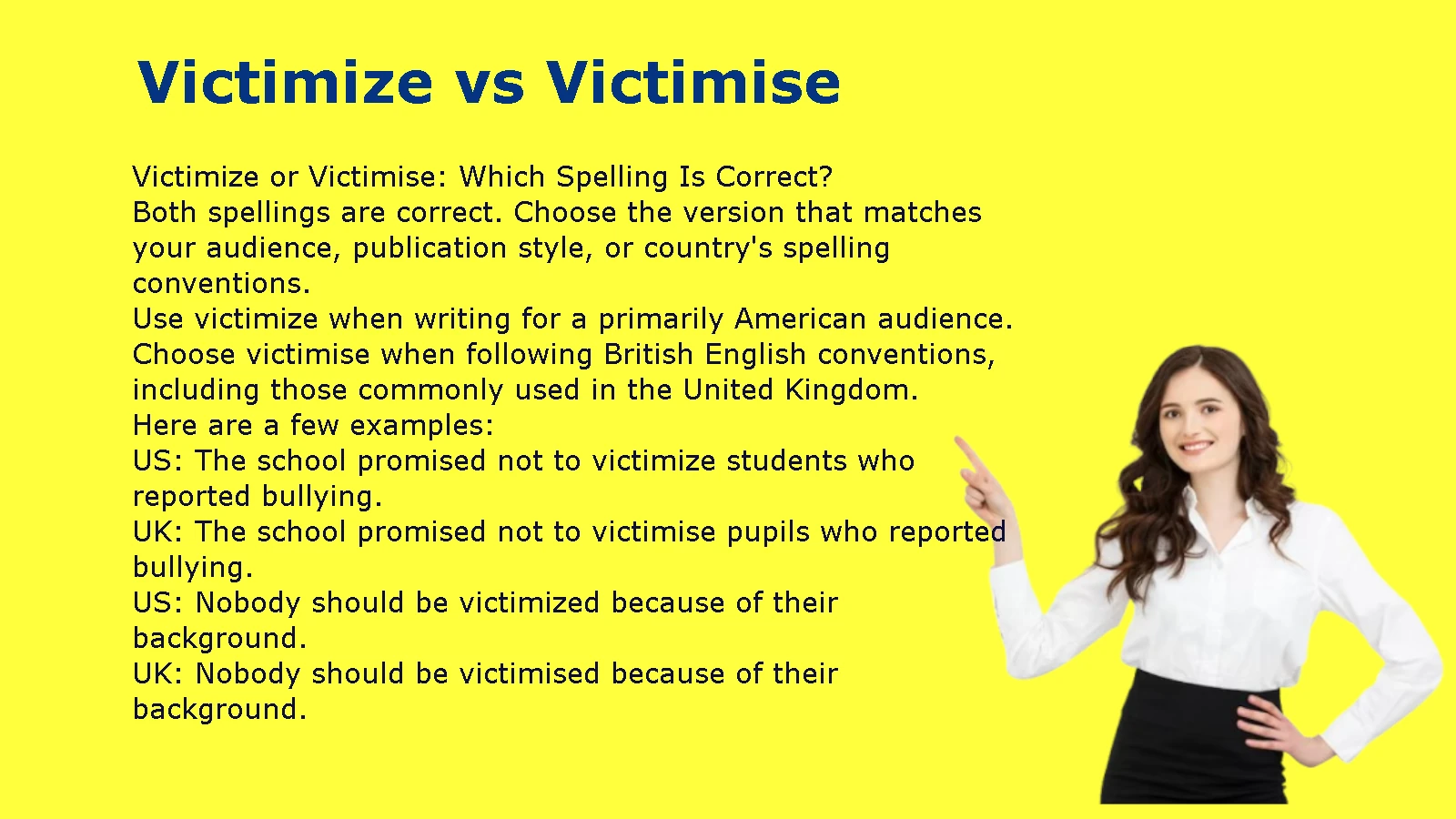
Victimize or Victimise: Which Spelling Is Correct?
Both spellings are correct. Choose the version that matches your audience, publication style, or country’s spelling conventions.
Use victimize when writing for a primarily American audience. Choose victimise when following British English conventions, including those commonly used in the United Kingdom.
Here are a few examples:
- US: The school promised not to victimize students who reported bullying.
- UK: The school promised not to victimise pupils who reported bullying.
- US: Nobody should be victimized because of their background.
- UK: Nobody should be victimised because of their background.
The spelling choice should remain consistent throughout your article or document. Mixing victimize with victimisation, for example, can make a piece of writing look inconsistent.
Victimize vs Victimise in American and British English
The -ize and -ise distinction appears in several English words. American English generally favors -ize, while British English often uses -ise for words such as victimise.
| American English | British English |
| Victimize | Victimise |
| Organize | Organise |
| Recognize | Recognise |
| Apologize | Apologise |
| Realize | Realise |
| Socialize | Socialise |
British English spelling is not entirely uniform. Some British publications and dictionaries also accept -ize forms, so the letter z does not automatically make a word American.
The practical rule is simple: follow the style guide used by your publisher, school, employer, or website. If you manage an American English website, use victimize. If you publish for a British audience and follow an -ise style, use victimise.
Is Victimise Wrong in American English?
Victimise is not the standard spelling in most American English writing. American readers will usually understand it, but they may regard it as a British spelling or an inconsistency.
For American school assignments, business documents, and US-focused blog posts, use victimize. For British English writing that follows -ise conventions, use victimise.
Neither form changes the meaning. The important consideration is matching the expected spelling convention rather than treating one version as universally correct.
Victimize Definition and Meaning
Victimize is a verb meaning to make someone a victim by harming, exploiting, targeting, or treating them unfairly. It often describes deliberate mistreatment, but the exact meaning depends on the situation. People can be victimized through bullying, fraud, abuse, discrimination, intimidation, or other forms of harmful behavior.
For example, a dishonest seller may victimize customers by charging them for products that never arrive. A manager may victimize an employee by repeatedly targeting them with unfair treatment.
The word focuses on what someone does to another person. It does not automatically describe the victim’s personality, attitude, or response to the experience.
What Does Victimize Mean?
To victimize someone means to expose that person to harm, unfair treatment, exploitation, or abuse.
The word can describe a single harmful incident or a repeated pattern of mistreatment. Its meaning becomes clearer when you examine the context.
Consider these examples:
- A scammer victimized elderly customers by stealing their savings.
- The coach refused to victimize a player for making one mistake.
- Several employees said their supervisor had victimized them after they raised concerns.
- Criminals often target people who they believe will be easier to deceive.
In each example, the word describes someone experiencing harmful treatment because of another person’s actions.
Important distinction: Being victimized does not mean someone is weak, careless, or responsible for the mistreatment. The word describes the experience of harm, not a personal failure.
Victimize Meaning in Different Contexts
The meaning of victimize remains broadly consistent across settings, but the type of harm changes with the situation.
Everyday life
In ordinary conversation, the word can describe unfair treatment between friends, relatives, neighbors, or acquaintances.
Example: “The older children repeatedly victimized the new student by excluding him from activities and mocking his appearance.”
Workplace
At work, victimization may involve bullying, intimidation, retaliation, or unfair treatment. In some legal and workplace contexts, the word also has a more specific meaning connected to punishing someone for raising a complaint or exercising a protected right.
Example: “The employee alleged that management victimized her after she reported unsafe working conditions.”
The precise legal meaning depends on the applicable jurisdiction and circumstances.
Crime and fraud
The word often describes people harmed by theft, scams, identity fraud, assault, or other criminal activity.
Example: “The fraudster victimized dozens of customers through a fake investment scheme.”
Social situations
Victimization can also involve exclusion, harassment, or repeated targeting based on a person’s identity, circumstances, or perceived vulnerability.
Example: “The campaign aims to prevent students from being victimized because of their disability.”
These examples show why context matters. Someone may be victimized through physical harm, financial exploitation, emotional abuse, or unfair treatment.
What Does It Mean to Be Victimized?
To be victimized means to experience harmful or unfair treatment from another person, group, or organization. Victimized is the past-tense and past-participle form of victimize. It can also function as an adjective describing someone who has experienced such treatment.
Examples:
- The customers were victimized by an online scam.
- She felt victimized when her colleagues repeatedly mocked her.
- The report described how vulnerable residents had been victimized by dishonest contractors.
The word can describe an established event, an allegation, or someone’s perception, depending on how the sentence is written. For example, “She alleged that she was victimized” reports a claim without independently establishing that the event occurred.
Being victimized is not the same as feeling upset about every disagreement. A genuine experience of victimization involves harmful or unfair treatment, while ordinary conflict can arise from misunderstandings, competing interests, or mistakes.
However, you should not dismiss someone’s experience merely because you have a different interpretation of the situation. Examine the specific behavior, evidence, and context before reaching a conclusion.
Victimize vs Victimized vs Victimization
These related forms share a root but perform different grammatical roles.
| Word | Part of speech | Meaning | Example |
| Victimize | Verb | To harm or mistreat someone | They must not victimize witnesses. |
| Victimized | Past-tense verb or past participle; sometimes an adjective | Experienced harmful treatment | The customers were victimized by fraud. |
| Victimization | Noun | The act or process of making someone a victim | The report examined workplace victimization. |
| Victimizer | Noun | A person who victimizes another | The victimizer was eventually identified. |
| Victim | Noun | Someone who experiences harm | The victim reported the theft. |
| Victimising | Present participle in British spelling | Currently harming or mistreating someone | The group was accused of victimising residents. |
Understanding these forms helps you avoid awkward constructions.
For example, write “The policy prevents victimization” when discussing the general problem. Use “The policy prevents managers from victimizing employees” when emphasizing the action.
Victimize in a Sentence: Examples and Usage
The best way to understand a word is to see how people use it in complete sentences. Victimize usually describes an action directed at another person or group, while victimized describes an experience that has already occurred or a person who has experienced mistreatment.
Simple Sentences With Victimize
Here are ten original examples using victimize in different contexts.
- Fraudsters sometimes victimize people by pretending to represent legitimate businesses.
- A fair teacher does not victimize students for asking difficult questions.
- The organization works to prevent criminals from victimizing vulnerable residents.
- No employer should victimize workers who raise legitimate safety concerns.
- Bullying can victimize children who already feel isolated.
- Dishonest contractors may victimize homeowners through inflated bills.
- The new policy aims to stop people from victimizing others online.
- A responsible manager addresses mistakes without trying to victimize an employee.
- The investigation examined whether the company had deliberately victimized its customers.
- Communities can reduce opportunities for criminals to victimize residents through fraud.
Each sentence shows a person or group experiencing harm, exploitation, or unfair treatment.
Notice that victimize does not always require physical violence. Fraud, intimidation, harassment, and retaliation can also fit the word’s meaning.
Victimized in a Sentence
The word victimized often appears in the past tense or in passive constructions. It helps explain what happened to a person or group.
Here are eight examples:
- The family was victimized by a contractor who accepted payment and abandoned the project.
- Several students were victimized by a group that repeatedly bullied them.
- She felt victimized when her colleagues blamed her for a decision she had not made.
- The investigation found that customers had been victimized by misleading advertising.
- Residents who were victimized by the scam received help filing complaints.
- The employee claimed that he was victimized after reporting misconduct.
- People who have been victimized by fraud may need help securing their accounts.
- The report documented how local businesses were victimized by repeated theft.
These sentences cover criminal, professional, social, and emotional contexts.
The distinction between fact and allegation matters. “The employee was victimized” presents the experience as a statement of fact, while “The employee said he was victimized” clearly attributes the claim to the employee.
Victimize in Formal and Informal Writing
You can use victimize in conversations, reports, essays, news articles, and professional communication. However, the word carries a stronger meaning than many everyday alternatives.
In formal writing, it can help describe a pattern of harm or unfair treatment.
Example: “The investigation assessed whether the company had victimized employees who reported safety violations.”
In casual conversation, a simpler phrase may sound more natural.
Example: “He kept picking on the new kid.”
Both sentences describe harmful behavior, but the tone differs. The first sounds formal and investigative. The second is conversational and direct.
Choose a more specific verb when it makes the situation clearer:
- Exploit someone when another person takes unfair advantage of them.
- Bully someone when the behavior involves intimidation or repeated aggressive mistreatment.
- Target someone when a person or group is singled out.
- Defraud someone when deception causes financial or similar loss.
- Harass someone when unwanted conduct repeatedly disturbs, intimidates, or targets them.
Precise wording makes your writing more informative. Instead of saying a business “victimized customers,” explain whether it overcharged them, deceived them, or sold them a product it never delivered.
Common Grammar Patterns With Victimize
The verb victimize follows several useful sentence patterns.
Victimize + person or group
Use this active construction to identify who experiences the harmful action.
Example: “The scammer victimized several retirees.”
Be victimized by + person or cause
Use this passive construction when the person experiencing harm matters more than the person responsible.
Example: “The residents were victimized by an organized fraud scheme.”
Feel victimized
Use this construction to describe someone’s perception or emotional response. It does not, by itself, establish whether unfair treatment occurred.
Example: “He felt victimized when his manager rejected his proposal.”
Prevent someone from victimizing others
Use this pattern when discussing safeguards, rules, or protective action.
Example: “The organization introduced new procedures to prevent staff members from victimizing vulnerable clients.”
A common mistake is to confuse victimized with victimizing. The first usually refers to the person who experiences harm; the second refers to the person or action causing it.
Compare:
- “The customer was victimized by the seller.”
- “The seller was victimizing the customer.”
The difference is small in spelling but important in meaning.
Victimized Synonyms: Words With Similar Meanings
A victimized synonym is a word or phrase that communicates a similar idea to experiencing harm, exploitation, or unfair treatment. Common alternatives include mistreated, exploited, abused, targeted, persecuted, and wronged. The best choice depends on what happened and how much detail your sentence needs.
Common Synonyms for Victimized
The following words overlap with victimized, but they are not interchangeable in every situation.
| Synonym | Meaning | Example |
| Mistreated | Treated unfairly or badly | The workers were mistreated by their supervisor. |
| Exploited | Taken advantage of for another person’s benefit | The company exploited workers who lacked bargaining power. |
| Abused | Subjected to harmful treatment, often serious or repeated | The child was abused by a trusted adult. |
| Targeted | Singled out for a particular action | The account holder was targeted by scammers. |
| Persecuted | Subjected to sustained hostility or oppression | The group was persecuted because of its beliefs. |
| Wronged | Treated unjustly or unfairly | She believed the decision had wronged her. |
| Harassed | Subjected to unwanted, troubling, or intimidating conduct | The employee was harassed by a colleague. |
| Defrauded | Deceived, often for financial gain | The investors were defrauded by a dishonest promoter. |
These terms describe different aspects of harm. Defrauded points to deception, while persecuted often implies sustained hostility or systematic mistreatment.
Best Synonyms for Different Contexts
Choosing the right synonym improves accuracy and helps readers understand exactly what happened.
Use mistreated for general unfair treatment.
Example: “The tenants were mistreated by their landlord.”
This word works when you know the treatment was poor but do not need to specify whether it involved intimidation, exploitation, or discrimination.
Use exploited when someone takes unfair advantage of another person.
Example: “The agency exploited inexperienced workers by withholding promised wages.”
This word emphasizes an imbalance in power or benefit.
Use abused when the situation involves harmful treatment that fits the context of abuse.
Example: “The report examined allegations that residents had been abused.”
Because abuse can describe serious conduct, use it carefully and accurately.
Use targeted when the main point is that someone was singled out.
Example: “The business was targeted by a group sending fraudulent invoices.”
The term does not always imply that the target suffered harm, so the surrounding sentence should make the outcome clear.
Use persecuted when someone experiences sustained hostility or oppression.
Example: “The community reported being persecuted because of its religious practices.”
This term often carries a stronger implication than ordinary unfair treatment.
Victimize vs Abuse vs Exploit vs Persecute
These verbs overlap, but their emphasis differs.
| Word | Main emphasis | Best use |
| Victimize | Making someone a victim of harmful treatment | Broad descriptions of mistreatment |
| Abuse | Harmful or cruel treatment | Situations involving abuse of a person, position, or relationship |
| Exploit | Taking unfair advantage | Financial, professional, or personal advantage |
| Persecute | Sustained hostility or oppression | Repeated or systematic targeting |
| Harass | Unwanted conduct that troubles or intimidates | Bullying, repeated unwanted contact, or targeted mistreatment |
| Defraud | Deception that causes loss | Scams and dishonest transactions |
Practical example: Imagine a company that recruits workers, promises them fair wages, withholds their pay, and threatens them when they complain.
You could say the company victimized its workers. You could also say it exploited them financially, abused its position of power, or harassed employees who raised concerns if the conduct supports those descriptions.
Each verb highlights a different part of the situation. Good writing selects the word that best describes the actual behavior.
Victimize Antonym: What Is the Opposite of Victimize?
The best antonym of victimize depends on the intended meaning. Protect, defend, safeguard, support, and empower can express the opposite idea in different contexts. Protect and defend focus on preventing harm, while support and empower emphasize helping people respond to difficult circumstances.
Common Antonyms of Victimize
| Antonym | Meaning | Example |
| Protect | Keep someone safe from harm | The policy protects employees from retaliation. |
| Defend | Stand up for someone or resist an attack | The lawyer defended the person facing unfair accusations. |
| Safeguard | Protect against risks or danger | The new rules safeguard customer information. |
| Support | Provide help or assistance | The community supported people affected by fraud. |
| Empower | Give someone greater ability or control | Training can empower workers to report misconduct. |
| Respect | Treat someone with consideration | A fair manager respects every employee. |
| Reassure | Help someone feel less worried or threatened | The adviser reassured customers after the security incident. |
These are contextual opposites rather than perfect replacements in every sentence.
For instance, protect is a strong opposite when discussing preventing harm. Empower works better when the focus is helping people regain confidence or control.
Victimize vs Protect
The contrast between victimize and protect is direct.
- “The scammer tried to victimize elderly customers.”
- “The bank introduced safeguards to protect elderly customers.”
The first sentence describes an attempt to cause harm. The second describes action designed to prevent it.
This contrast works in discussions of crime prevention, workplace policies, child safety, cybersecurity, and community services.
Choosing the Right Opposite of Victimize
Use the word that matches the action you want to describe.
Choose protect when someone prevents harm from happening.
Example: “The school introduced a policy to protect students from bullying.”
Choose defend when someone actively stands up for another person.
Example: “Her colleagues defended her against unfair accusations.”
Choose support when someone helps a person who has already experienced harm.
Example: “The charity supports families affected by fraud.”
Choose empower when the goal is to help someone develop greater control or confidence.
Example: “The workshop empowers employees to recognize and report workplace misconduct.”
These distinctions matter because preventing harm, responding to harm, and restoring someone’s independence are related but different goals.
Victimizer Meaning: What Is a Victimizer?
A victimizer is a person, group, or entity that makes someone a victim by causing harm, exploiting them, or treating them unfairly. The word identifies the party responsible for the harmful action. It can apply to bullying, fraud, abuse, exploitation, and other forms of mistreatment.
For example, a person who repeatedly intimidates a coworker may be described as a victimizer. A fraudster who deceives customers may also fit the term.
Victimizer Definition
The noun victimizer comes from the verb victimize. It refers to someone who carries out the action described by that verb.
Examples:
- The investigation attempted to identify the victimizer responsible for the fraud.
- A school must address bullying and hold the victimizer accountable.
- The report examined how the victimizer used threats to control the affected workers.
The word can sound formal or accusatory. In everyday writing, more specific terms such as bully, abuser, scammer, or fraudster may communicate the behavior more clearly.
For example, “The fraudster stole customer information” gives readers more detail than “The victimizer harmed customers.”
Use victimizer when you need a broad term or when the exact type of harmful behavior is not the main focus.
Victimizer vs Victim
The terms identify different roles in an act of harm.
| Term | Meaning | Example |
| Victimizer | The person or entity that causes the harm | The victimizer deceived customers into sending money. |
| Victim | The person who experiences the harm | The victim reported the fraudulent transaction. |
| Witness | Someone who observes or has relevant knowledge of the event | A witness described the transaction to investigators. |
| Bystander | Someone present who may not directly intervene | A bystander called for help. |
These roles describe a particular situation. A person can be a victim in one event and a witness in another. Avoid assuming that someone’s role in one incident defines their personality or behavior in every situation.
Victimizer vs Bully vs Abuser
Although these words overlap, each carries a different emphasis.
A victimizer is a broad term for someone who makes another person a victim of harmful treatment.
A bully is someone who intimidates, threatens, or mistreats another person. Bullying often involves repeated behavior or an imbalance of power, although the exact definition depends on the context.
An abuser is someone who subjects another person to abuse. This can involve physical, emotional, sexual, financial, or other harmful conduct, depending on the circumstances.
Consider three examples:
- A scammer deceives a customer into paying for a nonexistent product. The person is a fraudster and a victimizer.
- A student repeatedly intimidates a classmate. The student may be described as a bully and a victimizer.
- A person repeatedly controls and harms a partner through threats and intimidation. The person may be described as an abuser and a victimizer.
The most useful term is the one that describes the behavior accurately without exaggerating or minimizing what happened.
Victimize Yourself Meaning: What Does It Mean?
The phrase “victimize yourself” can describe treating yourself as powerless, reinforcing a sense of helplessness, or interpreting difficult experiences as proof that you have no control. However, its meaning depends on context. It should not be used to dismiss genuine abuse, discrimination, exploitation, or other experiences of harm.
People sometimes use the phrase when encouraging someone to stop blaming themselves unnecessarily or to focus on the choices still available to them.
For example, a friend might say, “You made a mistake, but don’t victimize yourself over it. Learn from what happened and decide what to do next.”
The phrase can be helpful when it encourages constructive action, but it can also sound dismissive if someone uses it to minimize another person’s suffering.
What Does It Mean to Victimize Yourself?
To victimize yourself can mean repeatedly viewing yourself as powerless or allowing a painful experience to define how you see yourself. In some contexts, the phrase suggests interpreting every setback as unfair treatment or believing that nothing can improve.
For example, imagine that an employee receives constructive feedback about a presentation. Instead of considering the specific suggestions, the employee concludes that everyone is against them and that success is impossible.
A friend might describe this response as “victimizing yourself,” particularly if the employee repeatedly assumes hostile intentions without considering other explanations.
However, this phrase does not establish that someone is exaggerating or imagining harm. The employee might actually be facing workplace bullying or unfair treatment. You need to examine the facts before deciding which interpretation fits.
It helps to distinguish three situations:
- Self-blame: Someone assumes every problem is their fault, even when other people contributed to it.
- Helplessness: Someone believes they have no possible way to respond to a difficult situation.
- Actual victimization: Someone experiences real harm, exploitation, abuse, discrimination, or unfair treatment.
These situations can overlap, but they are not identical. A person can experience genuine victimization and also struggle with helplessness or self-blame.
Don’t Victimize Yourself Meaning
“Don’t victimize yourself” is an expression that usually encourages someone not to reinforce feelings of helplessness, self-blame, or powerlessness. It may mean, “Don’t let this setback convince you that you have no choices.”
For example:
“Your business failed, and that hurts. But don’t victimize yourself by assuming you’ll never succeed again. Review what went wrong and decide what you can change.”
In this example, the speaker encourages the person to learn from a setback rather than treat it as a permanent judgment on their future.
However, the phrase can carry a different tone depending on the conversation.
Supportive use:
“You made a mistake, but don’t victimize yourself over it. Everyone has setbacks, and you can still take steps to improve.”
Dismissive use:
“You’re upset about being harassed? Stop victimizing yourself.”
The second example uses the phrase to invalidate someone’s experience. If harassment actually occurred, that response avoids the real issue and may discourage the person from seeking help.
A more thoughtful alternative is to say, “What happened wasn’t okay. Let’s look at what support you need and what options you have.”
Victim Mentality vs Actually Being a Victim
A victim mentality generally describes a recurring pattern in which someone sees themselves as powerless, assumes that other people are responsible for most difficulties, or struggles to recognize their own available choices. Being a victim, by contrast, means experiencing harm or mistreatment. The two concepts are different, and one does not rule out the other.
| Situation | What it means | Helpful response |
| Someone experiences fraud | They have suffered a specific harmful act. | Help them report the incident and secure their accounts. |
| Someone blames themselves for another person’s abuse | They may be taking responsibility for harm they did not cause. | Reassure them that another person’s abusive behavior is not their fault. |
| Someone assumes every disagreement is an attack | They may be interpreting conflict as intentional mistreatment without enough evidence. | Examine the facts and consider alternative explanations. |
| Someone experiences workplace retaliation | They may be facing genuine unfair treatment. | Document incidents and seek appropriate support. |
| Someone feels powerless after repeated setbacks | They may need support identifying realistic choices. | Break the problem into manageable next steps. |
Calling someone a victim does not mean calling them weak. It simply describes their relationship to a harmful event.
Likewise, recognizing that someone feels powerless does not prove that the original harm was imaginary. People can experience serious mistreatment and still benefit from support that helps them regain a sense of control.
The key distinction is this: You can acknowledge what happened, take its consequences seriously, and still help someone identify their options for moving forward.
How to Respond Without Blaming Yourself
If you have experienced unfair treatment, focus on understanding the event and identifying useful next steps. You do not need to pretend that everything is fine, and you do not have to blame yourself for someone else’s actions.
Describe what happened.
Use specific details instead of broad conclusions.
Rather than saying, “Everyone is against me,” try identifying the actual behavior: “My manager excluded me from three meetings that were necessary for my project.”
Specific descriptions make it easier to identify patterns and decide what to do.
Separate facts from assumptions.
Ask yourself what you know, what you suspect, and what you still need to clarify. Someone may have acted unfairly, but you may not yet know their motive.
This approach does not excuse harmful behavior. It helps you respond to evidence rather than uncertainty.
Identify what you can control.
You cannot always change another person’s behavior, but you may be able to document incidents, set boundaries, ask for assistance, or leave an unsafe situation.
Choose practical steps that fit the circumstances instead of expecting yourself to solve everything immediately.
Seek support when necessary.
If the situation involves abuse, harassment, discrimination, threats, or repeated retaliation, consider contacting a trusted person, an appropriate workplace representative, a qualified professional, or a relevant support service.
You do not need to handle serious mistreatment alone.
Avoid turning a difficult experience into a permanent identity.
Being harmed does not mean you will always be powerless. You can recognize the impact of an experience without allowing it to define your entire future.
The aim is not to deny what happened. It is to respond in a way that protects your well-being and supports your next steps.
Common Mistakes When Using Victimize and Victimise
The words victimize and victimise are easy to understand once you recognize the spelling difference. Most mistakes happen when writers mix regional conventions, confuse related expressions, or use the word without enough context.
Mixing American and British Spellings
A common error is switching between American and British forms in the same piece of writing.
For example:
“The company promised to victimize no workers and prevent workplace victimisation.”
This sentence mixes the American spelling victimize with the British spelling victimisation.
A consistent American version would be:
“The company promised not to victimize workers and to prevent workplace victimization.”
A consistent British version would be:
“The company promised not to victimise workers and to prevent workplace victimisation.”
Consistency improves readability and makes your writing look more carefully edited.
Confusing Victimize With Play the Victim
The expressions victimize someone and play the victim have different meanings.
To victimize someone is to harm or treat them unfairly. To play the victim usually means presenting oneself as the wronged party, sometimes to gain sympathy, avoid responsibility, or influence how others see a situation.
Compare these examples:
- “The manager victimized the employee by repeatedly threatening to punish her for reporting misconduct.”
- “The manager accused the employee of playing the victim whenever she received feedback.”
The first sentence describes alleged harmful conduct. The second reports an accusation about how someone presents a situation.
The second expression can be unfairly used to dismiss genuine suffering. A person who reports mistreatment should not automatically be assumed to be manipulating others.
When evaluating a disagreement, focus on the actual behavior and available evidence instead of relying on labels.
Using Victimized When Another Word Is More Precise
Victimized is useful when you want to describe harmful or unfair treatment broadly. However, a more specific verb may communicate your meaning better.
| If you mean… | Consider using… | Example |
| Someone was treated unfairly | Mistreated | The workers were mistreated by their supervisor. |
| Someone was deceived for financial gain | Defrauded | Customers were defrauded through fake invoices. |
| Someone was intimidated repeatedly | Bullied | The student was bullied by classmates. |
| Someone was singled out | Targeted | The journalist was targeted with threats. |
| Someone was taken advantage of | Exploited | The company exploited temporary workers. |
| Someone experienced sustained oppression | Persecuted | The community was persecuted because of its beliefs. |
Specific words help readers understand what happened without forcing them to infer the nature of the harm.
For example, “The customers were victimized” tells readers that they suffered mistreatment. “The customers were defrauded through fake invoices” identifies the conduct more clearly.
Frequently Asked Questions
Is It Victimize or Victimise?
Both spellings are correct, but they follow different regional conventions. Victimize is the standard American English spelling, while victimise is common in British English. Both words have the same meaning and pronunciation in ordinary usage. Choose the spelling that matches your audience and remain consistent throughout your writing.
What Is the Definition of Victimize?
To victimize means to harm, exploit, target, or treat someone unfairly. The word can describe bullying, fraud, abuse, discrimination, or other forms of mistreatment. For example, a scammer may victimize customers by deceiving them into paying for products that do not exist.
What Is a Synonym for Victimized?
Common synonyms for victimized include mistreated, exploited, abused, targeted, persecuted, and wronged. Choose the word that best describes the experience. Use defrauded for deception involving loss, bullied for intimidation or repeated mistreatment, and exploited when someone takes unfair advantage of another person.
What Is the Antonym of Victimize?
Protect and defend are useful antonyms of victimize when the focus is preventing or resisting harm. Other contextual opposites include safeguard, support, and empower. The best choice depends on the sentence. For example, an organization can protect employees from mistreatment or empower them to report misconduct.
What Does Victimize Yourself Mean?
To victimize yourself can mean reinforcing feelings of helplessness, interpreting setbacks as proof that you have no control, or repeatedly viewing yourself as powerless. The phrase depends on context and should not be used to dismiss genuine harm. Someone can experience real victimization and still benefit from support that helps them regain confidence and control.
What Does Victimizer Mean?
A victimizer is a person, group, or entity that harms, exploits, or mistreats another person. The term can describe someone involved in bullying, abuse, fraud, or other harmful conduct. More specific terms such as bully, abuser, or fraudster may communicate the behavior more clearly when the circumstances are known.
Conclusion: Victimize vs Victimise Explained
The difference between victimize vs victimise comes down to spelling, not meaning. American English generally uses victimize, while British English commonly uses victimise. Both words describe harming, exploiting, or treating someone unfairly.
Understanding the related vocabulary helps you communicate more precisely:
- Use victimize or victimise according to your preferred spelling convention.
- Use victimized to describe someone who has experienced harmful treatment.
- Choose a suitable victimized synonym, such as mistreated, exploited, or targeted, when it better describes the situation.
- Use protect or defend as an antonym when discussing preventing harm.
- Use victimizer to identify the person or entity causing the harm.
- Interpret “victimize yourself” carefully, since the phrase should never be used to dismiss genuine mistreatment.













