Have you ever seen the words Ardor and Ardour and wondered if they mean different things? While Ardor vs Ardour may look like a spelling debate, both words have the same meaning. The main difference is where they are used and which English spelling they follow.
Ardor is the standard American English spelling, while Ardour is the standard British English spelling. Both words describe strong passion, enthusiasm, or intense feeling, especially toward a person, activity, or cause.
Examples:
- She pursued her dream with great ardor.
- He spoke about his work with great ardour.
The confusion is understandable. People often search for ardor vs ardour, ardor meaning, ardour meaning, or is ardor or ardour correct because the spelling changes between American and British English. And here’s the kicker: neither spelling is wrong. Your choice simply depends on the variety of English you’re using.
In this guide, you’ll learn the complete Ardor vs Ardour difference, including their meaning, definition, pronunciation, origin, and correct usage. You’ll also discover whether ardor or ardour is preferred in American and British English, along with clear examples to help you use the word correctly.
Ardor vs Ardour: The Quick Answer
| Word | Main English variety | Meaning | Example |
| ardor | American English | Strong passion, enthusiasm, or intense feeling | She pursued her work with great ardor. |
| ardour | British English | Strong passion, enthusiasm, or intense feeling | She pursued her work with great ardour. |
The two sentences mean exactly the same thing.
If you’re writing for an American audience, choose ardor. If you’re following British English conventions, choose ardour. Oxford lists ardor as an American English noun and notes ardour as the usual Canadian form as well.
Is Ardor or Ardour Correct?
Both spellings are correct.
The right choice depends on your audience and the variety of English you’re using.
- US English: ardor
- UK English: ardour
- Canadian English: ardour is commonly used
- British influenced varieties: ardour is often preferred
The important thing is consistency. If an article follows American spelling, use ardor throughout. If it follows British spelling, use ardour throughout.
What Does Ardor Mean?
Ardor is a noun that describes an intense or passionate feeling. It can refer to enthusiasm, eagerness, zeal, love, or emotional intensity.
Merriam Webster gives several related senses, including warmth of feeling, intensity, zeal, and loyalty. It also records a more specific sense involving sexual excitement.
Cambridge gives a simpler everyday definition: “great enthusiasm or love.”
That range matters because ardor doesn’t always describe romantic feelings. Context does the heavy lifting.
For example:
- Her ardor for painting was obvious.
- He approached the campaign with great ardor.
- His romantic ardor faded over time.
- The team’s ardor for the sport never disappeared.
In each case, the word points to strong feeling. The object of that feeling changes.
Ardor Can Mean Passion
When ardor describes romantic or emotional feeling, it can suggest powerful passion or desire.
Their youthful ardor did not last forever.
Here, ardor refers to intense romantic feeling.
The word can sound somewhat formal or literary in this sense. In everyday conversation, people often choose words such as passion, love, or desire instead.
Ardor Can Mean Enthusiasm
The word also works well when someone feels strongly about an activity, subject, goal, or cause.
She studied the subject with remarkable ardor.
This doesn’t suggest romance. Instead, it describes intense enthusiasm and dedication.
Oxford classifies ardor as a formal, uncountable noun and defines it as very strong feelings of enthusiasm or love.
What Does Ardour Mean?
Ardour means the same thing as ardor. The only major difference is the spelling.
Cambridge labels ardour as the UK form and defines it as great enthusiasm or love. Oxford likewise lists ardour as the British spelling and gives examples involving revolutionary and romantic passion.
For example:
- She pursued her career with great ardour.
- His ardour for literature was unmistakable.
- The supporters showed considerable ardour.
- Her romantic ardour gradually cooled.
Notice what happens if the British spelling changes to the American spelling:
She pursued her career with great ardor.
Nothing else needs to change.
The meaning stays intact.
Why Does Ardour Have a U?
The u comes from the spelling tradition associated with British English.
You can see a similar pattern in words such as:
| American English | British English |
| color | colour |
| honor | honour |
| favor | favour |
| labor | labour |
| ardor | ardour |
However, this pattern isn’t a rule that applies perfectly to every English word. Some words ending in -or remain spelled that way in British English, such as author, error, and horror. The spelling difference is historical rather than a simple modern formula.
Ardor vs Ardour: Do They Have Different Meanings?
No.
This is the most important point to remember.
Ardor and ardour are regional spelling variants of the same word. Merriam Webster explicitly describes ardour as the chiefly British spelling of ardor.
Cambridge follows the same distinction by listing:
- ardor — US
- ardour — UK
The meaning doesn’t change when the spelling changes.
A Simple Comparison
Consider these two sentences:
He spoke about his work with ardor.
He spoke about his work with ardour.
The first follows American spelling. The second follows British spelling.
Both mean that he spoke with strong enthusiasm or passion.
Think of the spelling as a regional accent on the page. The word looks different, but the underlying meaning remains the same.
Ardor vs Ardour in American and British English
The clearest way to choose between the two forms is to consider who will read your writing.
American English Uses Ardor
American English generally removes the u from words that historically developed the -our spelling.
So an American writer would normally write:
- ardor
- color
- honor
- favor
- labor
For example:
The students approached the competition with enthusiasm and ardor.
If you’re writing an American English article, essay, report, or website, ardor is the natural choice.
British English Uses Ardour
British English generally retains the u in this group of words.
A British writer would normally write:
- ardour
- colour
- honour
- favour
- labour
For example:
The students approached the competition with enthusiasm and ardour.
Again, the meaning doesn’t change.
What About Canadian English?
Canadian spelling can follow a mixture of British and American conventions. Oxford specifically notes that Canadian English usually uses ardour.
That makes ardour a reasonable choice for Canadian English, especially in formal writing.
Ardor and Ardour Are Nouns
Both ardor and ardour function as nouns.
They are generally used as uncountable nouns, particularly when referring to a general state of intense passion or enthusiasm. Oxford marks ardor as uncountable.
Common constructions include:
- with ardor
- with great ardor
- full of ardor
- romantic ardor
- youthful ardor
- ardor for something
- ardor toward a cause
- his ardor
- her ardor
The same structures work with ardour.
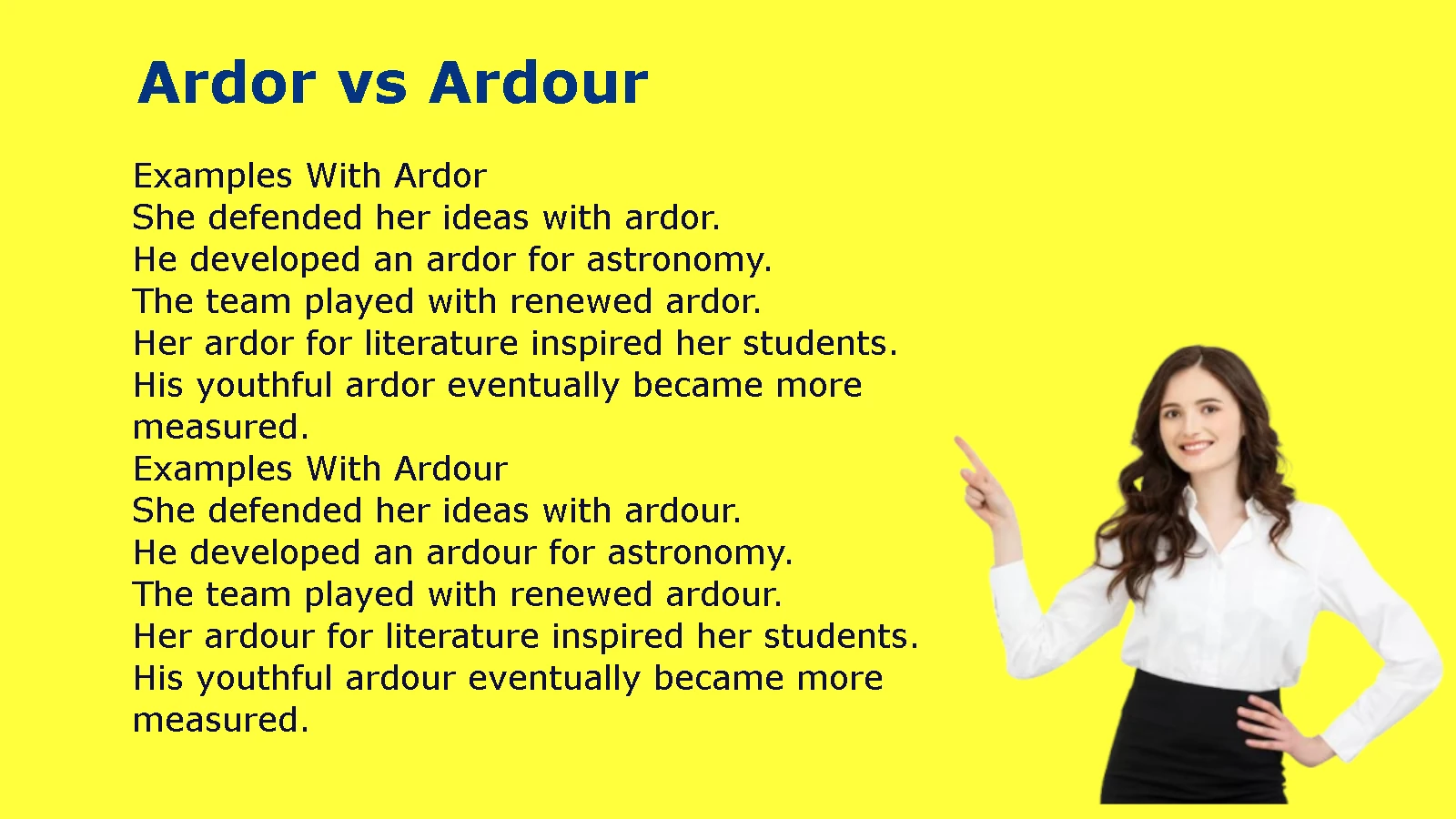
Examples With Ardor
- She defended her ideas with ardor.
- He developed an ardor for astronomy.
- The team played with renewed ardor.
- Her ardor for literature inspired her students.
- His youthful ardor eventually became more measured.
Examples With Ardour
- She defended her ideas with ardour.
- He developed an ardour for astronomy.
- The team played with renewed ardour.
- Her ardour for literature inspired her students.
- His youthful ardour eventually became more measured.
The grammar remains the same. Only the spelling changes.
Common Meanings and Contexts of Ardor and Ardour
The word becomes easier to understand when you see the different situations in which writers use it.
Romantic Passion
One of the oldest and most recognizable uses of ardor involves love, desire, and romantic passion.
For example:
His ardor for her was obvious to everyone in the room.
The word suggests more than ordinary affection. It points toward strong emotional intensity.
Cambridge gives a similar example in which someone’s ardor for another person eventually cools.
The British version works in exactly the same way:
His ardour for her was obvious to everyone in the room.
Enthusiasm for Work
Ardor can also describe someone’s unusually strong enthusiasm for a task or profession.
She approached every research project with remarkable ardor.
This suggests energy and passion rather than simple willingness to work.
A person can complete a task without ardor. Someone who works with ardor throws themselves into it.
Passion for a Hobby
The word can describe strong enthusiasm for almost any serious interest.
For example:
- an ardor for music
- an ardor for painting
- an ardor for literature
- an ardor for football
- an ardor for science
His ardor for classical music led him to study hundreds of compositions.
Here, ardor means deep enthusiasm rather than romantic passion.
Zeal for a Cause
Ardor can also describe commitment to an idea, movement, belief, or cause.
She defended the environmental campaign with considerable ardor.
This sense is close to zeal or fervor.
Merriam Webster specifically includes zeal among the meanings of ardor.
Ardor vs Ardour Example Sentences
The easiest way to see the relationship is to compare the two spellings side by side.
| American English | British English |
| She worked with great ardor. | She worked with great ardour. |
| His ardor for science was impressive. | His ardour for science was impressive. |
| Their romantic ardor soon faded. | Their romantic ardour soon faded. |
| She defended the cause with ardor. | She defended the cause with ardour. |
| His youthful ardor gave him confidence. | His youthful ardour gave him confidence. |
| The fans showed remarkable ardor. | The fans showed remarkable ardour. |
| Her ardor for music never disappeared. | Her ardour for music never disappeared. |
| He pursued his ambition with ardor. | He pursued his ambition with ardour. |
These aren’t different definitions. They’re regional spelling choices.
Ardor vs Ardour Pronunciation
The two forms are generally pronounced alike within the same variety of English.
Cambridge gives the US pronunciation as approximately /ˈɑːr.dɚ/ and the UK pronunciation as /ˈɑː.dər/.
In simple terms, an American speaker normally pronounces the r in ardor, while many British speakers use a non rhotic pronunciation in which that r isn’t pronounced in the same position.
The spelling difference itself doesn’t create a separate word or a fundamentally different pronunciation.
Simple Pronunciation Guide
For American English:
ardor → roughly AR der
For British English:
ardour → roughly AR duh
Pronunciation can vary by regional accent, so these simplified guides aren’t meant to represent every English speaking community.
What Is the Origin of Ardor and Ardour?
The history of these words is surprisingly vivid because their original meaning was connected to burning.
The English word ultimately traces back to Latin ardor, meaning burning, heat, flame, or intense feeling. It comes from the Latin verb ardēre, meaning “to burn.”
The word entered English through French and Anglo French forms before becoming established in Middle English.
Merriam Webster traces ardor through Middle English ardour and Anglo French ardur to Latin ardor.
From Physical Heat to Emotional Heat
The semantic development makes intuitive sense.
Something that burns intensely has heat and energy. Over time, that idea can be used metaphorically for a person who feels something intensely.
The progression is roughly:
burning heat → intensity → emotional heat → passion and enthusiasm
That’s why ardor can describe both emotional passion and powerful enthusiasm.
The French connection is also visible in modern French ardeur, which continues to mean intense heat and figurative passion or zeal. The Académie française traces ardeur to Latin ardor and ardere, “to burn.”
Ardor vs Ardour vs Ardent
Although they look closely related, ardor, ardour, and ardent don’t perform the same grammatical job.
| Word | Part of speech | Meaning | Example |
| ardor | Noun | Strong passion or enthusiasm | Her ardor was obvious. |
| ardour | Noun | British spelling of ardor | Her ardour was obvious. |
| ardent | Adjective | Passionate, enthusiastic, or devoted | She was an ardent supporter. |
| ardently | Adverb | In a passionate or enthusiastic way | She ardently supported the plan. |
Merriam Webster defines ardent as describing warmth of feeling expressed through eager or zealous support or activity.
Ardor as a Noun
His ardor impressed the committee.
Ardent as an Adjective
He was an ardent supporter of the proposal.
Ardently as an Adverb
She ardently defended her position.
The relationship becomes easy to remember:
ardor/ardour = the feeling
ardent = the person or thing showing the feeling
ardently = the way the action happens
Ardor vs Ardour Synonyms
Because ardor can express several shades of intense feeling, no single synonym works perfectly in every context.
When Ardor Means Passion
Useful alternatives include:
- passion
- fervor
- intensity
- fire
- feeling
When Ardor Means Enthusiasm
You might use:
- enthusiasm
- eagerness
- zest
- excitement
- energy
When Ardor Means Zeal
Consider:
- zeal
- devotion
- dedication
- commitment
- fervor
Merriam Webster’s thesaurus includes words such as enthusiasm, passion, fervor, zeal, eagerness, zest, and intensity among related terms.
However, these words aren’t interchangeable in every sentence.
For example, enthusiasm often sounds lighter and more everyday:
She showed enthusiasm for the project.
Ardor suggests stronger emotional intensity:
She showed ardor for the project.
That difference in strength is often what makes ardor useful in formal or literary writing.
Ardor vs Ardour: Common Mistakes
Although the spelling question is straightforward, a few mistakes appear often.
Mistake: Treating Ardor and Ardour as Different Words
The biggest mistake is assuming that one describes romance while the other describes enthusiasm.
That’s incorrect.
Both forms can describe romantic passion, enthusiasm, zeal, or strong emotional feeling.
The spelling determines the regional convention.
Mistake: Calling Ardour Incorrect
Ardour isn’t a misspelling of ardor.
It’s the standard British spelling and is also commonly used in Canadian English.
Mistake: Calling Ardor Incorrect in British English
Likewise, ardor isn’t a meaningless or invalid word in Britain. It is the American spelling and will generally be understood by British readers.
However, if you’re deliberately following British English style, ardour is the better choice.
Mistake: Mixing the Two Forms
A document that uses American English everywhere else can look inconsistent if it suddenly uses ardour.
For example:
The color of the building was striking, and the artist painted it with great ardour.
If the document follows American spelling, this would normally become:
The color of the building was striking, and the artist painted it with great ardor.
Consistency makes your writing look deliberate rather than accidental.
How to Choose Between Ardor and Ardour
Choosing the correct spelling doesn’t require a dictionary every time. Start with your audience.
If You’re Writing for an American Audience
Use ardor.
Examples:
- American English article
- US school assignment
- American business publication
- US focused website
- American academic writing
If You’re Writing for a British Audience
Use ardour.
Examples:
- British publication
- UK school assignment
- British academic writing
- UK focused website
- British style guide
If You’re Following a Style Guide
Follow the style guide.
A publisher, university, employer, or publication may have a preferred regional variety. Consistency with that guide matters more than personal preference.
If You’re Writing for an International Audience
Choose one variety and use it consistently.
If the content primarily targets US readers, ardor is the sensible choice. If it targets UK readers, ardour is the better fit.
Ardor vs Ardour in a Sentence: Side by Side
Here are more examples showing how the spelling changes without changing the meaning.
Career
US: She pursued her career with remarkable ardor.
UK: She pursued her career with remarkable ardour.
Education
US: His ardor for learning impressed his teachers.
UK: His ardour for learning impressed his teachers.
Literature
US: She discussed the novel with genuine ardor.
UK: She discussed the novel with genuine ardour.
Sports
US: The supporters watched the match with incredible ardor.
UK: The supporters watched the match with incredible ardour.
Romance
US: His romantic ardor eventually faded.
UK: His romantic ardour eventually faded.
Social Causes
US: She defended the cause with unwavering ardor.
UK: She defended the cause with unwavering ardour.
Art
US: The painter approached every canvas with ardor.
UK: The painter approached every canvas with ardour.
Ambition
US: He pursued his ambitions with youthful ardor.
UK: He pursued his ambitions with youthful ardour.
The pattern is consistent: change the spelling, not the meaning.
A Practical Case Study: Choosing the Right Spelling
Imagine an American writer preparing an article for a US audience.
The draft contains:
The young artist worked with unusual ardour and showed great colour sensitivity.
The writer hasn’t made a grammatical error. Both words are recognizable in English. However, the spelling is inconsistent with standard American usage.
For a US audience, the revised version would be:
The young artist worked with unusual ardor and showed great color sensitivity.
Now imagine a British publication. The original spellings fit the publication’s regional convention much better.
This small example illustrates an important principle: regional spelling is about consistency and audience expectations, not about one variety being inherently more correct.
Why Ardor Sounds More Formal Than Enthusiasm
One reason people sometimes hesitate over ardor is its tone.
The word is perfectly valid, but it often sounds formal, literary, or elevated compared with everyday alternatives.
Compare:
She has a lot of enthusiasm for the project.
with:
She approaches the project with great ardor.
The second sentence feels more intense and more literary.
That doesn’t make ardor better. It simply gives the sentence a different texture.
Use Ardor When You Want to Emphasize Intensity
Ardor works especially well when ordinary enthusiasm doesn’t fully capture the feeling.
For example:
His ardor for discovery drove him to spend years studying the subject.
The word adds a sense of emotional force.
Use Enthusiasm in Casual Writing
If you’re writing an everyday email, enthusiasm may sound more natural:
Thanks for your enthusiasm for the new project.
You could write ardor, but it would probably sound more formal than necessary.
Ardor vs Ardour: Key Facts at a Glance
| Fact | Answer |
| Are ardor and ardour different words? | No. They are spelling variants. |
| Is ardor American English? | Yes. |
| Is ardour British English? | Yes. |
| Does the meaning change? | No. |
| Can both describe romantic passion? | Yes. |
| Can both describe enthusiasm? | Yes. |
| Are they nouns? | Yes. |
| Are they usually uncountable? | Yes. |
| Is ardent related to ardor? | Yes. |
| Does ardour have an extra “u”? | Yes. |
| Does the spelling normally change the meaning? | No. |
| Does the spelling convention vary by region? | Yes. |
Frequently Asked Questions About Ardor vs Ardour
Is ardor the American spelling?
Yes. Ardor is the standard American English spelling. Cambridge identifies it as the US form and gives ardour as the UK equivalent.
Is ardour the British spelling?
Yes. Ardour is the standard British spelling of ardor. Merriam Webster describes it as the chiefly British spelling.
Do ardor and ardour mean the same thing?
Yes. Both words describe strong passion, enthusiasm, love, zeal, or intense feeling. The difference is primarily regional spelling.
Which is correct: ardor or ardour?
Both are correct. Use ardor for American English and ardour for British English.
Are ardor and ardour pronounced the same?
They are generally pronounced alike within the corresponding English varieties, although American and British accents can produce differences. Cambridge gives US /ˈɑːr.dɚ/ and UK /ˈɑː.dər/.
Can ardor describe romantic feelings?
Yes. Ardor can describe intense romantic passion or desire. Cambridge and Oxford both provide romantic uses of the word.
Can ardor describe enthusiasm for work?
Yes. Someone can pursue work, study, art, sports, or a cause with ardor.
Is ardor a noun?
Yes. Ardor is a noun. The British spelling, ardour, is also a noun.
What is the adjective form of ardor?
The related adjective is ardent.
For example:
She is an ardent supporter of the arts.
Merriam Webster defines ardent in terms of warmth of feeling, eager support, passion, and zeal.
What is the adverb form?
The related adverb is ardently.
For example:
He ardently defended his position.
Is ardour a misspelling of ardor?
No. Ardour is the standard British spelling, not a mistake.
Is ardor a misspelling of ardour?
No. Ardor is the standard American spelling.
Is ardor formal?
Usually, yes. The word often has a formal or literary tone. Oxford labels ardor as formal.
What are the best synonyms for ardor?
Depending on the context, useful synonyms include passion, enthusiasm, fervor, zeal, intensity, eagerness, zest, and devotion. The best choice depends on the exact shade of meaning.
Final Verdict: Ardor or Ardour?
The ardor vs ardour question has a straightforward answer.
Ardor and ardour mean the same thing. Both describe strong passion, enthusiasm, love, zeal, or intense feeling. The primary difference is spelling.
- Ardor is the standard American English form.
- Ardour is the standard British English form.
- Canadian English commonly uses ardour.
- Neither spelling is inherently more correct.
- The safest choice is to match your audience and remain consistent.
The word also has an interesting history. Both forms ultimately trace back to Latin ardor, connected with ardēre, meaning to burn. That history helps explain why a word originally associated with physical heat came to describe emotional heat, passion, and intense enthusiasm.
So, when you’re deciding between the two, don’t get burned by the extra u.
Writing in US English? Choose ardor. Writing in British English? Choose ardour. The meaning stays the same.