Have you ever wondered whether you should write check or cheque? While Check vs Cheque may look like a simple spelling difference, the correct word depends on where you use it and what you mean. The two words can refer to the same thing when talking about a bank payment, but they follow different regional spelling conventions.
Check is the standard spelling in American English, while cheque is the standard spelling in British English and is also commonly used in countries such as Canada, Australia, and New Zealand when referring to a written bank payment.
Examples:
- I wrote a check for $500.
- I wrote a cheque for £500.
The confusion is understandable. People often search for check vs cheque, check or cheque, is cheque British or American, and difference between check and cheque because both words can have the same meaning in banking. And here’s the catch: check has several other meanings in English, while cheque specifically refers to a written payment order.
In this guide, you’ll learn the complete Check vs Cheque difference, including their meaning, definition, pronunciation, American and British English usage, and examples in sentences. You’ll also discover when to use check or cheque, how the words differ in other contexts, and an easy way to remember which spelling to choose.
Check vs. Cheque at a Glance
| Feature | Check | Cheque |
| Main banking meaning | A written payment from a bank account | A written payment from a bank account |
| American English | Yes | No, generally |
| British English | Used for other meanings | Yes, for bank payments |
| Pronunciation | /tʃek/ | /tʃek/ |
| Example | I wrote a check. | I wrote a cheque. |
| Common related term | checkbook | chequebook |
| Meaning “examine” | Yes | No |
| Restaurant payment | Common in American English | Not normally used for this meaning |
Cambridge lists cheque as the UK form and check as the US form for the banking meaning. Oxford follows the same distinction.
So, if you’re writing in US English, use check when referring to a bank payment. If you’re writing in British English, use cheque for that meaning.
What Does “Check” Mean?
The word check has a much wider range of meanings than cheque. That matters because the two words aren’t interchangeable in every sentence.
In American English, check can refer to a bank payment, an examination, a mark, a restaurant bill, a pattern, or an action that limits something. It also works as a verb meaning to examine, verify, or find information.
Check as a Bank Payment
In banking, a check is a written payment instruction that allows money to be paid from a bank account to another person or organization.
For example:
- I wrote a check for $200.
- She deposited the check yesterday.
- The company sent me a check.
- Can I pay by check?
- He forgot to sign the check.
Cambridge defines this American usage as a printed form used to make payments from a bank account.
A check normally includes important information such as:
- The name of the person or organization receiving the payment
- The amount of money
- The date
- The account holder’s signature
- Banking information used to process the payment
The exact design varies by country and financial institution, but the basic purpose remains the same: it authorizes a payment from a bank account.
Check as a Verb
The verb check has nothing to do with the spelling cheque.
When you check something, you examine it to make sure it is correct, safe, suitable, or accurate.
For example:
- Check your email before you leave.
- Please check the address.
- I checked the figures twice.
- Check that the door is locked.
- She checked the report for errors.
Cambridge gives check as a verb meaning to examine something to make sure it is correct or safe.
This is one of the most important rules to remember:
Use “check” when you mean examine or verify, even in British English.
You wouldn’t normally write “Please cheque the figures.” That spelling would suggest the banking word rather than the verb.
Check as a Noun
The noun check can also mean an examination or inspection.
For example:
- The mechanic performed a safety check.
- The teacher gave the essay one final check.
- The company carries out regular equipment checks.
Here, check means an act of examining something.
Check as a Mark
In American English, a check can also mean the symbol ✓ used to indicate that something is correct or completed.
For example:
- Put a check next to your name.
- Check all the boxes that apply.
- The teacher put a check beside the correct answer.
Cambridge notes that American English commonly uses check for this mark, while British English often uses tick for the same symbol.
That gives you another useful regional difference:
| American English | British English |
| Put a check next to it. | Put a tick next to it. |
The verb remains check in both varieties.
What Does “Cheque” Mean?
Cheque is the British English spelling for the banking term that American English spells check.
It refers to a written document used to make a payment from a bank account. Cambridge and Oxford both define cheque this way.
Examples include:
- I wrote a cheque for £100.
- She paid by cheque.
- The cheque cleared yesterday.
- Please make the cheque payable to John Smith.
- The company no longer accepts cheques.
The word is pronounced exactly like check: /tʃek/.
Cheque Is a Banking Word
Here’s the key point: cheque is not simply the British spelling of every use of check.
It is the British spelling for the banking sense.
Consider these examples:
- I wrote a cheque. ✓
- She paid by cheque. ✓
- Please check your email. ✓
- Please cheque your email. ✗
The last example is wrong because cheque doesn’t mean “examine” or “verify.”
This distinction separates a precise explanation from the oversimplified rule that says, “Cheque is British, check is American.” That rule works for bank payments, but it doesn’t explain all uses of check.
Check vs. Cheque: Which Spelling Is Correct?
Both are correct. The correct spelling depends on the variety of English and the meaning.
If you are writing in American English and referring to a bank payment, use check.
I mailed the check this morning.
If you are writing in British English and referring to a bank payment, use cheque.
I posted the cheque this morning.
Neither spelling is inherently more correct. They belong to different regional spelling conventions.
Cambridge’s British and American spelling guidance explicitly lists cheque (bank) as the British form and check as the American form.
If You Write in American English
Use:
- check
- personal check
- cashier’s check
- checkbook
- write a check
- cash a check
- deposit a check
- pay by check
For example:
She wrote a personal check to pay the bill.
If You Write in British English
Use:
- cheque
- personal cheque
- chequebook
- write a cheque
- cash a cheque
- deposit a cheque
- pay by cheque
For example:
She wrote a personal cheque to pay the bill.
The goal isn’t to decide which spelling is “better.” Instead, match your spelling to your audience.
Check vs. Cheque in American and British English
The difference becomes clearer when you compare several meanings side by side.
| Meaning | American English | British English |
| Bank payment | check | cheque |
| Examine or verify | check | check |
| Examination | check | check |
| ✓ symbol | check | tick is common |
| Restaurant bill | check | bill is usual |
| Pattern of squares | check | check |
The restaurant example is particularly useful.
In the United States, a customer may say:
“Could we get the check, please?”
In Britain, the usual word is:
“Could we get the bill, please?”
Oxford identifies check as an American English term for the restaurant bill and notes that bill is the usual British English equivalent.
Notice what happens here: British English doesn’t turn check into cheque. Instead, it uses another word entirely.
Check vs. Cheque Examples
Examples make the difference much easier to remember.
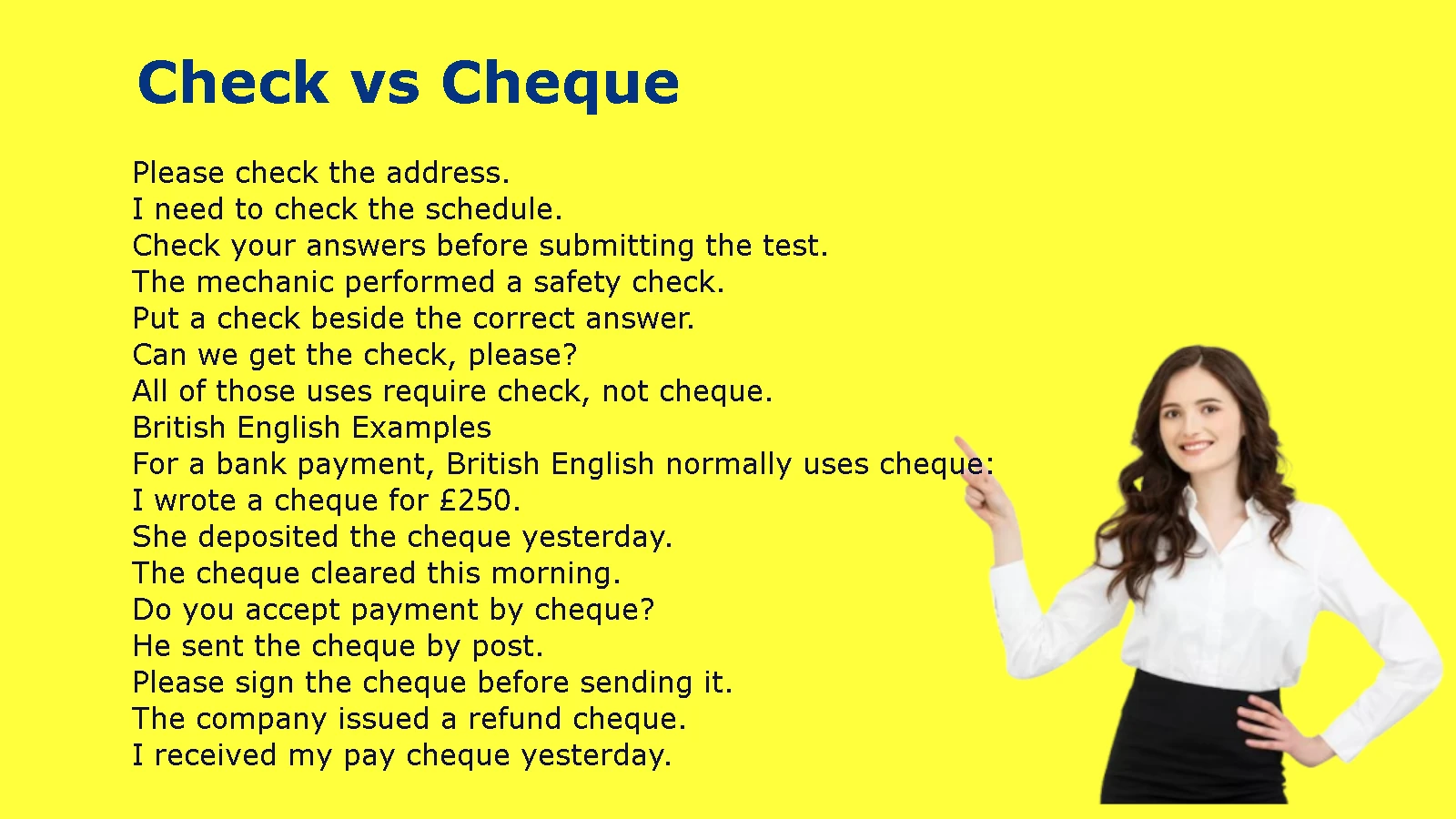
American English Examples
Here are natural examples using check for a bank payment:
- I wrote a check for $250.
- She deposited the check at her bank.
- The check cleared this morning.
- Do you accept payment by check?
- He sent the check by mail.
- Please sign the check before sending it.
- The company issued a refund check.
- I received my paycheck yesterday.
Now compare those with other meanings of check:
- Please check the address.
- I need to check the schedule.
- Check your answers before submitting the test.
- The mechanic performed a safety check.
- Put a check beside the correct answer.
- Can we get the check, please?
All of those uses require check, not cheque.
British English Examples
For a bank payment, British English normally uses cheque:
- I wrote a cheque for £250.
- She deposited the cheque yesterday.
- The cheque cleared this morning.
- Do you accept payment by cheque?
- He sent the cheque by post.
- Please sign the cheque before sending it.
- The company issued a refund cheque.
- I received my pay cheque yesterday.
But British English still uses check when the meaning is “examine” or “verify”:
- Please check the address.
- I need to check the schedule.
- Check your answers before submitting the test.
- The mechanic performed a safety check.
For a restaurant bill, British English normally uses bill:
- Could we have the bill, please?
That pattern is worth remembering because it shows why the simple “British versus American spelling” explanation isn’t enough.
Check vs. Cheque Pronunciation
Check and cheque have the same pronunciation.
Both are pronounced:
/tʃek/
A simple approximation for English learners is “chek.”
The spelling changes, but the sound doesn’t.
| Word | Pronunciation | Sound |
| check | /tʃek/ | chek |
| cheque | /tʃek/ | chek |
Cambridge lists /tʃek/ for both words.
So if you hear someone say “check,” you can’t tell from the sound alone whether they would write check or cheque. You need the context or the writer’s regional spelling convention.
Check or Cheque in Common Phrases
The banking distinction carries into many related expressions.
| American English | British English |
| write a check | write a cheque |
| cash a check | cash a cheque |
| deposit a check | deposit a cheque |
| pay by check | pay by cheque |
| personal check | personal cheque |
| checkbook | chequebook |
| cashier’s check | cashier’s cheque |
| certified check | certified cheque |
| blank check | blank cheque |
| traveler’s check | traveller’s cheque |
The exact terminology can vary across countries, especially for specialized banking products. Still, the central spelling pattern remains consistent: American banking English favors check, while British banking English favors cheque. Cambridge’s banking entries include forms such as bank cheque, certified cheque, cashier’s cheque, personal cheque, and traveller’s cheque.
Checkbook vs. Chequebook
This is a useful example of how the spelling difference carries into compounds.
American English:
checkbook
British English:
chequebook
The meaning is the same: a book containing blank checks or cheques.
There’s another interesting regional variation in Canada. Oxford identifies chequing account as Canadian English, while American English uses checking account and British English generally uses current account.
That example shows that English spelling differences can extend beyond a single word.
Check vs. Cheque in a Sentence
Let’s look at the words in context.
“I wrote a check for $500.”
This is standard American English.
The word check refers to a bank payment.
“I wrote a cheque for £500.”
This is standard British English.
The word cheque has exactly the same banking meaning as the American check.
“Please check the payment details.”
Here, check is a verb meaning examine or verify.
The spelling doesn’t change in British English.
“The cheque cleared after several days.”
Here, cheque is a noun referring to a bank payment in British English.
“The waiter brought the check.”
This is natural in American English, where check can mean the restaurant bill. Oxford lists this as an American English usage.
“The waiter brought the bill.”
This is the usual British English equivalent.
These examples reveal the central lesson:
The spelling depends on the meaning and the variety of English.
Common Mistakes With Check and Cheque
The most common mistakes happen when writers apply the regional spelling rule too broadly.
Mistake: Using “Cheque” for Every British Use of “Check”
This is incorrect.
British English uses check as a verb:
- Check your work.
- Check the figures.
- Check the door.
- Check the information.
It also uses check as a noun for an examination:
- We need to do a safety check.
- Give the document one final check.
Only the banking sense normally changes to cheque.
Mistake: Assuming “Check” Is Wrong in British English
That’s also incorrect.
British English uses check in many contexts.
For instance:
“Please check your email.”
That sentence is perfectly normal in British English.
What changes is the banking noun:
American: I wrote a check.
British: I wrote a cheque.
Cambridge’s British English dictionary explicitly defines check as a verb meaning to look at something to make sure it is right or safe.
Mistake: Thinking the Words Sound Different
They don’t.
Check and cheque are homophones in standard English. Both are pronounced /tʃek/.
The difference exists in writing, not in ordinary pronunciation.
Mistake: Mixing Regional Spellings Without a Reason
Imagine a document that says:
I wrote a check yesterday. The cheque arrived today.
That could be correct if the writer is deliberately discussing two different regional forms. In ordinary US or UK writing, however, switching back and forth can look inconsistent.
If you’re writing for an American audience, choose check for the banking term.
If you’re writing for a British audience, choose cheque for the banking term.
Consistency makes your writing cleaner.
Is “Cheque” American or British?
Cheque is British English.
It is the standard British spelling for the banking term that American English spells check. Cambridge and Oxford both make this distinction directly.
For example:
British:
She paid by cheque.
American:
She paid by check.
The meaning is the same.
It’s worth remembering that cheque is not the British spelling of the verb check. British writers still write:
Please check the document.
They don’t normally write:
Please cheque the document.
Is “Check” British English?
Yes.
British English uses check for several meanings, including the verb meaning “examine” or “verify.”
For example:
- Check the figures.
- Check your email.
- Check that the door is locked.
- Do a final check before submitting the form.
What British English normally doesn’t use is check for the banking document. For that meaning, cheque is the standard form.
So the statement “check is American and cheque is British” is useful as a quick memory trick, but it isn’t completely accurate.
A better rule is:
Check is used in both American and British English for most meanings. Cheque is the British banking spelling.
That is the distinction worth remembering.
Why Do Check and Cheque Have Different Spellings?
The difference comes from the development of regional English spelling conventions.
Over time, British and American English developed different preferences for certain spellings. Some differences are familiar:
| British English | American English |
| colour | color |
| centre | center |
| labour | labor |
| defence | defense |
| travelling | traveling |
| cheque | check |
Cambridge lists cheque (bank) and check among British and American spelling differences.
The important point is that spelling variation doesn’t necessarily indicate a difference in meaning. Often, the same word or concept simply follows different regional conventions.
Cheque and check are a perfect example.
A Practical Case Study: Choosing the Right Word
Imagine you’re writing an article for an American financial website.
You want to write:
Customers can pay by cheque.
That spelling would look out of place in standard US English.
The better version is:
Customers can pay by check.
Now imagine you’re writing the same sentence for a British audience:
Customers can pay by cheque.
The meaning hasn’t changed. Only the regional spelling has.
Now change the sentence slightly:
Customers should check their payment details before submitting the form.
Here, check remains correct in both American and British English because it functions as a verb meaning “verify.”
The Rule in Action
| Sentence | US English | British English |
| I wrote a check. | ✓ | Usually ✗ |
| I wrote a cheque. | Usually ✗ | ✓ |
| Please check the form. | ✓ | ✓ |
| Please cheque the form. | ✗ | ✗ |
| I paid by check. | ✓ | Usually ✗ |
| I paid by cheque. | Usually ✗ | ✓ |
| Can I have the check? | ✓ | Usually ✗ |
| Can I have the bill? | ✓ | ✓ |
This simple test can solve most check vs. cheque questions in seconds.
Check vs. Cheque for Formal Writing
When you’re writing a formal document, the safest approach is to identify your intended audience before choosing a spelling.
Writing for an American Audience
Use check consistently:
- check
- personal check
- cashier’s check
- checkbook
- pay by check
For example:
Please send payment by check to the address listed below.
Writing for a British Audience
Use cheque for the banking sense:
- cheque
- personal cheque
- cashier’s cheque
- chequebook
- pay by cheque
For example:
Please send payment by cheque to the address listed below.
The same principle applies to color/colour, center/centre, and other regional differences.
Is “Check” or “Cheque” More Common?
The answer depends heavily on where the English is being used and what type of writing you’re examining.
American English generally uses check for the banking term. British English generally uses cheque.
Modern banking also matters. Checks and cheques have become less central to everyday payments in many places as cards, electronic transfers, direct debits, mobile payments, and online banking have expanded. Cambridge’s Business English entry describes payment by cheque as becoming increasingly unusual.
That doesn’t make either spelling obsolete. Both remain established dictionary words.
It simply means that many readers now encounter the words more often in:
- Banking documents
- Legal documents
- Historical writing
- Financial records
- Business correspondence
- Language learning materials
- Older documents
- Discussions about payment methods
Check vs. Cheque: Quick Memory Trick
Here’s an easy way to remember the difference:
US = check.
UK = cheque for banking.
Think of the extra “que” in cheque as part of the British spelling pattern.
But don’t let the trick fool you into changing every check into cheque.
Remember:
Check your work. Write a cheque.
That one sentence captures the distinction beautifully.
Frequently Asked Questions About Check vs. Cheque
Are “check” and “cheque” the same thing?
Yes, when they refer to a bank payment.
American English uses check, while British English uses cheque. The pronunciation is also the same.
Is “cheque” British or American?
Cheque is British English for the banking term.
American English normally uses check instead.
Is “check” American or British?
Both.
British English uses check for meanings such as examine, verify, or inspect. American English also uses check for those meanings.
For the banking document, however, American English uses check, while British English uses cheque.
Which is correct in the USA: check or cheque?
Check is the standard American English spelling for a bank payment.
Example:
I mailed the check yesterday.
Which is correct in the UK: check or cheque?
For a bank payment, cheque is the standard British English spelling.
Example:
I mailed the cheque yesterday.
Do “check” and “cheque” sound the same?
Yes.
Both are pronounced /tʃek/.
Can “cheque” mean “examine”?
No.
Use check when you mean examine, verify, or inspect.
Correct:
Please check the figures.
Incorrect:
Please cheque the figures.
Is “checkbook” or “chequebook” correct?
Both are correct in their respective regional varieties.
- American English: checkbook
- British English: chequebook
Is “paycheck” or “pay cheque” correct?
Both forms can reflect regional English.
American English commonly uses paycheck.
British English commonly uses pay cheque.
The spelling follows the same regional pattern as check/cheque.
Do British people use the word “check”?
Yes. British English uses check as a verb and in several noun expressions.
For example:
Check your work.
We need a safety check.
The banking noun is where cheque is used.
Do Americans use “cheque”?
You may encounter cheque in American writing when someone is quoting British usage, referring to a British institution, or discussing regional English. However, check is the normal American spelling for the banking term.
Is “check” a noun or a verb?
It can be both.
As a verb:
Please check the report.
As a noun:
I wrote a check.
It also has many other noun meanings, including an examination and, in American English, a restaurant bill.
Check vs. Cheque: The Bottom Line
The difference between check vs. cheque is easier than it first appears.
When you’re talking about a bank payment:
- American English → check
- British English → cheque
Both words mean the same thing in that context. Both are pronounced /tʃek/.
The bigger trap is assuming that cheque replaces check in every British English sentence. It doesn’t.
British writers still use check when they mean:
- Examine
- Verify
- Inspect
- Confirm
- Review
- Perform an examination
So compare these two sentences:
I wrote a check.
American English banking term.
I wrote a cheque.
British English banking term.
But:
Please check the document.
Correct in both varieties.
That is the whole distinction in a nutshell.
Quick Reference
| If you mean… | American English | British English |
| Bank payment | check | cheque |
| Examine something | check | check |
| Verify information | check | check |
| Examination | check | check |
| ✓ symbol | check | tick is common |
| Restaurant bill | check | bill is usual |
Final rule: If you’re writing in US English, use check for the bank payment. If you’re writing in British English, use cheque for the bank payment. When the word means examine or verify, keep check regardless of the variety of English.