Have you ever wondered whether you should write Behavior vs Behaviour in a sentence? Both spellings are correct, but the right choice depends on the type of English you are using. Understanding this small spelling difference can help you write more clearly and avoid confusion.
Behavior is the standard American English spelling, while behaviour is the standard British English spelling. Both words have the same meaning and refer to the way a person, animal, or group acts or responds in a particular situation.
Examples:
- His behavior was polite and respectful.
- Her behaviour changed after the experience.
The confusion is understandable. People often search for Behavior vs Behaviour, behavior meaning, behaviour meaning, behavior or behaviour, or which spelling is correct because the only difference is the letter u. And here’s the kicker: neither spelling is wrong. You simply need to match your spelling to the variety of English you’re using.
In this guide, you’ll learn the complete Behavior vs Behaviour difference, including their definitions, pronunciation, correct spelling, usage, and examples in sentences. You’ll also discover when to use behavior or behaviour, which spelling is preferred in American and British English, and other related spelling differences you may come across.
Behavior vs Behaviour: Quick Difference
| Word | Main usage | Meaning | Pronunciation |
| behavior | American English | The way a person, animal, group, or thing acts | Same as behaviour |
| behaviour | British English and other varieties | The way a person, animal, group, or thing acts | Same as behavior |
Cambridge Dictionary identifies behavior as the US spelling of behaviour and behaviour as the UK form of behavior. Both entries give the same core meaning: the way someone or something behaves.
So, if you write:
His behavior was unusual.
and someone else writes:
His behaviour was unusual.
the two sentences communicate the same idea. The spelling simply reflects the variety of English being used.
The simplest rule
- 🇺🇸 American English: behavior
- 🇬🇧 British English: behaviour
- 🇨🇦 Canadian English: behaviour is commonly used
- 🇦🇺 Australian English: behaviour is generally used
The most important point isn’t memorizing which country uses which spelling. It’s staying consistent within the variety of English you’ve chosen.
What Does Behavior Mean?
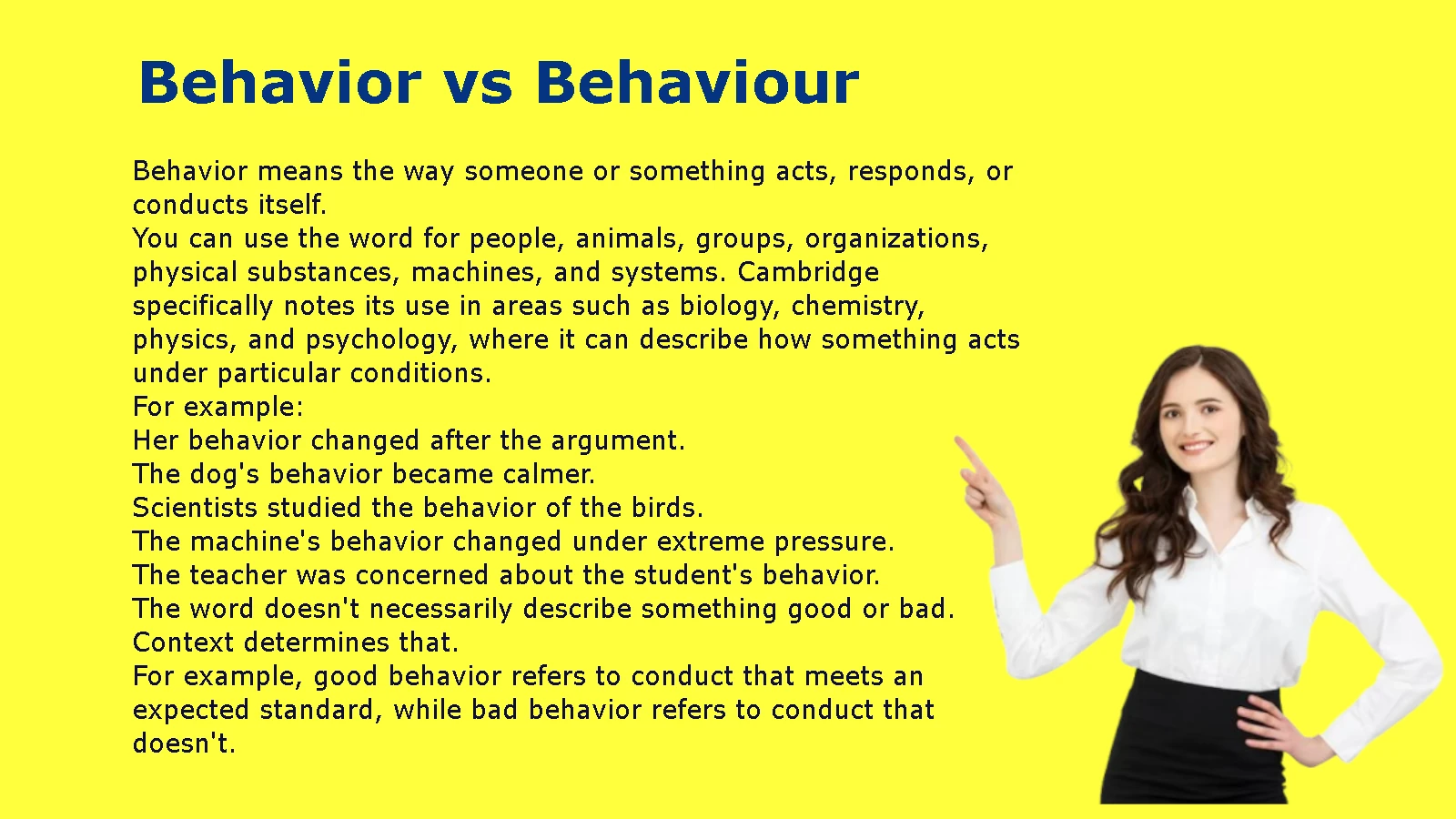
Behavior means the way someone or something acts, responds, or conducts itself.
You can use the word for people, animals, groups, organizations, physical substances, machines, and systems. Cambridge specifically notes its use in areas such as biology, chemistry, physics, and psychology, where it can describe how something acts under particular conditions.
For example:
- Her behavior changed after the argument.
- The dog’s behavior became calmer.
- Scientists studied the behavior of the birds.
- The machine’s behavior changed under extreme pressure.
- The teacher was concerned about the student’s behavior.
The word doesn’t necessarily describe something good or bad. Context determines that.
For example, good behavior refers to conduct that meets an expected standard, while bad behavior refers to conduct that doesn’t.
You can also use behavior in more technical contexts. A scientist might study how an animal responds to its environment. An engineer might examine how a material behaves under stress. A psychologist might investigate patterns in human behavior.
That broader meaning is important because behavior isn’t limited to manners or discipline.
What Does Behaviour Mean?
Behaviour has the same meaning as behavior. The only difference is the spelling.
British English typically uses the form with -our:
- His behaviour was unacceptable.
- The children displayed excellent behaviour.
- Researchers observed the behaviour of several bird species.
- The company’s behaviour attracted public attention.
Cambridge lists behaviour as the UK form and gives both everyday and specialized meanings for the word.
Merriam-Webster likewise describes behaviour as a chiefly British spelling of behavior.
In other words, the extra u doesn’t create a different meaning. It simply signals a different spelling convention.
Think of it like color and colour. The object doesn’t change when you add the u. The spelling convention does.
Why Does Behavior Become Behaviour?
The spelling difference has a long history. It didn’t appear because American and British speakers decided to invent two unrelated words.
Merriam-Webster traces behavior to Middle English behavour, from behaven meaning “to behave,” combined with the noun-forming ending -our/-or. Its entry dates the first known use of behavior to the 15th century.
The important detail is that -our and -or have historical connections. British English retained the -our spelling in many words, while American English came to favor the shorter -or form.
That pattern appears in several familiar pairs:
| American English | British English |
| behavior | behaviour |
| color | colour |
| favor | favour |
| honor | honour |
| labor | labour |
| neighbor | neighbour |
The change wasn’t completely random. American spelling developed its own conventions over time, and dictionaries associated with American English helped establish those conventions.
Noah Webster played a major role in standardizing distinctive American spellings. His dictionaries promoted forms that differed from British conventions, including shorter spellings in a number of words. The broader history of American and British spelling shows how language can develop regional identities while remaining mutually understandable.
A useful historical detail
Merriam-Webster’s etymology makes one thing especially clear: behavior isn’t a modern American invention. The word itself has medieval roots. The regional difference concerns the spelling of the ending rather than the basic origin or meaning of the word.
That’s why calling behaviour the “old” word and behavior the “new” word would oversimplify the history.
Behavior vs Behaviour in American English
If you’re writing in American English, use behavior.
This is the standard form in US writing across everyday, academic, professional, and scientific contexts.
Examples include:
- The student’s behavior improved during the semester.
- The researchers studied animal behavior.
- The company has a strict code of behavior.
- Social behavior can change depending on the environment.
- The software’s behavior was difficult to predict.
The same rule applies to most derivatives:
- behavior
- behavioral
- behaviorism
- behaviorist
- misbehavior
For American readers, behaviour can look like a British spelling, much as colour or favour does.
That doesn’t make it wrong. It simply doesn’t match standard US spelling.
Behavior vs Behaviour in British English
If you’re writing in British English, use behaviour.
Examples:
- His behaviour was completely unexpected.
- The school has strict rules about student behaviour.
- The study examined children’s behaviour.
- Scientists observed the behaviour of the animals.
- The company reviewed its behaviour toward customers.
British English uses the same basic spelling pattern in several related words:
- behaviour
- behavioural
- behaviourism
- behaviourist
- misbehaviour
Merriam-Webster specifically groups behaviour, behaviourism, and behaviourist as chiefly British spellings of their -or counterparts.
Behavior vs Behaviour in Canadian English
Canadian English doesn’t fit neatly into a simple “British or American” box. It has its own conventions and reflects influences from both sides of the Atlantic.
For behavior/behaviour, behaviour is widely used in Canadian English.
That means Canadian writing can commonly contain:
- student behaviour
- animal behaviour
- consumer behaviour
- workplace behaviour
However, Canadian spelling has its own patterns across the language, and individual style guides or organizations may make specific choices.
The practical lesson is simple: if you’re writing for a Canadian publication, institution, or audience, follow its preferred style guide rather than assuming every Canadian spelling works exactly like British English.
Behavior vs Behaviour in Australian English
Australian English generally uses behaviour.
You’ll therefore commonly encounter phrases such as:
- student behaviour
- animal behaviour
- consumer behaviour
- workplace behaviour
- human behaviour
Australian English generally retains the -our spelling in words such as colour, favour, and behaviour.
So if an Australian website writes behaviour, that isn’t a typo or an outdated form. It’s a normal regional spelling.
Behavior vs Behaviour in Other English-Speaking Countries
English has never been a single uniform system. Different regions developed their own spelling, vocabulary, and pronunciation conventions while retaining a shared core language.
As a broad rule:
| Variety of English | Common spelling |
| American English | behavior |
| British English | behaviour |
| Canadian English | behaviour is common |
| Australian English | behaviour |
| Other British-influenced varieties | behaviour is often used |
These are useful generalizations rather than rigid rules for every publication.
A particular organization may adopt a different editorial style. Academic journals can also specify their own spelling conventions.
The safest approach is always to follow the style requirements of the publication you’re writing for.
Behavior vs Behaviour Pronunciation
Here’s some good news: you don’t have to learn two pronunciations.
Behavior and behaviour are normally pronounced the same way.
Cambridge gives the pronunciations as approximately:
- behavior: /bɪˈheɪ.vjɚ/
- behaviour: /bɪˈheɪ.vjər/
The exact final sound can vary somewhat with accent. The spelling difference doesn’t create a meaningful difference in pronunciation.
The extra u in behaviour is therefore silent.
This makes the pair different from some words where spelling changes can affect pronunciation. Here, you’re simply looking at two written forms of the same word.
Behavior vs Behaviour in Different Contexts
One reason this word causes confusion is that behavior has a much broader meaning than “good or bad manners.”
Let’s look at the major contexts.
Everyday Behavior
In everyday conversation, behavior often refers to how a person acts.
For example:
- I don’t understand his behavior.
- Her behavior was polite and respectful.
- The child’s behavior changed after the move.
In British English, replace behavior with behaviour:
- I don’t understand his behaviour.
- Her behaviour was polite and respectful.
- The child’s behaviour changed after the move.
Animal Behavior
Scientists use the word extensively when discussing animals.
Animal behavior can include:
- feeding
- communication
- mating patterns
- movement
- social interaction
- territorial activity
- responses to environmental conditions
For example:
The researchers studied the behavior of wolves in different habitats.
British English would write:
The researchers studied the behaviour of wolves in different habitats.
The scientific concept stays exactly the same.
Child Behavior
Parents, teachers, psychologists, and researchers often use behavior/behaviour when discussing how children act or respond.
Examples include:
- The teacher noticed a change in the student’s behavior.
- The study examined children’s social behavior.
- Parents often discuss positive behavior at home.
In British English, these become behaviour and behavioural.
Scientific Behavior
The word can describe much more than living creatures.
Chemists can discuss how substances behave under certain conditions. Physicists can describe how materials or particles respond to forces. Engineers can analyze the behavior of a machine or structure.
Merriam-Webster’s definition of behave includes acting, functioning, or reacting in a particular way, including how metals respond to heat and pressure.
That gives behavior a useful technical sense:
Behavior = the observable way something acts or responds under particular conditions.
Computer and System Behavior
You may also see behavior in technology.
For example:
- The software’s behavior changed after the update.
- The system showed unexpected behavior.
- Developers tested the application’s behavior under heavy demand.
Here, the word doesn’t imply manners at all. It describes how a system responds to inputs or conditions.
British English uses behaviour in the same context.
Behavior vs Behaviour in Academic and Scientific Writing
Academic writing makes consistency especially important.
Suppose a US-based research paper uses behavior, behavioral, and behaviorism. Switching suddenly to behaviour halfway through the paper can make the spelling look inconsistent.
The same principle works in reverse for British English.
American academic style
- human behavior
- animal behavior
- behavioral psychology
- consumer behavior
British academic style
- human behaviour
- animal behaviour
- behavioural psychology
- consumer behaviour
The underlying concepts don’t change.
What changes is the spelling convention used by the publication, institution, or author.
Why consistency matters
Imagine reading a paper that begins with:
The study examined consumer behavior.
A few pages later, it says:
The researchers then analyzed consumer behaviour.
You can understand both sentences, but the switch may look accidental.
A consistent spelling system makes the writing feel more polished.
Choose your English variety first. Then stick with it.
Behavioral vs Behavioural
The adjective creates another common spelling question.
| American English | British English |
| behavior | behaviour |
| behavioral | behavioural |
| behaviorism | behaviourism |
| behaviorist | behaviourist |
| misbehavior | misbehaviour |
For example:
American English:
The researchers conducted a behavioral study.
British English:
The researchers conducted a behavioural study.
Merriam-Webster defines behavioral as relating to behavior and gives examples such as behavioral problems and behavioral similarities. Its entry records the first known use of behavioral as 1919.
So if you’re writing American English, behavioral is the form to use. Don’t add the extra u simply because the noun sometimes appears in British sources.
Other Related Words and Their Spellings
Once you understand behavior vs behaviour, several related words become easier.
Behavior vs Behaviour
- US: behavior
- UK: behaviour
Behavioral vs Behavioural
- US: behavioral
- UK: behavioural
Behaviorism vs Behaviourism
- US: behaviorism
- UK: behaviourism
Behaviorist vs Behaviourist
- US: behaviorist
- UK: behaviourist
Misbehavior vs Misbehaviour
- US: misbehavior
- UK: misbehaviour
The spelling pattern usually carries through the related word family.
However, don’t assume every word containing -or has a British -our counterpart. English spelling has plenty of exceptions. For example, British English uses author, error, horror, and senator, not authour, errour, horrour, or senatour.
That’s why it’s better to learn established spelling pairs rather than inventing an -our version whenever you see -or.
Behavior vs Behaviour Examples
The easiest way to see the difference is to compare the same sentences side by side.
| American English | British English |
| His behavior was polite. | His behaviour was polite. |
| The child’s behavior changed. | The child’s behaviour changed. |
| Scientists studied animal behavior. | Scientists studied animal behaviour. |
| The company reviewed employee behavior. | The company reviewed employee behaviour. |
| Social behavior can be complex. | Social behaviour can be complex. |
| The study examined consumer behavior. | The study examined consumer behaviour. |
| The software displayed unexpected behavior. | The software displayed unexpected behaviour. |
| Researchers analyzed behavioral patterns. | Researchers analyzed behavioural patterns. |
Notice what’s missing from the table: a difference in meaning.
There isn’t one.
Only the regional spelling changes.
Behavior vs Behaviour: Example Sentences in Context
American English
Everyday use:
His behavior at the meeting surprised everyone.
School:
The teacher praised the students for their positive behavior.
Science:
The researchers observed the behavior of the birds over several weeks.
Business:
Consumer behavior can influence how companies design products.
Technology:
The developers investigated the software’s unexpected behavior.
British English
Everyday use:
His behaviour at the meeting surprised everyone.
School:
The teacher praised the students for their positive behaviour.
Science:
The researchers observed the behaviour of the birds over several weeks.
Business:
Consumer behaviour can influence how companies design products.
Technology:
The developers investigated the software’s unexpected behaviour.
The grammar remains unchanged. You simply replace the spelling according to the English variety.
Behavior or Behaviour: Which Spelling Should You Use?
The answer depends on who you’re writing for.
Use behavior when you’re writing in American English.
Use behaviour when you’re writing in British English or another variety that follows the -our spelling.
If you’re writing professionally, don’t choose based on which form “looks better.” Choose based on the conventions of your audience or organization.
Use behavior if:
- Your audience is primarily in the United States.
- You’re following American English.
- Your school, employer, publisher, or journal requires US spelling.
- You’re writing for a US-based website or publication.
Use behaviour if:
- You’re following British English.
- Your audience is primarily in the United Kingdom.
- You’re writing for an organization that uses British spelling.
- Your publication specifically requests -our spellings.
- You’re following a style system that uses the British form.
What if your audience is international?
Pick one spelling system and use it consistently.
For a global website, consistency often matters more than trying to alternate between regional forms. If the site uses American English throughout, behavior will usually fit naturally. If it follows British English, use behaviour.
Behavior vs Behaviour: Common Mistakes
The spelling itself is rarely the real problem. Mixing conventions causes more trouble.
Mistake: Thinking one spelling is wrong
Seeing behaviour in an American context doesn’t automatically mean someone made a spelling mistake.
Likewise, seeing behavior in a British context doesn’t mean the word itself is incorrect.
Both forms are established English spellings.
Mistake: Treating them as different words
Behavior and behaviour don’t represent different concepts.
They’re regional variants of the same noun.
Mistake: Mixing American and British spelling
A document that uses behavior, colour, favour, and centre without a clear reason is mixing conventions.
That doesn’t necessarily make the document impossible to understand. However, it can make the writing look inconsistent.
Mistake: Changing a quotation
If you’re reproducing a quotation from a British source, changing behaviour to behavior can alter the source’s original spelling.
When preserving a quotation matters, retain the original form unless your publication’s rules tell you otherwise.
Behavior vs Behaviour in Style Guides
Style guides exist partly to prevent this kind of inconsistency.
Academic institutions, journals, newspapers, publishers, and companies may specify whether writers should use American, British, or another variety of English.
That choice can affect many words beyond behavior/behaviour, including:
- color/colour
- center/centre
- organize/organise
- traveling/travelling
- analyze/analyse
The exact rules vary by style guide.
For that reason, if you’re submitting an academic paper or manuscript, check the publication’s instructions before deciding which spelling system to use.
The dictionary tells you whether a spelling exists and where it’s used. A style guide tells you which convention your particular publication expects.
Those are two different jobs.
Behavior vs Behaviour: A Practical Writing Case Study
Consider a short report written for an American university.
The first paragraph says:
The study examines student behavior in collaborative classrooms.
Later, the report says:
Researchers also observed changes in student behaviour.
The reader understands both sentences, but the spelling shift looks accidental.
Now consider the same report after editing:
The study examines student behavior in collaborative classrooms. Researchers also observed changes in student behavior.
The terminology now follows one spelling convention.
The same principle applies to British English:
The study examines student behaviour in collaborative classrooms. Researchers also observed changes in student behaviour.
The best choice isn’t the spelling that everyone uses. It’s the spelling that matches the variety you’re using consistently.
Is Behavior or Behaviour Correct?
Both are correct.
Behavior is the standard American English spelling.
Behaviour is the standard British English spelling and is also common in several other varieties influenced by British English.
The choice isn’t about right versus wrong. It’s about regional spelling conventions.
Is Behavior American or British?
Behavior is American English.
American English generally drops the u found in the British form behaviour.
For example:
- American: animal behavior
- British: animal behaviour
- American: human behavior
- British: human behaviour
- American: behavioral science
- British: behavioural science
Is Behaviour British or American?
Behaviour is British English.
British English generally retains the u in this word.
The same spelling pattern appears in:
- colour
- favour
- honour
- labour
- neighbour
However, -our isn’t a universal British spelling rule. English has exceptions, so you shouldn’t automatically add u to every American -or word.
Do Behavior and Behaviour Sound the Same?
Yes. Behavior and behaviour are normally pronounced the same.
The spelling difference doesn’t add another syllable or change the basic pronunciation.
That’s useful to remember because it means the distinction is primarily visual and regional, not a difference in spoken vocabulary.
Is Behavioral American or British?
Behavioral is the standard American spelling.
Behavioural is common in British English.
For example:
- US: behavioral psychology
- UK: behavioural psychology
- US: behavioral patterns
- UK: behavioural patterns
- US: behavioral changes
- UK: behavioural changes
The same regional pattern carries from the noun into its adjective.
Is Behavior the Same as Behaviour?
Yes.
Behavior and behaviour have the same meaning. Both refer to the way a person, animal, group, substance, machine, or system acts or responds.
The difference is simply the spelling convention.
Cambridge lists each as the regional counterpart of the other, while Merriam-Webster describes behaviour as a chiefly British spelling of behavior.
Behavior vs Behaviour: Final Comparison
| Feature | Behavior | Behaviour |
| Main variety | American English | British English |
| Meaning | Way of acting or responding | Way of acting or responding |
| Pronunciation | Same | Same |
| Extra letter | No u | Includes u |
| Adjective | behavioral | behavioural |
| Noun related to theory | behaviorism | behaviourism |
| Person associated with the field | behaviorist | behaviourist |
| Common spelling in US writing | Yes | No |
| Common spelling in UK writing | No | Yes |
| Is it correct? | Yes | Yes |
Behavior vs Behaviour: Frequently Asked Questions
Is behavior the same as behaviour?
Yes. Behavior and behaviour have the same meaning. They differ only in regional spelling.
Which is correct, behavior or behaviour?
Both are correct. Use behavior for American English and behaviour for British English and other varieties that use the -our spelling.
Does behavior mean something different from behaviour?
No. The spelling doesn’t change the definition.
Is behavior American spelling?
Yes. Behavior is the standard American English spelling.
Is behaviour British spelling?
Yes. Behaviour is the standard British English spelling.
Do behavior and behaviour sound the same?
Yes. They’re normally pronounced the same way.
What is the American spelling of behaviour?
The American spelling is behavior.
What is the British spelling of behavior?
The British spelling is behaviour.
Is behavioral American or British?
Behavioral is the usual American spelling. Behavioural is the common British form.
Should I use behavior or behaviour in academic writing?
Use whichever form your academic institution, journal, publisher, or selected English variety requires. Most importantly, don’t switch between the two without a reason.
Why does British English add a “u” to behaviour?
The spelling reflects the historical -our convention used in British English. American English standardized many corresponding forms with the shorter -or ending.
Does the “u” in behaviour change pronunciation?
No. The u doesn’t create a separate sound in behaviour.
Can I use behavior in British English?
You may encounter behavior in British contexts, particularly in American sources or quotations. However, behaviour is the normal British spelling.
Can I use behaviour in American English?
You may encounter it when quoting or reproducing British English. For standard American writing, however, behavior is the expected form.
The Bottom Line on Behavior vs Behaviour
Behavior and behaviour are two spellings of the same word. Neither one changes the meaning, pronunciation, or basic grammatical function.
The key distinction is regional:
- Behavior = American English
- Behaviour = British English
- Behaviour = also widely used in Canadian and Australian English
The word itself has medieval roots, and the modern spelling difference developed from broader English spelling conventions. Merriam-Webster traces behavior to Middle English behavour and identifies behaviour as its chiefly British counterpart.
So when you’re deciding which form to use, don’t overthink it. Match your audience and stay consistent.
If you’re writing for Americans, choose behavior. If you’re writing in British English, choose behaviour. Once you make that choice, carry the same convention through related words such as behavioral/behavioural and behaviorism/behaviourism.
That small spelling choice tells readers which variety of English you’re using—and, in this case, that’s the whole difference.