Have you ever wondered whether to use “between” or “among” in a sentence? The difference between Between vs Among can be confusing because both words are used to describe relationships, choices, or positions involving more than one person or thing. However, they are not always interchangeable.
Between is generally used when talking about a relationship, choice, or position involving two or more clearly separate people or things. Among is usually used when someone or something is part of a group or surrounded by several people or things.
Examples:
- The agreement was between the two companies.
- She felt comfortable among her friends.
The confusion is understandable. People often search for between vs among, difference between between and among, when to use between or among, or between vs among examples because traditional grammar rules can make the choice seem more complicated than it really is. And here’s the kicker: between can be used with more than two people or things when you are referring to them as separate individuals or distinct items.
In this guide, you’ll learn the complete difference between Between vs Among, including their definitions, grammar rules, correct usage, and examples in sentences. You’ll also discover when to use between, when to use among, common mistakes to avoid, and easy tips to help you choose the right word with confidence.
Between vs Among: Quick Answer
Between generally describes a relationship involving distinct, identifiable people or things. Among usually describes someone or something as being within, surrounded by, or part of a group.
| Word | Main idea | Example |
| Between | A relationship or separation involving distinct entities | “The agreement was between the three companies.” |
| Among | Being within or part of a group | “She felt comfortable among her friends.” |
| Between | A choice involving distinct options | “Choose between the three plans.” |
| Among | Something distributed or occurring within a group | “The prizes were divided among the winners.” |
The key isn’t simply counting the nouns. Instead, ask yourself how you are viewing those nouns.
Are they separate entities with individual relationships? Between is often the better choice.
Are they being treated as a group or collective? Among will usually fit better.
Cambridge’s grammar guidance makes the same broad distinction: between focuses on clearly separated things, while among generally refers to things that form part of a group or mass.
What Does “Between” Mean?
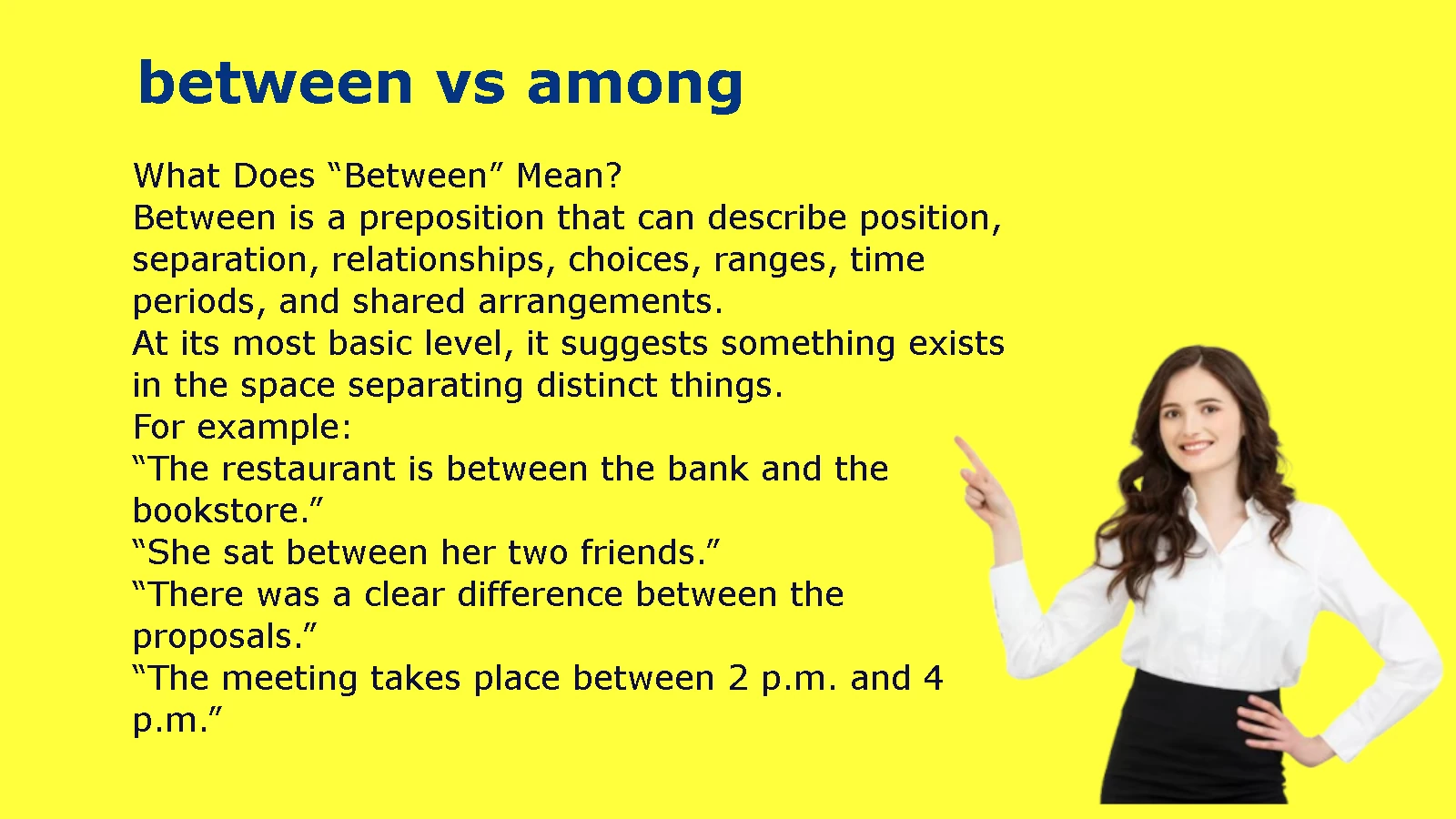
Between is a preposition that can describe position, separation, relationships, choices, ranges, time periods, and shared arrangements.
At its most basic level, it suggests something exists in the space separating distinct things.
For example:
- “The restaurant is between the bank and the bookstore.”
- “She sat between her two friends.”
- “There was a clear difference between the proposals.”
- “The meeting takes place between 2 p.m. and 4 p.m.”
The word can also describe an abstract relationship. You don’t need physical space for between to work.
Consider:
“There is a strong connection between sleep and concentration.”
Sleep and concentration aren’t sitting on opposite sides of a physical gap. Instead, the sentence identifies a specific relationship between two distinct concepts.
Between Can Refer to More Than Two Things
This is where the traditional grammar rule starts to crack.
Many people learn:
Two = between; three or more = among.
That’s a useful starting point, but it’s not an absolute rule.
You can use between with three or more entities when you are treating them as separate and identifiable parties.
For example:
- “The negotiations between the three countries continued.”
- “The differences between the four proposals were significant.”
- “The road runs between several villages.”
- “The agreement between the five organizations created a new partnership.”
The important point is that the entities remain distinct.
Imagine three companies negotiating a contract. You could think of the situation as one group of companies, but the contract involves specific relationships between identifiable parties. Between therefore makes sense.
Cambridge specifically recognizes between for shared or involving relationships among more than two people or things.
What Does “Among” Mean?
Among generally means in the middle of, surrounded by, included in, or part of a group.
For example:
- “She was standing among the crowd.”
- “He found the missing document among the old files.”
- “There was excitement among the students.”
- “The cabin was hidden among the trees.”
Here, the focus isn’t on one-to-one relationships. The focus is the larger setting.
If you say:
“She stood among the trees.”
you picture her surrounded by a collection of trees.
If you say:
“The path runs between the trees.”
you focus more on the distinct spaces or relationships between particular trees.
That’s the heart of the between vs among distinction.
Among Can Describe Group Membership
Among also works when someone or something belongs to or exists within a group.
For example:
- “He was popular among his classmates.”
- “The policy caused concern among parents.”
- “She felt at home among friends.”
- “The tradition remains common among local families.”
In each sentence, the noun after among represents a group.
The person isn’t necessarily interacting separately with every individual member. Instead, the sentence places that person or idea within the group.
Cambridge defines among in terms of being in the middle of, surrounded by, or included as part of a larger group.
Between vs Among: The Main Difference
The simplest reliable way to remember between vs among is to think about individual relationships versus group membership.
Use “Between” for Distinct Entities
Choose between when the people or things are clearly identifiable and the sentence emphasizes their relationship.
Examples:
- “The conflict between the three departments lasted for months.”
- “There is a difference between the four models.”
- “The agreement between the five partners was finalized yesterday.”
- “The negotiations between the countries resumed Monday.”
Each department, model, partner, or country remains a separate entity.
Use “Among” for a Group
Choose among when you want to emphasize the group as a whole.
Examples:
- “The announcement caused confusion among employees.”
- “She searched among the boxes.”
- “The teacher noticed excitement among the students.”
- “The rumor spread quickly among the residents.”
The group matters more than the individual relationships.
A Simple Mental Test
When you’re unsure, ask:
Am I connecting distinct things, or placing something within a group?
If you’re connecting distinct things, between will often work.
If you’re placing something inside a group, among will often work.
Why “Between Means Two” Is an Incomplete Rule
The “two versus three” rule has survived for generations because it gives learners an easy starting point. Unfortunately, it can also create mistakes.
Consider:
“The treaty was negotiated between the three countries.”
That sentence can be perfectly natural because the three countries are separate parties.
Now consider:
“There was disagreement among the three countries.”
Here, among emphasizes disagreement within the group.
Both sentences involve three countries. The correct preposition changes because the relationship changes.
This is why simply counting nouns isn’t enough.
Compare These Sentences
| Sentence | Why it works |
| “The agreement was between the three companies.” | The companies are distinct parties. |
| “There was disagreement among the three companies.” | The companies are viewed collectively. |
| “The differences between the three plans were obvious.” | The plans are being compared individually. |
| “There was confusion among the three teams.” | The teams form a group experiencing confusion. |
The number stays the same. The perspective changes.
Between vs Among With More Than Two People
This is probably the most important point in the entire between vs among debate.
Between can refer to more than two people or things.
Suppose three friends are deciding how to divide responsibility for a project.
You could say:
“The responsibility was divided between the three friends.”
The sentence treats the three friends as distinct participants in a specific arrangement.
You could also say:
“The responsibility was divided among the three friends.”
That version emphasizes the group receiving the responsibility.
Neither sentence is automatically wrong simply because three people are involved.
Another Example
Compare:
“The negotiations between the four companies took six months.”
The four companies are separate negotiating parties.
Now compare:
“There was growing tension among the four companies.”
The companies are presented collectively as a group experiencing tension.
This distinction is more useful than memorizing a numerical rule.
Between vs Among in Distribution
Both words can appear when something gets divided or shared.
That can make sentences such as divided between and divided among confusing.
“Divided Between”
Between works when the recipients are viewed as distinct parties.
For example:
“The inheritance was divided between the three siblings.”
Each sibling is a specific recipient.
You could imagine the distribution as separate relationships:
- sibling A receives a share
- sibling B receives a share
- sibling C receives a share
The focus is on the distinct parties.
“Divided Among”
Among emphasizes distribution throughout a group.
For example:
“The food was divided among the guests.”
The guests are treated as a group receiving portions.
The same basic event can therefore take either preposition depending on the emphasis.
Cambridge gives examples of between used for sharing among several people and among used when something is distributed through a group.
Is “Divided Between” or “Divided Among” Correct?
Both can be correct.
The choice depends on how you frame the recipients.
| Phrase | Typical emphasis |
| Divided between the three siblings | Distinct individuals or parties |
| Divided among the three siblings | The siblings as a group |
| Shared between the two departments | Two distinct parties |
| Shared among the employees | A group of employees |
So don’t automatically replace between with among whenever you see more than two recipients.
Between vs Among in Location
Location provides one of the clearest ways to see the difference.
Between: Separate Points or Objects
Use between when something lies in relation to identifiable objects or boundaries.
For example:
“The house stands between the school and the library.”
There are two clear reference points.
But between can also work with more than two objects when the objects remain individually identifiable.
“A narrow path winds between the trees.”
The trees create distinct spaces around the path.
Cambridge notes that between can describe physical space separating places, people, or objects.
Among: Surrounded by a Group
Use among when something exists within a collection.
“The house is hidden among the trees.”
The image changes.
With between, you picture the relationships and spaces separating individual trees.
With among, you picture the house surrounded by a larger collection of trees
Focus: something located within a group
That’s a simple visual distinction, but it captures the basic idea surprisingly well.
Between vs Among in Relationships
The same principle applies to social and abstract relationships.
Use “Between” for Specific Relationships
Examples include:
- “The relationship between the two companies improved.”
- “There is a strong connection between exercise and sleep.”
- “The difference between the two approaches is significant.”
- “The rivalry between the teams has lasted for years.”
Words such as difference, relationship, connection, distinction, link, and contrast frequently pair with between.
Cambridge specifically lists nouns such as connection, difference, distinction, link, and relationship among common words followed by between.
Use “Among” for Group Dynamics
Now look at these:
- “There was tension among the employees.”
- “The policy created concern among parents.”
- “The idea became popular among teenagers.”
- “There was disagreement among the committee members.”
Here, the emphasis falls on what is happening within the group.
Think of among as putting the reader inside the crowd.
Between vs Among in Comparisons
When you compare clearly defined things, between is usually the natural choice.
For example:
“What is the difference between these three models?”
The models are individually identified.
You might also say:
“The contrast between the three proposals was obvious.”
Again, the writer is comparing distinct items.
Why “Among” Changes the Meaning
Consider:
“The product became popular among college students.”
This isn’t a comparison among individual students. Instead, the students form a group in which the product has become popular.
So:
- difference between = compare distinct things
- popular among = accepted or common within a group
That pattern appears constantly in everyday English.
Between vs Among in Choices
Between commonly introduces choices.
Examples:
- “I had to choose between the red shirt and the blue shirt.”
- “She couldn’t decide between the three universities.”
- “You can choose between several payment options.”
The last example may surprise people who learned the two-item rule.
Yet choose between can naturally refer to multiple distinct options. Cambridge includes choose among verbs commonly followed by between.
What About “Choose Among”?
Choose among also exists, but it can carry a slightly different emphasis.
Compare:
“You can choose between three plans.”
The plans are presented as distinct alternatives.
“You can choose among several available options.”
The options feel more like a group or pool from which you can select.
In many contexts, both may be acceptable. The writer’s intended emphasis determines which sounds better.
Between vs Among in Time
Between is the natural choice when you describe a period separating two points in time.
Examples:
- “The store is open between 9 a.m. and 5 p.m.”
- “I usually study between dinner and bedtime.”
- “The meeting takes place between Monday and Wednesday.”
- “She worked there between 2020 and 2024.”
You can also use it for ranges:
- “The temperature will remain between 60 and 70 degrees.”
- “The trip should take between three and four hours.”
Cambridge explicitly uses between for periods, time ranges, and numerical ranges.
Among generally doesn’t replace between in these constructions.
For example:
“The store is open between 9 a.m. and 5 p.m.”
Not:
“The store is open among 9 a.m. and 5 p.m.”
Between vs Among in Abstract Ideas
Grammar doesn’t become less important just because the nouns aren’t physical.
Consider:
“There is a difference between theory and practice.”
That’s a relationship between two distinct ideas.
Now consider:
“There is disagreement among researchers.”
Researchers form a group within which disagreement exists.
Another pair:
“The connection between education and employment is widely discussed.”
versus:
“The issue remains controversial among educators.”
The first sentence identifies a relationship. The second describes a reaction within a group.
This pattern works across academic, professional, and everyday writing.
Between vs Among in Formal Writing
Precise prepositions can make formal writing much clearer.
Imagine a research report that says:
“The study found disagreement among the three methods.”
That wording sounds odd if the intended meaning is that the methods themselves differ from one another. Methods don’t necessarily form a social group capable of disagreeing.
A clearer sentence might be:
“The study found significant differences between the three methods.”
Now the sentence establishes a comparison between identifiable alternatives.
On the other hand:
“The study found disagreement among the researchers.”
works naturally because researchers can form a group with differing opinions.
Common Academic Pairings
You’ll often see:
Between:
- difference between
- relationship between
- connection between
- distinction between
- contrast between
- comparison between
- interaction between
- link between
Among:
- disagreement among
- differences among
- variation among
- concern among
- support among
- conflict among
- popularity among
- participation among
These aren’t rigid formulas. Context still matters. However, they provide useful clues when you’re deciding which word sounds natural.
Between vs Among in Everyday English
Everyday speech contains many familiar expressions with both words.
Common Expressions With “Between”
- between you and me
- in between
- somewhere between
- between jobs
- between meals
- between the lines
- between two places
For example:
“Just between you and me, I think the plan needs work.”
The expression between you and me is standard English.
Common Expressions With “Among”
- among friends
- among other things
- among others
- among the crowd
- among themselves
- among the students
For example:
“The proposal was discussed among the team members.”
Here, the focus is on discussion within a group.
“Among Other Things” and “Among Others”
Among has a useful meaning in expressions such as among other things and among others.
In these phrases, among can mean something similar to as well as.
For example:
“The job requires writing, research, and, among other things, strong communication skills.”
The phrase signals that the list isn’t complete.
Similarly:
“Several experts, among others, criticized the proposal.”
The phrase indicates that the named experts aren’t the only people involved.
Cambridge identifies these as established uses of among.
Between vs Among: Common Mistakes
Mistake: Thinking Between Only Means Two
This is the most common mistake.
Incorrect assumption:
“There are three companies, so I must use among.”
Not necessarily.
Correct:
“The agreement between the three companies was signed yesterday.”
The companies are distinct parties.
Mistake: Using Among Whenever There Are Three or More
The number of entities doesn’t automatically determine the preposition.
Compare:
“The differences between the three products are minor.”
and:
“The products are popular among consumers.”
The first sentence compares distinct products. The second places a group of consumers around the idea of popularity.
Mistake: Using Among for Two Specific Things
When two distinct things form the relationship, between is normally the natural choice.
For example:
“What’s the difference between cats and dogs?”
Not:
“What’s the difference among cats and dogs?”
The sentence identifies two distinct categories.
Mistake: Confusing “Within a Group” With “Between Individuals”
Compare:
“She felt comfortable among her classmates.”
with:
“She had a disagreement between herself and her classmate.”
The first describes group membership.
The second describes a specific relationship.
Mistake: Assuming the Words Are Always Interchangeable
Sometimes both words can work. That doesn’t mean they communicate exactly the same idea.
Compare:
“The prize was divided between the three finalists.”
“The prize was divided among the three finalists.”
Both can be grammatical. Between can emphasize the finalists as distinct recipients. Among emphasizes distribution throughout the group.
The difference may be subtle, but good writing often depends on subtle distinctions.
Between vs Among Examples
The following examples show how the choice changes with context.
| Sentence | Correct choice | Explanation |
| The house sits ___ two buildings. | between | Two distinct reference points |
| She disappeared ___ the crowd. | among | She was within a group |
| The agreement was ___ the three companies. | between | Three distinct parties |
| There was disagreement ___ the employees. | among | Employees form a group |
| What’s the difference ___ the two plans? | between | Two distinct things are compared |
| The product is popular ___ teenagers. | among | Teenagers form a group |
| The temperature stayed ___ 60 and 70 degrees. | between | A numerical range |
| The money was shared ___ the winners. | among | Distribution within a group |
| The path runs ___ several trees. | between | The trees are treated as separate objects |
| The cabin is hidden ___ the trees. | among | The cabin is surrounded by a group |
| The negotiations ___ the four countries continued. | between | Distinct negotiating parties |
| There was excitement ___ the four countries’ supporters. | among | Supporters are treated as a group |
A Case Study: Three Companies
Imagine Companies A, B, and C are negotiating a shared contract.
You could write:
“The negotiations between the three companies lasted six months.”
Why between?
Because each company is a distinct participant. The sentence focuses on the relationships involved in the negotiations.
Now change the sentence:
“There was disagreement among the three companies.”
Why among?
Because the companies are being viewed collectively as a group in which disagreement exists.
The number hasn’t changed.
The perspective has.
That is the most important lesson to remember when dealing with between vs among.
A Case Study: Three Students
Now imagine three students receive a scholarship.
You could say:
“The scholarship money was divided between the three students.”
This treats each student as a distinct recipient.
You could also say:
“The scholarship money was divided among the three students.”
This emphasizes the distribution throughout the group.
Neither choice becomes automatically wrong simply because there are three students.
The intended emphasis determines the better fit.
A Case Study: Trees and a House
Consider these two sentences:
“The house stands between the trees.”
“The house stands among the trees.”
Both can paint a reasonable picture, but they aren’t identical.
Between directs attention toward the individual trees and the spaces separating them.
Among makes you imagine the house surrounded by a larger collection of trees.
This physical example provides a useful shortcut for understanding abstract uses too.
Between vs Among: A Quick Decision Guide
When you’re stuck, run through these questions.
Are the things distinct and identifiable?
Use between.
“The difference between the three designs is obvious.”
Are you describing something inside a group?
Use among.
“The design became popular among younger buyers.”
Are you describing a specific relationship?
Use between.
“The relationship between the two departments improved.”
Are you describing something happening within a group?
Use among.
“There was disagreement among the department members.”
Are you describing a time or numerical range?
Use between.
“The temperature will remain between 65 and 70 degrees.”
Are you describing group membership or surroundings?
Use among.
“She found herself among experienced professionals.”
Between vs Among: Memory Trick
Here’s an easy way to remember the difference:
Between = distinct relationships.
Among = inside a group.
Picture between as lines connecting separate points.
A ——– B
\ /
\ /
C
Each point remains identifiable.
Now picture among as standing inside a crowd:
● ● ●
●
● ● ●
The focus is the surrounding group rather than the individual connections.
It isn’t a perfect rule for every sentence, but it gives you the right starting point.
Is “Between You and Me” Correct?
Yes.
The expression between you and me is grammatically standard.
For example:
“Just between you and me, I think we should reconsider the plan.”
Here, between identifies the relationship between two specific people.
The pronoun after the preposition should also be in the objective form:
- between you and me
- between him and her
- between us
- between them
Not:
- between you and I
- between he and she
The reason is straightforward: between is a preposition, so it takes object pronouns.
Is It “Between” or “Among” Friends?
Both can be correct, but they express different ideas.
“The secret stayed between the two friends.”
This focuses on a specific relationship.
“She felt relaxed among her friends.”
This focuses on being part of a group.
The same noun, friends, can therefore work with either preposition. Context determines the meaning.
Is It “Choose Between” or “Choose Among”?
Both expressions exist.
Use choose between when the options are presented as distinct alternatives:
“You need to choose between the three plans.”
Use choose among when the choices are framed more like a group or collection:
“You can choose among several available designs.”
In everyday American English, choose between is extremely common even when more than two options exist.
So don’t assume that among is required simply because the number exceeds two.
Is It “Among” or “Amongst”?
Amongst is an alternative form of among, but among is generally the more common choice in modern American English.
For example:
“She was sitting among her friends.”
is more natural for most American readers than:
“She was sitting amongst her friends.”
Cambridge notes that amongst can be used as an alternative and tends to be more formal and less common.
For standard American English, among is usually the safest and most natural option.
Between vs Among in Professional Writing
In business writing, the distinction can affect precision.
Compare:
“The relationship between the sales and marketing departments has improved.”
This identifies two specific departments and their relationship.
Now:
“The new policy caused confusion among employees.”
This describes a reaction within a larger group.
Another example:
“The differences between the five proposals were carefully evaluated.”
The proposals are separate alternatives.
“The proposal received strong support among investors.”
Investors are treated as a group.
Clear preposition choices help readers understand exactly what the sentence is doing.
Between vs Among in Academic Writing
Academic writing often depends on careful comparisons and group descriptions, so this distinction appears frequently.
Consider:
“The researchers identified a significant difference between the three treatment methods.”
The methods are distinct variables or approaches being compared.
Now:
“The researchers found considerable variation among participants.”
The participants form a group in which variation occurs.
That distinction can prevent ambiguity.
Useful Academic Patterns
Between often appears with:
- difference
- relationship
- correlation
- distinction
- contrast
- comparison
- interaction
- connection
- link
Among often appears with:
- participants
- researchers
- students
- employees
- groups
- communities
- consumers
- voters
- members
Again, these are patterns rather than unbreakable rules.
Between vs Among: The Most Important Facts
Here are the facts worth remembering:
- Between does not mean “only two.”
- Among does not simply mean “three or more.”
- Between often highlights distinct entities and their relationships.
- Among often emphasizes a group or collective setting.
- Between works naturally for time and numerical ranges.
- Among commonly describes group membership or something surrounded by a collection.
- Both words can occur with three or more people or things.
- Context matters more than counting nouns.
- Between is common with words such as difference, relationship, and connection.
- Among is common with expressions describing group reactions, membership, and distribution.
Between vs Among Comparison Table
| Feature | Between | Among |
| Main idea | Relationship or separation | Inclusion within a group |
| Usually emphasizes | Distinct entities | Collective group |
| Can refer to more than two? | Yes | Yes |
| Physical location | Space separating distinct objects | Surrounded by a group |
| Group membership | Less common | Very common |
| Specific comparisons | Common | Less common |
| Time ranges | Yes | No |
| Numerical ranges | Yes | No |
| Relationships | Common | Usually group relationships |
| Distribution | Can be used | Common |
| Example | “The difference between the plans” | “Popular among students” |
Frequently Asked Questions About Between vs Among
Is “between” only used for two things?
No. Between can refer to three or more distinct people or things when the sentence emphasizes their individual relationships, comparisons, or connections.
“The agreement between the three countries was finalized.”
Is “among” only used for three or more things?
The traditional rule associates among with groups of three or more, but simply counting entities isn’t enough to determine the correct word. Among emphasizes inclusion within or interaction in a group.
Should I say “between three people” or “among three people”?
Either can be correct. Use between when the three people are distinct parties in a specific relationship. Use among when you’re treating them as a group.
Is it “divided between” or “divided among”?
Both can be correct. Between can emphasize distinct recipients, while among can emphasize distribution throughout a group.
Is “choose between three options” correct?
Yes. Between can introduce more than two clearly defined choices.
Is “among friends” correct?
Yes. Among friends means within or surrounded by a group of friends.
Is “between you and me” correct?
Yes. Between you and me is the standard grammatical form.
Can “between” and “among” be interchangeable?
Sometimes they can describe the same general situation, particularly with distribution. However, they often create different emphasis. Between tends to make individual relationships more visible, while among tends to emphasize the group.
Final Takeaway: Between vs Among
The biggest mistake with between vs among is treating the choice as a simple counting exercise.
Two doesn’t automatically mean between, and three doesn’t automatically mean among.
Instead, look at the relationship you’re describing.
Use between when you want to connect, compare, separate, or identify a relationship involving distinct entities:
“The difference between the three proposals was significant.”
Use among when you want to show that something exists within, surrounds, or involves a group:
“There was strong support among the employees.”
If you remember only one thing, remember this:
Between focuses on distinct relationships. Among focuses on groups.
Once you start looking at meaning rather than simply counting nouns, the difference becomes much clearer. And that makes choosing the right word far less of a guessing game.