Privilege is the correct spelling, while priviledge is a common spelling mistake. The word privilege means a special right, advantage, benefit, or honor that a person or group receives. You might use it when describing an opportunity to meet someone important, a legal protection, or an advantage that not everyone enjoys.
The confusion usually comes from the way English words sound. Writers often add a silent “d” because they associate the final sound with words such as bridge, badge, and knowledge. However, the correct spelling contains no “d.” Understanding the privilege definition, its grammatical forms, and its use in everyday and professional sentences will help you avoid this mistake. With a few practical examples and an easy memory trick, you can spell privilege vs. priviledge correctly whenever you write an email, essay, report, or social media post.
Priviledge vs Privilege: Which Spelling Is Correct?
Privilege is the only correct spelling in standard English. Priviledge is a misspelling and should not appear in polished writing. Although both forms may look similar and sound nearly identical, only privilege follows the accepted spelling of the word.
Here is the difference at a glance:
| Word | Spelling status | Meaning | Example |
| Privilege | Correct | A special right, advantage, or honor | It was a privilege to attend the ceremony. |
| Priviledge | Incorrect | A common spelling error | Replace “priviledge” with “privilege” in your essay. |
The difference comes down to one extra letter. The incorrect version inserts a d before the final g. The correct word does not contain that letter.
How to Spell Privilege Correctly
To spell privilege correctly, write it as follows:
P-R-I-V-I-L-E-G-E
Break the word into smaller parts to make it easier to remember:
- PRIVI — the opening letters.
- LEG — the middle letter sequence.
- E — the final letter.
The complete spelling is privilege, not priviledge.
For example, write:
- Correct: “It is a privilege to represent our school.”
- Incorrect: “It is a priviledge to represent our school.”
This distinction matters in school assignments, job applications, business correspondence, and published content. A spelling mistake can distract readers from your message, even when they understand what you mean.
Is Priviledge Ever Correct?
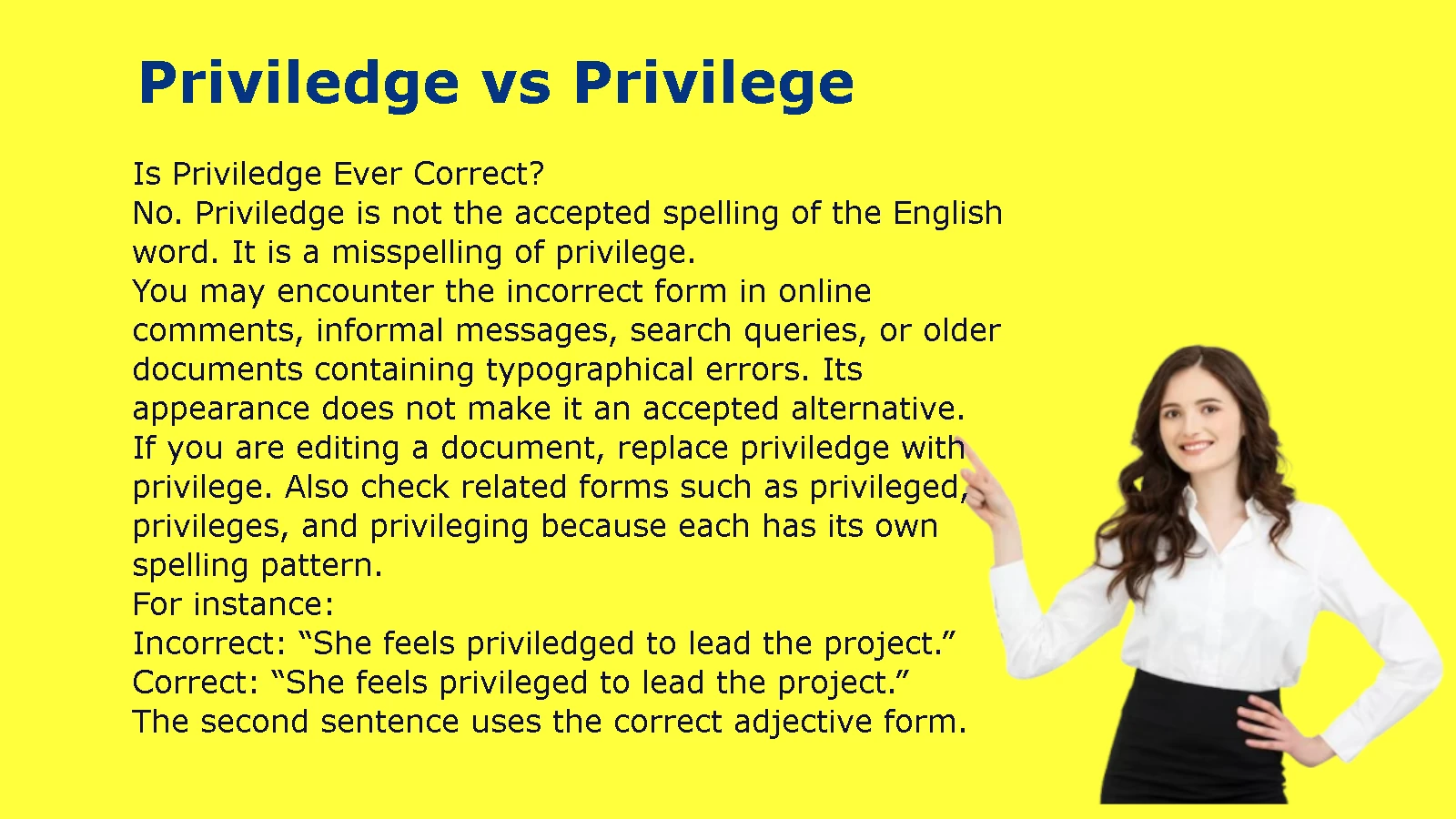
No. Priviledge is not the accepted spelling of the English word. It is a misspelling of privilege.
You may encounter the incorrect form in online comments, informal messages, search queries, or older documents containing typographical errors. Its appearance does not make it an accepted alternative.
If you are editing a document, replace priviledge with privilege. Also check related forms such as privileged, privileges, and privileging because each has its own spelling pattern.
For instance:
- Incorrect: “She feels priviledged to lead the project.”
- Correct: “She feels privileged to lead the project.”
The second sentence uses the correct adjective form.
Why Do So Many People Spell It “Priviledge”?
People often spell privilege incorrectly because English pronunciation does not always reveal the exact letters a word needs. The ending of privilege can remind writers of words that contain “dge,” so they insert a d even though the standard spelling has no such letter.
This is a common example of how familiar spelling patterns can influence memory. A writer may know the word’s meaning perfectly but still choose the wrong letters when typing quickly.
The Confusion Between “-ge” and “-dge”
English uses several spelling patterns to represent similar sounds. Words such as edge, ledge, badge, and bridge contain “dge.” Other words, including age, stage, and college, use “ge” for a similar soft sound.
Compare these examples:
| Word | Correct ending | Example |
| Privilege | -lege | She considered it a privilege to speak. |
| College | -lege | He plans to attend college. |
| Knowledge | -ledge | Knowledge helps people make informed decisions. |
| Bridge | -idge | The bridge crosses the river. |
| Badge | -dge | The employee wore an identification badge. |
| Edge | -dge | Keep the glass away from the edge. |
Notice that privilege and college share the same final letter sequence, “lege.” Neither word needs a d before its final g.
The mistake becomes easier to understand when you consider how people learn spelling. Readers often remember a word by connecting it to other familiar words. If someone remembers the sound of bridge or badge, that pattern may influence how they write privilege.
However, English spelling depends on the individual word, not just the sound. Similar pronunciation does not guarantee identical spelling.
Why Pronunciation Can Be Misleading
The final syllables of privilege and knowledge sound similar, although their spellings differ. When you hear a word rather than see it written, your brain must choose the letters that best match the sound.
That process can produce errors when several spellings seem reasonable.
For example, someone might write:
- Priviledge instead of privilege
- Knowlege instead of knowledge
- Collage when they mean college
These mistakes are not identical, but they demonstrate the same problem: a familiar sound can lead to an incorrect spelling.
The best solution is to connect each word with its established written form. When you learn privilege, remember the complete spelling rather than trying to reconstruct it from pronunciation alone.
Practical tip: If you frequently misspell a word, write it correctly several times in meaningful sentences. This reinforces the visual pattern and makes the correct form easier to recall.
Etymology: Where Does the Word Privilege Come From?
The word privilege has historical roots in Latin and developed through French before entering English. Its history helps explain its connection to individual rights and special advantages, although the modern spelling is best learned as a complete word.
Understanding word origins can make vocabulary more memorable. It also shows why the spelling of privilege does not require a “d.”
The Latin Roots of Privilege
The English word comes from Latin privilegium, a term associated with a law or legal provision affecting a particular individual. It passed through Old French before developing into the English word used today.
Two Latin elements help explain the original meaning:
- Privus: Private, individual, or particular.
- Lex: Law. Its related stem, leg-, appears in forms connected with legislation and legal concepts.
The historical idea involved a provision or rule applying to a particular person rather than a general rule for everyone.
Over time, privilege developed broader meanings. Today, it can refer to a special right, an advantage, a benefit, or an opportunity that someone values.
For example, a person might describe meeting a respected teacher as a privilege. In a legal setting, the same word can describe a protection recognized under particular rules.
Does the Latin Root Explain the Spelling?
The Latin background can help you remember that privilege belongs to a family of words associated with law and individual rights. However, it is not necessary to know Latin to spell the English word correctly.
The “LEG” memory trick works as a reminder, not as a complete explanation of every letter in the word.
Think of the spelling this way:
- Start with privi-.
- Keep the leg sequence in the middle.
- Finish with -e.
This gives you privilege without inserting an extra consonant.
Do not assume that every word containing a similar sound follows the same historical pattern. Etymology helps explain where words come from, but modern spelling still requires you to learn the accepted form.
What Does Privilege Mean?
Privilege is a noun meaning a special right, advantage, benefit, or honor. It can also function as a verb meaning to favor or give priority to someone or something. The intended meaning depends on the sentence, so context determines whether the word describes an opportunity, a protected right, or preferential treatment.
For example, receiving an invitation to a private event may be a privilege. Giving one employee preferential treatment over others may mean that a manager privileges that employee.
Privilege as a Noun
As a noun, privilege describes something a person can enjoy, receive, or benefit from.
The word often appears in personal, educational, professional, and social contexts.
Examples include:
- “It was a privilege to meet the award-winning author.”
- “Students received the privilege of using the research laboratory.”
- “Working with such a talented team is a privilege.”
- “The organization offers parking privileges to senior employees.”
- “Some families have access to educational opportunities that others cannot afford.”
In these examples, privilege refers to an opportunity, benefit, or advantage.
The word can also describe a special right that comes with a particular position. For example, a company might give senior employees access to certain facilities. Those benefits may be described as workplace privileges.
However, not every advantage is a formal right. Someone can call an opportunity a privilege simply because they value it or recognize that not everyone receives the same opportunity.
Privilege as a Verb
Although many people first learn privilege as a noun, it can also function as a verb.
To privilege someone or something means to favor it, give it priority, or provide it with an advantage.
Consider these examples:
- “The policy should not privilege large corporations over small businesses.”
- “The school aims to privilege critical thinking over memorization.”
- “The committee should not privilege personal connections when selecting candidates.”
- “The new system privileges speed over detailed customization.”
In each sentence, the verb describes a preference or priority.
This use often appears in academic writing, social analysis, public policy, and professional discussions. It can sound more formal than phrases such as favor, give priority to, or give an advantage to.
When you use privilege as a verb, make sure the sentence makes the intended preference clear.
For instance, “The policy privileges established businesses” means the policy favors those businesses. It does not mean the businesses simply possess a special right.
Privilege in Legal and Professional Contexts
In legal and professional settings, privilege can refer to a recognized protection or special right.
One familiar example is attorney-client privilege, a legal protection that can prevent certain confidential communications between a lawyer and a client from being disclosed in legal proceedings.
The exact rules and exceptions depend on the applicable law and circumstances. The phrase does not mean that every conversation with a lawyer automatically receives absolute protection.
Other professional uses include:
- Executive privileges: Special benefits or permissions associated with a senior role.
- Access privileges: Permissions that determine which files, systems, or facilities someone may use.
- Voting privileges: Rights or permissions related to voting under applicable rules.
- Membership privileges: Benefits available to members of a club, organization, or service.
The meaning changes with the context, but the spelling remains the same in every case.
For example, a software administrator might say, “The employee’s access privileges were reduced.” In this sentence, privileges means permissions within a system.
A lawyer might discuss “attorney-client privilege,” where the word refers to a specific legal protection. Both uses are correct.
Priviledge vs Privilege: Quick Comparison
The easiest way to distinguish the two forms is to check their spelling and meaning. Privilege is the correct word for a special right or advantage, while priviledge is an error that should be corrected.
| Feature | Privilege | Priviledge |
| Spelling status | Correct | Incorrect |
| Dictionary-standard word | Yes | No |
| Meaning | A special right, advantage, benefit, or honor | No accepted standard meaning |
| Grammatical use | Noun or verb | Misspelling |
| Example | “Education is a right, not a privilege.” | “Education is a right, not a priviledge.” |
| Appropriate in formal writing | Yes | No |
| Contains an extra “d” | No | Yes |
The comparison is straightforward: use privilege whenever you mean the accepted English word.
Privilege vs. Priviledge in Everyday Writing
A spelling error can appear in many kinds of writing, including text messages, emails, essays, resumes, and workplace reports.
Consider this short example:
Incorrect: “It was a priviledge to work with your team, and I appreciate the opportunity.”
Correct: “It was a privilege to work with your team, and I appreciate the opportunity.”
The correction does not change the meaning of the sentence. It simply makes the writing accurate and professional.
Here are three more examples:
| Incorrect sentence | Correct sentence |
| “She had the priviledge of meeting the director.” | “She had the privilege of meeting the director.” |
| “The company offers special parking priviledges.” | “The company offers special parking privileges.” |
| “He feels priviledged to represent his community.” | “He feels privileged to represent his community.” |
Pay attention to the second example. The correct plural form is privileges, not priviledges. The third example uses privileged, which follows a different ending pattern.
These related forms deserve special attention because correcting the base word alone will not fix every possible spelling error.
How to Remember the Correct Spelling of Privilege
The best spelling strategy is to choose a memory aid that directly addresses your mistake. If you repeatedly insert a “d,” use a reminder that tells you to leave it out.
Two useful techniques are the “No D” rule and the “LEG” trick. Both are easy to apply when you write the word from memory.
Use the “No D” Memory Trick
Remember this simple rule:
Privilege has no “d” before the “g.”
The incorrect spelling priviledge contains an extra letter. Removing that letter produces the correct spelling.
Try this quick exercise:
- Write privilege without looking at the word.
- Check whether you accidentally added a “d.”
- Repeat the word in a complete sentence.
- Review the spelling again before using it in important writing.
For example:
- “It is a privilege to help the community.”
- “The employee received additional privileges.”
- “She felt privileged to attend the event.”
Practicing the base word alongside its related forms helps you recognize the correct spelling in different grammatical situations.
You can also create a short personal reminder: “A privilege needs no D.” The phrase is simple enough to recall while typing.
Use the “LEG” Spelling Trick
Another way to remember privilege is to focus on the letters LEG near the end of the word.
Think of the word as privi + leg + e. This visual breakdown reminds you to preserve the correct letter sequence without adding a “d.”
You can connect the trick to the word’s historical association with law, but remember that it is a memory aid rather than a complete rule for English spelling.
Practice it with these sentences:
- “It was a privilege to attend the ceremony.”
- “The policy should not privilege one group over another.”
- “Access privileges depend on the employee’s role.”
Each sentence contains the same core spelling, even though the word serves a different purpose.
Learn the Correct Forms: Privilege, Privileges, Privileged, and Privileging
One common mistake is to learn privilege correctly but misspell its related forms. The solution is to understand how the word changes when you use it as a plural noun, adjective, or verb form.
| Word form | Part of speech | Meaning or function | Example |
| Privilege | Noun or verb | A special advantage; to favor something | “It is a privilege to serve.” |
| Privileges | Plural noun or verb | Multiple benefits; favors something | “Members enjoy several privileges.” |
| Privileged | Adjective or past-tense verb | Having an advantage; gave preference to | “She comes from a privileged background.” |
| Privileging | Present participle or gerund | Favoring or giving priority to something | “The policy is privileging speed over accuracy.” |
The most important distinction is between privilege and privileged.
The base word privilege contains no “d.” The form privileged includes a “d” because the word adds the suffix -ed. That does not make priviledge correct.
Compare the following:
- Correct: “I appreciate the privilege.”
- Correct: “I feel privileged to participate.”
- Incorrect: “I feel priviledged to participate.”
The spelling of privileged may seem confusing because it contains a “d,” but the letter belongs to the ending, not the base word.
Singular and Plural Agreement
Correct spelling also requires correct grammatical agreement.
Use privilege when referring to one benefit or when using the word as a verb with the appropriate subject. Use privileges when referring to multiple benefits or when the verb takes a third-person singular subject.
Examples:
- “This privilege comes with certain responsibilities.” — Singular noun.
- “These privileges come with certain responsibilities.” — Plural noun.
- “The policy privileges efficiency over convenience.” — Singular subject with a verb.
- “The policies privilege efficiency over convenience.” — Plural subject with a verb.
Notice that the verb changes depending on the subject. In the third example, privileges is a verb, not a plural noun.
This distinction matters when editing articles, academic work, or business documents. A sentence may contain the correct spelling but still have a grammatical error.
Privilege Examples in Sentences
Seeing privilege in different contexts makes its meaning easier to understand. The following examples show how to use the word naturally in personal conversations, academic writing, professional communication, and legal discussions.
Everyday and Personal Examples
In everyday English, privilege often describes a valued opportunity or benefit. It can also express gratitude or acknowledge that someone has an advantage others may not share.
Here are some original examples:
- “It was a privilege to spend the afternoon learning from an experienced mentor.”
- “Having a safe place to live should not be treated as a privilege.”
- “She considered it a privilege to care for her grandparents.”
- “The invitation gave us the privilege of attending the private exhibition.”
- “Traveling abroad opened his eyes to the privileges he had taken for granted.”
The meaning depends on the situation. In the first and third sentences, privilege expresses appreciation. In the second and fifth, it refers to an advantage or benefit that may not be equally available to everyone.
You can also use the word in polite expressions:
- “It would be a privilege to assist you.”
- “Thank you for giving me the privilege of joining your team.”
- “I had the privilege of hearing her speak in person.”
These expressions work well in speeches, thank-you notes, professional introductions, and formal correspondence.
Academic and Professional Examples
In academic and workplace settings, privilege can describe opportunities, permissions, or unequal advantages. As a verb, it can identify a person, idea, or priority that receives preferential treatment.
Consider these examples:
- “The university granted research privileges to qualified students.”
- “It was a privilege to present our findings to the board.”
- “The hiring process should not privilege personal connections over relevant skills.”
- “The company restricted access privileges after the security review.”
- “The new training program privileges practical experience over theoretical knowledge.”
These examples demonstrate why context matters. The first two use privilege to describe benefits or valued opportunities. The remaining examples show how the word can describe permissions or preferential treatment.
For business writing, choose the meaning that fits your point. If you simply mean that someone received a benefit, words such as benefit or opportunity may sound more direct. If you mean that a policy favors one group over another, privilege may communicate the idea more precisely.
Legal Examples
Legal writing uses privilege in specific ways. The word may refer to a recognized protection, permission, or special right under applicable law.
Examples include:
- “The lawyer explained the limits of attorney-client privilege.”
- “The court considered whether the communication qualified for legal protection.”
- “The organization reviewed each employee’s system access privileges.”
- “The agreement described the privileges available to participating members.”
Legal meanings often depend on the governing rules and the facts of a particular situation. Avoid assuming that every advantage is a legal privilege or that every conversation with a lawyer receives automatic protection.
A Practical Editing Example
Imagine that a marketing manager drafts the following email:
“It was a priviledge to collaborate with your team. We appreciate the opportunity and hope to continue working together.”
The message is friendly and clear, but the misspelling distracts from its professional tone.
The corrected version reads:
“It was a privilege to collaborate with your team. We appreciate the opportunity and hope to continue working together.”
Only one letter changed, yet the revised version looks more polished. This illustrates an important editing principle: small spelling errors can affect the credibility of otherwise strong writing.
Before sending a professional email, check commonly confused words such as privilege, separate, definitely, and accommodate. A quick proofreading pass can catch errors that spell-checking tools sometimes miss.
Frequently Asked Questions About Priviledge vs Privilege
Is priviledge a word?
No. Priviledge is a common misspelling of privilege, not the accepted spelling in standard English. Use privilege when referring to a special right, advantage, benefit, or honor.
Why is privilege spelled without a “d”?
The standard spelling is privilege. The extra “d” often appears because writers associate the ending with words such as bridge and badge. However, privilege follows its own established spelling pattern.
What is the adjective form of privilege?
The adjective form is privileged. It describes someone who has a particular advantage, benefit, or favorable position.
Example: “She had a privileged upbringing.”
The word privileged contains a “d” because it adds the suffix -ed to privilege. The base word itself still has no “d.”
How many syllables are in privilege?
Privilege generally has three syllables: priv-i-lege. Pronunciation varies slightly by accent, but the word is commonly spoken with three syllables in standard English.
Remember that the spoken syllables do not determine whether a “d” belongs in the spelling.
What is the plural of privilege?
The plural is privileges.
For example: “Employees receive several privileges after completing their probation period.”
The word can also function as a verb. In “The policy privileges certain industries,” the ending -s marks the verb’s agreement with a singular subject.
What is the difference between privilege and privileged?
Privilege is a noun or verb, while privileged is an adjective or a past-tense verb form.
Compare these sentences:
- “It was a privilege to attend the conference.” Here, privilege is a noun.
- “She felt privileged to attend the conference.” Here, privileged is an adjective.
Both words are correct, but they perform different grammatical functions.
Conclusion: Remember the Correct Spelling of Privilege
The difference between Priviledge vs Privilege is simple: privilege is correct, and priviledge is a misspelling. The word can describe a special right, an advantage, a valued opportunity, or a form of preferential treatment. Its meaning changes with context, but its spelling stays consistent.
Use the “No D” trick whenever you feel tempted to insert an extra letter. You can also remember the “LEG” sequence in the middle of the word. When writing related forms, distinguish privilege, privileges, privileged, and privileging so you can choose the correct form for each sentence.
Before submitting an essay, sending a business email, or publishing an article, take a moment to check your spelling. If you have written priviledge, replace it with privilege. That small correction helps your writing remain clear, accurate, and professional.