Ever come across the words Dike or Dyke and wondered why they look the same but appear in completely different contexts? The confusion is common because both spellings can refer to very different meanings depending on geography, engineering, or language usage.
That’s the problem most readers face. In some cases, dike or dyke refers to a man-made water barrier used in flood control and land protection, while in other contexts, it can have entirely different linguistic or cultural meanings. You’re not alone if this has caused confusion while reading articles, maps, or technical texts—and here’s the kicker: using the wrong spelling in the wrong context can completely change your meaning.
But don’t worry, this is easier to understand than it seems.
In this guide, you’ll learn the clear difference between dike or dyke, where each term is used (American vs British English), and how it applies in contexts like flood defense structures, coastal engineering, and general language usage. You’ll also see simple examples that make the distinction easy to remember.
So let’s break it down and clear up the confusion once and for all.
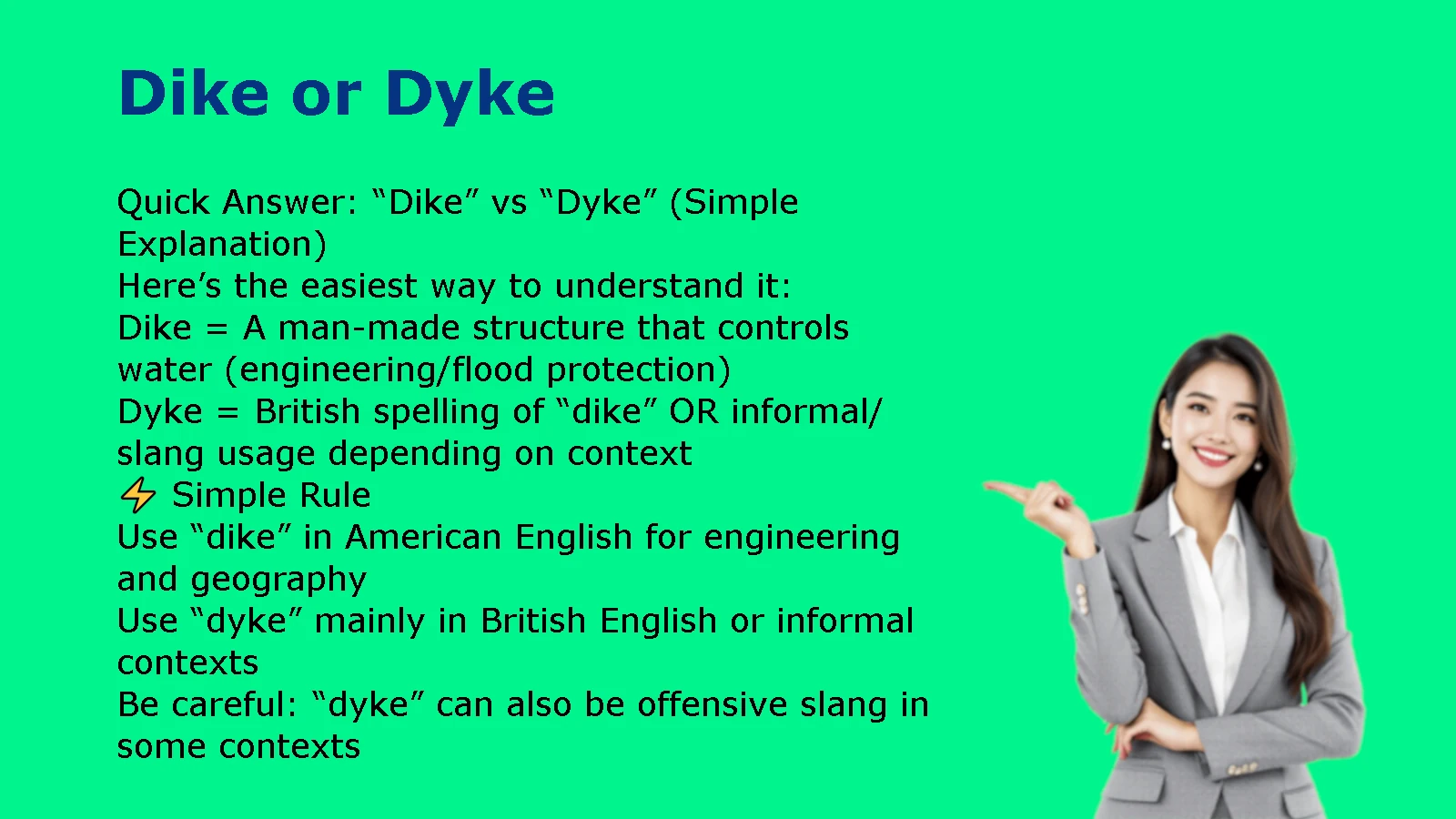
Quick Answer: “Dike” vs “Dyke” (Simple Explanation)
Here’s the easiest way to understand it:
Dike = A man-made structure that controls water (engineering/flood protection)
Dyke = British spelling of “dike” OR informal/slang usage depending on context
⚡ Simple Rule
- Use “dike” in American English for engineering and geography
- Use “dyke” mainly in British English or informal contexts
- Be careful: “dyke” can also be offensive slang in some contexts
The Core Meaning of “Dike” (Engineering & Geography)
In modern usage, “dike” is the most widely accepted spelling, especially in American English.
It refers to a barrier built to prevent flooding or control water flow.
Examples of “Dike”
- “The city built a strong dike to stop river flooding.”
- “Farmers rely on dikes to protect farmland from seawater.”
- “The coastal dike saved the village during the storm.”
Key Idea
A dike = protection against water
It is commonly used in:
- Civil engineering
- Flood control systems
- Coastal protection
The Meaning of “Dyke” (Why It Confuses People)
The spelling “dyke” is where confusion starts.
It has multiple meanings depending on region and context:
1. British English Spelling
In some British usage, “dyke” = “dike” (same meaning: water barrier).
- “The dyke prevented the sea from entering the land.”
2. Informal / Slang Usage (Important)
In some contexts, especially historically, “dyke” has been used as a derogatory term for a lesbian.
⚠️ This usage is considered offensive when used as an insult and should be avoided unless discussing language or identity in a respectful, academic way.
Key Takeaway
- Engineering context → usually means dike
- British spelling → sometimes dyke
- Slang context → can be sensitive or offensive
Why “Dike vs Dyke” Causes Confusion
There are three main reasons:
1. Same pronunciation
Both words are pronounced exactly the same → /daɪk/
2. Different English variants
- American English prefers dike
- British English sometimes uses dyke
3. Multiple meanings
“Dyke” has additional social and cultural meanings, unlike “dike”
Side-by-Side Comparison Table
| Word | Main Meaning | Usage Region | Safety of Use |
|---|---|---|---|
| Dike | Water barrier / flood control | American English (standard) | Safe |
| Dyke | Same as dike (UK usage) | British English (less common) | Context-dependent |
| Dyke | Slang term (informal/offensive in some contexts) | Informal speech | Use carefully |
Real-Life Examples of “Dike”
- “Engineers reinforced the dike before the hurricane.”
- “The river dike collapsed after heavy rain.”
- “New dikes were built along the coastline.”
What it always means here:
A physical structure for controlling water
Real-Life Examples of “Dyke”
British English Usage
- “The village sits behind an old dyke.”
Slang Context (Be Careful)
- The word can appear in informal speech, but it may be offensive depending on intent and audience.
👉 In professional writing, avoid slang usage entirely.
Common Mistakes People Make
❌ Using “dyke” in technical writing without context
This can confuse readers or sound incorrect in American English.
❌ Assuming both spellings are always interchangeable
They are not, especially in global communication.
❌ Ignoring slang meaning
This can lead to unintended offense.
How to Choose the Correct Word Every Time
Use this simple decision guide:
- Talking about floods, rivers, engineering → Dike
- Writing British English geography → Dyke (context-dependent)
- Professional or global audience → Always use “dike”
- Unsure? → Stick with dike
Quick Memory Trick
Think of it like this:
💧 Dike = Defends water (engineering)
🌍 Dyke = Dialect or context-dependent spelling
FAQ: Dike vs Dyke
Is “dyke” incorrect spelling?
Not always. It can be British English, but “dike” is more standard globally.
Are “dike” and “dyke” pronounced differently?
No, both are pronounced the same.
Should I use “dyke” in formal writing?
It’s safer to use “dike” unless you’re specifically using British English sources.
Why does “dyke” have another meaning?
Language evolves, and some words develop slang meanings over time.
Final Takeaway
The difference between “dike” and “dyke” comes down to context, region, and sensitivity.
- If you’re talking about engineering or flood control, use dike
- If you see dyke, check whether it’s British spelling or another context
- In professional writing, “dike” is the safest and clearest choice
👉 The best rule is simple: when in doubt, use “dike” and avoid confusion altogether.