Ever wondered why Personal vs. Personnel causes so much confusion in writing? These two words look almost identical, but one relates to private matters, individual information, and personal life, while the other refers to employees, staff members, and a company’s workforce.
You’re not alone if you’ve mixed them up before. Many writers, students, and professionals accidentally use the wrong term in business communication, workplace documents, HR policies, or everyday conversations. And here’s the kicker: a single spelling mistake can make your writing appear less polished and even change the meaning of your message.
But don’t worry—understanding the difference is simpler than it seems.
In this guide, you’ll learn the exact distinction between Personal vs. Personnel, when to use each word correctly, and how they apply in contexts such as human resources, employee management, professional correspondence, and personal records. And it gets better—you’ll also discover easy memory tricks and real-world examples that make these commonly confused words impossible to mix up.
So, if you want to improve your grammar, vocabulary, and writing accuracy, keep reading. By the end, you’ll know exactly when to use personal and when to use personnel with confidence.
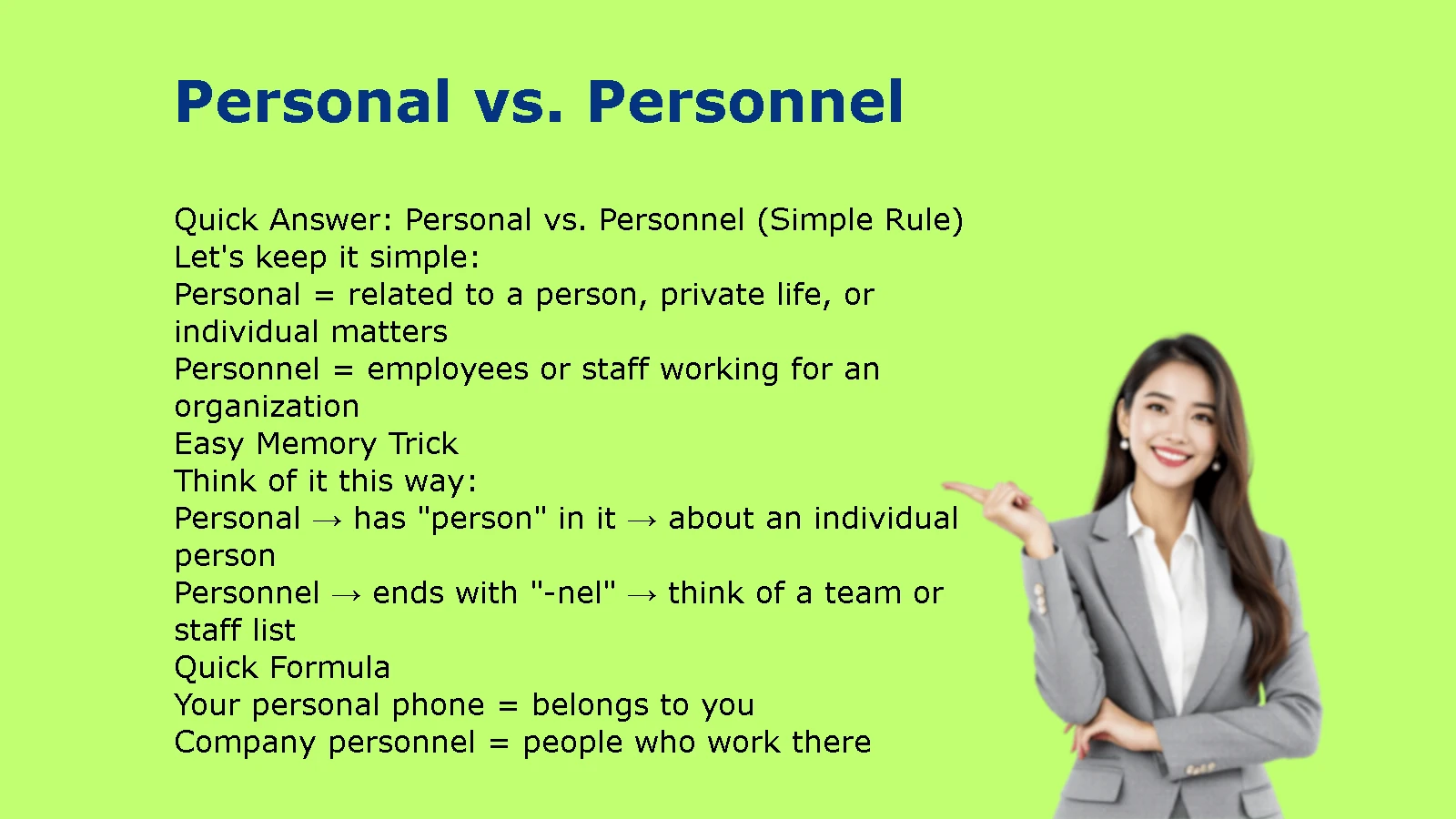
Quick Answer: Personal vs. Personnel (Simple Rule)
Let’s keep it simple:
Personal = related to a person, private life, or individual matters
Personnel = employees or staff working for an organization
Easy Memory Trick
Think of it this way:
- Personal → has “person” in it → about an individual person
- Personnel → ends with “-nel” → think of a team or staff list
Quick Formula
- Your personal phone = belongs to you
- Company personnel = people who work there
How People Actually Use Personal and Personnel
This confusion happens because the words look very similar.
In Everyday Conversations
People often use personal when discussing:
- Personal goals
- Personal opinions
- Personal belongings
- Personal relationships
In Workplaces
You’ll usually hear personnel when talking about:
- Human resources
- Company staff
- Military members
- Employee management
Why the Confusion Happens
- Both words start with “person”
- Their spellings are nearly identical
- Many people rarely use “personnel” outside work settings
The Core Difference Between Personal and Personnel
The easiest way to understand them is by looking at what each word refers to.
| Word | Meaning | Refers To |
|---|---|---|
| Personal | Private or individual | One person |
| Personnel | Employees or staff | A group of workers |
Key Insight
Personal = individual
Personnel = employees
That’s the distinction you should remember every time.
“Personal” Explained Clearly
The word personal relates to an individual person.
Common Meanings
It can describe:
- Private matters
- Individual preferences
- Personal property
- Personal experiences
Examples
- This is my personal laptop.
- She shared a personal story.
- That’s a personal decision.
- Please keep this information personal.
What Personal Does NOT Mean
It does not refer to company employees or staff members.
Incorrect:
- The company hired new personal.
Correct:
- The company hired new personnel.
Key Takeaway
Whenever you’re talking about something belonging to, affecting, or relating to an individual, use personal.
“Personnel” Explained Clearly
Now let’s look at personnel.
Standard Meaning
Personnel refers to people employed by an organization.
Common Uses
You’ll often see it in:
- Human resources
- Government agencies
- Military organizations
- Business documents
Examples
- The company added new personnel.
- Security personnel monitored the event.
- Military personnel arrived early.
- Personnel records must remain confidential.
Important Note
Personnel is usually treated as a collective noun referring to employees as a group.
Key Takeaway
If you’re talking about workers, staff, employees, or members of an organization, use personnel.
The Biggest Mistake People Make
Most errors happen because writers focus on spelling rather than meaning.
What Goes Wrong
Someone wants to write:
“Please update your personal information.”
But accidentally writes:
“Please update your personnel information.”
The sentence suddenly sounds like it’s referring to employee records rather than private information.
Real Scenario
An employee receives an email:
“Update your personnel details.”
They may think it’s an HR-related request.
But if the intention was personal contact information, the message becomes confusing.
Lesson
Always ask:
Am I talking about an individual person or a group of employees?
Side-by-Side Comparison Table
Here’s a quick reference guide:
| Word | Meaning | Common Use | Risk of Confusion |
|---|---|---|---|
| Personal | Individual or private | Personal life, belongings, information | Medium |
| Personnel | Employees or staff | HR, workforce, company staff | High |
Real-Life Examples of Personal
Let’s see it in action.
Common Situations
- My personal email is different from my work email.
- She has a personal interest in photography.
- This is a personal matter.
- He gave his personal opinion.
Mini Scenario
A friend asks:
“Can I borrow your laptop?”
You reply:
“Sorry, that’s my personal laptop.”
The meaning is clear—it belongs to you personally.
Real-Life Examples of Personnel
Now compare these examples.
Common Situations
- Emergency personnel arrived quickly.
- The company increased its personnel.
- Airport personnel assisted travelers.
- Personnel records are stored securely.
Mini Scenario
A manager says:
“We need additional personnel for the project.”
Everyone understands that more employees are needed.
Personal Information vs. Personnel Information
This is one of the most commonly confused phrases.
Personal Information
Refers to information about an individual.
Examples:
- Name
- Address
- Phone number
- Date of birth
Personnel Information
Refers to employee-related records.
Examples:
- Employment history
- Job title
- Salary records
- Performance evaluations
Quick Tip
If it belongs to a person, it’s usually personal information.
If it belongs to employee records, it’s often personnel information.
Common Mistakes and Corrections
Incorrect
- Please update your personnel email address.
Correct
- Please update your personal email address.
Incorrect
- The company hired ten new personals.
Correct
- The company hired ten new personnel.
Incorrect
- That’s a personnel choice.
Correct
- That’s a personal choice.
Incorrect
- Personnel belongings are not allowed inside.
Correct
- Personal belongings are not allowed inside.
Memory Tricks That Actually Work
Trick #1: Personal = Private
Both start with P.
Personal = Private
Trick #2: Personnel = Employees
Think of personnel as a staff roster or employee list.
Trick #3: One Person vs. Many Workers
- Personal → one individual
- Personnel → many employees
Why These Work
Simple associations help your brain recall the correct word instantly.
What to Say Instead When Unsure
If you’re worried about making a mistake, use clearer alternatives.
Instead of Personal
Try:
- Private
- Individual
- Personalized
- Own
Instead of Personnel
Try:
- Staff
- Employees
- Workforce
- Team members
Example
Instead of:
“Company personnel”
You can write:
“Company staff”
It’s often clearer and easier to understand.
Quick Decision Guide (Use This Instantly)
Ask yourself one question:
Am I talking about a person or employees?
If it’s about an individual → Personal
If it’s about workers or staff → Personnel
Fast Rule
- Personal = private or individual
- Personnel = employees
Simple. Reliable. Done.
FAQ: Personal vs. Personnel
Is personnel singular or plural?
Personnel is a collective noun that refers to employees as a group.
Can personal refer to employees?
No. Personal relates to an individual, not staff members.
Why are these words confusing?
Because they look and sound similar but have completely different meanings.
Which word is more common?
Personal is used far more often in everyday conversation, while personnel appears frequently in workplace and organizational contexts.
Case Study: An Email Mix-Up
A company sent an email to all employees.
The message said:
“Please update your personnel contact information.”
What Happened
Some employees thought HR records needed updating.
Others believed it referred to emergency contacts.
The intended meaning was:
“Update your personal contact information.”
Result
Confusion and unnecessary follow-up emails.
Fix
The company revised the message:
“Please update your personal contact information.”
The confusion disappeared immediately.
Key Facts You Should Remember
- Personal relates to an individual person.
- Personnel refers to employees or staff.
- Personal information is private information.
- Personnel records are employee records.
- The words look similar but mean very different things.
- Most mistakes happen in workplace communication.
- Simple memory tricks can prevent confusion.
Final Takeaway: The One Rule That Never Fails
Here’s the easiest way to remember the difference between personal vs. personnel:
Personal = about a person
Personnel = people who work for an organization
Whenever you’re unsure, ask yourself whether you’re discussing an individual’s private matters or a company’s employees.
If it’s private, individual, or belongs to one person, choose personal.
If it’s about staff, workers, or employees, choose personnel.
That single distinction will help you avoid almost every mistake and communicate with confidence every time.