Ever stopped while writing and wondered whether Elfs vs. Elves is the correct plural form? You’re not alone. This common grammar mistake confuses writers, students, and English learners because both words look plausible at first glance.
The confusion comes from the way English handles plural nouns. While many words simply add an “s,” others follow unique spelling rules that can make choosing the correct form tricky. And here’s the kicker: using the wrong plural can make your writing appear less polished and grammatically incorrect.
But don’t worry—there’s an easy explanation.
In this guide, you’ll learn the difference between Elfs vs. Elves, which spelling is considered standard English, and why one form is accepted while the other is usually viewed as an error. You’ll also discover the grammar rules, word forms, and real-world examples that make the correct usage easy to remember.
So whether you’re writing about fantasy creatures, checking your English grammar, or simply trying to improve your vocabulary, this article will help you use the right word with confidence.
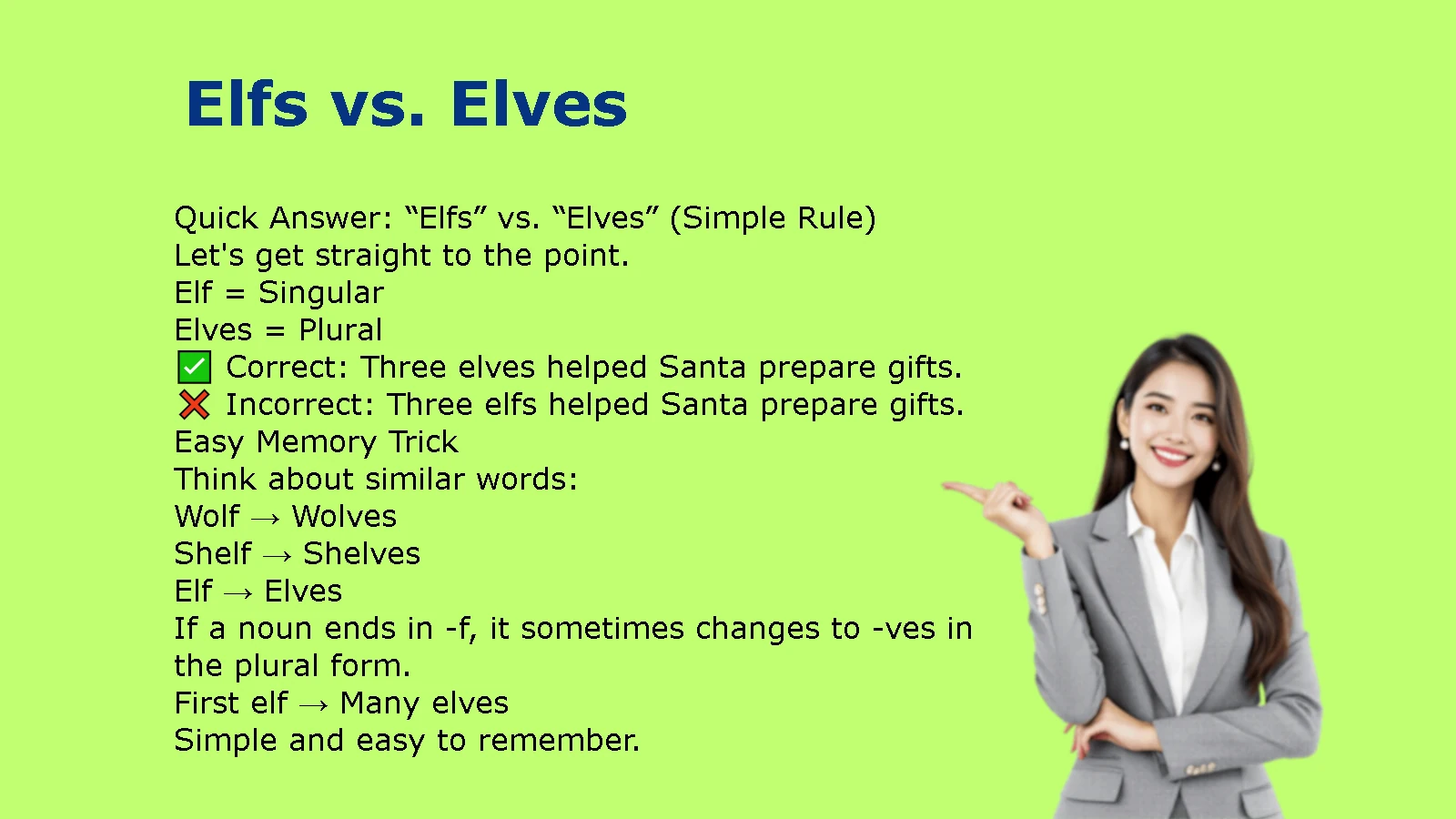
Quick Answer: “Elfs” vs. “Elves” (Simple Rule)
Let’s get straight to the point.
Elf = Singular
Elves = Plural
✅ Correct: Three elves helped Santa prepare gifts.
❌ Incorrect: Three elfs helped Santa prepare gifts.
Easy Memory Trick
Think about similar words:
- Wolf → Wolves
- Shelf → Shelves
- Elf → Elves
If a noun ends in -f, it sometimes changes to -ves in the plural form.
First elf → Many elves
Simple and easy to remember.
Why People Confuse “Elfs” and “Elves”
The mistake usually comes from applying the most common English plural rule.
The Normal English Rule
Most nouns become plural by adding -s:
- Book → Books
- Car → Cars
- Tree → Trees
Because of this pattern, many people naturally assume:
- Elf → Elfs
But English has exceptions.
The Irregular Plural Rule
Some nouns ending in -f change to -ves:
- Leaf → Leaves
- Knife → Knives
- Wolf → Wolves
- Elf → Elves
Since these words don’t follow the standard pattern, mistakes are common.
The Grammar Rule Behind “Elf” and “Elves”
Understanding the rule makes the difference easier to remember.
Singular Form
When referring to one magical creature:
Elf
Examples:
- The elf lives in the forest.
- An elf appeared in the story.
- The elf crafted a magical sword.
Plural Form
When referring to more than one:
Elves
Examples:
- The elves protected the kingdom.
- Several elves worked in Santa’s workshop.
- The elves gathered around the fire.
Key Insight
The plural of elf is formed by changing f to ves.
Elf → Elves
Not:
Elf → Elfs
“Elf” Explained Clearly
The word elf refers to a single creature.
Traditionally, elves appear in:
- Folklore
- Fairy tales
- Fantasy novels
- Christmas traditions
Examples of “Elf”
- The elf delivered a mysterious message.
- An elf guided the traveler through the woods.
- The young elf learned magic from a wise teacher.
Whenever you’re talking about just one, use elf.
“Elves” Explained Clearly
When referring to two or more, use elves.
Examples of “Elves”
- The elves celebrated their victory.
- Several elves worked throughout the night.
- The elves built beautiful homes in the forest.
Fantasy Example
In many fantasy stories:
- One elf guards the gate.
- Many elves protect the kingdom.
The plural form is always elves.
The Biggest Mistake People Make
The most common error is assuming every noun follows the standard add -s rule.
What Goes Wrong
People think:
- Book → Books
- Cat → Cats
- Elf → Elfs
But the last example doesn’t follow English grammar conventions.
Correct Pattern
- Wolf → Wolves
- Shelf → Shelves
- Leaf → Leaves
- Elf → Elves
Lesson
Not every English noun forms its plural by simply adding -s.
Side-by-Side Comparison Table
| Form | Meaning | Correct Usage |
|---|---|---|
| Elf | One magical being | ✅ Correct |
| Elves | More than one magical being | ✅ Correct |
| Elfs | Nonstandard plural form | ❌ Incorrect |
Real-Life Examples of “Elf”
Let’s see how the singular form works.
Common Sentences
- The elf repaired the toy.
- An elf appeared near the castle.
- The little elf smiled happily.
Mini Scenario
A child reads a storybook.
“The elf found a hidden treasure.”
Since only one character is involved, elf is correct.
Real-Life Examples of “Elves”
Now let’s look at the plural form.
Common Sentences
- The elves prepared gifts for Christmas.
- The elves guarded the ancient forest.
- Several elves attended the celebration.
Mini Scenario
A fantasy army approaches.
“The elves marched toward the city.”
Because multiple characters are involved, elves is correct.
Why “Elves” Looks Strange to Some People
Many learners expect English spelling to be completely predictable.
Unfortunately, English has historical spelling patterns that remain in use today.
Similar Examples
- Life → Lives
- Wife → Wives
- Knife → Knives
- Leaf → Leaves
- Elf → Elves
Once you recognize the pattern, elves feels much more natural.
Common Mistakes to Avoid
Mistake #1: Writing “Elfs”
❌ The elfs are working in the workshop.
✅ The elves are working in the workshop.
Mistake #2: Using “Elves” for One Character
❌ An elves entered the room.
✅ An elf entered the room.
Mistake #3: Mixing Singular and Plural Forms
❌ One elves was standing outside.
✅ One elf was standing outside.
What to Say Instead (When You’re Unsure)
If you’re uncertain, remember this formula:
One = Elf
- One elf
- An elf
- The elf
More Than One = Elves
- Two elves
- Many elves
- Several elves
This rule works every time.
Quick Decision Guide (Use This Instantly)
Ask yourself:
Is there only one?
Use:
Elf
Example:
“The elf opened the door.”
Is there more than one?
Use:
Elves
Example:
“The elves opened the door.”
Never Use
Elfs
This form is considered incorrect in standard English.
FAQ: “Elfs” vs. “Elves”
Is “elfs” ever correct?
In modern standard English, elves is the accepted plural form. Elfs is generally considered incorrect.
Why isn’t the plural simply “elfs”?
Because elf follows an older English pluralization pattern that changes -f to -ves.
What is the plural of elf in fantasy books?
The plural is almost always elves.
How do I remember the correct form?
Think:
- Wolf → Wolves
- Shelf → Shelves
- Elf → Elves
The pattern is the same.
Case Study: A Common Writing Error
A student was writing a fantasy story.
They wrote:
“The elfs gathered near the mountain.”
Their teacher corrected it to:
“The elves gathered near the mountain.”
Why?
Because elves is the standard plural form recognized by English dictionaries and grammar guides.
Result
The sentence became grammatically correct and sounded natural to readers.
Key Facts You Should Remember
- Elf is singular.
- Elves is plural.
- Elfs is generally incorrect.
- The word follows the -f to -ves pattern.
- Many fantasy and holiday stories use elves.
- Similar words include wolves, leaves, and knives.
Final Takeaway: The One Rule That Never Fails
Here’s the simple truth.
The debate between “elfs” vs. “elves” isn’t actually much of a debate in standard English. The correct plural form is elves.
So remember:
One elf → Many elves
Whenever you’re talking about more than one magical helper, fantasy warrior, or mythical creature, choose elves.
It’s the form used in dictionaries, books, professional writing, and everyday English.
When in doubt, skip elfs and use elves. That’s the rule that never fails.