Ever stopped while writing and wondered whether you should use Peal vs. Peel? These two words look almost identical, but they have completely different meanings, making them a common source of spelling mistakes, word confusion, and grammar errors.
You’re not alone if you’ve mixed them up before. Many writers, students, and English learners struggle with this pair because they sound similar yet are used in very different contexts. And here’s the kicker: choosing the wrong word can change the meaning of your sentence entirely.
But don’t worry—this confusion is easier to solve than you might think.
In this guide, you’ll learn the difference between Peal vs. Peel, their correct definitions, proper word usage, and simple examples in sentences. You’ll also discover helpful memory tricks, homophone tips, and common mistakes to avoid so you can write with greater confidence.
Whether you’re improving your English vocabulary, sharpening your writing skills, or simply checking which word is correct, this article will help you understand when to use each one. Let’s break it down and clear up the confusion once and for all.
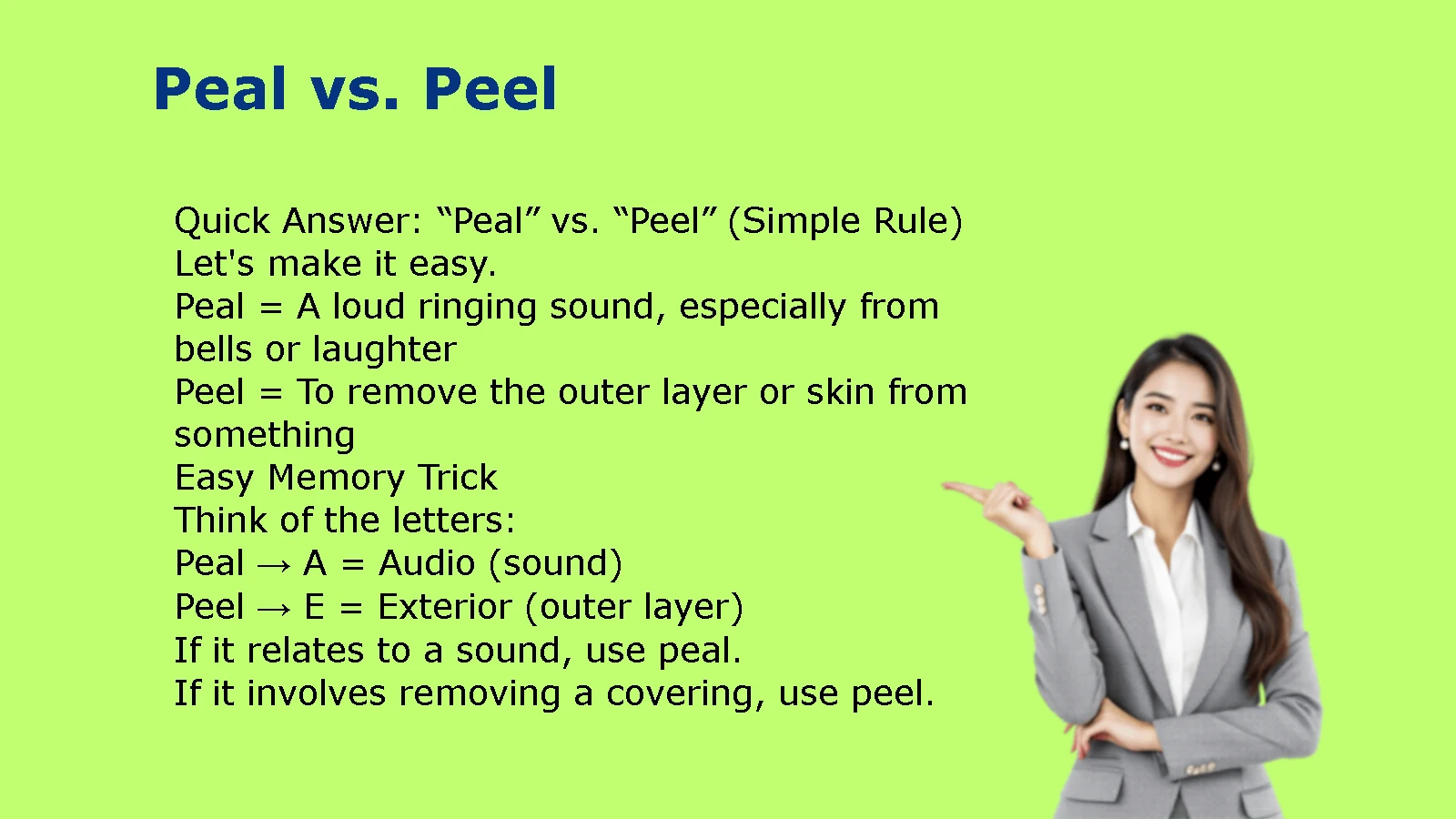
Quick Answer: “Peal” vs. “Peel” (Simple Rule)
Let’s make it easy.
Peal = A loud ringing sound, especially from bells or laughter
Peel = To remove the outer layer or skin from something
Easy Memory Trick
Think of the letters:
Peal → A = Audio (sound)
Peel → E = Exterior (outer layer)
If it relates to a sound, use peal.
If it involves removing a covering, use peel.
What Does “Peal” Mean?
The word peal refers to a loud ringing sound or a series of ringing sounds.
It is most commonly used when talking about:
- Church bells
- Loud laughter
- Thunder
- Alarm bells
Examples of “Peal”
- A peal of bells echoed through the town.
- We heard a peal of thunder in the distance.
- Her joke triggered a peal of laughter.
- The wedding began with a joyful peal of church bells.
Key Idea
A peal is something you hear, not something you touch.
What Does “Peel” Mean?
The word peel usually means to remove the outer covering of something.
It can be used as both a verb and a noun.
Examples of “Peel”
- Please peel the potatoes before cooking.
- I need to peel an orange.
- The paint began to peel from the wall.
- Banana peel can be used for composting.
Key Idea
A peel involves removing or referring to an outer layer.
The Core Difference Between “Peal” and “Peel”
The easiest way to distinguish them is by what they describe.
| Word | Meaning | Related To |
|---|---|---|
| Peal | A loud ringing sound | Hearing |
| Peel | Remove outer skin or layer | Touching/Removing |
Quick Test
Ask yourself:
Am I talking about a sound?
→ Use peal
Am I talking about removing a covering?
→ Use peel
Why People Confuse “Peal” and “Peel”
The main reason is simple.
They Sound Identical
Both words are pronounced:
/piːl/
Since they sound exactly the same, many writers choose the wrong spelling.
They Are Homophones
Homophones are words that:
- Sound the same
- Have different meanings
- Have different spellings
Other examples include:
- There vs. Their
- Flour vs. Flower
- Sea vs. See
“Peal” Explained Clearly (With Examples)
Let’s look closer at how peal is used in everyday English.
Common Uses
Bells
- A peal of bells announced the celebration.
- The church’s peal could be heard miles away.
Laughter
- The room erupted in a peal of laughter.
- Her comment caused another peal of laughter.
Thunder
- A sudden peal of thunder startled everyone.
Key Takeaway
When you can hear it ringing, booming, or echoing, peal is usually the correct choice.
“Peel” Explained Clearly (With Examples)
Now let’s focus on peel.
Food Preparation
- Peel the apple before slicing it.
- She peeled the carrots for dinner.
Removing Layers
- The wallpaper began to peel.
- The old sticker peeled off easily.
As a Noun
- Orange peel contains natural oils.
- Banana peel can be slippery.
Key Takeaway
When something’s outer layer is being removed, use peel.
The Biggest Mistake People Make
Many people use peel whenever they hear the sound.
Incorrect
❌ A peel of laughter filled the room.
Correct
✅ A peal of laughter filled the room.
Why?
Because laughter is a sound, not an outer covering.
Side-by-Side Comparison Table
Here’s a quick reference guide.
| Feature | Peal | Peel |
|---|---|---|
| Meaning | Loud ringing sound | Outer covering or removal |
| Part of Speech | Noun (mostly) | Noun and verb |
| Related To | Bells, thunder, laughter | Fruit, vegetables, paint |
| Sense Involved | Hearing | Touch/Action |
| Common Usage | A peal of bells | Peel an orange |
Real-Life Examples of “Peal”
Common Sentences
- A peal of church bells marked the holiday.
- We heard a peal of thunder after the lightning strike.
- Her story caused a peal of laughter.
- The bell’s peal echoed through the valley.
Mini Scenario
You’re attending a wedding.
As the ceremony ends, bells begin ringing loudly.
You would say:
“A peal of bells filled the air.”
Real-Life Examples of “Peel”
Common Sentences
- Peel the potatoes before boiling them.
- The sunburn caused my skin to peel.
- He carefully peeled the label off the bottle.
- Banana peel covered the sidewalk.
Mini Scenario
You’re preparing fruit salad.
You remove the skin from several oranges.
You would say:
“I peeled the oranges.”
Common Mistakes and Corrections
Mistake #1
❌ The peel of thunder frightened us.
✅ The peal of thunder frightened us.
Mistake #2
❌ She pealed the banana.
✅ She peeled the banana.
Mistake #3
❌ We heard a peel of laughter.
✅ We heard a peal of laughter.
Mistake #4
❌ The orange peal was thrown away.
✅ The orange peel was thrown away.
How to Remember the Difference Every Time
Try these memory tricks.
Peal = Audio
The letter A can remind you of Audio.
Sound → Peal
Peel = Exterior
The letter E can remind you of Exterior.
Outer layer → Peel
Visual Trick
Imagine:
- Bells ringing loudly = Peal
- Someone removing a banana skin = Peel
Simple images make the distinction easy.
What to Say Instead (If You’re Unsure)
Sometimes you can avoid confusion altogether.
Instead of “Peal”
Use:
- Ringing
- Chime
- Resonance
- Sound
Instead of “Peel”
Use:
- Remove the skin
- Strip away
- Take off the covering
These alternatives can make your meaning even clearer.
Quick Decision Guide (Use This Instantly)
Ask yourself:
Is it a sound?
→ Peal
Is it an outer layer being removed?
→ Peel
Still unsure?
Think:
Bells ring = Peal
Bananas peel = Peel
Done.
FAQ: “Peal” vs. “Peel”
Is “peal” a common word?
Not as common as “peel,” but it’s frequently used when describing bells, thunder, and laughter.
Can “peal” be used as a verb?
Yes. It can mean to ring loudly, although this usage is less common today.
Is “peel” both a noun and a verb?
Yes.
- Verb: Peel the apple.
- Noun: Throw away the apple peel.
Which word is more common?
Peel is far more common in everyday conversation and writing.
Case Study: A Classroom Writing Error
A student wrote:
“A loud peel of thunder shook the building.”
The teacher marked it incorrect.
Why?
Thunder creates a sound.
The correct sentence is:
“A loud peal of thunder shook the building.”
Lesson
If you can hear it, think peal.
If you’re removing something, think peel.
Key Facts You Should Remember
- Peal refers to a loud ringing sound.
- Peel refers to an outer covering or removing it.
- Both words are pronounced the same.
- They are homophones.
- Bells, thunder, and laughter create a peal.
- Bananas, oranges, and potatoes have a peel.
Final Takeaway: The One Rule That Never Fails
Here’s the simplest way to remember the difference between “Peal” vs. “Peel.”
If it makes a sound, use “peal.”
If it removes or refers to an outer layer, use “peel.”
That’s it.
A peal rings through the air.
A peel comes off a fruit, vegetable, wall, or surface.
Whenever you’re unsure, picture church bells and a banana. One rings. One peels.
Follow that simple image, and you’ll never confuse these two words again.