Moat” vs. “Mote” is a classic example of two words that look almost identical but mean completely different things—and mixing them up can completely change your sentence. Have you ever paused mid-writing, unsure which spelling is correct because they “feel” the same? You’re not alone. These tiny spelling differences are one of the most common sources of confusion in English.
This guide is here to clear it up once and for all. It promises a simple, memorable breakdown of both words so you never confuse them again. You’ll learn what each word means, how they are used in real contexts, and easy tricks to remember the difference instantly.
But here’s the kicker: one word belongs to castles and defense, while the other belongs to dust and tiny particles. And it gets better…
You’ll also see examples side by side so the contrast becomes crystal clear. By the end, you’ll confidently use “moat” and “mote” correctly in writing, without second-guessing yourself.
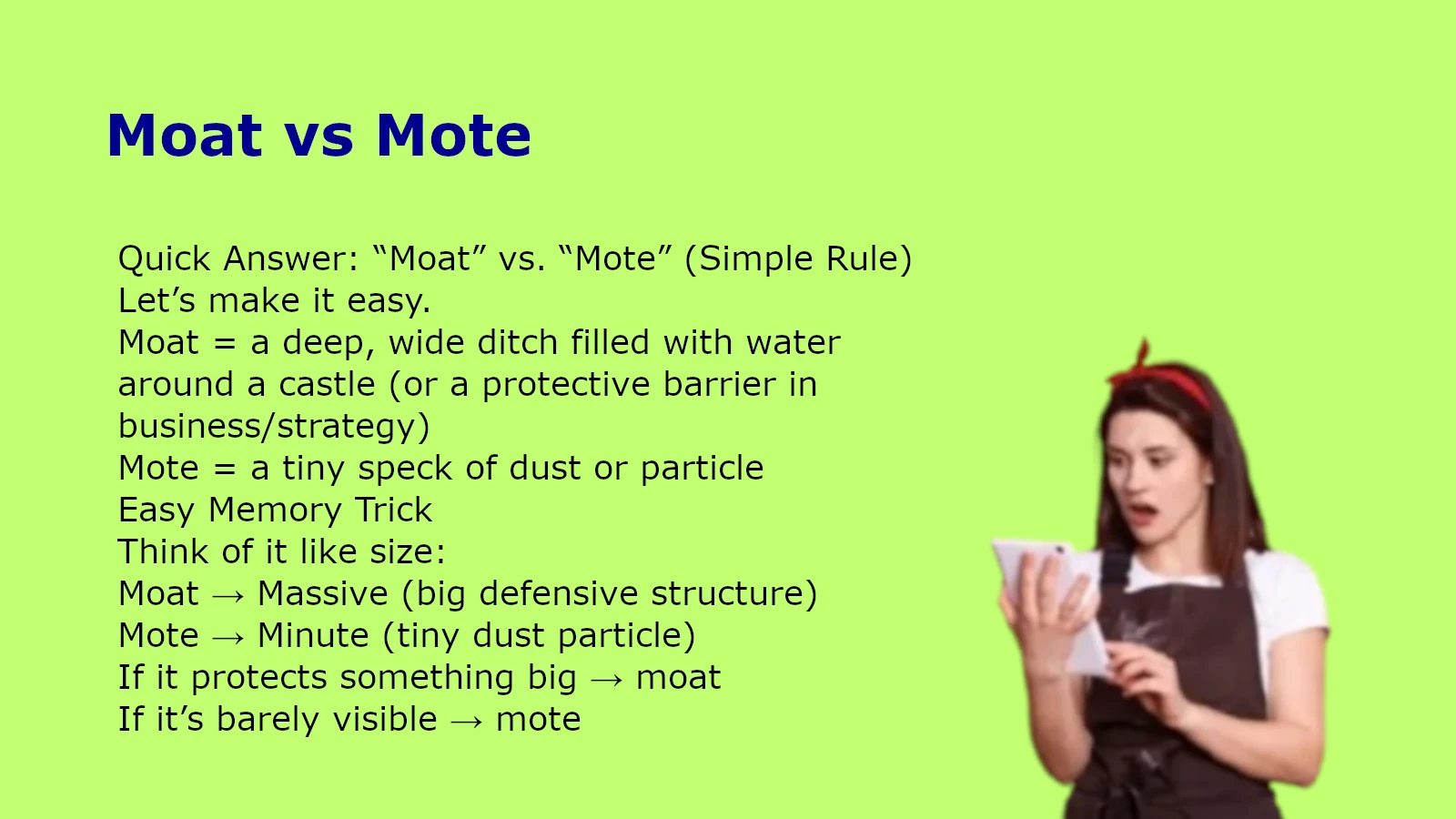
Quick Answer: “Moat” vs. “Mote” (Simple Rule)
Let’s make it easy.
Moat = a deep, wide ditch filled with water around a castle (or a protective barrier in business/strategy)
Mote = a tiny speck of dust or particle
Easy Memory Trick
Think of it like size:
- Moat → Massive (big defensive structure)
- Mote → Minute (tiny dust particle)
If it protects something big → moat
If it’s barely visible → mote
Why People Confuse “Moat” and “Mote”
The confusion happens for three simple reasons:
- They sound almost identical
- They differ by only one letter
- Most people rarely see “mote” in modern writing
So your brain naturally mixes them up, especially when reading quickly.
But once you see their meanings side by side, the confusion disappears.
The Core Meaning of “Moat” (With Real Context)
A moat is traditionally a defensive water-filled trench built around castles.
But in modern English, it has grown beyond medieval walls.
Traditional Meaning
- A ditch filled with water
- Built around castles or fortresses
- Used for protection from enemies
Modern Meaning (Business & Strategy)
In business, a moat means a competitive advantage that protects a company from rivals.
Think of it as:
“What keeps competitors out.”
Examples
- “The castle was surrounded by a deep moat.”
- “The company’s strong brand acts as a moat against competitors.”
- “High switching costs create a business moat.”
Key Idea
A moat is always about protection and defense—physical or strategic.
The Core Meaning of “Mote” (With Real Context)
Now let’s switch to the tiny one.
A mote is a very small particle—usually of dust.
Meaning
- A tiny speck
- Often seen floating in sunlight
- Almost invisible unless you look closely
Examples
- “A mote of dust floated in the sunlight.”
- “He removed a mote from his eye.”
- “The room was empty except for a few motes in the air.”
Key Idea
A mote is always about smallness and insignificance.
Moat vs. Mote: Side-by-Side Comparison Table
Here’s a quick visual breakdown:
| Word | Meaning | Size | Context | Memory Cue |
|---|---|---|---|---|
| Moat | Defensive ditch or protective barrier | Large | Castles, strategy, business | Big protection |
| Mote | Tiny particle of dust | Tiny | Physical description | Small speck |
Real-Life Examples of “Moat”
Let’s make it practical.
Everyday / Historical Use
- “The medieval castle had a wide moat filled with water.”
- “Alligators lived in the moat surrounding the fortress.”
Business Use
- “Apple’s ecosystem creates a strong moat.”
- “Brand loyalty is a powerful moat in competitive markets.”
- “Patents act as a legal moat.”
Mini Scenario
A startup survives in a crowded market because:
- Its technology is unique
- Customers can’t easily switch
That’s a moat, not luck.
Real-Life Examples of “Mote”
Now the tiny one in action.
Everyday Use
- “She noticed a mote floating in her coffee.”
- “A mote of dust entered his eye.”
Literary Use
- “Sunlight revealed motes dancing in the air.”
- “Not even a single mote disturbed the still room.”
Mini Scenario
You open a window and see sunlight streaming in.
Tiny particles floating in the beam?
Those are motes.
The Biggest Mistake People Make
Here’s where things go wrong:
People assume both words are interchangeable because they “sound poetic.”
But the real issue is context blindness.
What Goes Wrong
- Mixing up spelling in writing
- Misunderstanding business “moat”
- Assuming “mote” is just a typo
Simple Truth
They are completely unrelated words.
One is strategic protection.
The other is tiny dust.
Why “Moat” Became Popular in Business English
You’ll often hear “moat” in finance, startups, and investing.
Why?
Because it perfectly describes protection.
Business Moat Types
- Brand strength
- Technology advantage
- High switching costs
- Network effects
Example
“A strong moat keeps competitors from entering the market easily.”
So when investors say “moat,” they mean:
“How hard is it for others to compete?”
How to Never Confuse “Moat” and “Mote” Again
Here are simple tricks that actually work:
1. Think Size
- Moat = massive structure
- Mote = microscopic particle
2. Think Function
- Moat = protects something
- Mote = floats unnoticed
3. Think Memory Sentence
- “A moat protects a castle.”
- “A mote is dust in the light.”
Quick Decision Guide (Instant Use)
When you see the word:
- Defensive barrier or business strategy → Moat
- Dust or tiny particle → Mote
- Still unsure → check context (big vs small)
FAQ: Moat vs. Mote
Is “mote” still commonly used?
Not really in daily speech, but it appears in literature and poetic writing.
Is “moat” only related to castles?
No. It’s widely used in business strategy today.
Why do they sound the same?
They come from different historical roots but evolved into similar pronunciation patterns in English.
Key Facts You Should Remember
- Moat = protection barrier (castle or business)
- Mote = tiny dust particle
- One is large and strategic
- The other is microscopic and physical
- Context always decides meaning
Final Takeaway: The One Rule That Never Fails
Here’s the simplest way to lock it in:
If it protects something → it’s a moat
If it floats in the air → it’s a mote
They may look similar on paper, but in meaning, they live in completely different worlds.
So next time you see them, don’t overthink it—just ask:
Is it something big and protective… or something tiny and floating?