Have you ever wondered whether something is objective or subjective? The two words are often used together because they describe two different ways of looking at information, opinions, judgments, and experiences. Understanding the difference can help you communicate more clearly, especially when you need to separate facts from personal views.
Objective means based on facts, evidence, or observable information, while subjective means based on personal opinions, feelings, or experiences.
| Word | Meaning | Based On |
| Objective | Not influenced by personal feelings or opinions | Facts, evidence, and observable information |
| Subjective | Influenced by personal feelings, opinions, or experiences | Individual perspective and interpretation |
The difference becomes easier to understand with a simple example. “The book contains 300 pages” is an objective statement because the number of pages can be verified. “The book is fascinating” is subjective because different readers may have different opinions about it.
You may encounter objective vs subjective, objective versus subjective, objective and subjective, and what is the difference between objective and subjective in discussions about writing, journalism, research, education, art, decision-making, and everyday communication.
The key point is simple: objective information can be checked against evidence, while subjective statements reflect a person’s perspective or judgment. However, the distinction can sometimes depend on context, and a statement that sounds factual may still contain subjective assumptions.
In this guide, you’ll learn the complete difference between Objective Versus Subjective, including their meanings, definitions, examples, usage, synonyms, and common contexts. You’ll also learn how to identify objective and subjective statements, understand objective vs subjective opinions, and use both words correctly in clear English sentences.
Objective Versus Subjective: Quick Answer
The easiest way to understand objective versus subjective is to ask what the statement depends on.
- Objective information relies on facts, observations, measurements, or other evidence that can be checked independently.
- Subjective information depends on a person’s feelings, preferences, experiences, opinions, or interpretation.
- An objective claim can often be verified by other people using the same evidence.
- A subjective judgment may reasonably differ from one person to another.
Quick comparison
| Objective | Subjective |
| Based on observable or verifiable information | Based on personal perspective or experience |
| Can often be checked independently | May vary from person to person |
| Uses measurable or documented information | Often involves feelings, preferences, or interpretation |
| Example: The class has 30 students. | Example: The class is too large. |
| Example: The package weighs 5 pounds. | Example: The package is surprisingly heavy. |
| Example: The restaurant opens at 11 a.m. | Example: The restaurant has a welcoming atmosphere. |
A useful rule is:
Objective statements focus on what can be established with evidence; subjective statements focus on how someone personally experiences or interprets something.
This is a practical distinction rather than a rule that makes every sentence fit perfectly into one category.
What Does Objective Mean?
Objective means based on facts, conditions, observations, or evidence rather than being primarily shaped by personal feelings or preferences.
Merriam-Webster defines the adjective objective in one sense as dealing with facts or conditions without distortion from personal feelings, prejudices, or interpretations. It also uses objective for things existing independently of the mind and for information based on actual objects, conditions, or phenomena.
In everyday language, an objective statement is generally one that does not depend on whether the speaker personally likes, dislikes, approves of, or feels about the subject.
What makes a statement objective?
An objective statement commonly has one or more of these characteristics:
- It describes something that can be observed.
- It gives a measurable quantity.
- It reports a documented event.
- It can be checked against reliable evidence.
- Different observers can independently verify the relevant information.
- It avoids presenting personal preference as established fact.
Consider these examples:
“The building has 12 floors.”
The number of floors can be counted.
“The meeting began at 2:00 p.m.”
The starting time can be confirmed using a schedule, recording, or other documentation.
“The company reported revenue of $10 million for the year.”
This is an objective report about a documented financial figure, assuming the stated source is accurate.
“The temperature reached 95°F.”
A thermometer or weather record can provide evidence for the measurement.
Objective language therefore tends to answer questions such as what happened, when did it happen, how many, how much, and what was measured?
Objective facts and evidence
Objectivity does not simply mean saying something confidently.
A person can confidently make a false claim. Confidence is not evidence.
For example:
“This is definitely the best restaurant in the city.”
The word definitely does not make the statement objective. “Best” is an evaluation that requires a standard or preference.
Compare it with:
“The restaurant received 4.8 stars from 2,000 customer reviews.”
The second statement describes a measurable review statistic. It does not automatically prove that the restaurant is objectively the best, but the statistic itself can be checked.
This distinction is important: objective evidence can support a subjective conclusion without turning the conclusion itself into an objective fact.
What Does Subjective Mean?
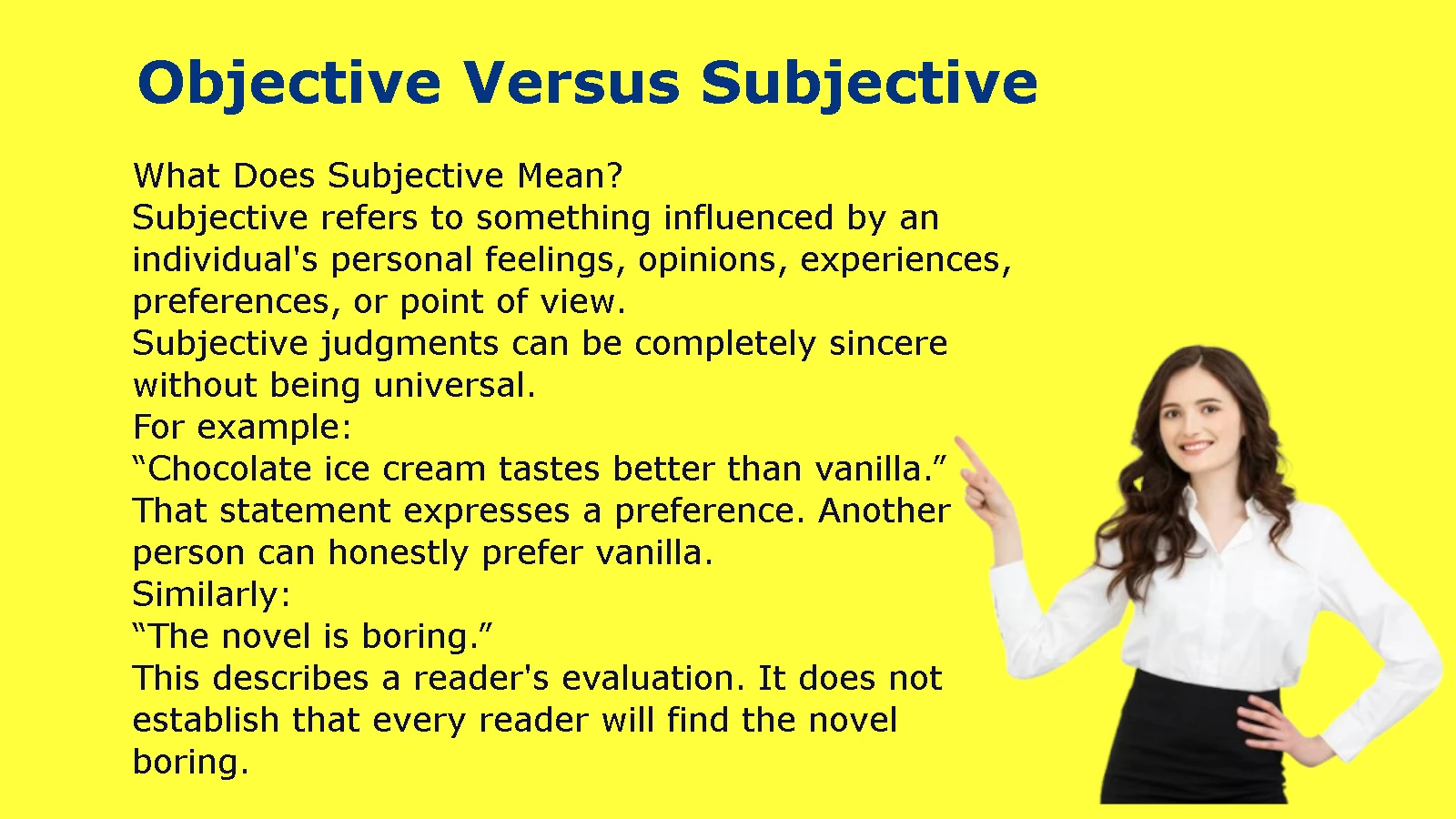
Subjective refers to something influenced by an individual’s personal feelings, opinions, experiences, preferences, or point of view.
Subjective judgments can be completely sincere without being universal.
For example:
“Chocolate ice cream tastes better than vanilla.”
That statement expresses a preference. Another person can honestly prefer vanilla.
Similarly:
“The novel is boring.”
This describes a reader’s evaluation. It does not establish that every reader will find the novel boring.
Subjective information is especially important when the subject involves personal experience, taste, emotion, perception, or interpretation.
Examples of subjective statements
- “That was the best meal I’ve ever had.”
- “The movie was disappointing.”
- “The blue dress looks beautiful.”
- “The lecture was boring.”
- “The new design feels more modern.”
- “This is the most interesting chapter.”
- “The room feels too small.”
- “The music is relaxing.”
These statements may communicate meaningful information, but the judgment depends partly on the person making or experiencing it.
Subjective does not mean false
This is one of the most important points when learning objective versus subjective.
Calling something subjective does not mean calling it incorrect.
Suppose someone says:
“The restaurant is too noisy.”
That is a subjective assessment. However, it may be based on a genuine experience.
Another person might say:
“The restaurant has a lively atmosphere.”
Both people may have experienced the same environment and interpreted it differently.
Subjectivity often tells you whose perspective you are hearing. It does not automatically tell you whether that perspective is valuable, accurate, or worthless.
Objective Versus Subjective: Key Differences
The main difference between objective and subjective information is the basis on which the statement is made.
| Feature | Objective | Subjective |
| Main basis | Evidence, observation, measurement, or documented information | Personal feelings, preferences, experience, or interpretation |
| Verification | Often independently verifiable | Often depends on individual perspective |
| Personal preference | Usually minimized | Often central |
| Agreement | People can often reach the same answer by checking evidence | Reasonable people may have different views |
| Common language | Measured, recorded, observed, documented | Beautiful, boring, enjoyable, disappointing |
| Common settings | Research, reports, factual descriptions | Reviews, opinions, personal reflections |
| Example | “The book contains 350 pages.” | “The book is too long.” |
The distinction becomes especially clear when you place the statements side by side.
Objective:
“The restaurant received 4.7 out of 5 from 1,500 reviews.”
Subjective:
“The restaurant serves the best food in the city.”
The first statement describes a numerical rating that can be checked. The second makes a broad judgment about quality.
That does not mean the second statement is meaningless. It means the statement expresses an evaluation rather than a directly measurable fact.
Objective and Subjective Examples
The quickest way to learn the difference is through paired examples.
Examples of objective statements
- The meeting started at 9 a.m.
- The report contains 25 pages.
- The box weighs 10 pounds.
- The test contains 50 questions.
- The company opened its first store in 2018.
- The train arrived at 6:15 p.m.
- The apartment has three bedrooms.
- The article contains 2,500 words.
Each statement refers to information that can potentially be checked.
Examples of subjective statements
- The meeting was too long.
- The report is difficult to read.
- The box is surprisingly heavy.
- The test is unfair.
- The store has a beautiful interior.
- The train ride was unpleasant.
- The apartment feels spacious.
- The article is interesting.
These statements contain evaluations or perceptions that can vary between people.
Objective and Subjective Examples in the Same Situation
Real communication often becomes clearer when you separate a factual observation from the interpretation that follows it.
Movie example
Objective:
“The movie runs for two hours.”
Subjective:
“The movie is too long.”
The running time is measurable. Whether two hours is “too long” depends on the viewer’s judgment.
Restaurant example
Objective:
“The restaurant opens at 11 a.m.”
Subjective:
“The restaurant has the best brunch in town.”
Opening hours can be verified. “Best brunch” is an evaluation based on criteria that may differ between people.
School example
Objective:
“The examination contains 50 questions.”
Subjective:
“The examination is unnecessarily difficult.”
The number of questions is measurable. Difficulty involves judgment, although performance data can provide evidence about how students performed.
Workplace example
Objective:
“The project was submitted on Friday.”
Subjective:
“The project was submitted too late.”
The submission date is factual. Whether Friday was “too late” depends on the deadline, expectations, and context.
Product review example
Objective:
“The phone has a 6.7-inch display.”
Subjective:
“The display is too large for comfortable one-handed use.”
The screen size is a specification. Whether that size is comfortable depends partly on the user’s preferences, hand size, habits, and intended use.
Objective vs Subjective in Everyday Language
You encounter the distinction between objective and subjective language constantly.
Consider the statement:
“The coffee is hot.”
It might appear objective because temperature can be measured. But in ordinary conversation, the speaker may simply be expressing a perception.
Now consider:
“The coffee is 180°F.”
That is much more clearly objective because it specifies a measurable temperature.
This illustrates an important point: context matters.
Words such as hot, cold, heavy, expensive, large, and small can describe observable conditions, but their practical meaning may depend on a comparison standard.
For example:
“The bag is heavy.”
A scale might show that the bag weighs 30 pounds. But whether 30 pounds is “heavy” depends on what the bag is being compared with.
A 30-pound suitcase may be heavy for one traveler but normal for another.
Facts and judgments can appear together
Consider:
“The apartment is 900 square feet, so it feels spacious.”
The first part is objective if the measurement is accurate.
The second part is subjective because the feeling of spaciousness depends on the person’s expectations and perspective.
Separating the two makes communication more precise.
How to Tell Whether a Statement Is Objective or Subjective
When you are unsure, ask a few simple questions.
Can the claim be independently verified?
If another person can check the same evidence and determine whether the claim is accurate, it is more likely to be objective.
For example:
“The package weighs 8 pounds.”
A scale can test the claim.
Does the statement depend on personal feelings?
If the answer depends heavily on someone’s preferences or emotional response, it is likely subjective.
For example:
“The package is attractive.”
There is no universal measurement for attractiveness.
Could reasonable people give different answers?
This question is particularly useful.
If two people can examine the same evidence and reasonably arrive at different evaluations, the statement may contain a subjective element.
For example:
“The movie is entertaining.”
Some viewers may agree, while others may not.
Is there measurable evidence?
Numbers, dates, counts, measurements, records, and documented events often indicate an objective component.
However, numbers alone do not automatically make a conclusion objective.
For example:
“The movie earned $100 million, so it is excellent.”
The revenue figure can be objective. The conclusion that the movie is excellent is an evaluation.
Is the statement describing or evaluating?
This is one of the fastest tests.
Description:
“The car has a 2.0-liter engine.”
Evaluation:
“The car has an excellent engine.”
The first provides a specification. The second expresses an assessment.
Objective vs Subjective in Writing
The distinction becomes especially important in formal writing.
Objective writing
Objective writing attempts to present information without allowing personal preferences to dominate the presentation.
It is common in:
- Academic writing
- Scientific reports
- Technical documentation
- Formal reports
- News reporting
- Research papers
- Business analysis
For example:
“The survey included 500 participants.”
This is more objective than:
“The survey included a huge number of participants.”
The word huge introduces an evaluation. Five hundred may be a large sample for one purpose and small for another.
Subjective writing
Subjective writing openly presents personal experience, interpretation, or opinion.
It is common in:
- Personal essays
- Reviews
- Opinion writing
- Memoirs
- Personal reflections
- Creative writing
For example:
“I found the novel emotionally powerful.”
The writer is clearly identifying a personal response.
There is nothing inherently wrong with subjective writing. The important thing is to present subjective judgments as judgments rather than disguising them as universal facts.
Objective vs Subjective in Research
The distinction between objective and subjective information is especially important in research, but it should not be reduced to the idea that all quantitative research is objective and all qualitative research is subjective.
Quantitative research commonly collects numerical measurements and uses statistical analysis. NIST, for example, describes quantitative research as involving objective measurements and numerical or statistical analysis, while qualitative methods can use interviews, surveys, and observations to understand people’s opinions and experiences.
Qualitative research can therefore examine information that is inherently connected to people’s perceptions, experiences, beliefs, and feelings. NCBI sources describe qualitative research as a way to explore experiences, perceptions, behaviors, meanings, and other contextual information.
Objective data in research
Examples can include:
- Blood pressure readings
- Test scores
- Temperature measurements
- Population counts
- Survey response frequencies
- Reaction times
- Recorded dates
- Financial measurements
These forms of information can be analyzed using quantitative methods.
Subjective data in research
Examples can include:
- Patient descriptions of pain
- Personal experiences
- Opinions
- Attitudes
- Perceptions
- Interview responses
- Feelings
- Individual interpretations
Subjective information can still be extremely valuable.
For example, a patient may report that pain is severe even when a numerical measurement does not fully capture the person’s experience. A researcher interested in quality of life may need participants to describe how a condition affects their daily lives.
Quantitative and qualitative methods can work together
Research does not always require choosing between objective and subjective information.
A mixed-methods study can combine quantitative and qualitative approaches. Research literature describes mixed methods as a way to integrate numerical findings with qualitative information to obtain a broader understanding of a research problem.
For example, imagine a university evaluating a new online course.
The researchers might collect:
Quantitative information:
- Student test scores
- Completion rates
- Attendance figures
- Assignment grades
Qualitative information:
- Student interviews
- Written comments
- Experiences with the course
- Perceptions of difficulty
The numbers can show what happened, while personal accounts can help explain how students experienced it and why certain patterns may have occurred.
Neither type automatically replaces the other.
Objective vs Subjective: A Practical Case Study
Imagine that a manager wants to evaluate an employee’s presentation.
The manager records:
“The presentation lasted 18 minutes.”
That is an objective observation if the timing is accurate.
The manager then writes:
“The presentation was too long.”
That is a subjective judgment unless a specific standard establishes what counts as too long.
The manager could make the assessment more precise:
“The presentation lasted 18 minutes, while the assigned time limit was 15 minutes.”
Now the factual information provides context for the evaluation.
The manager might still conclude:
“The presentation should have been shorter.”
That remains an evaluation, but it is supported by a measurable comparison.
This approach is useful because it separates evidence from interpretation.
Objective vs Subjective: Words That Often Signal the Difference
Certain words frequently indicate subjective judgments.
Common subjective signals
- beautiful
- ugly
- boring
- exciting
- excellent
- terrible
- disappointing
- enjoyable
- interesting
- impressive
- unfair
- comfortable
- annoying
- delicious
- expensive
These words are not automatically subjective in every possible use, but they often involve evaluation.
For example:
“That was an expensive watch.”
The word expensive depends on a standard.
By contrast:
“The watch costs $4,000.”
That statement gives a specific price.
Words commonly associated with objective information
Objective descriptions often use words such as:
- measured
- recorded
- observed
- counted
- documented
- calculated
- confirmed
- reported
- tested
- quantified
Again, these are signals rather than absolute rules.
A sentence containing the word reported could still report a subjective opinion:
“The customer reported that the service was terrible.”
The statement is objectively reporting what the customer said, while “the service was terrible” remains the customer’s subjective evaluation.
Objective vs Subjective: Common Confusions
Is an opinion always subjective?
Generally, yes, when opinion means a personal belief, judgment, preference, or interpretation.
For example:
“I think this is the best restaurant.”
The statement expresses personal judgment.
However, an opinion can be informed by substantial evidence. Evidence can strengthen an opinion without changing its basic status as an opinion.
Is a fact always objective?
A fact is generally presented as something that can be established as true based on evidence.
But people can disagree about whether a particular claim has enough evidence to qualify as established fact.
This is why careful writing distinguishes between:
- What was observed
- What was measured
- What a source reported
- What the evidence supports
- What someone interprets from that evidence
Can something be both objective and subjective?
Yes, a statement or discussion can contain both elements.
Consider:
“The restaurant has 40 seats, and it feels crowded.”
The number of seats is objective.
The feeling of being crowded is subjective.
Or:
“The movie lasts 150 minutes, which I found exhausting.”
The running time is objective.
The speaker’s response is subjective.
Does subjective mean biased?
Not necessarily.
Subjective information comes from a perspective. Bias refers to a tendency that can systematically influence judgment or presentation.
A person can openly state a subjective opinion without attempting to mislead anyone.
Likewise, something presented as objective can still be affected by errors, poor measurement, incomplete evidence, or biased methods.
Objectivity is therefore not simply the same thing as being unbiased in every possible sense.
Does objective mean completely certain?
No.
An objective claim can be based on evidence while still being incomplete, provisional, or affected by measurement limitations.
For example, a thermometer can objectively record a temperature, but the accuracy of that measurement depends on the instrument and conditions.
Objectivity concerns the basis and method of the claim, not an automatic guarantee of perfect certainty.
Objective Versus Subjective Synonyms and Related Terms
Understanding related vocabulary helps you use these concepts accurately.
Objective synonyms and related words
Depending on context, related terms include:
- factual
- impartial
- unbiased
- evidence-based
- observational
- neutral
- measurable
These words are not perfect synonyms.
For example, factual focuses on whether something corresponds to established facts, while objective can describe an approach that attempts to minimize personal influence.
Merriam-Webster also lists terms such as empirical and observational among related words for the adjective objective.
Subjective synonyms and related words
Related terms include:
- personal
- individual
- opinion-based
- interpretive
- perspective-based
- experiential
Again, context matters.
A personal experience is subjective because it belongs to an individual perspective. An interpretation may also be subjective because it involves assigning meaning to information.
Why the Difference Between Objective and Subjective Matters
Knowing the distinction is useful far beyond grammar or vocabulary.
In academic writing
Students often need to distinguish evidence from interpretation.
Instead of writing:
“The experiment was a huge success.”
A more precise approach is:
“The experiment produced the predicted result in 87% of trials.”
The second statement gives readers information they can evaluate.
In workplace communication
Clear separation between facts and judgments can prevent unnecessary disagreements.
Instead of:
“The employee performed badly.”
A manager could state:
“The employee missed three project deadlines during the quarter.”
The second statement gives specific information. If performance needs to be evaluated, the manager can then explain the relevant standards.
In journalism
Readers need to know the difference between a reported event and a person’s interpretation of that event.
For example:
“The organization reported a 15% increase in membership.”
is different from:
“The organization is becoming extremely successful.”
The first reports a specific figure. The second interprets its significance.
In product reviews
Reviews naturally contain subjective judgments, but separating specifications from opinions makes them more useful.
Objective:
“The laptop weighs 3.2 pounds.”
Subjective:
“I found it comfortable to carry during travel.”
The specification can be checked. The experience belongs to the reviewer.
Common Mistakes With Objective and Subjective
Treating an opinion as a fact
Instead of:
“This is the best phone.”
Write:
“I consider this one of the best phones for my needs.”
Or explain the criteria behind the judgment.
Assuming subjective means wrong
A subjective statement can accurately describe someone’s experience.
“The room felt cold to me.”
That is subjective, but it can still communicate useful information.
Assuming objective means unbiased in every sense
A numerical statistic can be objective while the choice of what to measure, how to measure it, or how to interpret it may involve human decisions.
That is why research methods matter.
Confusing evidence with interpretation
Consider:
“Sales increased by 20%, proving the new advertising campaign was successful.”
The increase in sales is a measurable result. The word proving introduces a causal interpretation that may require additional evidence.
A more careful statement might be:
“Sales increased by 20% after the campaign launched.”
Whether the campaign caused the increase requires further analysis.
Objective Versus Subjective: A Simple Test
When you need to identify whether something is objective or subjective, use this five-question test:
- Can I verify the claim using evidence?
- Does the statement contain a measurable fact?
- Would the answer remain the same regardless of who examined the evidence?
- Does the statement depend on personal taste or experience?
- Is the speaker describing something or evaluating it?
The more a statement depends on measurable evidence and independent verification, the more objective it tends to be.
The more it depends on individual experience, preference, emotion, or interpretation, the more subjective it tends to be.
A useful shortcut
Ask:
“Could two people reasonably disagree about this without either person making a factual error?”
If yes, the statement probably contains a subjective element.
For example:
“The painting is beautiful.”
Two people can reasonably disagree.
But:
“The painting is 60 inches wide.”
If the measurement is accurate, both people should be able to verify the same dimension.
Objective Versus Subjective: Final Comparison
| Question | Objective | Subjective |
| What is it based on? | Facts, observations, measurements, evidence | Feelings, preferences, experiences, interpretations |
| Can it be checked? | Usually | Not always in the same way |
| Can people disagree? | They can disagree about the evidence or its interpretation | Different perspectives are expected |
| Does personal preference matter? | Usually minimized | Often important |
| Is it necessarily true? | No; evidence can be incomplete or incorrect | No; it represents a perspective |
| Example | “The book has 400 pages.” | “The book is too long.” |
| Example | “The room is 20 feet wide.” | “The room feels spacious.” |
| Example | “The course has 12 lessons.” | “The course is enjoyable.” |
The most important distinction is not simply facts versus opinions. It is the relationship between a statement and the evidence, perspective, or interpretation behind it.
Frequently Asked Questions About Objective Versus Subjective
What is the difference between objective and subjective?
Objective information is based primarily on observable, measurable, documented, or independently verifiable information. Subjective information reflects personal feelings, preferences, experiences, or interpretations.
For example, “The book has 300 pages” is objective, while “The book is too long” is subjective.
What is an example of objective and subjective?
An objective example is:
“The meeting lasted 90 minutes.”
A subjective example is:
“The meeting lasted too long.”
The first describes a measurable duration. The second evaluates that duration.
Is an opinion subjective or objective?
An opinion is generally subjective because it expresses a person’s judgment, belief, preference, or interpretation.
An opinion can be supported by evidence, but evidence does not automatically turn the opinion into an objective fact.
Is a fact objective?
A fact is generally treated as objective when it can be established or verified using reliable evidence.
For example:
“The Earth orbits the Sun.”
The claim is not based on one person’s preference or feeling.
Can something be both objective and subjective?
Yes. A discussion can contain both.
For example:
“The restaurant received 10,000 reviews, and I think it deserves its high rating.”
The review count is objective information. The speaker’s assessment is subjective.
What is subjective thinking?
Subjective thinking involves considering information through personal experiences, feelings, preferences, values, or interpretations.
It is not automatically irrational or wrong. Many decisions necessarily involve personal priorities.
What is objective thinking?
Objective thinking attempts to evaluate information using evidence while minimizing the influence of personal preferences or prejudices.
It often involves checking sources, separating observations from assumptions, and distinguishing evidence from interpretation.
How do you identify an objective statement?
Look for information that can be independently checked, such as measurements, dates, documented events, counts, or recorded results.
For example:
“The package weighs 12 pounds.”
How do you identify a subjective statement?
Look for personal evaluations, preferences, feelings, or interpretations.
For example:
“The package is too heavy.”
The meaning of “too heavy” depends on the person and the situation.
Why is objective writing important?
Objective writing helps readers distinguish evidence from personal judgment. It is particularly useful in academic, scientific, technical, professional, and factual contexts.
However, subjective writing also has legitimate purposes. Reviews, personal essays, opinion pieces, and reflections often depend on personal perspective.
Conclusion: Objective Versus Subjective
The difference between objective versus subjective comes down to the basis of a statement.
Objective information focuses on facts, observations, measurements, records, or evidence that can generally be checked independently. Subjective information reflects a person’s feelings, preferences, experiences, or interpretation.
The distinction becomes clearer when you compare paired statements:
- Objective: “The test has 50 questions.”
- Subjective: “The test is too difficult.”
- Objective: “The movie lasts 150 minutes.”
- Subjective: “The movie is too long.”
- Objective: “The apartment measures 900 square feet.”
- Subjective: “The apartment feels spacious.”
One important lesson is that subjective does not mean false, and objective does not mean infallible. Objective claims can rely on incomplete or inaccurate evidence, while subjective experiences can provide valuable information about how people perceive and understand the world.
The best communication often keeps the two separate: state what the evidence shows, then identify the interpretation or opinion that follows from it. That simple habit makes writing more precise and helps readers understand exactly what is known, what is experienced, and what is being judged.