Workout vs Work Out is a common spelling question in English because the two forms look almost identical but serve different grammatical purposes. The main difference is simple: workout is a noun or adjective, while work out is a phrasal verb. You use workout to describe an exercise session or something related to exercise, and you use work out to describe the action of exercising, solving a problem, or achieving a successful outcome.
Understanding this grammar difference, along with the meanings of workout, work out, worked out, and working out, will help you write more accurately. Whether you’re writing a fitness blog, sending a text message, describing your gym routine, or explaining how a plan succeeded, the right spelling depends on how you use the phrase in a sentence.
Workout vs Work Out: The Quick Answer
Workout is one word when it functions as a noun or adjective. Work out is two words when it functions as a verb. For example, you can finish a workout, wear workout clothes, or work out at the gym. The grammatical role determines the spelling, not the subject of the sentence.
The Golden Rule: One Word vs. Two Words
Use workout as one word when you’re naming an exercise session or describing something associated with exercise. Use work out as two words when you’re describing an action or process.
Consider these examples:
- Correct: I had a great workout this morning.
- Correct: I work out every morning.
- Correct: She bought new workout shoes.
- Correct: We need to work out a solution.
- Correct: I hope everything will work out.
- Incorrect: I had a great work out this morning.
- Incorrect: I workout every morning.
The first sentence uses workout as a noun because it refers to an exercise session. The second uses work out as a verb because it describes the action of exercising.
The distinction remains the same outside fitness contexts. You can work out a budget, work out the answer to a problem, or hope that a difficult situation works out. In each case, the phrase describes an action or result, so you need two words.
Workout vs Work Out Comparison Table
This table summarizes the main differences between the two forms.
| Feature | Workout | Work Out |
| Spelling | One word | Two words |
| Main grammatical role | Noun or adjective | Phrasal verb |
| Meaning in fitness | An exercise session or something related to exercise | To perform physical exercise |
| Other meanings | Describes exercise-related items | To solve, calculate, resolve, or succeed |
| Example | I enjoyed my workout. | I work out after work. |
| Adjective example | She packed her workout clothes. | Not normally used as an adjective |
| Past-tense form | The workout was difficult. | We worked out yesterday. |
| Present participle | Not applicable as a verb | Working out helps me relax. |
| Plural form | Workouts | No corresponding plural form |
| Common phrase | Workout plan | Work out a plan |
One useful detail is that workout can modify another noun. In workout routine, for example, the word identifies the type of routine. It still functions as a noun used attributively, even though it behaves like an adjective in the sentence.
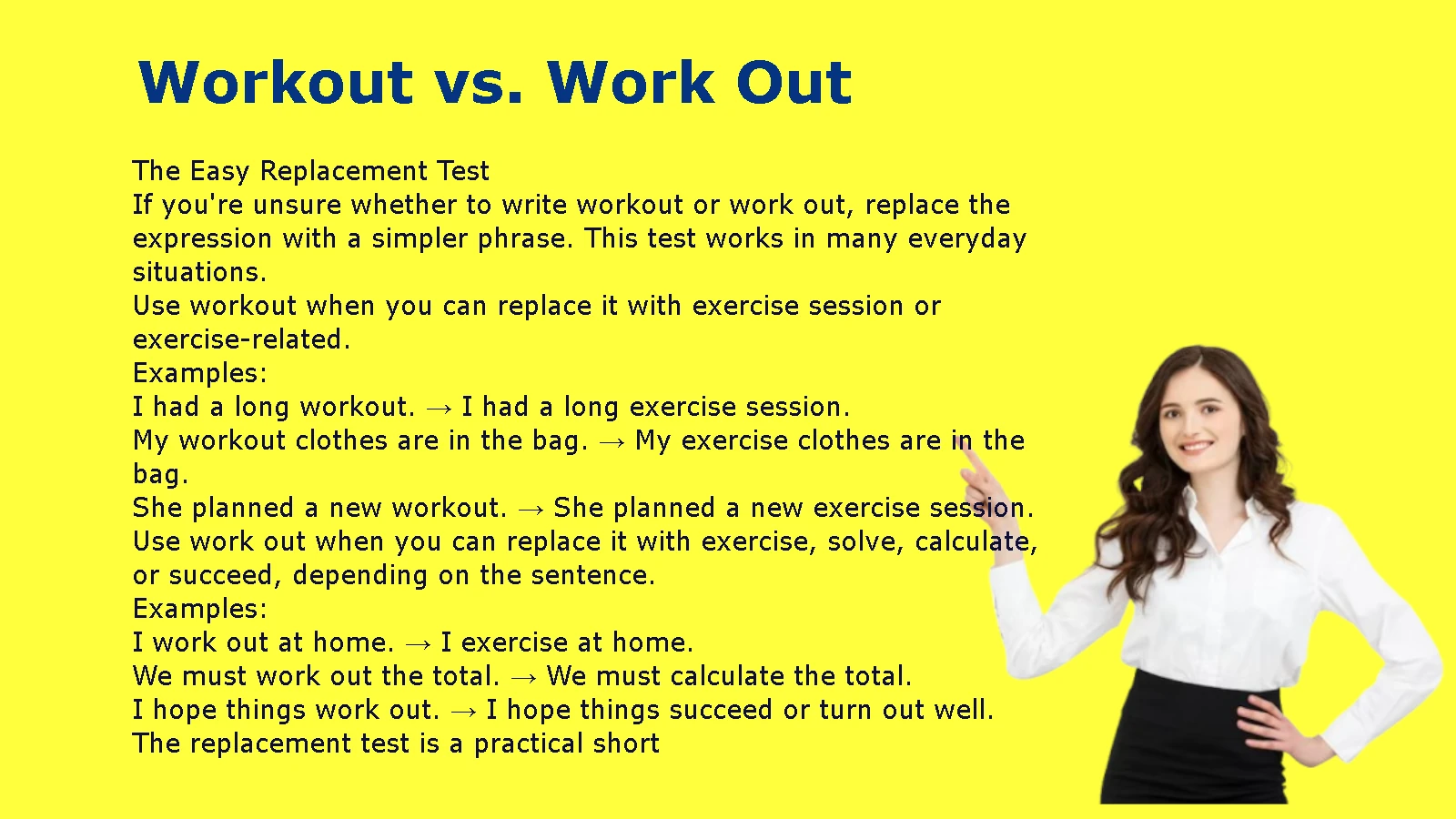
The Easy Replacement Test
If you’re unsure whether to write workout or work out, replace the expression with a simpler phrase. This test works in many everyday situations.
Use workout when you can replace it with exercise session or exercise-related.
Examples:
- I had a long workout. → I had a long exercise session.
- My workout clothes are in the bag. → My exercise clothes are in the bag.
- She planned a new workout. → She planned a new exercise session.
Use work out when you can replace it with exercise, solve, calculate, or succeed, depending on the sentence.
Examples:
- I work out at home. → I exercise at home.
- We must work out the total. → We must calculate the total.
- I hope things work out. → I hope things succeed or turn out well.
The replacement test is a practical shortcut, not an inflexible rule. Choose a substitute that preserves the meaning of the original sentence.
Quick Examples to Remember the Difference
Here are some short examples you can remember easily.
| Sentence | Correct Form | Why? |
| I need a quick workout. | Workout | Names an exercise session |
| I work out before breakfast. | Work out | Describes exercising |
| He purchased workout equipment. | Workout | Modifies the noun equipment |
| Let’s work out the details. | Work out | Means resolve or arrange |
| She finished her workout. | Workout | Refers to the completed session |
| We worked out the answer. | Work out | Past-tense phrasal verb |
| They are working out together. | Work out | Describes an ongoing action |
| Everything worked out perfectly. | Work out | Describes a successful result |
The simplest rule to remember is this: You do a workout, but you work out.
What Does Workout Mean?
Workout is a noun that refers to a planned or informal period of physical exercise. It can include activities such as running, lifting weights, cycling, swimming, or practicing bodyweight exercises. The same word can also modify another noun, as in workout plan, workout clothes, and workout equipment.
Workout as a Noun
As a noun, workout names an activity or exercise session. It can describe a brief home exercise routine, a strength-training session at the gym, or a longer endurance workout.
Because workout is a countable noun, you can use it with articles and numbers.
Examples:
- I completed a workout before breakfast.
- She does three workouts every week.
- Today’s workout focused on upper-body strength.
- That was the hardest workout I’ve done this month.
- My trainer designed a new workout for me.
Notice how the word identifies the session itself rather than the act of exercising. In the sentence I completed a workout, the noun is the thing you completed.
You can also use workout with adjectives to describe the session’s intensity, duration, or purpose.
Common combinations include:
- Quick workout: A short exercise session.
- Intense workout: A demanding exercise session.
- Full-body workout: A session that targets several major muscle groups.
- Cardio workout: An exercise session focused on cardiovascular activity.
- Strength workout: A session focused on building or maintaining muscular strength.
- Morning workout: An exercise session performed in the morning.
- Recovery workout: A lighter session intended to support recovery between harder training sessions.
For example, someone might say, “I squeezed in a quick workout during my lunch break.” The noun workout refers to the session that fit into the person’s schedule.
Workout as an Adjective
Workout can also describe a noun by identifying its connection to physical exercise. You’ll see this use frequently in fitness writing, shopping descriptions, and everyday conversation.
Examples include:
- Workout clothes: Clothing worn for exercise.
- Workout shoes: Shoes selected for a particular type of training.
- Workout playlist: Music chosen for an exercise session.
- Workout partner: Someone who exercises with you.
- Workout routine: A planned sequence of exercises.
- Workout equipment: Tools or machines used for exercise.
- Workout app: An application used to plan, track, or guide exercise.
Consider this sentence:
“My new workout routine includes walking, resistance training, and stretching.”
Here, workout modifies routine. It tells the reader what kind of routine the sentence describes.
You should not separate the word in these combinations. Workout routine is standard, while work out routine is incorrect when you intend to describe an exercise routine.
Examples of Workout in Sentences
The following examples show how workout appears in different contexts.
Fitness and exercise
- My morning workout lasts about 30 minutes.
- He tracks every workout in his fitness journal.
- The coach changed our workout after reviewing our progress.
- She prefers a low-impact workout on recovery days.
- We planned a short workout for our hotel room.
Clothing and equipment
- I washed my workout clothes last night.
- These workout shoes provide the support I need for training.
- He keeps his workout equipment in the garage.
- My workout playlist helps me stay focused.
Casual conversation
- “How was your workout today?”
- “That was a tough workout!”
- “I skipped my workout because I felt exhausted.”
- “Your workout plan looks manageable.”
In every example, workout names a session or modifies another noun. That grammatical role explains why it appears as one word.
Common Expressions That Use Workout
Several everyday expressions use workout as a noun or modifier.
| Expression | Meaning | Example |
| Workout plan | A planned exercise schedule | My workout plan includes two strength sessions. |
| Workout routine | A regular sequence of exercises | Her workout routine changes each month. |
| Workout partner | Someone who exercises with you | My workout partner keeps me accountable. |
| Workout gear | Clothing or equipment for exercise | I packed my workout gear for the trip. |
| Workout session | A period devoted to exercising | The morning workout session lasted 45 minutes. |
| Workout schedule | A timetable for exercise | I adjusted my workout schedule around work. |
These phrases are useful for grammar, but context matters. For example, workout session is perfectly grammatical, even though both words relate to exercise. The first word identifies the type of session, while the second names the session itself.
What Does Work Out Mean?
Work out is a phrasal verb formed by the verb work and the particle out. It can mean to perform physical exercise, solve or calculate something, resolve a difficulty, or develop a successful outcome. Because it functions as a verb, its tense changes: work out, works out, worked out, and working out.
Work Out Meaning to Exercise
The most familiar meaning of work out is to exercise, usually as part of a deliberate fitness activity. You can work out at a gym, at home, outdoors, or in another suitable place.
Examples:
- I work out three times a week.
- She works out before heading to the office.
- They worked out at the gym yesterday.
- We are working out together this afternoon.
- He wants to work out more consistently.
In these sentences, work out describes the activity rather than naming a session.
Compare these two examples:
- “I had a workout before work.”
- “I worked out before work.”
Both sentences communicate a similar idea, but their grammar differs. The first uses a noun as the object of had. The second uses a past-tense verb phrase to describe what the speaker did.
This distinction becomes especially useful when writing fitness content. A heading such as “Benefits of a Morning Workout” needs the noun, while an instruction such as “Work Out Before Breakfast” uses the verb phrase.
Work Out Meaning to Solve or Calculate Something
Work out can also mean to solve a problem, calculate an answer, or determine how something should be done. This meaning appears in mathematics, business, travel planning, budgeting, and everyday decision-making.
Examples:
- I need to work out how much the trip will cost.
- We should work out the details before signing the agreement.
- Can you work out the answer to this equation?
- The team met to work out a practical solution.
- She helped me work out a realistic monthly budget.
In each case, work out describes a process of thinking, calculating, or resolving something.
For example, imagine you’re planning a weekend trip. When you estimate transportation costs, compare hotel prices, and calculate your food budget. You might say, “I need to work out the total cost before booking.”
You would not write, “I need to workout the total cost.” The sentence describes an action, so the two-word verb phrase is necessary.
Work Out Meaning to Have a Successful Outcome
Another meaning of work out is to develop successfully, end well, or produce a satisfactory result. This use often appears in conversations about plans, relationships, jobs, and uncertain situations.
Examples:
- I hope everything works out for you.
- Their original plan didn’t work out.
- We changed our approach, and everything worked out in the end.
- She accepted the job and hopes it will work out.
- If we communicate clearly, things may work out.
This meaning doesn’t necessarily involve exercise or a physical task. It describes the eventual result of a situation.
Consider the difference between these statements:
- “I need a workout before dinner.”
- “I hope my new schedule will work out.”
The first refers to exercise. The second expresses hope that a plan will succeed.
The surrounding words make the intended meaning clear, but the grammar still determines the spelling.
Work Out in Different Verb Tenses
Because work out is a verb phrase, you can change its form to match the time or grammatical structure of your sentence.
| Verb Form | Example | Meaning |
| Base form | I work out regularly. | A general habit |
| Third-person singular | She works out daily. | A habit involving she, he, or it |
| Past tense | We worked out yesterday. | An action completed in the past |
| Present participle | They are working out now. | An action in progress |
| Infinitive | I want to work out tomorrow. | An intended or desired action |
| Present perfect | I have worked out three times this week. | Past activity connected to the present |
| Future | I will work out tomorrow. | An action planned for the future |
Pay particular attention to worked out and working out. Both contain two words because they retain the verb phrase structure.
For example:
- Correct: I worked out at home.
- Incorrect: I workout at home.
- Correct: I am working out now.
- Incorrect: I am workouting now.
The one-word noun doesn’t take verb endings. You can say workouts, but you cannot use workouted or workouting as standard verb forms.
Examples of Work Out in Sentences
Here are more examples showing the different meanings of the phrasal verb.
Physical exercise
- I work out at home when I can’t visit the gym.
- My brother works out after his evening classes.
- We worked out together during our vacation.
- She is working out while listening to music.
Problem-solving and calculation
- Let’s work out the best route to the airport.
- He worked out the answer without using a calculator.
- We need to work out a payment schedule.
- They are working out the final details of the project.
Successful outcomes
- The interview worked out better than I expected.
- I hope your plans work out.
- Their first idea failed, but the second one worked out.
- The arrangement may work out if everyone agrees.
These examples show why the distinction matters beyond the gym. The phrasal verb appears in many ordinary conversations, and the one-word form cannot replace it in those sentences.
Workout vs Work Out: Key Grammar Differences
The central difference between Workout vs Work Out is grammatical, not simply visual. Workout acts as a noun or modifier, while work out functions as a phrasal verb. Once you identify the role the expression plays in the sentence, choosing the correct spelling becomes much easier.
Noun vs. Phrasal Verb
A noun names a person, place, thing, or idea. A verb expresses an action, process, or state. These basic grammar roles explain the difference between the two spellings.
Compare the following sentences:
Noun:
“I scheduled a workout for Saturday.”
The noun workout identifies the exercise session. It follows the article a and functions as the object of the verb scheduled.
Phrasal verb:
“I plan to work out on Saturday.”
The phrase work out describes the activity the speaker intends to perform. It follows to in an infinitive construction.
You can also examine the surrounding words.
- A workout: The article a points to a countable noun.
- Several workouts: The plural ending confirms the noun.
- To work out: The infinitive to introduces the verb phrase.
- Worked out: The verb phrase takes a past-tense form.
- Working out: The verb phrase takes an -ing form.
These clues make the difference easier to spot, especially when you’re proofreading a long article or email.
How to Identify the Correct Form in a Sentence
When you encounter the phrase, follow this practical checklist.
Step: Identify the meaning.
Ask what you want to communicate. Are you talking about an exercise session, an action, a calculation, or a successful result?
Step: Identify the grammatical role.
Determine whether the expression names something or describes an action.
Step: Check the surrounding words.
Look for articles, plural markers, helping verbs, and infinitive constructions.
Step: Apply the replacement test.
Try substituting exercise session or exercise-related for workout. Try exercise, solve, or calculate for work out.
Step: Read the sentence aloud.
Reading the sentence can help you notice awkward phrasing, although the sound alone won’t tell you whether to use one word or two.
Consider this example:
“I need to ___ before my appointment.”
The intended meaning is to exercise. The phrase fits after need to as a verb, so the correct sentence is:
“I need to work out before my appointment.”
Now consider:
“I need a short ___ before my appointment.”
Here, the blank calls for a noun. The correct sentence is:
“I need a short workout before my appointment.”
The words around the blank provide the grammatical clue.
When to Use Workout and Work Out
Use this reference table when you need a quick decision.
| Situation | Correct Form | Example |
| Naming an exercise session | Workout | My workout was short. |
| Describing exercise clothing | Workout | I bought new workout clothes. |
| Describing an exercise habit | Work out | I work out every morning. |
| Describing a past exercise session as an action | Worked out | I worked out yesterday. |
| Describing exercise in progress | Working out | She is working out now. |
| Calculating a cost | Work out | Let’s work out the cost. |
| Resolving a disagreement | Work out | They need to work out their differences. |
| Describing a successful result | Work out | I hope the plan works out. |
| Referring to multiple exercise sessions | Workouts | My weekly workouts vary in length. |
One common source of confusion is the phrase workout plan. Since plan is the noun and workout identifies the type of plan, the one-word form is correct.
However, when you’re describing the action of creating that plan, use the two-word form: “We need to work out a plan.”
The wording looks similar, but the grammatical structure changes.
Is Workout Ever Correct as a Verb?
No. In standard modern English, workout is not the conventional verb form. Use work out for the action and its appropriate tense forms, including works out, worked out, and working out.
For example:
- Correct: I work out every weekend.
- Incorrect: I workout every weekend.
- Correct: She worked out this morning.
- Incorrect: She workouted this morning.
- Correct: They are working out together.
- Incorrect: They are workouting together.
You may encounter the incorrect one-word verb online, in informal messages, or in social media captions. Readers can often infer the intended meaning, but that doesn’t make the spelling standard.
For polished writing, use workout only as a noun or modifier and work out as the verb phrase.
Workout vs Work Out: Common Mistakes to Avoid
Many spelling errors happen because writers focus on the meaning instead of the grammatical role. Both forms relate to exercise, so it’s tempting to treat them as interchangeable. The easiest way to avoid mistakes is to check how the expression functions in the sentence.
Is “I’m Going to Workout” Correct?
No. When you mean that you’re about to exercise, the standard spelling is “I’m going to work out.”
The construction going to is followed by the base form of a verb. Since work out is the verb phrase, it must remain two words.
Compare these examples:
- Incorrect: I’m going to workout after work.
- Correct: I’m going to work out after work.
- Incorrect: We are going to workout together.
- Correct: We are going to work out together.
- Incorrect: He wants to workout more often.
- Correct: He wants to work out more often.
Now compare those sentences with:
“I’m going to plan a workout after work.”
In this example, plan is the verb, while workout is the noun that names the session being planned.
The words going to don’t automatically require work out. What matters is whether the sentence uses work out as the main verb or workout as a noun.
Is “Where Do You Workout?” Grammatically Correct?
In standard edited English, the preferred form is “Where do you work out?” The question asks where someone performs the action of exercising, so it needs the two-word phrasal verb.
Examples:
- Incorrect: Where do you workout?
- Correct: Where do you work out?
- Incorrect: Do you workout at home?
- Correct: Do you work out at home?
- Incorrect: When did you workout?
- Correct: When did you work out?
However, you can use workout in a similar question when it functions as a noun.
For example:
“Where do you do your workout?”
Here, do is the verb, and workout is the noun naming the exercise session.
Both questions are natural, but their grammatical structures differ.
Workout, Work Out, Worked Out, and Working Out
These forms are related, but you can’t substitute one for another without considering the sentence.
| Form | Grammatical Role | Correct Example |
| Workout | Noun | I enjoyed the workout. |
| Workout | Modifier | She packed her workout clothes. |
| Work out | Base verb phrase | I work out daily. |
| Works out | Present-tense verb phrase | He works out daily. |
| Worked out | Past-tense verb phrase | We worked out yesterday. |
| Working out | Present participle or gerund | Working out helps me relax. |
| Workouts | Plural noun | My workouts last 30 minutes. |
The final row deserves special attention. An -ing form can function as a noun, but that doesn’t mean you should combine working and out into one word.
For example, “Working out is part of my routine” uses the whole phrase working out as the subject of the sentence. It remains two words.
Should You Write Workout, Work-Out, or Work Out?
For standard contemporary English, use workout as a noun or modifier and work out as a verb. The hyphenated form work-out is generally unnecessary in ordinary modern writing.
Examples:
- Preferred: I had a great workout.
- Preferred: I work out before breakfast.
- Usually avoid: I had a great work-out.
- Incorrect for the intended verb: I workout before breakfast.
Consistency also matters in professional content. If you’re writing a fitness article, product description, newsletter, or exercise guide, use workout routine, workout plan, and work out regularly consistently.
A hyphen should not be added simply because the expression contains two words. English compounds follow established spelling conventions, and workout is conventionally written as one word when used as a noun.
Workout vs Work Out in Everyday Writing
The distinction becomes clearer when you see how the expressions function in different situations. Fitness conversations provide the easiest examples, but the verb phrase also appears in financial planning, workplace discussions, relationships, and everyday problem-solving.
Examples Related to Fitness and Exercise
Fitness writing uses both forms frequently, often within the same paragraph.
Examples:
- I completed a 20-minute workout before breakfast.
- I work out at home when the weather is bad.
- Her workout routine includes walking and strength training.
- We worked out at the hotel gym yesterday.
- He is working out with a personal trainer.
- My next workout will focus on flexibility.
- They want to work out more consistently this month.
Notice how a single sentence can contain both forms:
“I planned a new workout because I want to work out more regularly.”
The noun workout names the exercise session or plan, while work out describes the activity.
Practical writing tip: When creating fitness content, use the noun in headings that name a resource or session, such as “A Beginner Workout Plan.” Use the verb in instructions, such as “Work Out Three Times a Week.”
Examples Related to Work, Money, and Planning
The phrasal verb work out has several meanings unrelated to exercise. This is one reason the two-word form deserves attention beyond fitness writing.
Examples:
- We need to work out the monthly expenses.
- Can you work out how much each person owes?
- The manager will work out the details with the client.
- They worked out a schedule that suited everyone.
- I can’t work out why the computer keeps restarting.
- We are working out the final terms of the agreement.
In these sentences, work out means to calculate, understand, arrange, or resolve something.
A simple budgeting example illustrates the point.
Suppose three friends rent a vacation property for $900. They want to split the cost equally. One friend might say, “Let’s work out how much each person should pay.”
The answer is $300 per person. The verb phrase describes the calculation, so writing workout would be incorrect.
Examples Related to Relationships and Outcomes
People also use work out to discuss whether a situation succeeds or develops as hoped.
Examples:
- I hope the new arrangement works out.
- They discussed their differences and worked out a compromise.
- The relationship didn’t work out, but they remained friends.
- Everything should work out if we plan carefully.
- Her move to another city worked out better than expected.
- We are trying to work out a disagreement.
In these examples, the phrase communicates an outcome or an effort to resolve a situation. It doesn’t describe physical exercise.
This distinction can change the meaning of a sentence significantly. “Our plan needs a workout” might be interpreted as a request to test or exercise something metaphorically, but it doesn’t naturally replace “We need to work out our plan” in ordinary writing.
Examples for Text Messages, Social Media, and Casual Conversation
Casual messages often contain shortened sentences, emojis, and informal spellings. Even so, the standard distinction remains useful.
| Situation | Natural Message |
| Sharing a fitness update | Just finished my workout! |
| Describing a routine | I work out before work. |
| Inviting a friend | Want to work out together tomorrow? |
| Talking about a difficult session | That workout was exhausting. |
| Sharing progress | My new workout routine is going well. |
| Discussing a plan | We need to work out the details first. |
| Offering encouragement | Don’t worry. Things will work out. |
A social media caption might say, “Early-morning workout complete.” That sentence uses the noun correctly.
Another caption might read, “Time to work out before the day gets busy.” The verb phrase is correct because it describes the intended action.
Informal communication doesn’t eliminate grammar rules. It simply gives writers more flexibility in sentence structure and tone.
Why Is Workout One Word but Work Out Two Words?
The difference reflects a broader pattern in English: expressions can develop different grammatical functions and spellings over time. The noun workout is written as one word, while work out remains a two-word verb phrase. Similar patterns appear in other English expressions, although each compound has its own conventional spelling.
How Phrasal Verbs Become Compound Nouns
English contains many phrasal verbs made from a verb and a short particle or preposition. Examples include set up, log in, break down, and check out.
Some related noun forms are written as one word:
- Set up is a verb phrase: “We need to set up the equipment.”
- Setup is a noun: “The setup took an hour.”
- Log in is a verb phrase: “Please log in to your account.”
- Login is a noun or modifier: “I forgot my login details.”
- Work out is a verb phrase: “I work out every morning.”
- Workout is a noun or modifier: “My workout starts at seven.”
These pairs illustrate a common spelling pattern, but English isn’t perfectly uniform. You shouldn’t assume every phrasal verb has a one-word noun counterpart or that every compound follows the same rule.
For example, check out and checkout have distinct grammatical uses, but the appropriate form still depends on the sentence.
The best approach is to learn common pairs individually and use the grammatical role as your first clue.
Workout vs Work Out: A Brief History
The verb phrase work out developed from the ordinary verb work and the particle out. Its meanings expanded beyond physical activity to include ideas such as calculating, resolving, and producing a successful result.
The noun workout became familiar in connection with physical exercise and training. As organized fitness, gym culture, and home exercise became more prominent, the one-word noun gained wider everyday use.
There isn’t a single historical moment when every writer switched from two words to one. English spelling develops gradually, and usage can vary across periods and contexts. Today, however, the distinction between workout and work out is well established in standard writing.
For modern readers, the historical background is less important than the practical rule: use the spelling that matches the grammatical role.
Similar Examples: Setup vs. Set Up and Login vs. Log In
Other word pairs can help reinforce the pattern.
| Verb Phrase | Noun or Modifier | Example |
| Set up | Setup | We need to set up the room. The setup looks good. |
| Log in | Login | Please log in now. Your login information is ready. |
| Check out | Checkout | Let’s check out the store. The checkout line is long. |
| Break down | Breakdown | The car may break down. We reviewed the cost breakdown. |
| Work out | Workout | I work out daily. My workout is short. |
These comparisons are useful because they show that the spelling difference often signals a change in grammatical function.
However, don’t apply the pattern mechanically. For each expression, check whether the sentence requires an action or names a thing, process, or concept.
Practice Quiz: Workout or Work Out?
Test your understanding by choosing the correct form in each sentence. Pay attention to the words around the blank and the meaning of the sentence.
Choose the Correct Form
Complete each sentence with workout, work out, worked out, or working out.
- I usually ______ before breakfast.
- My morning ______ lasts 25 minutes.
- We need to ______ the details before Friday.
- She bought new ______ clothes.
- They ______ a solution to the problem yesterday.
- ______ regularly can improve general fitness.
- I hope everything will ______ in the end.
- He has completed three ______ this week.
- I am ______ at the gym right now.
- The coach designed a new ______ routine.
Try answering each one before checking the explanations.
Answers and Explanations
I usually work out before breakfast.
Use work out because the sentence describes a regular action. The adverb usually signals a habit, but the verb phrase determines the spelling.
My morning workout lasts 25 minutes.
Use workout because the word names the exercise session. The noun acts as the subject of the sentence.
We need to work out the details before Friday.
Use work out because it means to resolve or arrange the details. The infinitive construction need to is followed by a verb phrase.
She bought new workout clothes.
Use workout because it modifies the noun clothes and identifies their purpose.
They worked out a solution to the problem yesterday.
Use worked out because the sentence describes a completed action in the past. The phrase means they developed or found a solution.
Working out regularly can improve general fitness.
Use working out because the phrase functions as the subject of the sentence. It remains two words even though it occupies a noun-like position.
I hope everything will work out in the end.
Use work out because the phrase describes a hoped-for successful result. The auxiliary will is followed by the base verb phrase.
He has completed three workouts this week.
Use workouts because the sentence refers to three separate exercise sessions. The noun takes its regular plural ending.
I am working out at the gym right now.
Use working out because the action is in progress. The construction am working is part of the present progressive tense.
The coach designed a new workout routine.
Use workout because it modifies routine. The expression identifies the type of routine the coach designed.
The main lesson from this quiz is that context helps you identify meaning, while grammar tells you which spelling to use.
Frequently Asked Questions
Is Workout One Word or Two?
Workout is one word when used as a noun or adjective-like modifier. For example, “I enjoyed my workout” and “I bought workout clothes” both use the one-word form correctly. Use work out as two words when describing an action, such as “I work out every morning.”
Is It Correct to Say “I Work Out Every Day”?
Yes. “I work out every day” is grammatically correct because work out functions as a verb phrase describing the action of exercising. The phrase stays in two words even when you change the tense: “I worked out yesterday” or “I am working out now.”
Should I Write “Workout Routine” or “Work Out Routine”?
Write workout routine. In this expression, workout modifies the noun routine and identifies the type of routine you’re describing. For example, “My workout routine includes walking and strength training.” Use work out when describing the action, as in “I work out every morning.”
Is “I’m Going to Workout” Grammatically Correct?
No. When you mean that you’re about to exercise, write “I’m going to work out.” The phrase going to introduces the base verb, and the standard verb form is work out. You can use workout as a noun in a different construction, such as “I’m planning a workout.”
What Is the Difference Between Worked Out and Workout?
Worked out is the past-tense form of the phrasal verb work out. It can mean exercised, solved something, or achieved a successful outcome. Workout is a noun or modifier. For example, “I worked out yesterday” describes an action, while “Yesterday’s workout was challenging” names the session.
Does “Work Out” Also Mean to Solve a Problem?
Yes. Work out can mean to calculate, understand, arrange, or solve something. For example, “We need to work out the budget” means that the people involved must calculate or agree on the financial details. The phrase can also describe a positive result, as in “Everything worked out well.”
Conclusion: Remember When to Use Workout vs Work Out
The difference between Workout vs Work Out comes down to grammar. Use workout as one word when you name an exercise session or describe something associated with exercise. Use work out as two words when you describe exercising, solving a problem, calculating something, or reaching a successful outcome.
Keep these examples in mind:
- I finished my workout. The noun names the exercise session.
- I work out every morning. The verb phrase describes the action.
- I worked out the answer. The verb phrase describes problem-solving.
- I hope everything works out. The verb phrase describes a favorable result.
When you’re unsure, try the replacement test. If exercise session fits, choose workout. If exercise, solve, or calculate fits, choose work out, depending on the intended meaning.