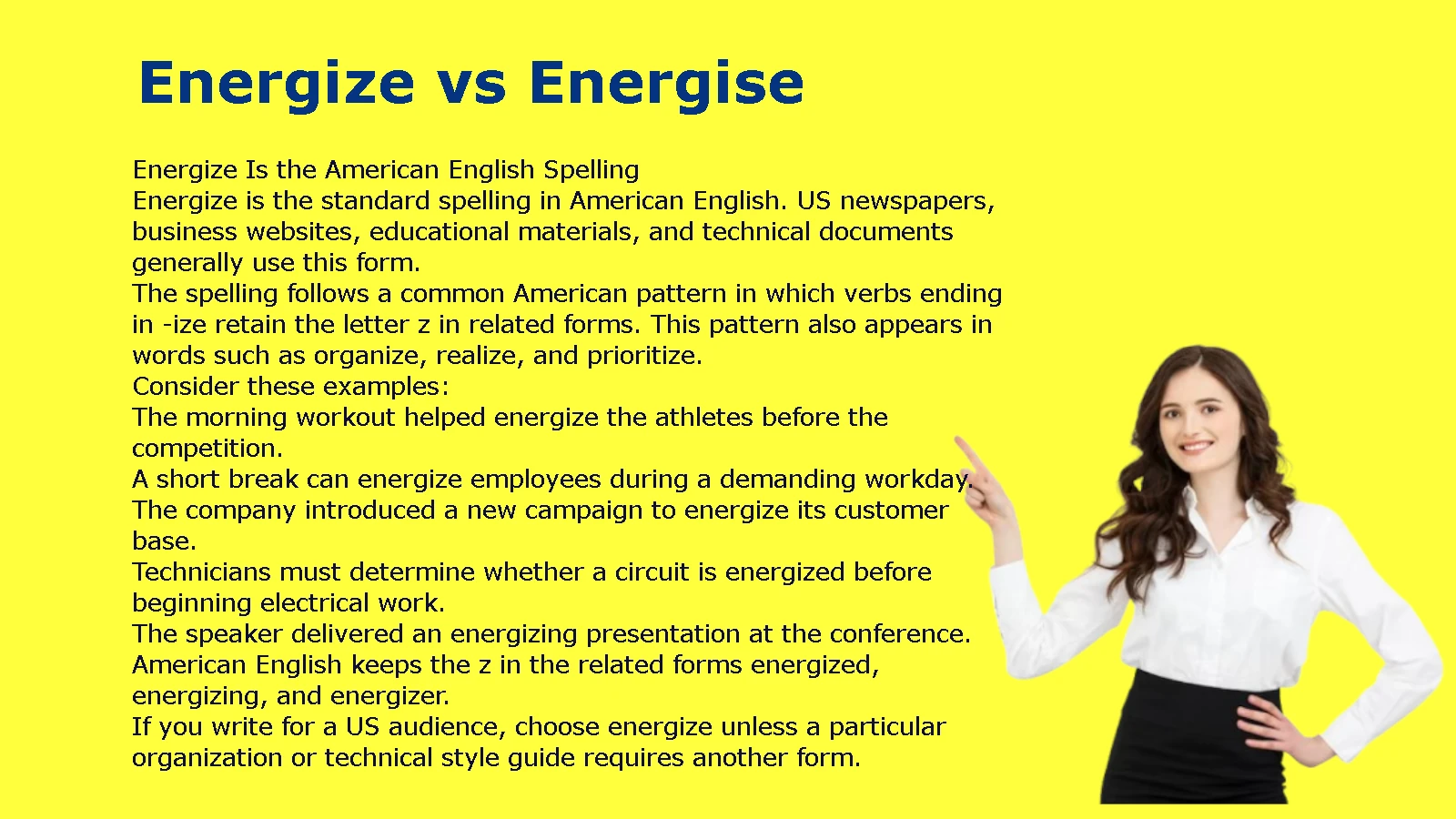
Energize vs energise is a spelling difference between American and British English. Both words mean to give someone or something energy, enthusiasm, or electrical power, but energize is the standard American spelling, while energise is the standard British spelling. The same pattern appears in energized vs energised, energizing vs energising, and de-energize vs de-energise.
Understanding this difference helps you choose the right spelling for your audience, write consistently, and avoid confusion in professional documents. The words also have important uses in everyday conversation, workplace communication, and electrical engineering. For example, an energized person might feel motivated after a good night’s sleep, while an energized electrical circuit carries electrical energy and may present a serious safety risk.
Energize vs Energise: Which Spelling Is Correct?
Energize and energise are both correct spellings of the same verb. American English generally uses the ending -ize, while British English commonly uses -ise. The difference affects spelling rather than meaning or pronunciation, so you can use either form as long as it matches your intended variety of English.
| Feature | Energize | Energise |
| Preferred spelling | American English | British English |
| Part of speech | Verb | Verb |
| Meaning | To give energy, enthusiasm, or electrical power | To give energy, enthusiasm, or electrical power |
| Past tense | Energized | Energised |
| Present participle | Energizing | Energising |
| Example | The new routine will energize the team. | The new routine will energise the team. |
| Common audience | US readers | UK readers |
Neither spelling is inherently more correct than the other. The appropriate choice depends on your audience, publication requirements, and writing style.
Energize Is the American English Spelling
Energize is the standard spelling in American English. US newspapers, business websites, educational materials, and technical documents generally use this form.
The spelling follows a common American pattern in which verbs ending in -ize retain the letter z in related forms. This pattern also appears in words such as organize, realize, and prioritize.
Consider these examples:
- The morning workout helped energize the athletes before the competition.
- A short break can energize employees during a demanding workday.
- The company introduced a new campaign to energize its customer base.
- Technicians must determine whether a circuit is energized before beginning electrical work.
- The speaker delivered an energizing presentation at the conference.
American English keeps the z in the related forms energized, energizing, and energizer.
If you write for a US audience, choose energize unless a particular organization or technical style guide requires another form.
Energise Is the British English Spelling
Energise is the standard British spelling of the same verb. It is common in British publications and many other varieties of English that follow British spelling conventions.
British English often uses -ise in verbs such as organise, realise, and prioritise. However, British spelling conventions are not entirely uniform. Some British publications use -ize under specific style rules, so -ise is common rather than universally mandatory throughout the UK.
Here are some examples:
- A brisk walk can energise you before work.
- The coach used music to energise the players.
- The manager introduced new activities to energise the team.
- The maintenance team checked whether the equipment remained energised.
- A refreshing lunch break can leave employees feeling more energised in the afternoon.
Notice that the meaning remains unchanged. Only the spelling differs.
For UK-focused writing, use energise and its related forms consistently. This approach helps your article, email, or report match the spelling conventions your readers expect.
Energize vs Energise at a Glance
The easiest way to remember the distinction is to associate energize with American English and energise with British English.
| American English | British English | Meaning |
| Energize | Energise | Give energy or power |
| Energized | Energised | Given energy or power |
| Energizing | Energising | Giving energy or power |
| Energizer | Energiser | A person or thing that energizes |
| De-energize | De-energise | Remove or disconnect an energy supply, depending on context |
| De-energized | De-energised | No longer energized |
| De-energizing | De-energising | Removing or disconnecting an energy supply |
The spelling difference is predictable across most forms of the word.
One practical exception deserves attention: technical documents may use standardized terminology, product names, or wording required by a particular industry. When writing safety procedures or equipment instructions, follow the relevant technical standard rather than changing terminology merely to match a regional spelling preference.
Energized vs Energised: Meaning and Examples
Energized and energised are past-tense and past-participle forms of the verb energize or energise. They can describe someone who has gained energy or enthusiasm, an activity that has become more lively, or electrical equipment that has an energy supply. The intended meaning depends on the context.
What Does Energized or Energised Mean?
The verb energize means to give energy, strength, enthusiasm, or power to someone or something. Its past-tense form describes an action that happened earlier, while its past participle can describe a resulting state or form part of a perfect-tense construction.
For example:
- Physical energy: The morning run energized Maya before her shift.
- Mental alertness: A short break energized the students before the exam.
- Motivation: The new project energized the entire department.
- Activity: The announcement energized the campaign.
- Electrical power: The technician identified an energized conductor.
The word can describe a temporary feeling or a technical condition. A person who feels energized may have more enthusiasm or alertness than before. An energized conductor, however, may carry a dangerous electrical voltage.
This distinction matters because context changes how readers interpret the word.
Compare these sentences:
- “The music energized the crowd.” This describes excitement and enthusiasm.
- “The equipment remained energized.” This describes an electrical condition.
Although both sentences use the same word family, the second has a specific technical meaning.
Energized vs Energised in Sentences
The two spellings work in equivalent sentences. Choose the form that matches the variety of English you are writing.
| American English | British English |
| The exercise energized the students. | The exercise energised the students. |
| I felt energized after lunch. | I felt energised after lunch. |
| The new strategy energized the business. | The new strategy energised the business. |
| The speaker delivered an energizing talk. | The speaker delivered an energising talk. |
| The technician found an energized cable. | The technician found an energised cable. |
The spelling difference does not change the sentence’s grammar.
For example, both of these sentences use the past tense correctly:
- The new training program energized the staff.
- The new training programme energised the staff.
The second sentence also uses the British spelling programme in its general sense. The two examples demonstrate how regional spelling conventions can affect several words in the same sentence.
Energized or Energised in Professional Writing
Professional writing benefits from consistent spelling. A report that switches between American and British forms may look poorly edited, even when every individual word is understandable.
Use the following guidelines:
- US business writing: Prefer energize, energized, and energizing.
- UK business writing: Prefer energise, energised, and energising.
- International publications: Follow the publication’s established style guide.
- Technical documentation: Preserve the terminology required by the applicable standards and equipment documentation.
- Academic writing: Follow the institution’s or publisher’s spelling requirements.
Imagine that a company publishes a UK-facing article containing the sentence, “The new strategy energizes the team.” The sentence is understandable, but energises may better match the article’s British spelling style.
If the same company publishes a US version, it can use energizes instead.
Consistency matters more than treating one regional form as universally correct.
Energised Synonyms and Alternative Words
Energised synonyms include invigorated, refreshed, revitalized, motivated, and stimulated. However, these words are not interchangeable in every sentence. Choose a synonym according to whether you mean physical energy, emotional enthusiasm, increased activity, or electrical power.
Synonyms for Energised When Describing People
When energised describes a person, the best synonym depends on the source of the energy and the effect it produces.
| Synonym | Meaning | Example sentence |
| Invigorated | Made to feel stronger, more energetic, or more alert | The cool morning air left us invigorated. |
| Refreshed | Restored after rest or a break | She felt refreshed after a quiet afternoon. |
| Revitalized | Given renewed strength or vitality | The holiday revitalized the tired team. |
| Motivated | Given a reason or desire to act | The encouraging feedback motivated the employee. |
| Stimulated | Encouraged mental or physical activity | The discussion stimulated new ideas. |
| Reinvigorated | Given energy or enthusiasm again | The new leadership reinvigorated the organization. |
| Rejuvenated | Made to feel younger, fresher, or more energetic | A weekend away left him rejuvenated. |
These words express related ideas, but each emphasizes something different.
For example, refreshed often suggests recovery after rest. Motivated emphasizes a desire to achieve a goal. Invigorated suggests renewed energy or alertness.
Consider this sentence:
“The team felt energized after the meeting.”
You could rewrite it in several ways:
- “The team felt motivated after the meeting.” This emphasizes its desire to act.
- “The team felt invigorated after the meeting.” This emphasizes renewed energy.
- “The team felt inspired after the meeting.” This emphasizes new ideas or encouragement.
- “The team felt reinvigorated after the meeting.” This suggests that the meeting restored energy that had declined.
Select the synonym that preserves your intended meaning rather than replacing the word simply to avoid repetition.
Synonyms for Energised When Describing Excitement
Sometimes, energised describes a lively atmosphere rather than physical strength.
In that context, consider these alternatives:
- Enthusiastic: Showing strong interest or excitement.
- Excited: Feeling eager or emotionally stirred.
- Animated: Showing visible energy through speech, movement, or expression.
- Lively: Full of activity, movement, or interest.
- Inspired: Filled with ideas or a desire to do something meaningful.
- Charged up: Informal language for feeling excited, motivated, or ready to act.
- Fired up: Informal language for strong enthusiasm or determination.
Here are a few examples:
“The announcement energized the audience.”
- “The announcement excited the audience.”
- “The announcement left the audience fired up.”
- “The announcement created a lively atmosphere.”
- “The announcement inspired the audience to participate.”
Each version changes the emphasis slightly. Excited highlights an emotional response, while inspired suggests that the announcement encouraged people to think or act differently.
In formal reports, motivated, inspired, or invigorated may fit better than conversational expressions such as fired up.
Energised Synonyms in Technical Contexts
In electrical engineering, the word energized has a more precise meaning than it does in everyday conversation. It generally describes equipment or a conductor that has electrical energy supplied to it or is electrically live.
Words such as powered, live, and supplied with electricity may sometimes communicate a similar idea. However, they do not always carry exactly the same technical implications.
| Term | Typical use | Important distinction |
| Energized | Electrical equipment, conductors, or circuits | Describes an electrical state involving supplied electrical energy or a live condition. |
| Electrically live | Conductors or components | Emphasizes the presence of a potentially hazardous electrical voltage. |
| Powered | Devices and systems | Indicates a power supply, but does not always establish the precise electrical safety status. |
| Activated | Equipment, systems, or functions | Often means switched on or made operational, not necessarily electrically safe or unsafe. |
| De-energized | Equipment or circuits | Indicates that the relevant energy supply has been removed or the equipment is no longer energized. |
Do not replace energized with activated in a safety procedure unless the wording accurately describes the intended condition.
A machine can be switched off while parts of its electrical system remain energized. Similarly, stored energy may remain after a supply has been disconnected.
For technical writing, precision matters more than stylistic variety.
Energized Meaning in Electrical Engineering
In electrical engineering, energized describes a circuit, conductor, or piece of equipment that has electrical energy supplied to it or is electrically live. The term often signals that an electrical hazard may exist. Its everyday meaning is different: a person who feels energized simply feels more alert, active, or enthusiastic.
What Does Energized Mean in Electrical Terms?
An electrical component is described as energized when it is supplied with electrical energy or has an electrical condition that makes it live. The term commonly appears in electrical maintenance, power distribution, industrial machinery, and workplace safety instructions.
For example:
- An energized circuit may carry electrical current when connected to a suitable load.
- An energized conductor may present an electric shock hazard.
- An energized motor may receive electrical power even when its mechanical output is limited.
- An energized control panel may contain live electrical components.
- An energized system may require specific precautions before inspection or maintenance.
Voltage and current are related but distinct concepts. Voltage is the electrical potential difference between two points, while current is the flow of electric charge. A live conductor can present a shock hazard even when a particular operating condition produces little or no current through a connected load.
This is why technicians do not rely on a machine’s appearance or a switch position alone to determine whether it is safe.
For example, a worker might see a motor that has stopped turning and assume that its electrical supply has been removed. However, the motor could still be connected to an energized circuit. The lack of movement does not establish electrical safety.
Energized vs De-Energized Electrical Equipment
| Feature | Energized equipment | De-energized equipment |
| Electrical condition | May be supplied with electrical energy or electrically live | The relevant electrical energy supply has been removed |
| Potential hazards | Electric shock, arc flash, and other electrical hazards, depending on conditions | Stored energy, unexpected re-energization, and other residual hazards may remain |
| Maintenance | Requires controls appropriate for the live condition and task | Requires proper isolation and verification before work |
| Example | A live distribution panel | A panel isolated from its electrical supply and verified under the applicable procedure |
| Safety assumption | Must be treated according to its actual electrical condition | Must not be assumed safe solely because a switch is off |
The distinction has practical consequences in industrial workplaces.
Before maintenance, workers may need to identify every energy source, isolate the equipment, apply the required lockout/tagout controls, and verify the absence of hazardous voltage using suitable equipment and procedures.
De-energized does not automatically mean safe. Capacitors may retain a charge, rotating machinery may store mechanical energy, and other systems may contain pneumatic, hydraulic, thermal, or gravitational energy.
The exact steps depend on the equipment and the applicable safety requirements.
What Does De-Energized Mean?
De-energized means that the relevant energy supply has been removed or that equipment is no longer energized. In electrical contexts, the word usually refers to removing the electrical supply. The related British spelling is de-energised.
The term appears in maintenance manuals, industrial safety procedures, and electrical work instructions.
Examples include:
- The electrician de-energized the circuit before beginning the inspection.
- The control panel was de-energized before the scheduled maintenance.
- Workers verified that the equipment was de-energized before handling the conductors.
- The technician followed the approved procedure to isolate and de-energize the machine.
British English uses equivalent forms:
- The electrician de-energised the circuit before beginning the inspection.
- The control panel was de-energised before the scheduled maintenance.
- Workers verified that the equipment was de-energised before handling the conductors.
These sentences use different spellings but communicate the same basic idea.
In safety-related documents, however, writers should distinguish the action of de-energizing equipment from the verification that makes it safe to work on. Simply writing that someone switched off a machine does not establish that every relevant energy source has been isolated.
Energized and De-Energized Examples in Technical Writing
Technical writers should use electrical terminology that identifies the actual condition of equipment.
Here are several examples of clear wording:
Example: Maintenance instruction
Less precise: “Turn off the machine before servicing it.”
More precise: “Follow the approved isolation procedure, de-energize the relevant electrical supply, and verify the required safe condition before servicing the machine.”
The second instruction identifies a process rather than relying on a switch position.
Example: Electrical inspection report
“Inspection was postponed because the panel remained energized.”
This sentence clearly states why the inspection did not proceed.
Example: Equipment handover
“The maintenance team isolated the circuit and verified the absence of hazardous voltage before releasing the equipment for the next work stage.”
This statement describes both isolation and verification without assuming that the word de-energized alone proves every safety condition.
Example: Training material
“Never assume that a conductor is de-energized because the connected equipment has stopped operating.”
This warning addresses a common misconception.
For safety-critical work, follow the relevant regulations, site procedures, and manufacturer instructions. Do not use a spelling guide as a substitute for technical training.
De-Energize vs De-Energise: Meaning and Spelling
De-energize is the standard American spelling, while de-energise is the standard British spelling. Both describe removing or disconnecting an energy supply, particularly electrical power. Their related forms follow the same regional pattern: de-energized and de-energised, for example.
De-Energize Is the American English Form
American English uses de-energize as the verb for removing an energy supply or placing equipment into a de-energized state.
The word often appears in industrial procedures and electrical safety documentation.
Examples:
- The technician will de-energize the equipment before inspection.
- Workers must de-energize the circuit according to the approved procedure.
- The control system automatically de-energizes the relevant output when specified conditions occur.
- The team de-energized the equipment before performing the maintenance task.
The word is built from the prefix de-, which can indicate removal or reversal, and energize, which means to supply with energy or make energized.
The resulting verb describes the removal of energy from a system or component in the relevant context.
De-Energise Is the British English Form
British English commonly uses de-energise. The meaning is the same as the American form.
Examples include:
- The engineer will de-energise the equipment before inspection.
- The maintenance team must de-energise the circuit before proceeding.
- The technician de-energised the system in accordance with the approved procedure.
- The equipment remained de-energised until the inspection was complete.
When writing for British readers, use de-energise and its related forms if your chosen style follows the -ise convention.
Some British technical documents may follow a different institutional or industry style. In that situation, use the terminology required by the relevant documentation.
De-Energized vs De-Energised
The difference between de-energized and de-energised is regional spelling, not meaning.
| American English | British English | Grammatical use |
| De-energize | De-energise | Base verb |
| De-energizes | De-energises | Third-person singular |
| De-energizing | De-energising | Present participle |
| De-energized | De-energised | Past tense and past participle |
Examples:
- US: The technician de-energizes the circuit before inspection.
- UK: The technician de-energises the circuit before inspection.
- US: The team is de-energizing the equipment.
- UK: The team is de-energising the equipment.
- US: The circuit was de-energized.
- UK: The circuit was de-energised.
Both varieties also use the noun de-energization or de-energisation, depending on the spelling convention.
For example, a report might refer to the de-energization of a circuit in American English or the de-energisation of a circuit in British English.
Choose one convention and apply it throughout the document.
Should De-Energized Always Mean Safe?
No. De-energized does not automatically mean that equipment is safe to touch or service. The term describes an energy condition, but workers must account for residual energy, alternative supplies, unexpected re-energization, and other hazards before beginning work.
Consider an industrial machine connected to an electrical supply and fitted with a large capacitor. Disconnecting the supply may stop the capacitor from receiving additional energy, but the capacitor could still hold a dangerous charge.
Similarly, a machine may receive power from more than one source. Isolating its main supply might not disconnect an auxiliary circuit or a backup power source.
A safe procedure may therefore require workers to:
- Identify all relevant energy sources.
- Shut down the equipment using the appropriate procedure.
- Isolate the relevant sources.
- Apply required lockout/tagout controls.
- Release or control stored energy where applicable.
- Verify the required safe condition using suitable methods.
- Follow site-specific instructions before beginning work.
These steps are general principles, not a complete procedure for every installation. Electrical safety requirements depend on the equipment, work being performed, and applicable regulations.
In a safety document, avoid statements such as “The machine is safe because it is de-energized.” A more accurate statement identifies the isolation and verification steps that establish the permitted work condition.
Energised Pronunciation and Word Forms
Energised and energized generally have the same pronunciation. The final -ed is pronounced as a separate syllable, and the word has four syllables in standard pronunciation. The spelling changes between American and British English, but the basic pronunciation and grammatical role remain the same.
How to Pronounce Energised
The standard pronunciation of energised is commonly represented in IPA as:
/ˈen.ə.dʒaɪzd/
Pronunciation can vary slightly across English accents. The word typically has four syllables, with the main stress on the first syllable.
A useful way to learn it is to break the word into its spoken parts:
- The first syllable carries the main stress.
- The middle syllables lead into the long i sound.
- The final -ised ends with a voiced /d/ sound following /z/.
The word rhymes approximately with the ending of realized in many accents, although the full words have different beginnings.
Examples in context:
- “I feel energised after a good night’s sleep.”
- “The announcement energised the audience.”
- “The technician checked the energised circuit.”
The spelling energize does not normally signal a different pronunciation from energise. Both forms use the same basic spoken word.
Energize and Energise Verb Forms
The verb forms follow a predictable pattern. The principal difference is the regional spelling of the letter z or s in the relevant forms.
| Verb form | American English | British English |
| Base form | Energize | Energise |
| Third-person singular | Energizes | Energises |
| Present participle | Energizing | Energising |
| Past tense | Energized | Energised |
| Past participle | Energized | Energised |
Here is how these forms work in sentences.
Base form: “Regular breaks can energize the team.”
Third-person singular: “The new routine energizes the athletes.”
Present participle: “The coach is energizing the players.”
Past tense: “The presentation energized the audience.”
Past participle: “The team has energized the campaign.”
The past tense and past participle share the same spelling, but their grammatical functions differ.
For example, “The announcement energized the crowd” uses the simple past tense. In “The announcement has energized the crowd,” the word energized forms part of the present perfect construction.
British English follows the same grammatical rules:
- The routine energises the athletes.
- The coach is energising the players.
- The presentation energised the audience.
- The team has energised the campaign.
Understanding these forms makes it easier to edit articles, reports, and other content without introducing spelling inconsistencies.
Energised UK Spelling: Related Words
The British spelling pattern also appears in several related words. The exact form depends on the part of speech.
| American English | British English | Part of speech |
| Energize | Energise | Verb |
| Energized | Energised | Past tense or past participle |
| Energizing | Energising | Present participle or adjective |
| Energizer | Energiser | Noun |
| Energization | Energisation | Noun |
| De-energize | De-energise | Verb |
| De-energized | De-energised | Past tense or past participle |
| De-energizing | De-energising | Present participle |
For example, a US company might describe a product as an energizer, while a UK publication might use energiser.
The spelling energisation may appear in British technical or formal writing when the noun refers to the act or process of energizing something.
However, related forms should not be changed mechanically when they appear in official product names, quotations, or established technical terminology. Check the relevant style guide before editing specialized documents.
How to Choose Between Energize and Energise
The best spelling depends on your readers and the conventions of the document. Use energize for standard American English and energise for standard British English. Keep related forms consistent, and follow any specific spelling requirements imposed by your publisher, employer, institution, or technical standard.
Use Energize for American Audiences
Choose energize when writing for a US audience.
This convention works well for:
- American blog posts and online articles.
- US business reports and company communications.
- Educational materials written in American English.
- Product descriptions and marketing campaigns aimed at US consumers.
- General technical documentation that follows American spelling conventions.
For example, a US fitness website might publish this sentence:
“The right warm-up can energize your body and help you prepare for exercise.”
The related forms should match:
- Energize
- Energized
- Energizing
- De-energize
- De-energized
A consistent spelling pattern helps readers recognize the intended regional style.
Use Energise for British Audiences
Choose energise when writing in standard British English.
This spelling often fits:
- UK-focused blog articles.
- British business correspondence.
- Educational resources following British conventions.
- Publications that use organise, realise, and prioritise.
- Technical documents whose style guide specifies -ise spellings.
For example:
“A short walk can energise employees and help them return to work feeling refreshed.”
The same spelling convention applies to energised and energising.
However, British English includes more than one established spelling tradition. Some publications use -ize for certain words, and organizations may maintain their own editorial rules. Therefore, follow the required style guide rather than assuming that every British publication must use -ise.
Keep Spelling Consistent Across Related Forms
Consistency makes your writing easier to read and edit. Mixing regional forms can distract readers, particularly in longer articles that use several forms of the same verb.
Use this quick editing checklist:
- Identify the intended audience.
- Choose American or British spelling conventions.
- Use the correct form in the title and introduction.
- Check past-tense and present-participle forms.
- Review related terms such as de-energized and de-energised.
- Follow the organization’s style guide.
- Preserve official product names and quoted wording where necessary.
For example, a UK article should normally use energise, energised, and energising if it follows the usual British -ise convention.
Avoid writing “The campaign energised the audience, and the new message energized its customers” unless there is a specific reason to retain both regional forms.
The sentence is grammatically understandable, but the inconsistent spelling may make the article look unedited.
A Practical Editing Example
Suppose you are preparing a company article for publication in the UK.
Your first draft contains these sentences:
“The new program energized the team. Its success has energised employees, and the company plans to energize more departments.”
The spelling and vocabulary do not follow one consistent regional style. A British English revision might read:
“The new programme energised the team. Its success has energised employees, and the company plans to energise more departments.”
For a US audience, the corresponding version might read:
“The new program energized the team. Its success has energized employees, and the company plans to energize more departments.”
Both versions communicate the same information. The editing decision simply aligns the spelling with the intended audience.
Frequently Asked Questions
Is Energize or Energise Correct?
Both energize and energise are correct. Energize is the standard American spelling, while energise is common in British English. Both words have the same meaning and pronunciation. Choose the form that matches your audience and the spelling conventions used throughout your document.
What Does Energised Mean in British English?
In British English, energised means given energy, enthusiasm, strength, or electrical power. For example, someone might feel energised after exercising or resting. In an electrical context, an energised component may be electrically live or supplied with electrical energy.
Is Energised the UK Spelling of Energized?
Yes. Energised is the standard British spelling of American energized. The two forms have the same meaning. British English also commonly uses energise and energising, while American English uses energize and energizing.
What Is a Synonym for Energised?
Common synonyms for energised include invigorated, refreshed, revitalized, motivated, and stimulated. Use refreshed when someone has recovered after rest, motivated when someone wants to take action, and invigorated when someone feels renewed energy. In electrical contexts, powered or electrically live may fit, depending on the precise meaning.
What Does De-Energized Mean in Electrical Terms?
De-energized describes equipment or a circuit whose relevant energy supply has been removed or that is no longer energized. The British spelling is de-energised. The term does not, by itself, prove that equipment is safe to touch. Workers must follow the applicable isolation and verification procedures before beginning electrical work.
How Do You Pronounce Energised?
Energised is generally pronounced /ˈen.ə.dʒaɪzd/ in IPA. The word has four syllables, with the main stress on the first syllable. Energized normally has the same basic pronunciation despite the different spelling.
Conclusion: Energize or Energise?
The difference between energize vs energise comes down to regional spelling conventions. American English normally uses energize, energized, and energizing, while British English commonly uses energise, energised, and energising. Neither form changes the basic meaning of the word.
When describing people, energised can mean refreshed, motivated, or full of enthusiasm. In electrical engineering, energized has a more specific meaning related to electrical power and potentially hazardous live equipment. The related terms de-energize and de-energise describe removing an energy supply, but they should not be treated as proof that equipment is safe without the required checks.
For clear writing, identify your audience, select the appropriate spelling convention, and apply it consistently across every related word.













