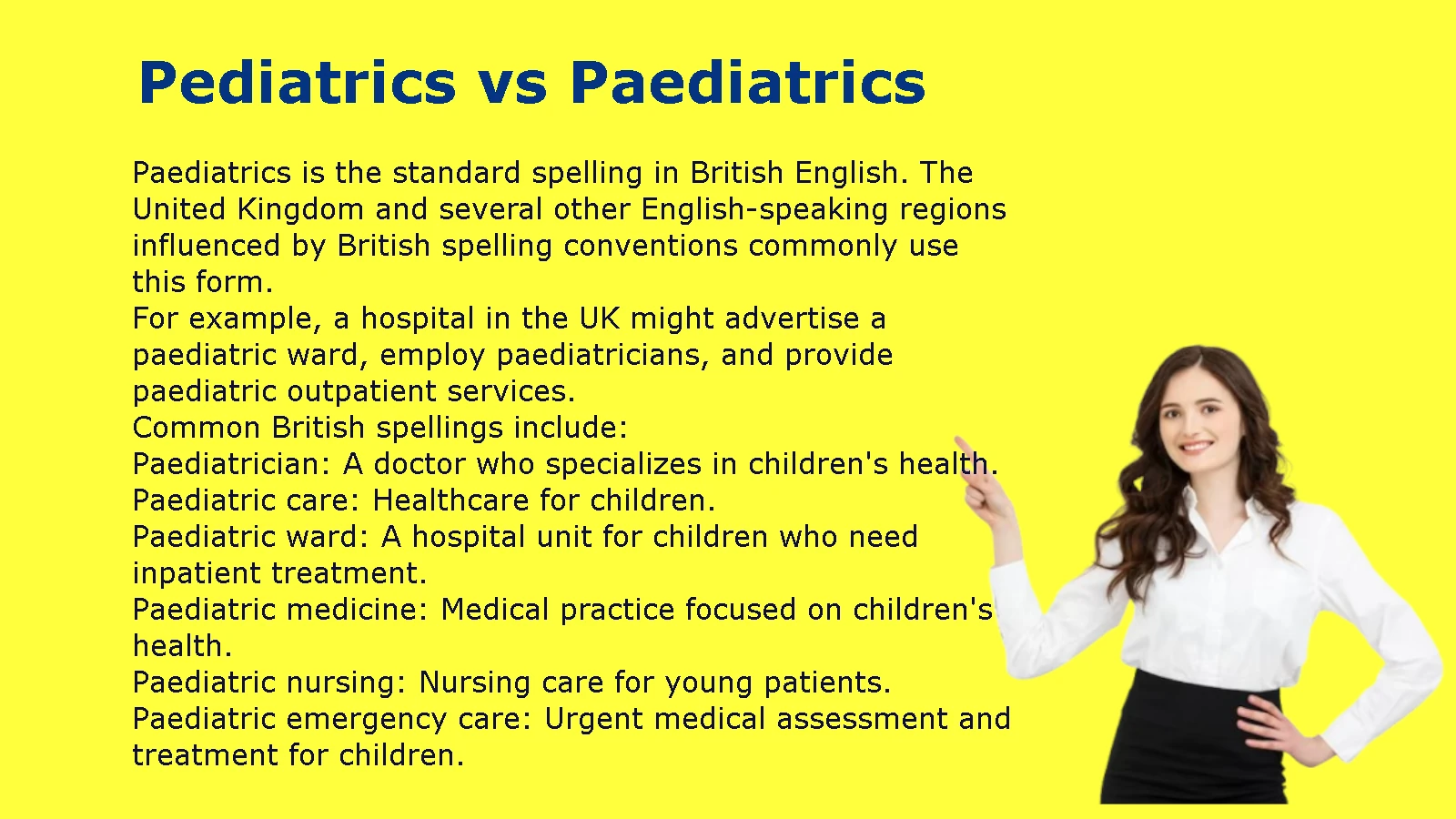
Pediatrics vs paediatrics comes down to a regional spelling difference: pediatrics is the standard American English spelling, while paediatrics is the standard British English spelling. Both words refer to the branch of medicine that focuses on children’s health, growth, development, and treatment. The same pattern appears in pediatric vs paediatric, pediatrician vs paediatrician, and pediatric care vs paediatric care.
Understanding this difference helps you choose the correct spelling for medical documents, school assignments, hospital websites, and everyday writing. You may also encounter related terms such as pediatric age range, paediatrics department, pediatric ward, and paediatrics pronunciation. Although the spelling changes between English varieties, the medical specialty remains the same.
Pediatrics vs Paediatrics: Which Spelling Is Correct?
Pediatrics and paediatrics are both correct spellings. American English generally uses pediatrics, while British English uses paediatrics. The choice depends on your audience and the spelling conventions you follow, not on a difference in medical meaning.
| Feature | American English | British English |
| Medical specialty | Pediatrics | Paediatrics |
| Adjective | Pediatric | Paediatric |
| Medical professional | Pediatrician | Paediatrician |
| Medical care | Pediatric care | Paediatric care |
| Hospital unit | Pediatric ward | Paediatric ward |
| Example | She works in pediatrics. | She works in paediatrics. |
Pediatrics Is the American English Spelling
Pediatrics is the standard spelling in the United States. American hospitals, medical schools, health organizations, and healthcare publications commonly use this form.
For example, an American hospital might advertise a pediatric department that provides routine checkups, vaccinations, developmental assessments, and treatment for childhood illnesses.
You will also see the American spelling in these expressions:
- Pediatrician: A doctor who specializes in children’s health.
- Pediatric care: Medical care designed for children.
- Pediatric hospital: A hospital that focuses on treating children.
- Pediatric medicine: Medical practice and treatment related to children.
- Pediatric nursing: Nursing care for infants, children, and adolescents.
- Pediatric emergency department: A hospital service that evaluates and treats urgent medical problems in children.
If you write for an American audience, use pediatrics and its related forms consistently.
Example: “The hospital expanded its pediatrics department to provide more specialized care for infants and teenagers.”
Paediatrics Is the British English Spelling
Paediatrics is the standard spelling in British English. The United Kingdom and several other English-speaking regions influenced by British spelling conventions commonly use this form.
For example, a hospital in the UK might advertise a paediatric ward, employ paediatricians, and provide paediatric outpatient services.
Common British spellings include:
- Paediatrician: A doctor who specializes in children’s health.
- Paediatric care: Healthcare for children.
- Paediatric ward: A hospital unit for children who need inpatient treatment.
- Paediatric medicine: Medical practice focused on children’s health.
- Paediatric nursing: Nursing care for young patients.
- Paediatric emergency care: Urgent medical assessment and treatment for children.
Example: “The hospital’s paediatrics department offers specialist services for children with complex medical conditions.”
The extra ae does not indicate a different specialty, treatment method, or level of medical expertise. It reflects a regional spelling convention.
Pediatrics vs Paediatrics: The Main Difference
The key difference between pediatrics and paediatrics is spelling, not meaning.
Both terms describe the same medical specialty. A pediatrician in the United States and a paediatrician in the United Kingdom perform comparable professional roles, although their training systems, responsibilities, and clinical settings may differ.
Consider these examples:
- American English: “My daughter has an appointment with her pediatrician.”
- British English: “My daughter has an appointment with her paediatrician.”
Both sentences communicate the same idea.
One useful rule is to follow your publication’s spelling system. If you write an American article, use pediatric. If you write a British article, use paediatric. Avoid switching between the two forms unless you are directly comparing regional usage.
What Does Pediatrics Mean in Medicine?
Pediatrics is the branch of medicine concerned with the physical health, growth, development, and medical treatment of infants, children, and adolescents. It includes preventive healthcare, diagnosis, treatment, and guidance for families. In British English, the same specialty is called paediatrics.
Pediatrics covers much more than treating childhood illnesses. It also supports healthy development, monitors growth, identifies potential problems early, and helps children manage acute and long-term medical conditions.
Definition of Pediatrics
The word pediatrics refers to a medical specialty that focuses on children’s health from birth through adolescence and, in some services, into young adulthood.
Pediatric care can include:
- Routine health examinations.
- Childhood vaccinations.
- Monitoring height, weight, and development.
- Diagnosing infections and other illnesses.
- Managing asthma, diabetes, and other chronic conditions.
- Assessing nutrition and feeding difficulties.
- Evaluating developmental concerns.
- Providing advice about sleep, safety, and healthy habits.
- Referring children to specialists when necessary.
For example, a pediatrician might examine a baby who has difficulty gaining weight, treat a child with an ear infection, or help a teenager manage asthma.
The specialty combines medical treatment with developmental knowledge. A child’s symptoms, medication requirements, communication needs, and emotional responses may differ from those of an adult. Pediatric professionals account for these differences when planning care.
What Is a Pediatrician?
A pediatrician is a medical doctor who specializes in the health and medical care of children. In British English, the corresponding term is paediatrician.
Pediatricians work in hospitals, outpatient clinics, private practices, community health services, and specialist medical centers.
Their responsibilities may include:
- Examining children and reviewing their medical histories.
- Diagnosing illnesses and assessing symptoms.
- Recommending appropriate treatment.
- Monitoring growth and developmental milestones.
- Advising parents about nutrition and preventive care.
- Managing certain long-term conditions.
- Coordinating care with nurses and other specialists.
For example, a pediatrician may evaluate a three-year-old who has frequent wheezing. The doctor might review the child’s symptoms, examine their breathing, consider possible causes, and recommend treatment or further testing.
Pediatricians also work with families. Parents often notice changes in behavior, appetite, sleep, or activity before a child can explain what feels wrong. Those observations can help a doctor assess the problem.
Pediatric vs Pediatrics: What’s the Difference?
Pediatrics is a noun that names the medical specialty. Pediatric is an adjective that describes something related to that specialty or to children’s medical care.
| Word | Part of speech | Meaning | Example |
| Pediatrics | Noun | The medical specialty | Pediatrics is her chosen specialty. |
| Pediatric | Adjective | Relating to children’s healthcare | The child needs a pediatric examination. |
| Pediatrician | Noun | A doctor specializing in children’s health | The pediatrician examined the infant. |
| Paediatrics | Noun | British spelling of the specialty | He trained in paediatrics. |
| Paediatric | Adjective | British form of the adjective | She works in a paediatric clinic. |
| Paediatrician | Noun | British spelling of the professional title | The paediatrician reviewed the results. |
Here is the difference in everyday use:
- “She studies pediatrics.” The sentence names a medical specialty.
- “She works in a pediatric clinic.” The adjective describes the clinic.
- “She is a pediatrician.” The noun identifies her profession.
These forms are related, but they do not perform the same grammatical role. Choosing the right form makes medical writing clearer and more accurate.
Pediatrics vs Paediatrics Pronunciation
Pediatrics and paediatrics generally have the same pronunciation pattern, although regional accents can affect vowel sounds and stress. Both forms typically place the main stress on the third syllable when counted from the beginning of the word’s spoken sequence, with the final syllable pronounced as “trics.”
How to Pronounce Pediatrics
The American spelling pediatrics is commonly pronounced approximately as:
pee-dee-AT-riks
A simplified syllable breakdown is:
- pee
- dee
- at
- riks
The main stress falls on AT.
In IPA, a common American English pronunciation is /ˌpiːdiˈætrɪks/, though pronunciation varies among speakers.
To practice, say the word slowly first, then combine the syllables into one smooth word. Avoid placing the strongest stress on the opening syllable.
Example: “She wants to specialize in pediatrics after medical school.”
How to Pronounce Paediatrics
The British spelling paediatrics is generally pronounced in a similar way. The spelling contains ae, but that combination does not create a separate medical term or an entirely different pronunciation.
A simplified guide is:
pee-dee-AT-riks
The exact vowel quality can vary by accent. Some British speakers pronounce the opening vowels differently from American speakers, but the basic stress pattern remains similar.
Example: “He is training in paediatrics at a children’s hospital.”
When learning the word, focus on the spoken form rather than trying to pronounce every written letter separately.
Do Pediatrics and Paediatrics Sound Different?
In most cases, the two forms sound very similar. Any noticeable difference usually comes from regional accent rather than the extra letters in paediatrics.
The distinction is comparable to other American and British spelling pairs, such as color and colour. The written forms differ, but they represent the same word.
| Question | Answer |
| Do the words have different meanings? | No. |
| Does the British spelling require a separate pronunciation? | No. |
| Can accents affect the vowel sounds? | Yes. |
| Should you choose spelling based on pronunciation alone? | No. Follow your audience’s spelling convention. |
If you are writing a medical article, prioritize consistent spelling. If you are speaking, use the pronunciation natural to your accent.
How to Use Pediatric and Paediatric Correctly
Use pediatric when writing in American English and paediatric when writing in British English. Apply the same regional pattern to related words such as pediatrician/paediatrician and pediatrics/paediatrics. Consistency matters more than choosing one form as universally correct.
When to Use Pediatric in American English
American English uses pediatric to describe medical services, professionals, equipment, and treatment intended for children.
Examples include:
- Pediatric care: “The clinic provides pediatric care for children from birth through adolescence.”
- Pediatrician: “Our pediatrician recommended a follow-up examination.”
- Pediatric hospital: “The family traveled to a pediatric hospital for specialist treatment.”
- Pediatric patient: “The nurse prepared the room for the pediatric patient.”
- Pediatric surgery: “The surgeon specializes in pediatric surgery.”
- Pediatric nursing: “She completed additional training in pediatric nursing.”
Notice that pediatric usually appears before another noun. It tells the reader what kind of care, service, patient, or medical practice the sentence describes.
A writer should also avoid using pediatrics where an adjective is required.
Incorrect: “The hospital offers pediatrics services.”
Better: “The hospital offers pediatric services.”
The noun pediatrics names the specialty. The adjective pediatric modifies the word services.
When to Use Paediatric in British English
British English uses paediatric in the same grammatical situations.
Examples include:
- Paediatric care: “The hospital provides paediatric care for local families.”
- Paediatrician: “The paediatrician examined the child.”
- Paediatric ward: “The child remained in the paediatric ward overnight.”
- Paediatric patient: “The team reviewed the paediatric patient’s medical history.”
- Paediatric surgery: “The hospital offers specialist paediatric surgery.”
- Paediatric nursing: “She works in paediatric nursing.”
These examples show how the spelling changes while the meaning and grammatical function remain the same.
If you manage a UK-focused healthcare website, use British forms across page titles, navigation labels, service descriptions, and supporting content. This creates a consistent experience for readers.
Common Medical Phrases Using Both Spellings
The following table provides useful American and British equivalents.
| American English | British English |
| Pediatric department | Paediatrics department |
| Pediatric clinic | Paediatric clinic |
| Pediatrician | Paediatrician |
| Pediatric care | Paediatric care |
| Pediatric ward | Paediatric ward |
| Pediatric patient | Paediatric patient |
| Pediatric surgery | Paediatric surgery |
| Pediatric emergency care | Paediatric emergency care |
| Pediatric intensive care unit | Paediatric intensive care unit |
| Pediatric medicine | Paediatric medicine |
For example, an American hospital might write, “Our pediatric department offers specialist services for children with complex conditions.”
A British hospital might write, “Our paediatrics department offers specialist services for children with complex conditions.”
Both sentences are correct within their respective spelling conventions.
Which Spelling Should You Use in Academic or Medical Writing?
Choose the spelling that matches the intended audience, institutional style guide, or publication requirements.
Use this practical framework:
- Writing for US readers: Use pediatrics, pediatric, and pediatrician.
- Writing for UK readers: Use paediatrics, paediatric, and paediatrician.
- Writing for an international organization: Check its preferred English style.
- Submitting a medical paper: Follow the journal’s author guidelines.
- Editing an existing document: Preserve its established spelling system unless you are standardizing it.
- Quoting a source: Keep the original spelling inside the quotation.
Search engines can understand both spellings, but that does not mean you should alternate between them without reason. A consistent spelling system helps readers recognize that the article follows a clear editorial standard.
For an SEO article targeting pediatrics vs paediatrics, it makes sense to include both forms naturally because the comparison itself requires them. In other articles, choose the form that best matches the target audience.
What Is the Pediatric Age Range?
The pediatric age range generally covers children from birth through adolescence, but the upper age limit varies by healthcare service. Many pediatric services care for patients until their 18th birthday, while some specialist programs accept older adolescents or young adults. Local policies and clinical needs determine the exact cutoff.
What Age Does Pediatric Care Start?
Pediatric care generally begins at birth. It includes care for newborns, infants, toddlers, school-age children, and adolescents.
Newborn care may involve feeding assessments, newborn examinations, monitoring weight, and identifying early health concerns. As children grow, pediatric care shifts toward development, vaccination, nutrition, illness prevention, and age-appropriate treatment.
A simplified age breakdown looks like this:
| Developmental stage | Common age range | Typical healthcare focus |
| Newborn | Birth to 28 days | Early examinations, feeding, weight, and newborn health |
| Infant | About 1 month to 1 year | Growth, immunizations, feeding, and development |
| Toddler | About 1–3 years | Language, movement, behavior, nutrition, and safety |
| Preschool child | About 3–5 years | Development, preventive care, and early learning concerns |
| School-age child | About 6–11 years | Growth, school health, injuries, and ongoing conditions |
| Adolescent | About 10–19 years in many public-health frameworks | Puberty, mental well-being, sexual health, and independence |
These age categories overlap because children develop at different rates. They also serve different purposes: a hospital may define service eligibility differently from a public-health organization.
When Does Pediatric Care End?
Many pediatric services use age 18 as a practical transition point, but this is not a universal rule.
Some hospitals provide pediatric care beyond age 18 for selected conditions. Others transfer patients to adult services at a specific age or when the patient reaches an appropriate stage of development.
For example, a teenager with a long-term congenital condition may need a carefully planned transition to adult specialist care. The process may involve shared appointments, updated treatment plans, and clear communication between medical teams.
Several factors can affect the transition:
- Hospital admission policies.
- The medical condition being treated.
- The availability of adult specialist services.
- Local healthcare regulations.
- The patient’s developmental and support needs.
- Whether the patient already receives care from a specialist team.
Therefore, avoid assuming that every pediatric department stops seeing patients at exactly the same age.
Does the Pediatric Age Limit Vary by Hospital?
Yes. The pediatric age limit can differ between hospitals, emergency departments, specialist clinics, and community services.
A children’s hospital may treat some young adults with complex childhood-onset conditions. Meanwhile, a general hospital may apply a different age limit for admission to its pediatric ward.
Consider this example:
A 17-year-old arrives at a hospital with severe abdominal pain. The emergency department’s policy, the patient’s clinical condition, and the availability of specialist care may determine whether the pediatric or adult team takes the lead.
That decision is not based on the word pediatric alone. It depends on local procedures and clinical judgment.
If you need to know whether a particular hospital accepts patients at a certain age, check its service information or contact the department directly.
What Is a Paediatrics or Pediatrics Department?
A pediatrics department or paediatrics department is a hospital or healthcare unit that provides medical services for children. Depending on the facility, it may offer outpatient consultations, inpatient treatment, emergency assessment, preventive care, and referrals to specialist teams.
The department brings together healthcare professionals who understand children’s medical and developmental needs.
What Does a Pediatrics Department Do?
A pediatrics department evaluates, treats, and monitors health problems affecting infants, children, and adolescents.
Its services may include:
- General medical consultations.
- Routine childhood examinations.
- Immunization services.
- Diagnosis and treatment of common illnesses.
- Monitoring growth and development.
- Management of chronic conditions.
- Referrals to pediatric specialists.
- Family education and preventive health guidance.
- Coordination with nurses, therapists, and other healthcare professionals.
For example, a parent may visit the department because a child has a persistent cough. A clinician can assess the symptoms, review the medical history, examine the child, and decide whether treatment or additional testing is necessary.
Some departments focus mainly on outpatient care. Others operate inpatient units and provide access to specialist services.
The precise range of services depends on the hospital’s size, staffing, equipment, and clinical specialties.
What Is a Pediatric Ward?
A pediatric ward is a hospital unit where children stay overnight or for longer periods while receiving medical treatment, monitoring, or recovery care.
The British spelling is paediatric ward.
A pediatric ward differs from an outpatient clinic because admitted patients need care that cannot be provided through a brief appointment alone.
Children may stay in a pediatric ward for reasons such as:
- Severe infections that require hospital treatment.
- Dehydration requiring close monitoring or intravenous fluids.
- Breathing problems.
- Recovery after surgery.
- Evaluation of complex symptoms.
- Management of certain chronic conditions during an acute episode.
For example, a child with a serious respiratory infection may need oxygen, medication, and regular observations. The pediatric ward allows the healthcare team to monitor the child’s condition and respond if it changes.
Many pediatric wards also consider the child’s emotional needs. Age-appropriate explanations, play activities, and family involvement can make a hospital stay less frightening.
However, the exact arrangements differ among hospitals. Some facilities have separate units for infants, adolescents, or children who need specialized treatment.
Common Services in a Pediatric Department
Pediatric departments may include several specialized services.
| Service | Main focus |
| General pediatrics | Common illnesses, examinations, and ongoing health needs |
| Neonatology | Medical care for newborns, especially premature or seriously ill babies |
| Pediatric cardiology | Heart conditions in children |
| Pediatric neurology | Conditions affecting the brain, nerves, and nervous system |
| Pediatric surgery | Surgical treatment for children |
| Pediatric emergency care | Urgent assessment and treatment |
| Pediatric intensive care | Close monitoring and advanced support for critically ill children |
| Developmental pediatrics | Developmental, behavioral, and related concerns |
Not every hospital offers every service. Smaller facilities may refer patients to larger centers when a child needs a specialist assessment or advanced treatment.
The terms pediatrics department and paediatrics department refer to the same general type of service. The spelling depends on the English variety used by the organization.
Who Is Known as the Father of Pediatrics?
Abraham Jacobi is widely known as the father of American pediatrics because of his major role in developing children’s medicine as a distinct medical field in the United States. His work helped establish specialized pediatric education, clinical services, and professional recognition for the care of children.
Abraham Jacobi and His Role in Pediatrics
Abraham Jacobi was a German-born physician who became an influential figure in American medicine. He lived from 1830 to 1919 and made important contributions to pediatric education and clinical practice.
During the nineteenth century, children’s healthcare was developing into a more distinct specialty. Jacobi advocated for dedicated medical attention to children’s needs and helped advance pediatric teaching and hospital services.
His contributions included work in medical education, clinical practice, and the development of institutions devoted to children’s health.
Jacobi’s historical importance comes from his influence on the organization and professional development of pediatrics in the United States. He helped shape the specialty at a time when medical care for children was becoming more systematic.
It is worth keeping the title precise: Jacobi is widely recognized as the father of American pediatrics. The history of children’s medicine also includes many other physicians, researchers, and healthcare workers who advanced pediatric knowledge in different countries.
How Pediatrics Developed Into a Medical Specialty
Pediatrics grew as doctors increasingly recognized that children require care tailored to their development and physiology.
A child’s body changes rapidly throughout infancy and childhood. Medication doses, nutritional needs, disease risks, and communication methods may differ from those used for adults.
Several developments helped establish pediatrics as a specialty:
- Dedicated children’s hospitals: These institutions created settings designed around children’s medical and developmental needs.
- Specialized medical education: Physicians began receiving more focused training in childhood diseases and development.
- Improved public health: Better understanding of sanitation, vaccination, nutrition, and infectious disease helped improve child health.
- Advances in newborn care: Specialized treatment improved care for premature and medically vulnerable infants.
- Growth of pediatric subspecialties: Fields such as pediatric cardiology and neonatology expanded treatment options for complex conditions.
Modern pediatrics now includes preventive medicine, emergency care, intensive care, developmental assessment, surgery, and long-term disease management.
The word pediatrics may look different from paediatrics, but both spellings describe the medical specialty that emerged through these historical developments.
Pediatrics vs Paediatrics: Common Spelling Mistakes
Most spelling errors occur when writers mix American and British forms or confuse the name of the specialty with its adjective. Remember that pediatrics names the field, pediatric describes something related to it, and pediatrician identifies the doctor.
Pediatric vs Paediatric
Pediatric is the American English adjective. Paediatric is the British English equivalent.
Both mean relating to children’s medical care.
Examples:
- American: “The hospital opened a new pediatric clinic.”
- British: “The hospital opened a new paediatric clinic.”
- American: “She is interested in pediatric research.”
- British: “She is interested in paediatric research.”
Neither spelling is inherently more correct than the other. The appropriate choice depends on the language variety you are using.
Pediatrician vs Paediatrician
A pediatrician is a doctor who specializes in children’s health. A paediatrician is the British spelling of the same professional title.
Examples:
- American: “The pediatrician reviewed the child’s growth chart.”
- British: “The paediatrician reviewed the child’s growth chart.”
Both words refer to the same type of medical professional. The spelling does not determine a doctor’s qualifications or scope of practice.
When writing about a specific doctor, use the spelling that matches the surrounding text or the institution’s preferred style.
Paediatric vs Paediatrics
Although the words look similar, paediatric and paediatrics have different grammatical functions.
- Paediatrics is a noun that names the medical specialty.
- Paediatric is an adjective that describes a related service, patient, or treatment.
Compare these sentences:
Correct: “He works in paediatrics.”
Correct: “He works in a paediatric clinic.”
Incorrect: “He works in paediatric.”
The final example lacks a noun or another grammatical structure that would complete the intended meaning.
The same distinction applies to American English:
- “She studies pediatrics.”
- “She works in a pediatric clinic.”
Learning the difference between nouns and adjectives helps prevent these mistakes in medical writing.
Is One Spelling More Correct Than the Other?
No. Pediatrics is standard American English, while paediatrics is standard British English. Both are accepted forms when used in the appropriate regional context.
The same principle applies to related spelling pairs:
| American form | British form |
| Pediatrics | Paediatrics |
| Pediatric | Paediatric |
| Pediatrician | Paediatrician |
| Pediatric care | Paediatric care |
| Pediatric ward | Paediatric ward |
One common mistake is to assume that a spelling difference indicates a difference in medical practice. It does not.
A pediatrician working in the United States and a paediatrician working in the United Kingdom may follow different national guidelines or training systems, but that distinction comes from the healthcare system rather than the spelling of their job title.
For clear writing, choose the form that fits your audience and use it throughout the document.
Frequently Asked Questions About Pediatrics vs Paediatrics
Is it pediatrics or paediatrics?
Both spellings are correct. Pediatrics is the standard American English form, while paediatrics is the standard British English form. They refer to the same medical specialty.
How do you pronounce pediatrics and paediatrics?
Both words generally follow a similar pronunciation pattern, approximately “pee-dee-AT-riks.” Regional accents can affect the vowel sounds, but the spelling difference does not create a separate medical term.
What does pediatric mean in medical terms?
Pediatric means relating to the medical care, health, growth, or development of children. For example, a pediatric clinic provides healthcare services for children.
What is the pediatric age range?
Pediatric care generally begins at birth and continues through childhood and adolescence. Many services use age 18 as a transition point, but some hospitals and specialist programs accept older patients.
What is a pediatric ward?
A pediatric ward is a hospital unit where children receive inpatient care. Patients may stay there for treatment, observation, recovery after surgery, or management of an illness that requires hospital monitoring.
Who is the father of pediatrics?
Abraham Jacobi is widely recognized as the father of American pediatrics. His work during the nineteenth century helped establish children’s medicine as a distinct medical specialty in the United States.
Conclusion: Choose the Right Spelling for Your Audience
The difference between pediatrics vs paediatrics is straightforward: American English uses pediatrics, while British English uses paediatrics. Both words describe the same medical specialty, and their related forms follow the same regional pattern.
Use pediatric, pediatrician, and pediatric ward when writing for an American audience. Choose paediatric, paediatrician, and paediatric ward when writing in British English.
Remember these three rules:
- Pediatrics/paediatrics: The name of the medical specialty.
- Pediatric/paediatric: An adjective describing children’s healthcare.
- Pediatrician/paediatrician: A doctor who specializes in children’s health.
If you are preparing a school assignment, medical article, hospital webpage, or healthcare document, select the appropriate spelling system before you begin. Then apply it consistently.
For more help with English spelling, explore related comparisons such as color vs colour, pediatric vs paediatric, and other American and British spelling differences. Understanding these patterns will help you write more clearly and confidently for any audience.