The buzzed meaning usually refers to feeling slightly drunk after drinking alcohol, but the exact meaning depends on the context. In informal conversations, buzzed can also describe feeling excited about something, experiencing a rush of energy, or having a tingling or vibrating sensation. Related terms such as tipsy, drunk, high, exhilarated, hyped, and energized have similar meanings in some contexts but can differ in intensity and usage.
Buzzed is more than just a word for feeling tipsy—it can describe being mildly intoxicated by alcohol, feeling excited or energized, or experiencing a tingling sensation in certain situations. If you’ve come across the word “buzzed” and wondered what it means, how it is used, or why people use it in casual conversations, the term is closely connected to alcohol, intoxication, slang, excitement, energy, and everyday expressions.
In this guide, you’ll learn what “buzzed” means, how the word is used in sentences, what it means in slang, and how “buzzed” differs from related expressions such as “tipsy” and “drunk.” You’ll also see clear examples to make each meaning easy to understand.
By the end, you’ll know exactly what buzzed means and how to use this common English word naturally and correctly.
What Does Buzzed Mean?
Buzzed means feeling the effects of alcohol or another substance, feeling excited or energized, or producing a buzzing sound, depending on the context. In everyday slang, it most commonly describes a person who has consumed alcohol and notices its effects. The word can also express enthusiasm about an upcoming event or describe a vibrating sound.
For example:
- Alcohol: “I’m a little buzzed after those drinks.”
- Excitement: “She’s buzzed about her new job.”
- Sound: “My phone buzzed during the meeting.”
- Haircut: “He got his hair buzzed yesterday.”
Each sentence uses the same word differently. The surrounding words help you identify the intended meaning.
Buzzed Meaning in Simple English
In simple English, buzzed means feeling a noticeable effect, feeling excited, or making a buzzing sound.
When someone says, “I’m buzzed,” they usually mean they feel the effects of alcohol or another substance. When someone says, “I’m buzzed about the concert,” they mean they’re excited about it.
Here are three simple examples:
- “Dad is buzzed after the party.” This usually means he feels the effects of alcohol.
- “I’m buzzed for the weekend.” This means the speaker feels excited about the weekend.
- “The phone buzzed twice.” This means the phone vibrated or made a buzzing sound.
Notice how the words around buzzed change its meaning. A reference to drinking suggests intoxication, while a reference to an event suggests enthusiasm.
Is Buzzed a Slang Word?
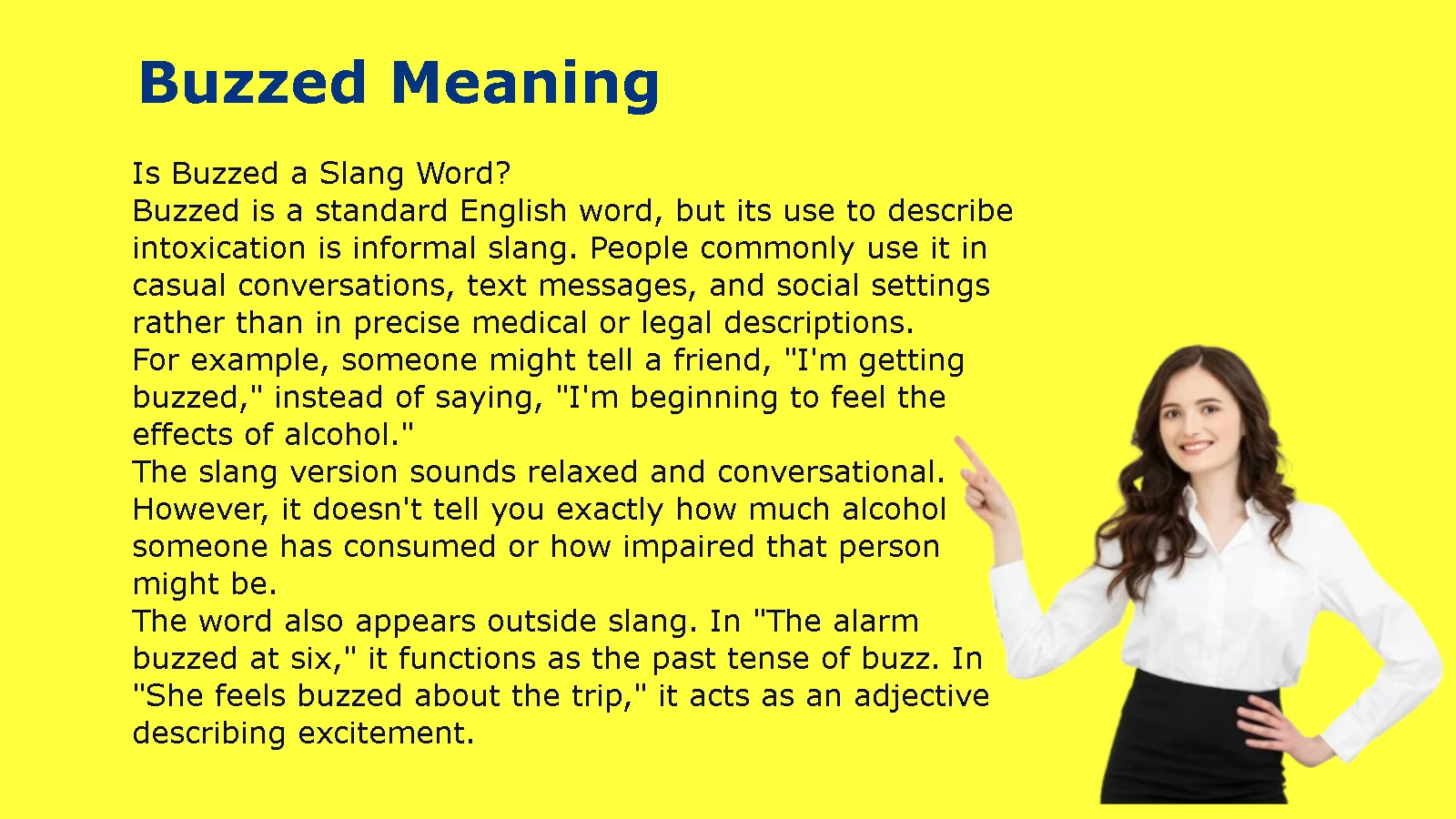
Buzzed is a standard English word, but its use to describe intoxication is informal slang. People commonly use it in casual conversations, text messages, and social settings rather than in precise medical or legal descriptions.
For example, someone might tell a friend, “I’m getting buzzed,” instead of saying, “I’m beginning to feel the effects of alcohol.”
The slang version sounds relaxed and conversational. However, it doesn’t tell you exactly how much alcohol someone has consumed or how impaired that person might be.
The word also appears outside slang. In “The alarm buzzed at six,” it functions as the past tense of buzz. In “She feels buzzed about the trip,” it acts as an adjective describing excitement.
Buzzed Meaning in Slang
In slang, buzzed usually means feeling the effects of alcohol without necessarily describing oneself as fully drunk. People often use it when they notice a change in their mood, perception, or physical sensations after drinking. The word can also describe a similar feeling associated with other substances.
For example:
“I’m feeling pretty buzzed after dinner.”
The speaker is probably saying that alcohol has begun to affect them. They may feel more relaxed, talkative, or lightheaded. However, the statement doesn’t establish their actual level of impairment.
In casual conversation, buzzed often suggests a relatively mild level of perceived intoxication. That distinction matters because the word describes someone’s subjective experience rather than a reliable measure of their physical condition.
What Does Buzzed Mean When Drinking?
When drinking alcohol, buzzed means noticing the effects of alcohol on your body or mind. People may use the term when they feel more relaxed, less inhibited, unusually talkative, or slightly lightheaded.
Consider this conversation:
Alex: “Are you ready to leave?”
Jordan: “Give me a minute. I’m feeling a little buzzed.”
Jordan is probably explaining that alcohol has started to affect them. The statement doesn’t necessarily mean Jordan is visibly drunk.
People may describe themselves as buzzed when they experience:
- A noticeable change in mood.
- Increased talkativeness or reduced social inhibition.
- A feeling of warmth or relaxation.
- Lightheadedness or changes in balance.
- Slower reactions or reduced concentration.
These effects vary from person to person. Factors such as the amount and speed of drinking, food intake, medications, body composition, and individual sensitivity can influence how alcohol affects someone.
An important distinction: Feeling only slightly buzzed doesn’t mean alcohol has had little effect on your ability to drive, make decisions, or react quickly. Someone can underestimate their impairment because they feel relaxed rather than obviously intoxicated.
Does Buzzed Mean Drunk?
Buzzed and drunk both describe states associated with alcohol, but they often communicate different degrees of perceived intoxication in everyday conversation.
Buzzed generally suggests that someone has started feeling alcohol’s effects, while drunk more broadly suggests more noticeable intoxication. These are informal distinctions, not precise categories of impairment.
For example:
- “I’m a little buzzed.” The speaker suggests that they notice alcohol’s effects but may not feel strongly intoxicated.
- “He’s drunk.” The speaker suggests more apparent intoxication.
- “She got really drunk last night.” The statement indicates substantial intoxication, although it doesn’t establish a precise blood alcohol concentration.
People don’t always use these words consistently. One person might describe a feeling as buzzed, while another might call the same experience tipsy or drunk.
The safest approach is to avoid treating these labels as measurements. A person’s subjective impression doesn’t reliably reveal their blood alcohol concentration or whether they’re safe to drive.
What Does Buzzed Mean When Talking About Drugs?
When people discuss drugs, buzzed can describe feeling the effects of a psychoactive substance. The exact meaning depends on the substance and the speaker’s experience.
For example:
- “He felt buzzed after taking the substance.” This suggests that he noticed its effects.
- “That medication makes me feel strangely buzzed.” This describes a subjective sensation that could involve stimulation, lightheadedness, or another effect.
- “They were talking about getting buzzed at the party.” Depending on the conversation, this might refer to alcohol or another substance.
The word doesn’t identify a particular drug by itself. You need the surrounding conversation to understand what the speaker means.
It’s also important not to assume that a buzzed feeling is harmless. Psychoactive substances can affect judgment, coordination, and alertness, and some combinations can cause dangerous reactions. If someone develops severe confusion, difficulty breathing, seizures, or cannot be awakened after taking a substance, seek emergency medical help.
Buzzed Meaning in Different Contexts
The meaning of buzzed changes with the situation. The word can describe intoxication, excitement, stimulation, sound, or a very short haircut.
The following table summarizes its main uses.
| Context | Meaning of buzzed | Example |
| Alcohol | Feeling alcohol’s effects | “I’m feeling buzzed after dinner.” |
| Excitement | Feeling enthusiastic or energized | “She’s buzzed about the promotion.” |
| Caffeine | Feeling stimulated after consuming caffeine | “I’m buzzed after two strong coffees.” |
| Sound | Made a buzzing noise or vibrated | “My phone buzzed in my pocket.” |
| Haircut | Had hair cut very short with clippers | “He got buzzed before summer.” |
| General stimulation | Feeling unusually energized or activated | “The atmosphere left everyone feeling buzzed.” |
Some uses overlap. For instance, caffeine-related buzzedness and excitement can both involve feeling energized. Context helps distinguish them.
Buzzed Meaning as Excited or Happy
Buzzed can mean excited, enthusiastic, or energized, especially when someone anticipates a positive event or reacts to good news.
For example:
- “I’m buzzed about my upcoming vacation.”
- “She’s still buzzed from winning the competition.”
- “The whole team was buzzed after the announcement.”
- “We’re buzzed for the concert tonight.”
In these examples, the word doesn’t refer to alcohol. It describes a positive emotional state.
You may also encounter expressions such as “buzzing with excitement.” This phrase suggests that someone feels so enthusiastic that their energy seems almost impossible to contain.
Imagine a student who has just received an acceptance letter from their first-choice university. They might tell a friend, “I’m absolutely buzzed about starting college.”
The intended meaning is clear because the sentence refers to a positive life event.
Usage tip: When you see buzzed about followed by a plan, achievement, or opportunity, the word often means excited rather than intoxicated.
Buzzed From Caffeine
When someone says they’re buzzed from caffeine, they usually mean they feel stimulated after consuming coffee, tea, energy drinks, or another caffeinated product.
For example:
“I had two large coffees before my exam, and now I’m buzzing.”
The speaker might feel more alert, restless, energetic, or jittery than usual.
Caffeine can temporarily increase alertness, but its effects vary with the dose and a person’s sensitivity. Too much caffeine can cause unpleasant symptoms, including anxiety, a racing heartbeat, and difficulty sleeping.
The expression caffeine buzz commonly refers to this energized feeling. People may also use wired or jittery when the stimulation feels uncomfortable.
Compare these examples:
- “I’m buzzed after my coffee.” This emphasizes the noticeable effect of caffeine.
- “I’m wired after three energy drinks.” This suggests strong stimulation or restlessness.
- “I’m jittery because I drank too much coffee.” This emphasizes shakiness or nervousness.
These phrases overlap, but they don’t communicate exactly the same experience.
Buzzed as a Sound or Vibration
Buzzed is the past tense and past participle of the verb buzz. In this context, it describes a short, continuous humming or vibrating sound.
Examples include:
- “The bee buzzed around the flowers.”
- “My phone buzzed during lunch.”
- “Someone buzzed the apartment intercom.”
- “The alarm buzzed until I switched it off.”
This meaning has nothing to do with intoxication or excitement.
The word can also describe an action involving a buzzer. For example, “She buzzed the receptionist” means she used a buzzer or similar signaling device to get someone’s attention.
Context makes the distinction straightforward. A phone, insect, alarm, or intercom usually signals the literal meaning.
What Does It Mean to Get Your Hair Buzzed?
To get your hair buzzed means to have it cut very short, usually with electric hair clippers.
For example:
- “I’m getting my hair buzzed this weekend.”
- “He got buzzed before joining the military.”
- “She decided to get a buzzed haircut for the summer.”
A buzz cut is a short hairstyle produced with clippers. The hair may be cut to a uniform length or styled with slightly different lengths on the top and sides.
The phrase doesn’t suggest that someone is intoxicated. Instead, it refers to the sound of the clippers and the resulting haircut.
You might hear someone say, “I’m going to the barber to get buzzed.” Without context, this sentence could be ambiguous. If the conversation concerns hair or a barber appointment, it most likely refers to getting a short haircut.
Buzzed vs. Tipsy vs. Drunk
Buzzed often describes noticing alcohol’s effects, tipsy commonly suggests mild intoxication, and drunk can describe a broader range of more apparent intoxication. These distinctions reflect everyday usage rather than fixed medical thresholds.
| Word | Common implication | Example sentence |
| Buzzed | Feeling the effects of alcohol | “I’m a little buzzed after that drink.” |
| Tipsy | Slightly intoxicated | “She felt tipsy after the party.” |
| Drunk | Intoxicated, sometimes noticeably so | “He was too drunk to follow the conversation.” |
| Sober | Not currently intoxicated | “She stayed sober throughout the evening.” |
| High | Experiencing effects associated with a psychoactive drug | “He said he felt high after using the substance.” |
These words aren’t precise measures of impairment. A person can feel buzzed while experiencing meaningful changes in attention, coordination, and judgment.
Buzzed vs. Tipsy
Buzzed and tipsy overlap considerably. Both can describe a person who feels the effects of alcohol but doesn’t necessarily appear heavily intoxicated.
The difference lies mainly in tone and emphasis.
Buzzed often emphasizes the sensation of alcohol taking effect. Tipsy commonly suggests mild intoxication, sometimes accompanied by lightheadedness or slightly altered behavior.
Examples:
- “I’m starting to feel buzzed.” The speaker notices alcohol’s effects beginning.
- “She’s a little tipsy.” The speaker describes her as mildly intoxicated.
- “We were tipsy and laughing at every joke.” The sentence suggests a lighthearted social situation.
However, these differences aren’t universal. Some people use buzzed and tipsy almost interchangeably.
Neither word establishes how much someone drank, and neither should be used to determine whether a person can safely drive.
Buzzed vs. Drunk
Buzzed often implies less noticeable intoxication than drunk, but the distinction depends on the speaker and the situation.
For example:
- “I’m buzzed, so I’m going to take it easy.” This suggests the speaker recognizes alcohol’s effects.
- “He’s drunk and having trouble walking.” This describes more obvious signs of impairment.
The second sentence includes a specific observation, while the first reports a subjective feeling.
That difference matters because people may underestimate alcohol’s effects. Someone can feel relaxed and conversational while still experiencing reduced reaction time, impaired judgment, or difficulty coordinating movements.
Don’t use the word buzzed as proof that someone is only mildly impaired. Alcohol affects people differently, and subjective descriptions can’t replace objective assessment.
Buzzed vs. High
Buzzed and high both describe altered states, but people commonly associate them with different substances.
- Buzzed: Often associated with alcohol, although it can describe the effects of other substances.
- High: Often associated with cannabis and other psychoactive drugs, depending on the context.
For example:
“I’m feeling buzzed after a few drinks.”
This sentence usually points to alcohol.
“I’m feeling high after using cannabis.”
This sentence points to a drug-related effect.
The terms can overlap in casual speech. Someone might use buzzed to describe a mild or noticeable drug effect without identifying a specific substance.
Neither word describes a uniform physical state. The effects depend on the substance, dose, individual sensitivity, and other circumstances.
Buzzed vs. Sober
Buzzed suggests that someone feels the effects of a substance. Sober generally means not intoxicated or not currently under the influence.
Examples:
- “He felt buzzed after dinner.”
- “She stayed sober because she was driving.”
- “I’m sober now, but I still feel tired.”
The last example highlights an important distinction: not feeling intoxicated doesn’t automatically mean someone has recovered from every effect of alcohol.
Time is needed for the body to process alcohol. Coffee, a cold shower, or a short rest won’t reliably eliminate intoxication. Anyone who may still be impaired should avoid driving or operating dangerous equipment.
Examples of Buzzed in a Sentence
Seeing buzzed in different sentences is one of the easiest ways to understand its meaning. The following examples cover alcohol-related slang, excitement, everyday English, and text messages.
Examples of Buzzed in Alcohol-Related Conversations
Here are some original examples of buzzed used to describe the effects of alcohol:
- “I felt buzzed after having a drink with dinner.”
- “He admitted that he was buzzed and asked someone else to drive.”
- “Are you buzzed, or are you just tired?”
- “She said she felt buzzed but decided not to drink any more.”
- “They left the gathering when they realized they were feeling the effects of alcohol.”
- “I thought I was fine, but I was more buzzed than I expected.”
In each sentence, buzzed describes a perceived state associated with alcohol.
The fourth example also shows how people use the word when discussing their own limits. However, stopping drinking doesn’t instantly remove alcohol from the body.
Examples of Buzzed Meaning Excited
Buzzed can communicate enthusiasm when the surrounding words refer to something positive or anticipated.
Examples include:
- “I’m buzzed about my first day at the new company.”
- “The students were buzzed after hearing the results.”
- “She’s been buzzed about the wedding all week.”
- “Our team was still buzzed after winning the final.”
- “I’m so buzzed for the weekend trip.”
- “He looked buzzed when he heard that his project had been approved.”
In these examples, the word expresses positive energy rather than intoxication.
Some sentences sound more natural in informal American English than others. “I’m excited about my first day” is more neutral and widely appropriate, while “I’m buzzed about my first day” sounds more casual.
Examples of Buzzed in Everyday English
The literal meaning of buzzed appears in sentences about sounds, devices, and haircuts.
| Sentence | Meaning |
| “My phone buzzed while I was cooking.” | The phone vibrated. |
| “The bee buzzed near the window.” | The bee produced a buzzing sound. |
| “Someone buzzed our apartment.” | Someone used the intercom or buzzer. |
| “The alarm buzzed at midnight.” | The alarm produced a buzzing sound. |
| “He got his hair buzzed before the trip.” | He had his hair cut very short. |
| “The electric clippers buzzed loudly.” | The clippers made a buzzing noise. |
These examples show why you shouldn’t interpret every use of buzzed as slang.
The subject of the sentence often gives you the answer. If a phone or alarm performs the action, buzzed usually describes a sound or vibration. If a person says they feel buzzed, the word more likely describes a sensation or emotional state.
Examples of Buzzed in Text Messages
Text messages often omit details, so context becomes especially important.
Conversation about alcohol
Mia: “How was the party?”
Sam: “Pretty good. I’m a little buzzed, though.”
Meaning: Sam is describing the effects of alcohol.
Conversation about excitement
Mia: “Your interview is tomorrow, right?”
Sam: “Yep! I’m so buzzed about it.”
Meaning: Sam feels excited or energized about the interview.
Conversation about a phone
Mia: “Did you see my message?”
Sam: “No, my phone buzzed, but I was in another room.”
Meaning: The phone vibrated or made a buzzing sound.
Conversation about a haircut
Mia: “You look different. Did you cut your hair?”
Sam: “Yeah, I got buzzed yesterday.”
Meaning: Sam probably had a very short haircut.
The last example is more ambiguous than the others. If the conversation doesn’t mention hair, the recipient might need clarification.
How to Use Buzzed Correctly
You can use buzzed as a verb or an adjective. The correct interpretation depends on the sentence structure and the meaning you want to communicate.
Buzzed as a Verb
As a verb, buzzed is the past tense and past participle of buzz. It describes an action that produced a buzzing sound or used a buzzer.
Examples:
- “The phone buzzed during the movie.”
- “The bee buzzed past my ear.”
- “She buzzed the front desk to request assistance.”
- “The intercom has buzzed several times today.”
In these sentences, buzzed describes an action rather than a person’s state of intoxication.
The verb can also appear in passive constructions. For example, “The visitor was buzzed into the building” means someone used a buzzer to allow the visitor to enter.
Buzzed as an Adjective
As an adjective, buzzed describes how someone feels.
Examples:
- “I’m still buzzed from the party.” This may refer to alcohol or excitement.
- “She’s buzzed about her promotion.” This indicates enthusiasm.
- “He felt buzzed after drinking coffee.” This indicates stimulation.
- “They were buzzed after the announcement.” This could indicate excitement or, in another context, intoxication.
When buzzed describes a person’s feelings, it often appears after linking verbs such as feel, be, or seem.
The phrase that follows it can also clarify the intended meaning. “Buzzed about the promotion” strongly suggests excitement, while “buzzed after drinking” points toward substance-related effects.
When Should You Avoid Using Buzzed?
Buzzed works well in casual speech, but it may be too vague in formal, professional, medical, or safety-related writing.
Choose a more precise term when the distinction matters.
| Situation | More precise wording | Why it helps |
| Formal report about alcohol | “Appeared intoxicated” or a specific documented observation | Avoids relying solely on informal slang. |
| Medical discussion | Describe the symptoms or substance involved | Provides clearer information about the person’s condition. |
| Workplace safety report | Describe observed impairment or relevant test results | Focuses on evidence rather than subjective labels. |
| Business communication about excitement | “Excited” or “enthusiastic” | Sounds more professional and avoids ambiguity. |
| Description of a vibrating device | “Vibrated” | Identifies the action directly. |
| Haircut instructions | “Clipper cut” or “buzz cut” | Communicates the desired hairstyle clearly. |
For example, instead of writing, “The employee looked buzzed,” a formal report should describe what was actually observed, such as slurred speech or difficulty maintaining balance, if those observations are accurate.
This approach separates facts from assumptions.
Synonyms and Related Words for Buzzed
Buzzed has several synonyms, but the best alternative depends on the intended meaning. A word associated with intoxication won’t necessarily work when buzzed means excited or energized.
Synonyms for Buzzed Meaning Slightly Intoxicated
Common alternatives include:
- Tipsy: Slightly intoxicated, often suggesting mild changes in behavior or sensation.
- Slightly drunk: A more direct description of perceived alcohol intoxication.
- Under the influence: A broader phrase for being affected by a substance.
- Intoxicated: A more formal term for being affected by alcohol or another substance.
- Lightheaded: Describes a sensation that may accompany alcohol use but can also have other causes.
Examples:
- “I’m a little tipsy after dinner.”
- “He appeared intoxicated and needed assistance.”
- “She felt lightheaded and sat down.”
- “The report described the person as under the influence.”
These terms aren’t interchangeable in every situation. Lightheaded, for instance, describes a physical sensation rather than necessarily indicating alcohol consumption.
Synonyms for Buzzed Meaning Excited
When buzzed describes enthusiasm, suitable alternatives include:
- Excited: Feeling eager or enthusiastic.
- Thrilled: Feeling strong happiness or excitement.
- Pumped: Feeling highly energized or motivated.
- Enthusiastic: Showing strong interest or eagerness.
- Energized: Feeling active or mentally stimulated.
- Psyched: Informally describing strong anticipation or excitement.
Examples:
- “I’m excited about my new position.”
- “She’s thrilled about the opportunity.”
- “The players were pumped for the final.”
- “We’re enthusiastic about the upcoming launch.”
- “I feel energized after that inspiring presentation.”
These alternatives can help you avoid ambiguity in professional writing. For instance, “I’m excited about the proposal” is clearer than “I’m buzzed about the proposal” in a formal email.
Related Expressions With Buzz
Several common expressions use buzz or buzzed in related ways.
Get a buzz: Experience a noticeable sensation, often associated with alcohol, stimulation, or excitement.
Example: “Some people describe a buzz after drinking coffee.”
Buzzing with excitement: Feeling extremely enthusiastic or full of energy.
Example: “The children were buzzing with excitement before the school trip.”
Buzz about something: Widespread discussion or attention surrounding a person, event, product, or idea.
Example: “There’s a lot of buzz about the new restaurant.”
A buzz cut: A short hairstyle created with clippers.
Example: “He chose a buzz cut because it was easy to maintain.”
Buzz someone in: Allow someone to enter a building using a buzzer or intercom.
Example: “Please buzz me in when I arrive.”
These expressions share the same root word, but each has its own meaning. Learning them as complete phrases is often more useful than memorizing a single definition.
What Is the Origin of Buzzed?
The word buzz is an example of onomatopoeia, a type of word that imitates a sound. Its familiar sound-related meaning resembles the continuous humming made by insects, electrical devices, and other sources.
Over time, English developed several figurative uses of buzz. People began using the word to describe excitement, activity, stimulation, and the feeling associated with alcohol.
The adjective buzzed grew from these broader uses of buzz. Today, the word can describe both a physical sensation and an emotional state.
How Buzz Developed Different Meanings
The word’s different meanings are connected by the idea of noticeable activity or stimulation.
Consider the following examples:
- Literal sound: “The electric razor buzzed.”
- Social excitement: “The crowd was buzzing after the announcement.”
- Personal enthusiasm: “I’m buzzed about the opportunity.”
- Alcohol-related sensation: “He said he felt buzzed after drinking.”
The first example refers to a sound. The second describes the lively atmosphere of a crowd. The third expresses a person’s excitement, while the fourth uses the informal alcohol-related sense.
These meanings developed through ordinary changes in language. Words often acquire figurative meanings when speakers use a familiar sound, sensation, or image to describe a different experience.
It’s best not to assume that every modern slang use has one simple historical origin. The current meaning is easier to understand by looking at how people use the word in context.
Frequently Asked Questions About Buzzed Meaning
What Does Buzzed Mean in Slang?
In slang, buzzed usually means feeling the effects of alcohol, often when someone perceives the intoxication as relatively mild. It can also describe the effects of other substances. In a different context, buzzed means excited or energized about something.
Does Buzzed Mean Drunk or Just Tipsy?
Buzzed often suggests less noticeable intoxication than drunk, and it overlaps with tipsy. However, these are informal descriptions rather than precise categories. Someone who feels buzzed can still experience impaired judgment, coordination, and reaction time.
What Does “I’m Buzzed” Mean?
“I’m buzzed” usually means the speaker feels the effects of alcohol or another substance. The phrase can also express excitement, depending on the conversation. If someone says, “I’m buzzed about my new job,” they mean they’re enthusiastic about it.
What Does Buzzed Mean in a Text?
In a text message, buzzed can mean intoxicated, excited, stimulated, or something else. Read the surrounding messages to determine the intended meaning. A conversation about drinking suggests intoxication, while a discussion about an upcoming event usually points to excitement.
Can Buzzed Mean Excited?
Yes. Buzzed can describe enthusiasm, anticipation, or a strong positive emotional response. For example, “I’m buzzed about the concert” means the speaker is excited about attending. The expression is informal and works best in casual conversations.
What Is the Difference Between Buzzed and High?
Buzzed commonly refers to the effects of alcohol, although it can describe other substances. High more commonly refers to the effects of cannabis or other psychoactive drugs. Their meanings can overlap in casual conversation, so the surrounding context matters.
Conclusion: Understanding the Meaning of Buzzed
The meaning of buzzed depends on how someone uses the word. In everyday slang, it most commonly describes feeling the effects of alcohol. It can also mean excited or energized, refer to caffeine-related stimulation, describe a buzzing sound, or relate to getting a very short haircut.
Remember these three distinctions:
- Buzzed from drinking: Feeling the effects of alcohol or another substance.
- Buzzed about something: Feeling excited or enthusiastic.
- Something buzzed: Produced a buzzing sound or vibration.
Buzzed often suggests mild intoxication in casual conversation, but it doesn’t measure impairment. Never assume that someone who feels buzzed is safe to drive.
When you encounter the word in a text, conversation, or article, look at the surrounding words first. That simple habit will help you understand its intended meaning and use it naturally in your own writing.













