Have you ever confused plain vs plane and wondered which word is correct? While PLAIN vs PLANE may sound exactly the same, these two words have completely different meanings, spellings, and uses. Choosing the right one depends on the context of the sentence.
Plain can mean simple, clear, ordinary, or without decoration. It can also refer to a large area of flat land. Plane, on the other hand, usually refers to an aircraft or a flat, level surface.
Examples:
- She wore a plain white shirt.
- We took a plane to Chicago.
The confusion is understandable. People often search for plain vs plane, plain or plane, what is the difference between plain and plane, or plain and plane meaning because the two words are pronounced the same but have different spellings and meanings. And here’s the kicker: plain and plane are homophones, so you can’t rely on pronunciation alone to tell them apart.
In this guide, you’ll learn the complete difference between PLAIN vs PLANE, including their definitions, pronunciations, parts of speech, correct usage, and examples in sentences. You’ll also discover plain vs plane in a sentence, common mistakes, and an easy trick to remember when to use plain or plane.
Plain vs Plane: Quick Difference
The easiest way to understand the difference is to focus on what each word represents.
| Word | Common meaning | Part of speech | Example |
| Plain | Simple or ordinary | Adjective | She wore a plain dress. |
| Plain | Clear or obvious | Adjective | The answer was plain to see. |
| Plain | Flat area of land | Noun | A vast plain stretched ahead. |
| Plain | Without added ingredients or decoration | Adjective | He ordered plain rice. |
| Plane | Aircraft | Noun | The plane took off. |
| Plane | Flat geometric surface | Noun | The point lies on a plane. |
| Plane | Woodworking tool | Noun | He used a plane on the board. |
| Plane | To smooth wood | Verb | The carpenter planed the wood. |
A quick memory rule works well:
Plain = simple, clear, or flat land.
Plane = aircraft, geometry, or woodworking.
There’s one important wrinkle: plain and plane aren’t interchangeable even when they appear in similar-looking phrases. Context determines which spelling belongs in the sentence.
What Does “Plain” Mean?
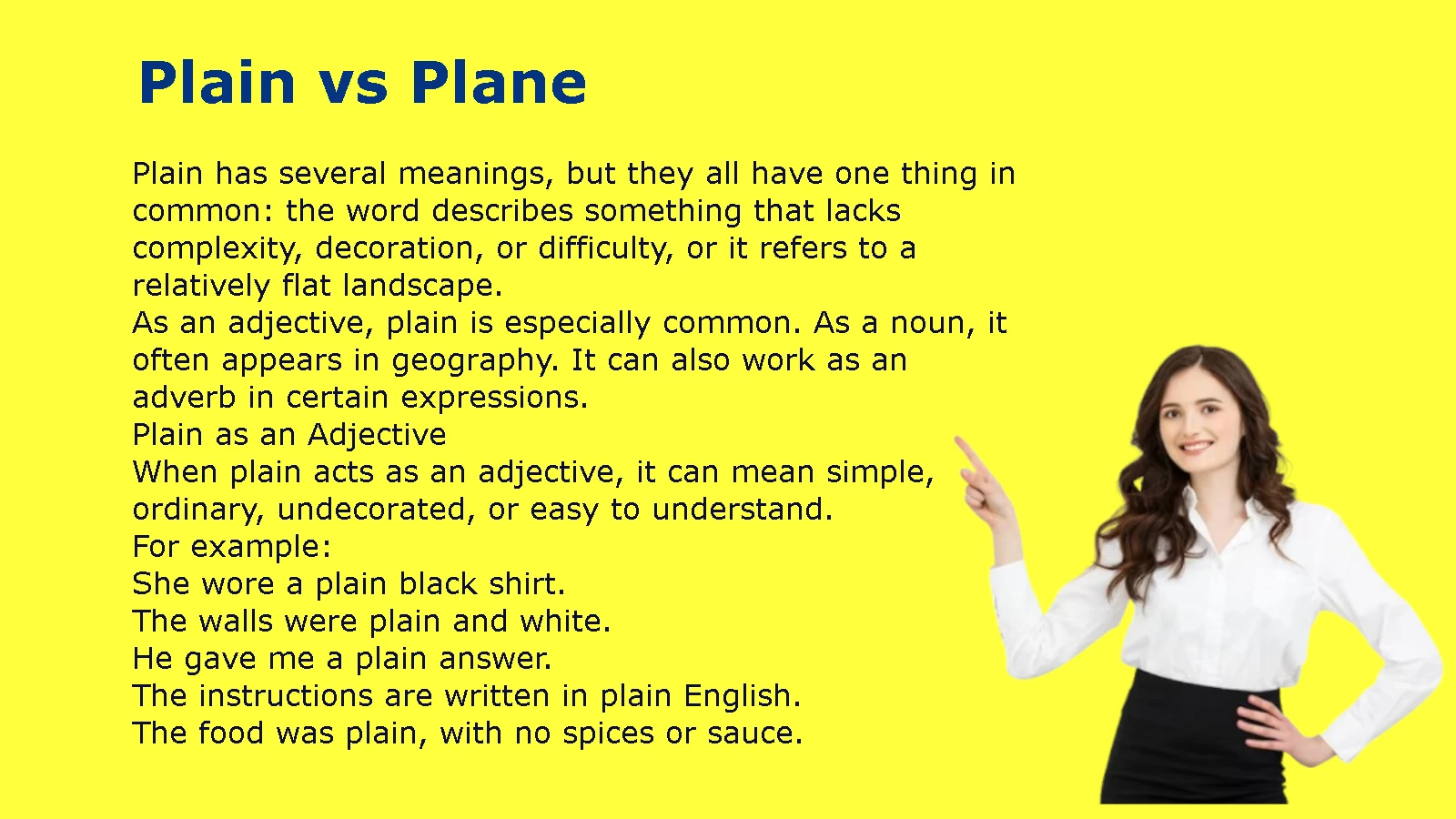
Plain has several meanings, but they all have one thing in common: the word describes something that lacks complexity, decoration, or difficulty, or it refers to a relatively flat landscape.
As an adjective, plain is especially common. As a noun, it often appears in geography. It can also work as an adverb in certain expressions.
Plain as an Adjective
When plain acts as an adjective, it can mean simple, ordinary, undecorated, or easy to understand.
For example:
- She wore a plain black shirt.
- The walls were plain and white.
- He gave me a plain answer.
- The instructions are written in plain English.
- The food was plain, with no spices or sauce.
In these sentences, plain describes something that isn’t elaborate.
Consider the difference between a decorated cake and a simple cake with no frosting or elaborate design. You could describe the second cake as plain. The word doesn’t necessarily mean bad. It simply emphasizes simplicity or a lack of decoration.
Plain Can Mean “Clear” or “Obvious”
Plain can also describe something that is easy to understand or impossible to miss.
For example:
- It was plain that she was tired.
- The evidence was plain to everyone.
- His disappointment was plain to see.
Here, plain doesn’t mean boring or undecorated. It means clear, obvious, or apparent.
The expression “plain to see” is especially common.
The difference between the two words is plain to see once you understand their meanings.
Plain Can Mean “Without Added Ingredients”
You’ll often see plain used when talking about food.
Examples include:
- plain yogurt
- plain rice
- plain bread
- plain oatmeal
- plain pasta
- plain water
In this context, plain generally means that the food doesn’t contain additional flavors, toppings, sauces, or seasonings.
For example, plain yogurt usually means yogurt without added fruit or flavoring.
However, the exact meaning can depend on the product. “Plain” doesn’t necessarily mean completely ingredient-free. It usually contrasts with flavored or specially prepared versions.
Plain as a Noun
As a noun, plain means a large area of relatively flat land.
Geographers use the term to describe broad landscapes that generally have little variation in elevation compared with mountainous or rugged terrain.
Examples include:
- coastal plains
- floodplains
- grasslands on plains
- agricultural plains
For example:
The farmers grow wheat across the vast plain.
In this sentence, plain has nothing to do with simplicity. It’s a geographical term.
What Is a Plain in Geography?
A plain is generally a broad area of land that is relatively level or gently rolling.
Plains can form through several geological processes. Some develop from sediments deposited by rivers. Others form through erosion, lava flows, or changes in sea level and landscape over long periods.
A floodplain, for instance, forms alongside a river and can receive sediment when the river periodically overflows.
Plains matter because their relatively level terrain can make them useful for:
- agriculture
- transportation
- settlements
- grazing
- large-scale infrastructure
The Great Plains of North America are a well-known example of a major plain region.
What Does “Plane” Mean?
Plane has several unrelated meanings. The most familiar one is an aircraft, but the word also has important meanings in mathematics, geometry, and woodworking.
Plane as an Aircraft
In everyday American English, a plane most commonly means an aircraft.
For example:
- The plane landed safely.
- Our plane leaves at six.
- She boarded the plane at the airport.
- The plane flew over the city.
This is the meaning you’re most likely to encounter in casual conversation.
The word plane is a shortened form of airplane. In American English, airplane is the standard spelling, while plane is the common shortened form.
So if you’re talking about something that flies passengers from one airport to another, use plane, not plain.
Plane as a Geometric Surface
In mathematics and geometry, a plane is a flat, two-dimensional surface that extends indefinitely.
You may encounter the term in phrases such as:
- coordinate plane
- geometric plane
- Cartesian plane
- plane geometry
- inclined plane
For example:
Point A lies on the coordinate plane.
This meaning has nothing to do with airplanes.
A useful way to picture a geometric plane is to imagine an enormous perfectly flat sheet extending endlessly in every direction. Unlike an ordinary physical sheet, a mathematical plane has no thickness and no boundary.
Plane as a Woodworking Tool
A plane can also be a hand tool used to remove thin layers of wood and create a smooth or accurately shaped surface.
A traditional hand plane contains a sharp blade that extends through the body of the tool. When the tool moves across wood, the blade removes a thin shaving.
For example:
The carpenter used a plane to smooth the wooden surface.
This meaning is less common in everyday conversation than the aircraft meaning, but it’s an established dictionary meaning.
Plane as a Verb
Plane can also function as a verb.
In woodworking, to plane wood means to smooth or shape it with a plane.
For example:
The carpenter planed the rough board until its surface was smooth.
The related forms include:
- plane
- planes
- planed
- planing
Don’t confuse planing with planning.
Planing involves smoothing or shaping something, usually wood.
Planning means deciding what you’re going to do.
For example:
- The carpenter is planing the board.
- The students are planning their project.
One extra letter creates a completely different word.
Plain vs Plane: Side-by-Side Comparison
When you’re deciding between plain and plane, ask yourself what you mean.
| Meaning | Correct word | Example |
| Simple | plain | The design is plain. |
| Ordinary | plain | He wore plain clothes. |
| Clear or obvious | plain | The truth was plain. |
| Without added flavor | plain | She ordered plain yogurt. |
| Flat area of land | plain | The river crosses the plain. |
| Aircraft | plane | The plane departed early. |
| Geometric surface | plane | The line lies on a plane. |
| Woodworking tool | plane | He picked up the plane. |
| Smooth wood with a tool | plane | She planed the board. |
The spelling becomes much easier when you stop thinking about pronunciation and start thinking about meaning.
Plain vs Plane Examples in Sentences
Seeing the words in context is one of the fastest ways to learn the distinction.
Examples With “Plain”
Here are several common uses of plain:
- She chose a plain white shirt.
- The room had plain walls.
- He prefers plain rice.
- The instructions were written in plain English.
- The answer was plain to everyone.
- A wide plain stretched beyond the village.
- The farmers worked across the fertile plain.
- His disappointment was plain from his expression.
Notice how the meaning changes depending on the sentence.
In “plain white shirt,” the word means simple or undecorated.
In “plain to everyone,” it means obvious.
In “fertile plain,” it means flat land.
Examples With “Plane”
Now compare those examples with plane:
- The plane landed on time.
- We watched the plane disappear into the clouds.
- Her plane leaves at 9 a.m.
- Plot the point on the coordinate plane.
- The line intersects the plane.
- The carpenter used a plane on the rough wood.
- He planed the board until it was smooth.
Each sentence involves an aircraft, a mathematical surface, or woodworking.
Plain vs Plane in Context
Sometimes a sentence can make the difference especially obvious.
Compare these pairs:
Aircraft vs Simple
The plane landed at the airport.
Here, plane means an aircraft.
She wore a plain shirt.
Here, plain means simple or undecorated.
Flat Land vs Aircraft
The village sits beside a broad plain.
The word refers to a geographical area.
The plane flew over the village.
Here, it refers to an aircraft.
Clear vs Geometric Surface
The answer was plain to see.
Plain means obvious.
The point lies on a geometric plane.
Plane has its mathematical meaning.
These examples show why you can’t determine the spelling by sound alone. You need to identify the meaning first.
Plain or Plane: Which One Should You Use?
If you hesitate between the two spellings, use this quick checklist.
Use “Plain” When You Mean:
- simple
- ordinary
- undecorated
- clear
- obvious
- without added flavor
- a broad, flat area of land
Examples:
- plain clothes
- plain language
- plain truth
- plain yogurt
- open plain
Use “Plane” When You Mean:
- aircraft
- geometric surface
- woodworking tool
- to smooth wood with a plane
Examples:
- passenger plane
- airplane
- coordinate plane
- inclined plane
- hand plane
- planed wood
A Simple Memory Trick for Plain vs Plane
A useful trick is to connect plane with airplane.
If you’re talking about something that flies, think:
airplane → plane
If you’re describing something simple, clear, or undecorated, think:
plain → simple
You can also remember the geographical meaning separately:
plain → flat land
So the shortcut becomes:
Plain = simple or flat land.
Plane = aircraft, geometry, or woodworking.
It isn’t a perfect mnemonic for every possible use, but it covers the meanings you’ll encounter most often.
Common Mistakes With Plain and Plane
Because these words sound alike, spelling mistakes are common.
“Plain” vs “Plane” for an Aircraft
Incorrect:
The plain landed safely.
Correct:
The plane landed safely.
An aircraft is always a plane in this context.
“Plain” vs “Plane” for Simple
Incorrect:
She wore a plane black dress.
Correct:
She wore a plain black dress.
The dress is simple or undecorated, so plain is the correct spelling.
“Plain” vs “Plane” for Flat Land
Incorrect:
The farmers crossed the wide plane.
Correct:
The farmers crossed the wide plain.
The word refers to a broad, relatively flat area of land.
“Plain” vs “Plane” in Geometry
Incorrect:
The point lies on a geometric plain.
Correct:
The point lies on a geometric plane.
Geometry uses plane.
Plain English vs Plane English
One particularly common spelling question is whether the phrase is plain English or plane English.
The correct phrase is:
plain English
Plain English refers to language that communicates information clearly and directly without unnecessary complexity or jargon.
For example:
The contract uses plain English instead of complicated legal language.
Here, plain means clear and easy to understand.
Plane English is not the standard phrase.
This distinction matters because “plain English” appears frequently in education, business, government communication, technical writing, and everyday discussions about clear writing.
Plain White vs Plane White
Another easy mistake involves descriptions of color or design.
The correct phrase is:
plain white
For example:
He wore a plain white shirt.
Here, plain means that the shirt has no elaborate pattern or decoration.
You wouldn’t normally write:
plane white shirt
unless Plane White happened to be a specific name or title.
Plain vs Plane vs Plan
There’s a third word worth keeping separate: plan.
Although plain, plane, and plan look similar, they have different pronunciations and meanings.
| Word | Meaning | Example |
| Plain | Simple, obvious, or flat land | The design is plain. |
| Plane | Aircraft, geometric surface, or tool | The plane took off. |
| Plan | An intended course of action | We made a plan. |
For example:
We plan to take the plane across the country.
That’s a useful sentence because it puts two commonly confused words together.
You could also say:
The plane crossed the plain.
That sentence is grammatically correct and demonstrates the distinction neatly: an aircraft crosses a flat area of land.
Are Plain and Plane Homophones?
Yes. Plain and plane are homophones in standard English pronunciation.
A homophone is a word that sounds the same as another word but has a different spelling and meaning.
Other common English homophone pairs include:
- pair / pear
- right / write
- flower / flour
- sea / see
- brake / break
With plain and plane, the pronunciation is generally /pleɪn/.
That means you can’t rely on the sound to determine the spelling. You have to use context.
For example, if someone says:
“The plane is coming.”
You hear the same sound regardless of whether you know the spelling. The surrounding context tells you that the person means an aircraft.
Writing removes that ambiguity because you have to choose the correct spelling yourself.
Plain vs Plane Pronunciation
Both words are generally pronounced the same way:
plain → /pleɪn/
plane → /pleɪn/
The vowel sound is the same as the sound in words such as day, rain, and train.
The important point is that pronunciation doesn’t distinguish the two words.
That’s why these words are easy to confuse in writing but rarely confusing in ordinary speech. When someone says “plane,” the listener relies on context to understand whether the speaker means an aircraft or something else.
Related Words: Plain
The word plain has several related forms and expressions.
Plainly
Plainly is an adverb meaning clearly, obviously, or in a straightforward manner.
Example:
She plainly stated what she wanted.
Plainness
Plainness refers to the quality of being plain.
Depending on context, it can refer to simplicity, lack of decoration, or straightforwardness.
Plains
The plural plains refers to multiple areas of flat land or a broad region of plains.
For example:
Herds of animals once roamed the open plains.
Plainspoken
Plainspoken describes someone who speaks directly and honestly without using elaborate language.
For example:
Her plainspoken explanation made the issue easy to understand.
Related Words: Plane
Plane also appears in several specialized terms.
Airplane
An airplane is an aircraft that uses aerodynamic forces to fly.
In everyday American English, plane is often enough.
Coordinate Plane
A coordinate plane is the two-dimensional mathematical system formed by intersecting number lines, commonly called the x-axis and y-axis.
Students use it to plot points and graph equations.
Plane Geometry
Plane geometry deals with figures and relationships on a flat, two-dimensional surface.
Common topics include:
- points
- lines
- angles
- triangles
- circles
- polygons
Inclined Plane
An inclined plane is a flat surface positioned at an angle. In physics, it’s one of the classic simple machines.
A ramp is a familiar real-world example.
Plane in Woodworking
A woodworking plane removes small amounts of material from wood to create a smoother or more precise surface.
Different types of planes serve different woodworking purposes.
Planing vs Planning
This pair deserves special attention because it creates another spelling trap.
Planing
Planing means smoothing or shaping material with a plane.
Example:
The carpenter is planing the wooden board.
Planning
Planning means deciding in advance what you intend to do.
Example:
We are planning a trip for next month.
The difference is simple:
planing = using a plane
planning = making a plan
A double n changes the word and its meaning.
Plain vs Plane: A Practical Case Study
Imagine you’re editing this sentence:
“We saw a plain flying over the plain.”
At first glance, it might seem correct because both words sound right when spoken. However, the first word should be plane because it refers to an aircraft:
“We saw a plane flying over the plain.”
Now the meaning is clear:
- plane = aircraft
- plain = flat area of land
This is a good example of why homophones require careful proofreading. A spell-checker may not always catch the mistake because both plain and plane are legitimate English words.
The problem isn’t spelling in isolation. It’s using the right word for the intended meaning.
Facts About Plain vs Plane
Here are the key facts worth remembering:
- Plain and plane are homophones.
- Both are generally pronounced /pleɪn/.
- Plain can be an adjective, noun, or adverb.
- Plane can be a noun or verb.
- Plain can describe something simple or obvious.
- Plain can refer to a broad area of flat land.
- Plane commonly means an aircraft.
- Plane has a technical meaning in geometry.
- Plane is also a woodworking tool.
- Plain English is the correct phrase for clear, straightforward language.
- Planing and planning have different meanings.
Plain vs Plane Quiz
Test yourself by choosing plain or plane in each sentence.
Questions
- The ___ arrived at the airport early.
- She ordered ___ yogurt.
- The farmers worked across the wide ___.
- His meaning was ___ to everyone.
- Plot the point on the coordinate ___.
- He wore a ___ black jacket.
- The carpenter used a ___ to smooth the wood.
- The ___ disappeared behind the clouds.
- The instructions were written in ___ English.
- The river crosses the grassy ___.
Answers
- plane
- plain
- plain
- plain
- plane
- plain
- plane
- plane
- plain
- plain
If you got all ten correct, you’ve got the basic distinction down.
Plain vs Plane: Frequently Asked Questions
Is “plain” and “plane” the same word?
No. Plain and plane are different words that happen to sound alike. They’re homophones.
Plain can mean simple, obvious, or a flat area of land.
Plane can mean an aircraft, a geometric surface, or a woodworking tool.
Is an aircraft a plain or a plane?
An aircraft is a plane.
For example:
The plane took off at 7:30.
Is it “plain English” or “plane English”?
The correct expression is plain English.
It means English that is clear, direct, and easy to understand.
Is it “plain white” or “plane white”?
It’s plain white when you mean white without a pattern or elaborate decoration.
For example:
She bought a plain white shirt.
What is a plain in geography?
A plain is a broad area of relatively flat or gently rolling land. Plains can form through processes such as sediment deposition, erosion, and volcanic activity.
What is a plane in geometry?
A plane is a flat, two-dimensional mathematical surface that extends indefinitely.
A coordinate plane is a familiar example.
Can “plane” be a verb?
Yes. In woodworking, plane can mean to smooth or shape wood using a plane.
For example:
The carpenter planed the board.
Why do plain and plane sound the same?
They have the same pronunciation in standard English but developed as different words with different spellings and meanings. That’s what makes them homophones.
What is the easiest way to remember plain vs plane?
Remember:
Plain = simple or flat land.
Plane = aircraft, geometry, or woodworking tool.
For an aircraft, connect plane with airplane. For something simple or undecorated, choose plain.
Plain vs Plane: The Bottom Line
The difference between plain and plane becomes straightforward once you focus on meaning instead of sound.
Use plain when you’re talking about something simple, ordinary, clear, undecorated, or a broad area of flat land.
Use plane when you mean an aircraft, a flat geometric surface, or a woodworking tool. It can also work as a verb when you mean smoothing wood with that tool.
The quickest rule is:
Plain = simple, clear, or flat land.
Plane = aircraft, geometry, or woodworking.
So if you’re writing about a simple shirt, choose plain. If you’re writing about an aircraft, choose plane. If you’re describing a broad stretch of flat land, it’s plain again.
Once you tie each spelling to its meaning, this homophone pair becomes much harder to mix up.