Have you ever paused while reading a sentence and wondered whether the writer meant “imply” or “infer”? These two commonly confused English words often create hesitation for learners because they appear closely related in meaning, yet they are used from completely different perspectives in communication. Understanding the difference between Imply vs Infer is essential for improving grammar accuracy, writing clarity, and overall communication skills in English.
In simple terms, “imply” means to suggest or hint at something indirectly without stating it clearly. It is what the speaker or writer does when they leave clues for the listener or reader to understand the hidden meaning. On the other hand, “infer” means to understand, conclude, or guess something based on the information that is given. It is what the listener or reader does when they interpret the message.
This confusion between Imply vs Infer is very common in everyday writing, academic contexts, professional communication, and even social conversations. Learners often search for terms like “imply meaning,” “infer meaning,” and “difference between imply and infer” while trying to strengthen their English vocabulary and avoid grammar mistakes.
For example, a speaker might imply a message without saying it directly, while the listener may infer the meaning from context. This small but important difference plays a major role in clear expression and effective understanding in both written and spoken English.
In this guide, you will learn the clear definitions, practical examples, usage rules, and simple memory tricks to confidently distinguish between imply and infer in any context.
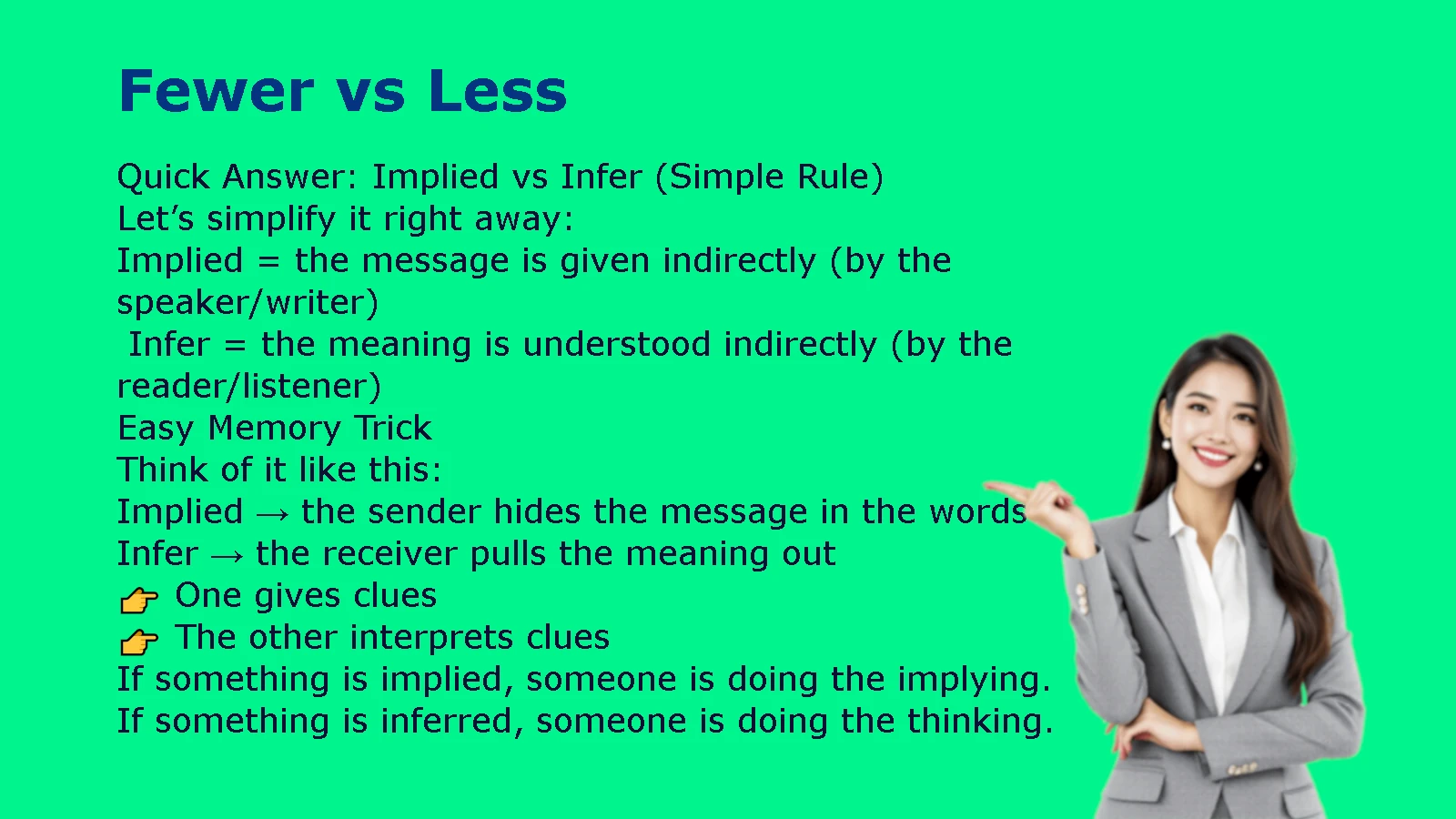
Quick Answer: Implied vs Infer (Simple Rule)
Let’s simplify it right away:
Implied = the message is given indirectly (by the speaker/writer)
Infer = the meaning is understood indirectly (by the reader/listener)
Easy Memory Trick
Think of it like this:
- Implied → the sender hides the message in the words
- Infer → the receiver pulls the meaning out
👉 One gives clues
👉 The other interprets clues
If something is implied, someone is doing the implying.
If something is inferred, someone is doing the thinking.
The Core Difference (In One Line)
- Imply = to suggest something indirectly
- Infer = to conclude something from hints or evidence
Simple—but powerful.
How People Get Confused
The confusion happens because both words deal with hidden meaning.
But here’s the key mistake:
People think they are interchangeable.
They are not.
Real Problem
- Writers/speakers imply
- Readers/listeners infer
If you swap them, the logic breaks.
“Implied” Explained Clearly (With Real Meaning)
When something is implied, it is not said directly—but it is suggested.
Definition
To imply means to hint at something without stating it openly.
Examples
- “It’s getting late…” (implies we should leave)
- “I forgot my wallet today.” (may imply you should pay)
- “Nice of you to finally show up.” (implies you are late)
Key Idea
The speaker never says it directly—but the message is still there.
👉 The responsibility is on the speaker/writer
“Infer” Explained Clearly (With Real Meaning)
When you infer, you are the one interpreting meaning.
Definition
To infer means to understand something indirectly from clues or evidence.
Examples
- You see dark clouds → you infer it will rain
- Someone sighs during a meeting → you infer they are bored or tired
- A friend says “I’m fine” but sounds upset → you infer something is wrong
Key Idea
Nothing is stated directly—you figure it out yourself.
👉 The responsibility is on the listener/reader
The Relationship Between Them (Very Important)
These two words always work together.
Here’s the chain:
Speaker implies → Listener infers
Example
- Your friend says: “This room is a bit warm.”
- They are implying: Turn on the fan
- You infer: They want cooler air
Same message—two roles.
Side-by-Side Comparison Table
| Word | Who Does It? | Meaning | Direction |
| Implied | Speaker / Writer | Suggests indirectly | Outgoing |
| Infer | Listener / Reader | Understands indirectly | Incoming |
Real-Life Example (Everyday Situation)
Scenario: Dinner Time
Someone says:
“I guess I’ll just skip dinner today…”
What is implied?
They are implying:
👉 “I want you to invite me / offer food”
What do you infer?
You infer:
👉 They are hungry but hesitant to ask directly
Same sentence. Two roles. Two meanings.
Why This Confuses Even Advanced Learners
There are three main reasons:
1. Similar meanings
Both deal with indirect communication.
2. Passive vs active confusion
Grammar roles get mixed up.
3. Translation issues
Some languages don’t separate these ideas clearly.
Common Mistake People Make
❌ “I inferred that he implied me to leave.”
This is confusing and incorrect.
Correct version:
✔ “I inferred that he implied I should leave.”
Better yet:
✔ “He implied I should leave, and I inferred it.”
Exam Tip (Very Important)
If you’re in school or preparing for tests:
Ask this question:
- Who is sending the message? → Imply
- Who is receiving and understanding it? → Infer
This trick works every time.
Real-World Communication Example
Office Scenario
Boss says:
“We might need to rethink this report.”
Implied meaning:
👉 The report is not good enough
Employee infers:
👉 I need to revise it
No direct criticism—but the meaning is clear.
Simple Shortcut Rule
If you forget everything else, remember this:
👉 Imply = Put the hint in
👉 Infer = Pull the meaning out
Quick Decision Guide
When you see a sentence, ask:
- Is someone hinting? → Implied
- Is someone understanding a hint? → Infer
Still unsure? Replace the word:
- “He ___ that I was late.” → Implied
- “I ___ that he was angry.” → Infer
FAQ: Implied vs Infer
Are implied and inferred opposites?
Not exactly. They are complementary actions in communication.
Can one sentence include both?
Yes. One person implies, another infers.
Which is more commonly used?
“Infer” is often used in reading comprehension and analysis, while “imply” is common in speaking and writing.
What’s the easiest way to remember?
Think:
👉 Implied = I send the message
👉 Infer = I figure out the message
Final Takeaway: The One Rule That Never Fails
Here’s the simplest truth:
Language is not always direct. People often say one thing and mean another. That’s where these two words live.
So remember:
👉 Implied = the hidden message is given
👉 Infer = the hidden message is understood
And if you ever get stuck again, just ask:
Who is speaking—and who is interpreting?
Because once you know that, Implied vs Infer becomes completely clear.