Have you ever wondered whether Master vs. Mister is simply an old-fashioned spelling difference or whether the two titles actually have distinct meanings? This common English language question often confuses students, writers, parents, and professionals because both terms are used before a male name, yet they apply to different age groups and social situations.
If you’ve ever addressed a letter, filled out a formal form, or wondered whether to use Master, Mr., or Mister, you’re not alone. The confusion usually comes from changes in modern English usage, traditional etiquette rules, and differences between formal and informal communication. Using the wrong title may not always be a serious mistake, but it can make your writing sound outdated, awkward, or less professional.
The good news is that understanding the difference between Master and Mister is easier than it seems.
In this guide, you’ll learn the meaning of Master vs. Mister, when each title should be used, the history behind these honorifics, and how modern English speakers use them today. You’ll also discover the differences between Master, Mr., and Mister, common grammar mistakes, etiquette rules, regional variations, and practical examples for both formal and everyday communication.
Whether you’re writing invitations, completing official documents, studying English grammar, or simply trying to improve your vocabulary, this article will help you choose the correct title with confidence.
So, if you’re ready to master the difference between Master and Mister, let’s dive in.
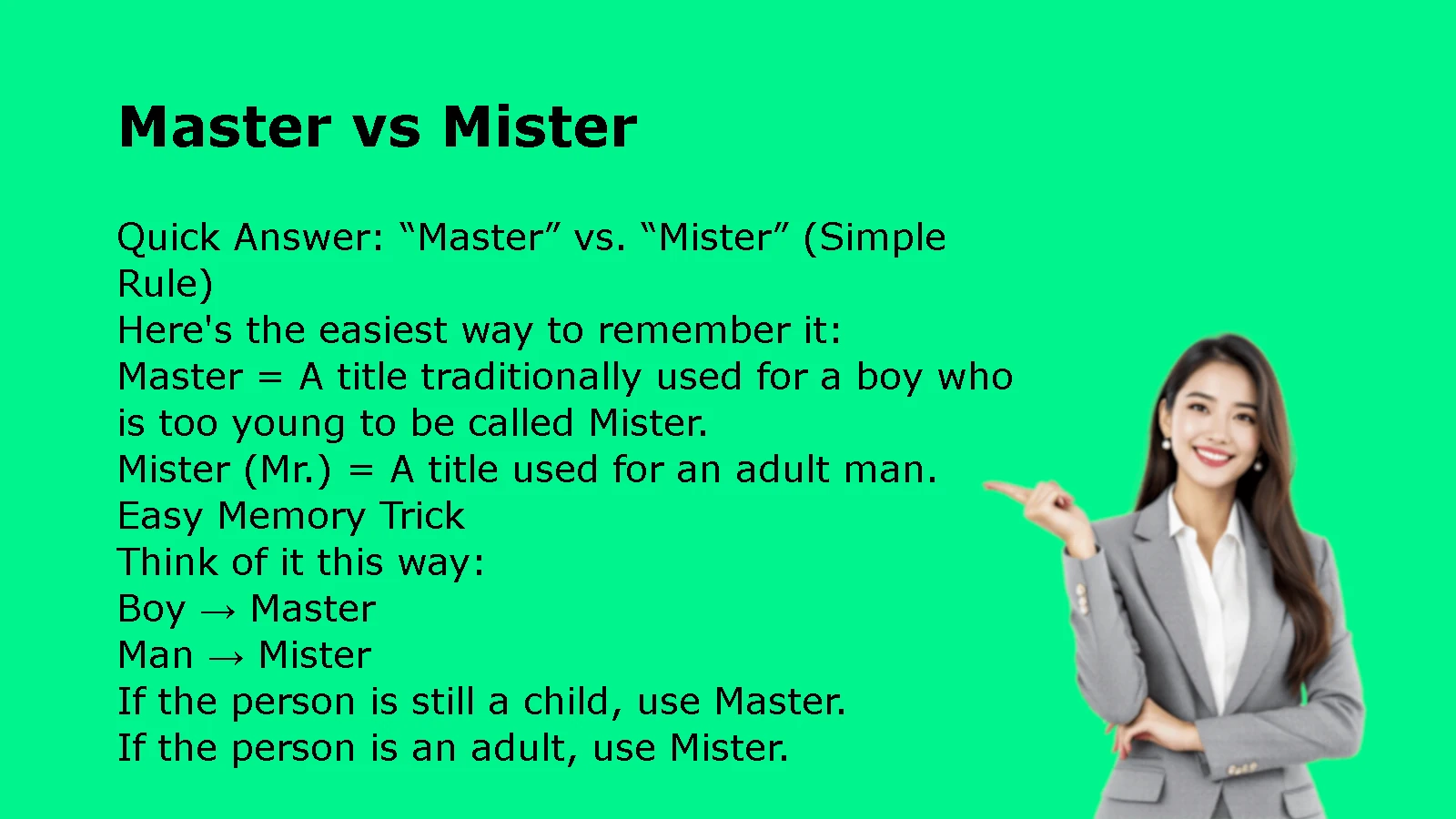
Quick Answer: “Master” vs. “Mister” (Simple Rule)
Here’s the easiest way to remember it:
Master = A title traditionally used for a boy who is too young to be called Mister.
Mister (Mr.) = A title used for an adult man.
Easy Memory Trick
Think of it this way:
Boy → Master
Man → Mister
If the person is still a child, use Master.
If the person is an adult, use Mister.
How People Actually Use “Master” and “Mister”
Modern usage isn’t always as strict as traditional grammar guides suggest.
In Everyday Conversations
Most people rarely use Master today.
Instead, children are usually addressed simply by their first names.
In Formal Documents
You may still see Master used on:
- Invitations
- School records
- Certificates
- Formal correspondence
In Professional Settings
Mister remains the standard title for adult men.
You’ll frequently see:
- Mr. Johnson
- Mr. Williams
- Mr. Brown
Why This Happens
Language evolves over time.
While Master was once common, modern society tends to use first names for children and Mr. for adults.
The Traditional Logic Behind “Master” vs. “Mister”
Understanding the history makes the distinction easier.
Traditional Usage
| Title | Used For |
| Master | Young boys |
| Mister | Adult men |
Historically, a boy would be addressed as Master until reaching adulthood.
After that, he would be addressed as Mister.
Key Insight
The difference is based primarily on age, not status or importance.
“Master” Explained Clearly (With Examples)
At its core, Master is a courtesy title for young boys.
Standard Meaning
Used before the name of a male child.
Examples:
- Master James Wilson
- Master Ethan Clark
- Master Noah Green
Common Situations
You may see it on:
- Wedding invitations
- Formal event guest lists
- School awards
- Family announcements
Example
Invitation:
Master Benjamin Carter is invited to attend the ceremony.
The title indicates that Benjamin is a child.
Modern Usage
Today, many parents skip the title entirely and simply write:
Benjamin Carter
This sounds perfectly natural in modern English.
Key Takeaway
Master is traditionally reserved for boys and is mostly used in formal contexts.
“Mister” Explained Clearly (With Examples)
Now let’s look at the more common title.
Standard Meaning
Mister (Mr.) is used for adult men.
Examples:
- Mr. Thomas Miller
- Mr. David Johnson
- Mr. Michael Brown
Common Situations
You’ll find Mr. in:
- Business correspondence
- Emails
- Professional documents
- Formal introductions
Example
Business Letter:
Dear Mr. Anderson,
This indicates the recipient is an adult man.
Modern Usage
Even today, Mr. remains widely used and accepted in professional settings.
Key Insight
Unlike Master, Mister is still common in everyday formal communication.
The Biggest Mistake People Make
The most common error is assuming that Master and Mister are interchangeable.
They aren’t.
What Goes Wrong
Someone writes:
Mr. Liam Parker
But Liam is a seven-year-old child.
Traditionally, this should be:
Master Liam Parker
Another Mistake
Some people think Master means a teacher, expert, or person with authority.
While the word master can have those meanings, the title Master before a name simply refers to a young boy.
Lesson
Context matters.
The title Master is not the same as the noun master.
Side-by-Side Comparison Table
Here’s a quick reference guide:
| Feature | Master | Mister (Mr.) |
| Refers to | Young boy | Adult man |
| Common Today | Rare | Very common |
| Formal Usage | Yes | Yes |
| Professional Use | Rare | Frequent |
| Modern Everyday Use | Uncommon | Common |
| Abbreviation | None usually | Mr. |
Real-Life Examples of “Master”
Let’s see the title in action.
Formal Invitation
Master William Harris is invited to attend the wedding.
School Certificate
Awarded to Master Oliver Smith.
Family Event
Master Henry Jones will participate in the ceremony.
What They Mean
In every example, the person is a child.
Real-Life Examples of “Mister”
Now compare these examples.
Business Email
Dear Mr. Thompson,
Professional Introduction
Please welcome Mr. David Roberts.
Official Document
Mr. Andrew Clark has signed the agreement.
What They Mean
In each case, the individual is an adult man.
Historical and Cultural Differences
The use of these titles varies across cultures and generations.
Traditional British Usage
Historically, Master was commonly used for boys until adulthood.
Modern American Usage
The title is much less common today.
Most children are simply addressed by name.
Formal Institutions
Certain schools, clubs, and organizations still use Master for boys in official documents.
Key Tip
If you’re unsure, using the child’s name without a title is usually acceptable in modern English.
How to Avoid Confusion Every Time
Want to get it right consistently?
Ask About Age
The simplest question is:
Is the person a child or an adult?
Use Modern Conventions
For children:
- First name only
- Or Master (formal contexts)
For adults:
- Mr.
Check the Context
Formal invitations may follow traditional rules more closely than everyday communication.
Why This Works
Age-based distinctions eliminate most confusion.
What to Use Instead (Modern Alternatives)
In many situations, titles aren’t necessary.
For Children
Instead of:
Master Jacob Lewis
You can write:
Jacob Lewis
For Adults
Instead of:
Mister Robert Hall
You can write:
Mr. Robert Hall
When to Use Them
Use titles when:
- Writing formally
- Sending invitations
- Creating official documents
Skip them when:
- Speaking casually
- Texting
- Writing informally
Quick Decision Guide (Use This Instantly)
When deciding between the two:
Young boy? → Master
Adult man? → Mister (Mr.)
Unsure? → Use the person’s full name without a title
Simple and effective.
FAQ: “Master” vs. “Mister”
Is “Master” still used today?
Yes, but mostly in formal documents and invitations involving young boys.
At what age does “Master” become “Mister”?
Traditionally, the change occurred around adulthood, though there is no universally fixed age.
Can I call an adult man “Master”?
Generally, no. In modern English, adult men are addressed as Mr.
Is “Master” the same as being an expert?
No. As a title before a name, Master refers to a young boy, not a skilled person.
Which title is more common today?
Mister (Mr.) is far more common in modern English.
Case Study: A Formal Invitation Mistake
A family was preparing wedding invitations.
One invitation read:
Mr. Ethan Walker
However, Ethan was only eight years old.
A relative pointed out that the traditional formal title would be:
Master Ethan Walker
What Happened
The invitations were corrected before printing.
Result
The family followed traditional etiquette accurately.
Lesson
Formal events often preserve older language conventions that everyday speech no longer uses.
Key Facts You Should Remember
- Master traditionally refers to a young boy.
- Mister (Mr.) refers to an adult man.
- Master is uncommon in modern everyday English.
- Mr. remains widely used.
- Formal invitations and documents may still use Master.
- Age is the primary distinction between the two titles.
Final Takeaway: The One Rule That Never Fails
Here’s the simplest way to remember the difference.
If you’re talking about a boy, the traditional title is Master.
If you’re talking about a man, use Mister (Mr.).
Modern English doesn’t use Master as often as it once did, which is why many people find the distinction confusing. Yet the traditional rule remains straightforward and useful, especially when reading formal documents or preparing invitations.
Think of it as a simple age-based transition:
Child → Master
Adult → Mister
When in doubt, remember that clarity matters more than strict formality. In most everyday situations, using a person’s name or the familiar title Mr. will keep your communication clear and professional.
Understanding “Master” vs. “Mister” isn’t just about grammar—it’s about choosing the right title for the right person and avoiding unnecessary confusion.