Ever wondered why Mic vs Mike confuses so many people, especially in writing, captions, and everyday conversation? One is a short form for a microphone, while the other is a common name—but they sound exactly the same, which makes mistakes surprisingly easy.
That’s the problem. You’re not alone if you’ve ever typed the wrong one in a message, social post, or note. And here’s the kicker: even a small spelling error can change meaning or make your writing look unprofessional.
But don’t worry—this is simpler than it seems.
In this guide, you’ll clearly understand the difference between Mic vs Mike, along with related keywords like microphone abbreviation, common spelling confusion words, and homophones in English. You’ll also learn when to use each term correctly so you never second-guess yourself again.
So, if you want to avoid simple but embarrassing writing mistakes, keep reading—this will clear it up in minutes.
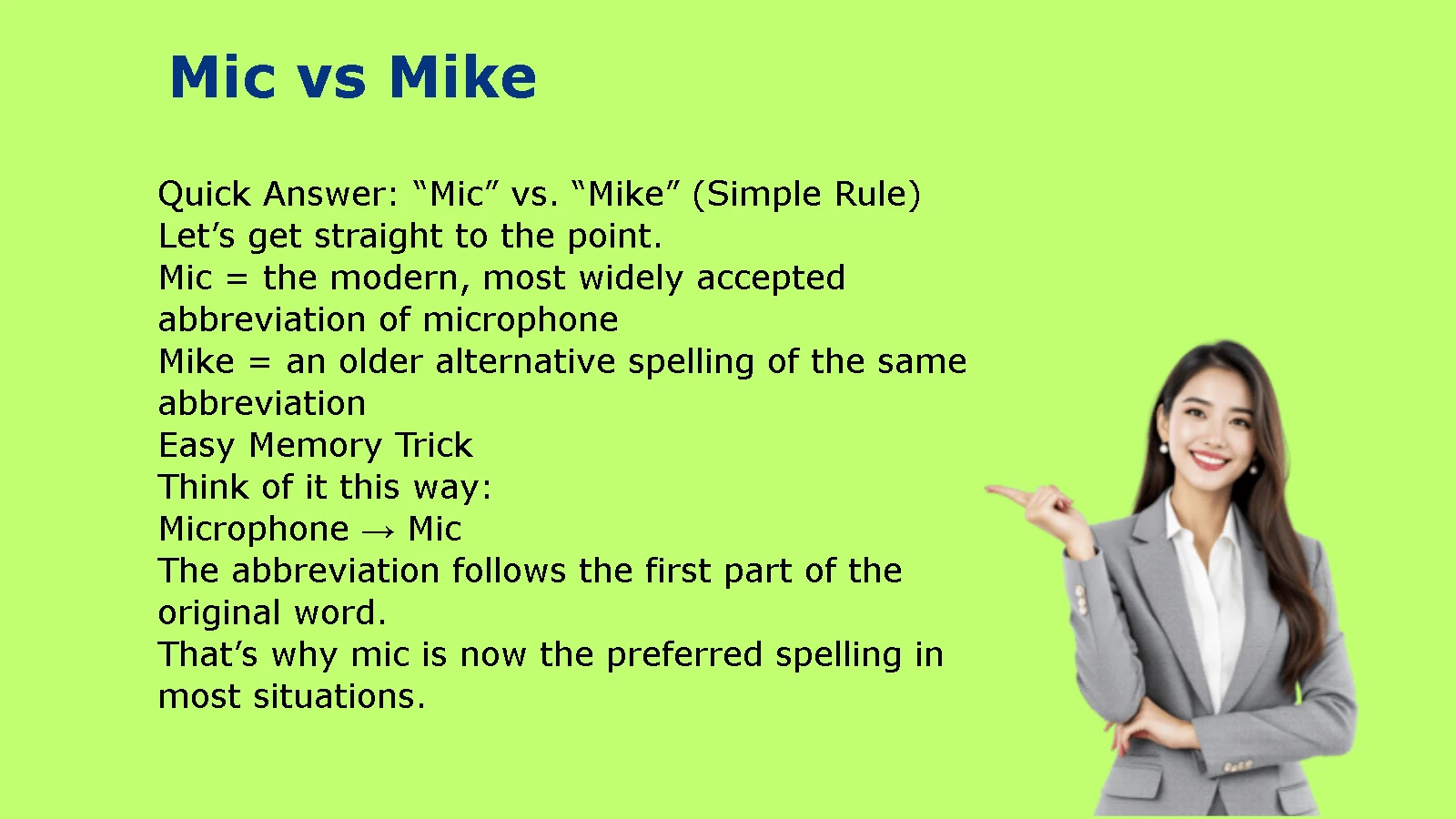
Quick Answer: “Mic” vs. “Mike” (Simple Rule)
Let’s get straight to the point.
Mic = the modern, most widely accepted abbreviation of microphone
Mike = an older alternative spelling of the same abbreviation
Easy Memory Trick
Think of it this way:
Microphone → Mic
The abbreviation follows the first part of the original word.
That’s why mic is now the preferred spelling in most situations.
How People Actually Use “Mic” and “Mike”
This is where many learners get confused.
Both spellings refer to a microphone, but modern usage strongly favors one over the other.
In Everyday Conversations
Most people write:
- “Turn on the mic.”
- “Pass me the mic.”
- “The mic isn’t working.”
Very few people write “mike” today.
In Media and Journalism
Modern publications overwhelmingly prefer:
- Mic
- Wireless mic
- Mic stand
- Mic check
In Older Publications
You may occasionally see:
- Mike
- Hand mike
- Radio mike
These usages were more common decades ago.
Why This Happens
Language evolves.
As abbreviations became more standardized, mic gradually replaced mike in most forms of English.
The History Behind “Mic” vs. “Mike”
Understanding the history makes the difference much clearer.
Where “Mike” Came From
Originally, people shortened microphone verbally.
The pronunciation sounded like:
“mike”
To help readers pronounce the abbreviation correctly, many writers spelled it:
mike
Where “Mic” Came From
Over time, English adopted a shorter written form:
mic
Even though it’s spelled differently, people still pronounce it exactly the same way:
Mic = Mike (pronunciation)
Key Insight
The pronunciation never changed.
Only the preferred spelling changed.
“Mic” Explained Clearly
Today, mic is considered the standard spelling.
Standard Meaning
Mic = microphone
Common Examples
- “Please test the mic.”
- “She adjusted her mic before speaking.”
- “The singer dropped the mic.”
- “We need another mic for the interview.”
Where You’ll See It
- News articles
- Blogs
- Product descriptions
- Social media
- Professional writing
Key Takeaway
If you’re unsure which spelling to use, mic is usually the safest choice.
“Mike” Explained Clearly
Now let’s look at the alternative spelling.
Standard Meaning
Mike = microphone
Common Examples
- “Hand me the mike.”
- “The radio host spoke into the mike.”
- “He adjusted the mike stand.”
Where You’ll See It
Mostly in:
- Older books
- Historical newspapers
- Traditional broadcasting contexts
Important Note
Many modern readers may mistake “mike” for a person’s name.
That’s one reason why mic became more popular.
Key Takeaway
“Mike” isn’t wrong, but it sounds old-fashioned in modern writing.
The Biggest Mistake People Make
Here’s the most common misunderstanding.
People assume mic and mike have different meanings.
They don’t.
What Goes Wrong
Someone sees:
“Pass the mike.”
And thinks:
“Who’s Mike?”
The Reality
Both words mean:
microphone
The difference is spelling preference, not meaning.
Side-by-Side Comparison Table
| Feature | Mic | Mike |
| Meaning | Microphone | Microphone |
| Pronunciation | Mike | Mike |
| Modern Usage | Very Common | Less Common |
| Professional Writing | Preferred | Rare |
| Informal Speech | Common | Occasionally Used |
| Risk of Confusion | Low | Higher |
Real-Life Examples of “Mic”
Let’s look at common modern usage.
Everyday Situations
- “Can you hear me through the mic?”
- “The mic battery is dead.”
- “She bought a new podcast mic.”
- “Let’s do a quick mic check.”
Mini Scenario
Before a presentation:
“Could someone test the mic?”
Everyone immediately understands the meaning.
No confusion.
Real-Life Examples of “Mike”
Now compare.
Traditional Usage
- “Please speak into the mike.”
- “The reporter held the mike close.”
- “The singer grabbed the mike.”
Mini Scenario
In an older newspaper article:
“The announcer stepped toward the mike.”
Readers understand the meaning, though the spelling feels dated.
Why “Mic” Became More Popular
Language naturally tends toward simplicity.
Shorter Looks Cleaner
Compare:
- Mic stand
- Mike stand
Many writers prefer the shorter version.
Less Confusion
“Mike” is also a very common male name.
For example:
“Mike grabbed the mike.”
That sentence can look awkward.
Industry Preference
Modern industries favor:
- Mic check
- Mic stand
- Wireless mic
- USB mic
As a result, mic became the dominant spelling.
Professional Writing: Which Should You Use?
If you’re writing for:
- Websites
- Blogs
- Business documents
- Academic content
- Product descriptions
Use:
Mic
Example
✅ “The podcast host tested the mic.”
Instead of:
⚠️ “The podcast host tested the mike.”
Why?
Because modern style guides and readers generally expect mic.
What Dictionaries Say
Most major dictionaries recognize both spellings.
Dictionary Consensus
- Mic = accepted abbreviation
- Mike = accepted alternative spelling
However:
- Mic is typically listed as the preferred modern form.
- Mike is often noted as a variant.
Key Insight
Both are technically correct.
One is simply much more common today.
How to Avoid Confusion Every Time
Want a simple rule?
Use “Mic” In Most Situations
For modern English:
- Emails
- Articles
- Social posts
- Professional writing
Choose:
Mic
Use “Mike” Only When
- Quoting older material
- Preserving historical style
- Following a publication’s specific preference
Why This Works
It matches current English usage and reader expectations.
What to Say Instead (Clear Alternatives)
If you want maximum clarity, use the full word.
Better Options
- Microphone
- Wireless microphone
- Studio microphone
- Podcast microphone
Example
Instead of:
“The mic stopped working.”
You could write:
“The microphone stopped working.”
When to Use Them
- Formal documents
- Technical manuals
- Academic writing
Quick Decision Guide (Use This Instantly)
When choosing between the two:
Modern writing → Mic
Historical style → Mike
Formal clarity → Microphone
Still unsure?
Choose mic.
FAQ: “Mic” vs. “Mike”
Is “mic” short for microphone?
Yes. It is the most common modern abbreviation for microphone.
Is “mike” incorrect?
No. It is an accepted alternative spelling.
Are “mic” and “mike” pronounced differently?
No. Both are pronounced exactly the same way: “mike.”
Which spelling is more common today?
Mic is significantly more common in modern English.
Which should I use in professional writing?
Use mic unless there’s a specific reason to use mike.
Case Study: A Simple Editing Decision
A podcast company was updating its website.
The original text said:
“Choose the best mike for your recording setup.”
What Happened
Editors noticed that users expected to see:
“Choose the best mic for your recording setup.”
The Result
After updating the spelling:
- Content looked more modern
- Product descriptions matched industry language
- User experience improved
Lesson
Using the preferred modern spelling helps readers process information more naturally.
Key Facts You Should Remember
- Mic and mike both mean microphone
- Both are pronounced the same way
- Mic is the modern standard spelling
- Mike is an older alternative spelling
- Most professional writers choose mic
- Dictionaries generally accept both forms
- Mic creates less confusion for readers
Final Takeaway: The One Rule That Never Fails
Here’s the truth.
The debate over “Mic” vs. “Mike” isn’t really about right versus wrong. Both spellings refer to the same device and both have been used by native English speakers for years.
However, language changes over time.
Today, mic has become the clear favorite in journalism, business writing, technology, media, and everyday communication.
So keep it simple:
Modern writing → Mic
Older or stylistic writing → Mike
Maximum clarity → Microphone
If your goal is clear, natural English, choosing mic will almost always be the safest and most effective option.