Ever wondered why you sometimes see Spilled vs. Spilt used for the same action, even in professional writing? The confusion between these two forms often leaves writers unsure whether they are breaking grammar rules or simply following different versions of English.
Here’s the truth: both words relate to the verb forms of “spill,” but their usage depends heavily on British English and American English conventions. And here’s the kicker: what looks like a mistake in one region may be completely correct in another.
You’re not alone if this has ever confused you while writing emails, essays, or social media posts. Many learners struggle with irregular verb patterns like this because English doesn’t always follow one simple rule.
But don’t worry—this is easier to understand than it looks.
In this guide, you’ll learn the clear difference between Spilled vs. Spilt, how American English typically prefers one form while British English often uses another, and when both are acceptable in modern writing. You’ll also see simple examples that make the distinction instantly clear.
And it gets better—you’ll finally understand how to use both forms confidently without second-guessing yourself again. So let’s break it down.
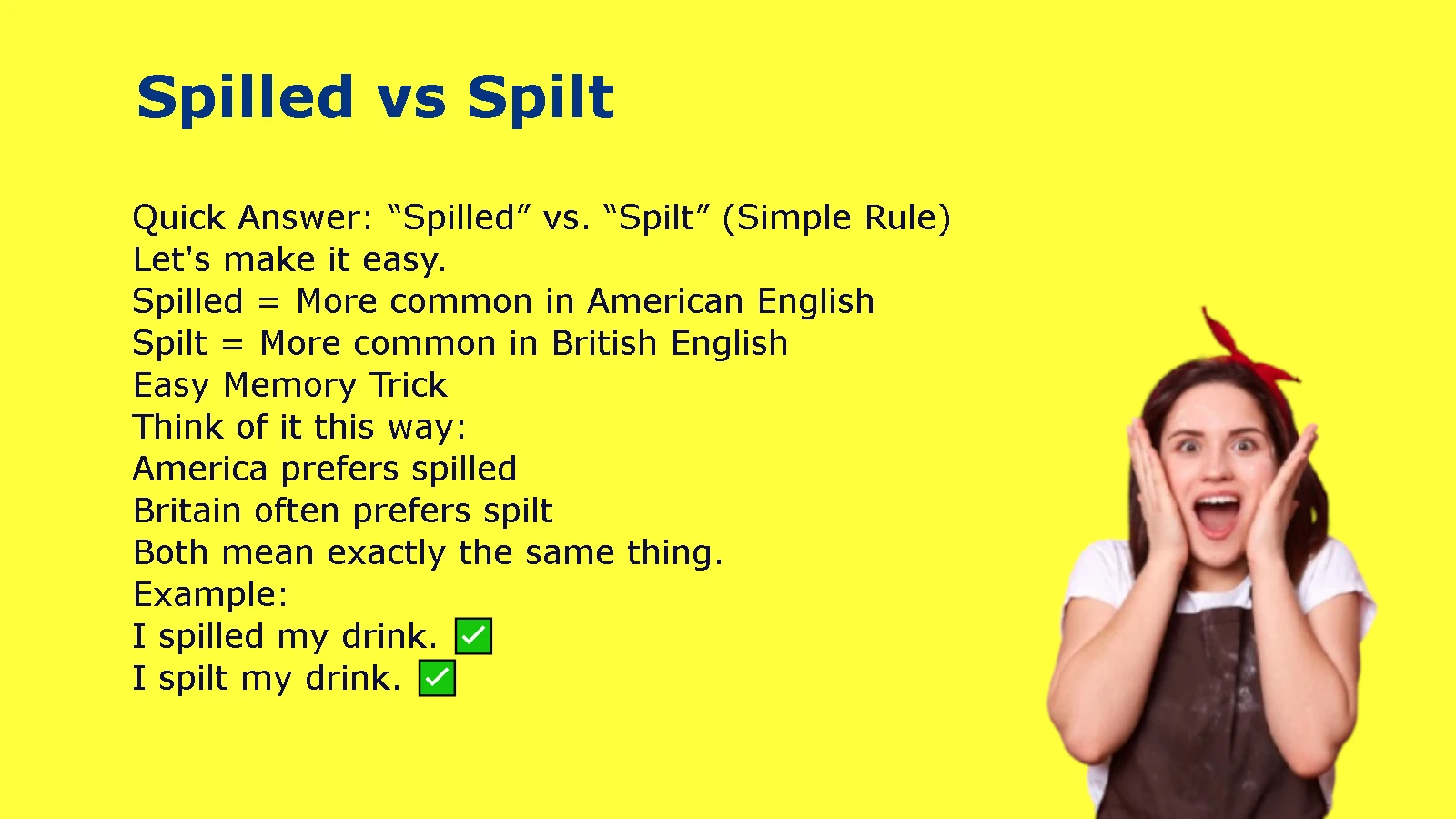
Quick Answer: “Spilled” vs. “Spilt” (Simple Rule)
Let’s make it easy.
Spilled = More common in American English
Spilt = More common in British English
Easy Memory Trick
Think of it this way:
- America prefers spilled
- Britain often prefers spilt
Both mean exactly the same thing.
Example:
- I spilled my drink. ✅
- I spilt my drink. ✅
No difference in meaning.
What Do “Spilled” and “Spilt” Mean?
Both words are the past tense and past participle of the verb spill.
Definition
To spill means:
- To accidentally cause liquid to flow out of a container
- To drop or scatter something unintentionally
- To reveal information unexpectedly
Examples
- She spilled water on the floor.
- She spilt water on the floor.
- He spilled the beans about the surprise party.
- He spilt the beans about the surprise party.
The meaning stays exactly the same.
The Main Difference Between “Spilled” and “Spilt”
The biggest difference is not grammar.
It’s usage.
| Form | Preferred In | Commonness |
| Spilled | American English | Very Common |
| Spilt | British English | Common |
| Spilled | British English | Also Accepted |
| Spilt | American English | Less Common |
Key Insight
If you’re writing for an American audience, use spilled.
If you’re writing for a British audience, either form works, but spilt may sound more natural.
Why Do Two Correct Forms Exist?
English has a long history of changing verb endings.
Many verbs once had both:
- Dreamed / Dreamt
- Learned / Learnt
- Burned / Burnt
- Spilled / Spilt
Over time, different English-speaking regions favored different forms.
What Happened?
American English generally adopted the -ed endings.
British English kept many of the shorter -t endings.
That’s why both forms survive today.
“Spilled” Explained Clearly
Standard Usage
“Spilled” is the dominant form in modern American English.
You’ll see it in:
- Newspapers
- Academic writing
- Business communication
- Everyday conversation
Examples
- I spilled coffee on my shirt.
- The child spilled juice on the carpet.
- Someone spilled confidential information online.
Why Writers Choose It
It sounds:
- Modern
- Neutral
- Widely understood
- Professional
Key Takeaway
When in doubt, spilled is the safest choice for international audiences.
“Spilt” Explained Clearly
“Spilt” is an alternative past tense form that remains popular in British English.
Standard Usage
You’ll frequently see it in:
- UK publications
- British novels
- Informal British conversation
Examples
- She spilt tea on the tablecloth.
- The milk spilt onto the floor.
- He spilt the truth during the interview.
Why Writers Choose It
Many people feel it sounds:
- Traditional
- Concise
- Distinctly British
Key Takeaway
“Spilt” is completely correct, especially in British English.
The Grammar Rule Behind “Spilled” vs. “Spilt”
Here’s the good news.
There isn’t a grammar rule forcing one choice.
Both Are Accepted Past Forms
Present Tense:
- spill
Past Tense:
- spilled
- spilt
Past Participle:
- spilled
- spilt
Examples
- I have spilled the milk.
- I have spilt the milk.
Both sentences are grammatically correct.
Real-Life Examples of “Spilled”
Let’s see how it appears naturally.
Everyday Situations
- I spilled coffee on my laptop.
- She spilled paint on the floor.
- They spilled water during dinner.
At Work
- Someone spilled confidential data.
- The employee spilled details before the announcement.
In School
- The student spilled ink across the notebook.
Common Pattern
American speakers overwhelmingly prefer spilled.
Real-Life Examples of “Spilt”
Now compare the British variant.
Everyday Situations
- I spilt tea on the sofa.
- She spilt milk over the counter.
- They spilt juice during breakfast.
Informal Conversation
- Oops, I spilt my drink.
- Who spilt water on the floor?
British Writing
You’ll often find “spilt” in UK newspapers, novels, and magazines.
Side-by-Side Comparison Table
Here’s a quick reference.
| Feature | Spilled | Spilt |
| Meaning | Same | Same |
| Grammar | Correct | Correct |
| American English | Preferred | Less Common |
| British English | Common | Common |
| Formal Writing | Very Common | Accepted |
| Informal Writing | Common | Common |
Bottom Line
There is no meaning difference.
The distinction is mainly regional.
Common Expressions Using “Spilled” and “Spilt”
Some idioms work with either form.
Spill the Beans
Meaning: Reveal a secret.
Examples:
- He spilled the beans.
- He spilt the beans.
Spill Your Guts
Meaning: Tell everything.
Examples:
- She spilled her guts during the interview.
- She spilt her guts during the interview.
Important Note
The idiom remains unchanged regardless of which past tense form you choose.
The Biggest Mistake People Make
Many learners think one version must be wrong.
That’s not true.
What Goes Wrong
People assume:
- Spilled = correct
- Spilt = incorrect
Or:
- Spilt = correct
- Spilled = incorrect
Reality
Both are recognized standard English.
The only difference is preference and audience.
Lesson
Focus on consistency rather than trying to find a “right” form.
Which Form Should You Use?
The answer depends on who will read your writing.
Use “Spilled” If:
- Your audience is American
- You’re writing professionally
- You want the safest international option
- You’re creating academic content
Use “Spilt” If:
- You’re writing for British readers
- You prefer traditional British usage
- Consistency with UK spelling matters
Best Practice
Pick one style and stick with it throughout your document.
Regional Differences Around the World
English varies globally.
United States
Almost everyone prefers spilled.
United Kingdom
Both forms appear regularly.
“Spilt” may sound slightly more natural in casual British speech.
Canada
Both forms occur, though spilled is often more common.
Australia and New Zealand
Both are accepted, with “spilt” appearing more often than in the United States.
Key Insight
Neither form will confuse native speakers.
How to Avoid Mistakes Every Time
Follow these simple guidelines.
Know Your Audience
American readers → spilled
British readers → spilt or spilled
Stay Consistent
Don’t switch back and forth unnecessarily.
Follow Style Guides
Many organizations have preferred spelling standards.
Use Spell Check Carefully
Some programs flag “spilt” depending on language settings.
Quick Decision Guide (Use This Instantly)
Ask yourself:
Writing for Americans?
→ Use spilled
Writing for Britons?
→ Use spilt or spilled
Writing for a global audience?
→ Use spilled
Simple. Reliable. Done.
FAQ: “Spilled” vs. “Spilt”
Is “spilt” grammatically correct?
Yes. It is a fully correct past tense and past participle form of “spill.”
Is “spilled” more common?
Yes. Especially in American English and international writing.
Do they mean different things?
No. Both words have exactly the same meaning.
Which form should students use?
“Spilled” is generally the safest choice because it is more universally recognized.
Can I use both in the same article?
It’s better to choose one and remain consistent.
Case Study: A Writing Style Mix-Up
A content writer created an article for a US audience.
Throughout the article, they wrote:
- “The coffee spilt across the desk.”
- “The water spilt onto the floor.”
The editor changed every instance to spilled.
Why?
Not because “spilt” was wrong.
Because the publication followed American English style guidelines.
Lesson
Audience expectations often matter more than grammar.
Key Facts You Should Remember
- Both “spilled” and “spilt” are correct.
- They have the same meaning.
- American English strongly prefers “spilled.”
- British English accepts both forms.
- “Spilt” is more traditional and British.
- Consistency is more important than choosing one over the other.
Final Takeaway: The One Rule That Never Fails
Here’s the truth.
The debate over “Spilled” vs. “Spilt” isn’t really about correctness. It’s about audience and style.
Both forms are accepted by dictionaries and understood by native speakers. The challenge is knowing which version sounds most natural to your readers.
So remember:
- American audience → Spilled
- British audience → Spilt or Spilled
- Global audience → Spilled
When you choose the form that matches your audience and stay consistent throughout your writing, you’ll never go wrong.
Because in the world of “Spilled” vs. “Spilt,” clarity and consistency matter far more than the spelling itself.