Ever found yourself confused between Situation vs Circumstance, wondering if they actually mean the same thing or if there’s a subtle difference that changes everything? These two words are often used interchangeably, but here’s the kicker: they don’t always carry the exact same meaning in every context.
The problem is that both words describe conditions or events around us, so it’s easy to mix them up in writing, conversation, or even formal communication. And when that happens, your message can become less clear or slightly off in tone.
Many people struggle with this in everyday English usage. That’s why learners and writers often look for simple explanations of situation vs circumstance, along with clear examples that show how each word is used in real life.
But don’t worry—this is easier to understand than it looks.
In this guide, you’ll learn the difference between Situation vs Circumstance, when to use each term correctly, and how they overlap in meaning. You’ll also see practical examples that make the distinction simple and memorable.
So if you’re ready to clear up the confusion and use both words with confidence, let’s break it down.
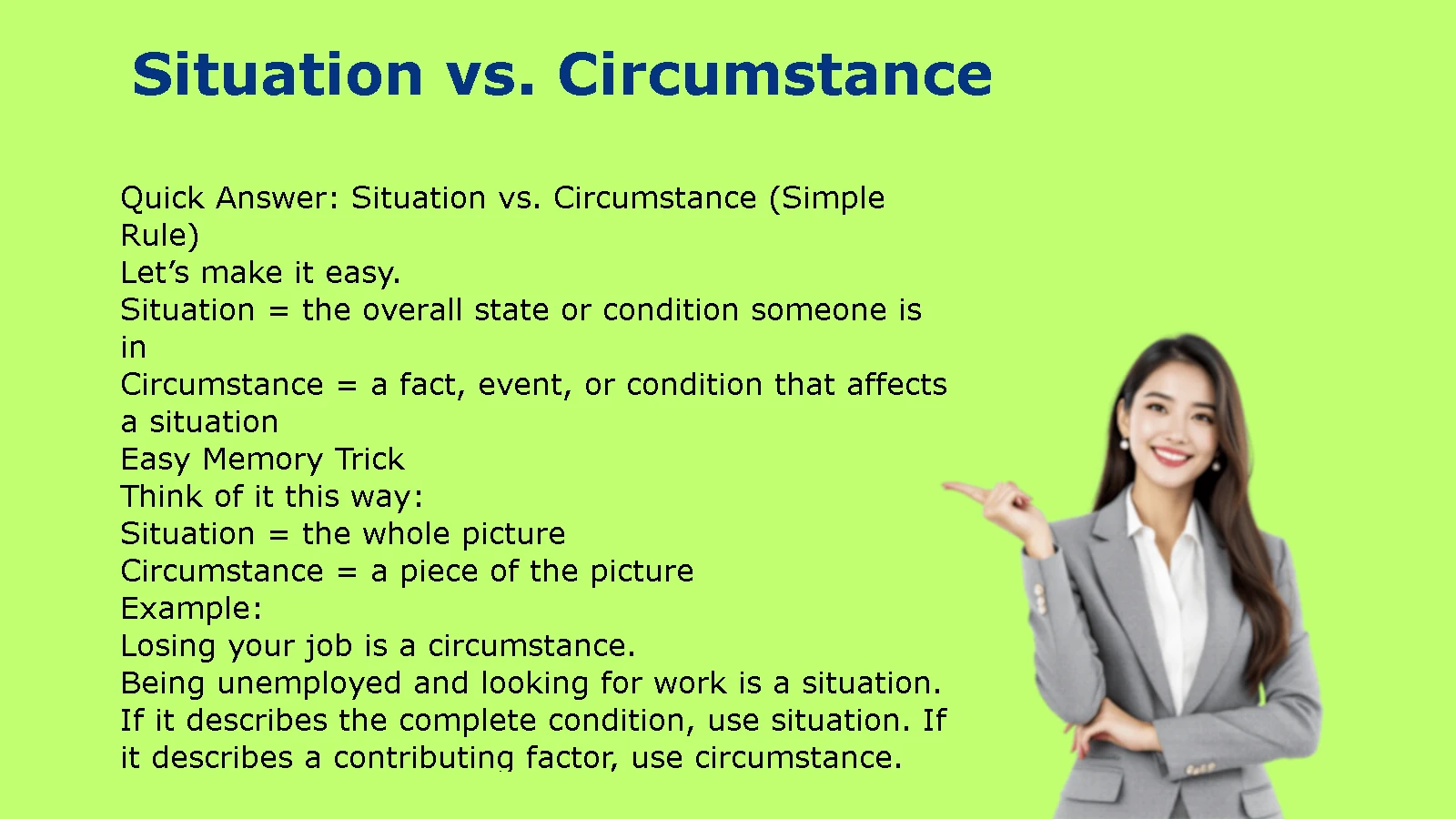
Quick Answer: Situation vs. Circumstance (Simple Rule)
Let’s make it easy.
Situation = the overall state or condition someone is in
Circumstance = a fact, event, or condition that affects a situation
Easy Memory Trick
Think of it this way:
Situation = the whole picture
Circumstance = a piece of the picture
Example:
- Losing your job is a circumstance.
- Being unemployed and looking for work is a situation.
If it describes the complete condition, use situation. If it describes a contributing factor, use circumstance.
How People Actually Use Situation and Circumstance
Here’s where confusion begins.
In everyday English, people often swap these words without thinking. Most listeners still understand the message, but the meaning can become less precise.
In Casual Conversations
People frequently use both words to describe problems or events.
For example:
- “I’m in a difficult situation.”
- “I’m dealing with difficult circumstances.”
Both sound natural, but they emphasize different things.
In Professional Writing
Writers tend to be more precise.
- Situation focuses on the overall condition.
- Circumstance focuses on factors or details affecting that condition.
Why This Happens
The meanings overlap.
Both words deal with conditions and events, making them easy to confuse.
The Core Difference Between Situation and Circumstance
The easiest way to understand the distinction is to look at scope.
Situation Is the Bigger Picture
A situation refers to the complete state of affairs.
Examples:
- Financial situation
- Political situation
- Family situation
- Work situation
It describes the overall condition at a particular time.
Circumstance Is a Specific Factor
A circumstance refers to an event, condition, or fact connected to a situation.
Examples:
- Unexpected medical bills
- A sudden relocation
- Bad weather
- A company merger
These circumstances influence the larger situation.
Key Insight
A situation can contain many circumstances.
But a single circumstance is usually only one part of a situation.
Situation Explained Clearly (With Examples)
Let’s focus on situation first.
Standard Meaning
A situation describes someone’s position, condition, or set of circumstances at a particular moment.
Examples:
- “The housing situation is improving.”
- “She explained her financial situation.”
- “The traffic situation is getting worse.”
In each example, the word refers to the overall condition.
Common Contexts
Situation is often used when discussing:
- Personal life
- Business
- Politics
- Emergencies
- Relationships
Example
Imagine:
- You recently moved.
- You started a new job.
- You’re looking for housing.
Together, these create your current situation.
Key Takeaway
Situation focuses on the complete scenario rather than individual details.
Circumstance Explained Clearly (With Examples)
Now let’s look at circumstance.
Standard Meaning
A circumstance is a condition, fact, or event connected to a particular situation.
Examples:
- “Due to unforeseen circumstances, the meeting was canceled.”
- “Financial circumstances forced him to move.”
- “The circumstances surrounding the accident remain unclear.”
Common Contexts
Circumstance is frequently used when discussing:
- Causes
- Influences
- Conditions
- Background details
- Explanations
Example
Imagine you lose your job.
The job loss itself is a circumstance.
The resulting unemployment is your situation.
Key Takeaway
Circumstances help explain why a situation exists.
The Biggest Mistake People Make
The most common mistake is treating both words as exact synonyms.
What Goes Wrong
People use circumstance when they mean the overall condition.
Or they use situation when discussing a specific factor.
Example
Incorrect emphasis:
“The circumstance at work is stressful.”
Better:
“The situation at work is stressful.”
Why?
Because the sentence describes the overall condition, not a specific factor.
Lesson
Ask yourself:
Am I describing the whole picture or just one contributing detail?
Side-by-Side Comparison Table
| Feature | Situation | Circumstance |
|---|---|---|
| Meaning | Overall condition | Specific factor or condition |
| Scope | Broad | Narrow |
| Focus | Entire scenario | Individual detail |
| Common Use | Personal, business, social conditions | Causes, influences, background factors |
| Example | Financial situation | Financial circumstances |
Real-Life Examples of Situation
Let’s see how situation works in everyday language.
Common Examples
- “The economic situation is improving.”
- “We need to assess the situation.”
- “Her living situation changed recently.”
- “The political situation remains unstable.”
Mini Scenario
A company experiences declining sales.
Managers discuss:
“The current business situation.”
They’re referring to the entire condition of the company.
Real-Life Examples of Circumstance
Now compare that with circumstance.
Common Examples
- “Unexpected circumstances delayed the project.”
- “The circumstances were beyond our control.”
- “Family circumstances prevented her from attending.”
- “Special circumstances require special measures.”
Mini Scenario
Sales decline because:
- A competitor enters the market.
- Supply costs increase.
- Demand drops.
These are circumstances affecting the business situation.
Situation vs. Circumstance in Common Phrases
Certain phrases strongly favor one word over the other.
Common Situation Phrases
- Current situation
- Financial situation
- Emergency situation
- Work situation
- Living situation
Common Circumstance Phrases
- Under the circumstances
- Due to circumstances
- Unforeseen circumstances
- Special circumstances
- Mitigating circumstances
Quick Tip
If you hear “under the circumstances,” situation usually won’t sound natural there.
Situation vs. Circumstance in Professional Communication
Business communication often requires precision.
Better Choice: Situation
Use when discussing the overall status.
Examples:
- “The market situation has changed.”
- “Let’s evaluate the current situation.”
Better Choice: Circumstance
Use when discussing causes or influencing factors.
Examples:
- “Due to unforeseen circumstances, delivery has been delayed.”
- “Several circumstances affected the outcome.”
Why It Matters
Using the right word makes communication clearer and more professional.
How to Avoid Confusion Every Time
Follow these simple strategies.
Ask One Question
Are you describing:
- The whole condition?
- Or a specific factor?
If it’s the whole condition → use situation
If it’s a contributing factor → use circumstance
Focus on Scope
Situation = broad
Circumstance = specific
Practice With Examples
“The financial situation is difficult.”
Why?
Because it refers to the overall condition.
“Medical circumstances created financial difficulties.”
Why?
Because medical issues are one contributing factor.
What to Say Instead (Clear Alternatives)
Sometimes another word works even better.
Alternatives to Situation
- Condition
- State
- Position
- Scenario
- Status
Alternatives to Circumstance
- Factor
- Condition
- Event
- Detail
- Influence
When to Use Them
Choose alternatives when you want greater precision or variety in writing.
Quick Decision Guide (Use This Instantly)
When you’re unsure, follow this rule:
Whole picture → Situation
Part of the picture → Circumstance
Overall condition → Situation
Contributing factor → Circumstance
Still unsure?
Replace circumstance with factor.
If the sentence still works, circumstance is probably correct.
FAQ: Situation vs. Circumstance
Are situation and circumstance synonyms?
They are similar but not identical. Situation refers to the overall condition, while circumstance refers to a contributing factor or detail.
Can a circumstance create a situation?
Yes. Multiple circumstances often combine to create a situation.
Which word is more common in business writing?
Both appear frequently, but situation is often used for overall conditions, while circumstance explains causes and influencing factors.
What does “under the circumstances” mean?
It means considering the existing conditions or factors affecting an event.
Is circumstance always singular?
No. It can be singular or plural.
Examples:
- A circumstance
- Several circumstances
Case Study: Understanding the Difference in Real Life
Imagine a small business owner facing financial problems.
The Situation
The company is struggling to stay profitable.
The Circumstances
- Rising costs
- Reduced customer demand
- New competition
- Supply chain delays
The circumstances explain why the situation exists.
Understanding this distinction makes the difference instantly clear.
Key Facts You Should Remember
- Situation describes the overall condition.
- Circumstance describes a contributing factor.
- A situation can include multiple circumstances.
- Circumstances often explain why a situation exists.
- Situation is broader than circumstance.
- Professional writing often distinguishes between them.
Final Takeaway: The One Rule That Never Fails
Here’s the easiest way to remember the difference between situation vs. circumstance:
Situation = the whole picture
Circumstance = a piece of the picture
Think of a puzzle.
The completed puzzle is the situation.
Each individual piece is a circumstance.
When you focus on the overall condition, choose situation. When you focus on a specific cause, influence, or detail, choose circumstance.
That simple distinction will help you use both words correctly every time.