You’ve probably seen it before. Someone writes “sleave” instead of “sleeve,” and suddenly the sentence looks… suspicious. Or you pause mid-reading and wonder if it’s a typo, an old word, or something completely different.
Here’s the truth: one of these words is common in modern English. The other is mostly historical or extremely rare. The confusion happens because they sound identical, but their meanings are worlds apart.
In this guide, you’ll finally understand “sleeve vs. sleave” in a clear, practical way—so you never mix them up again.
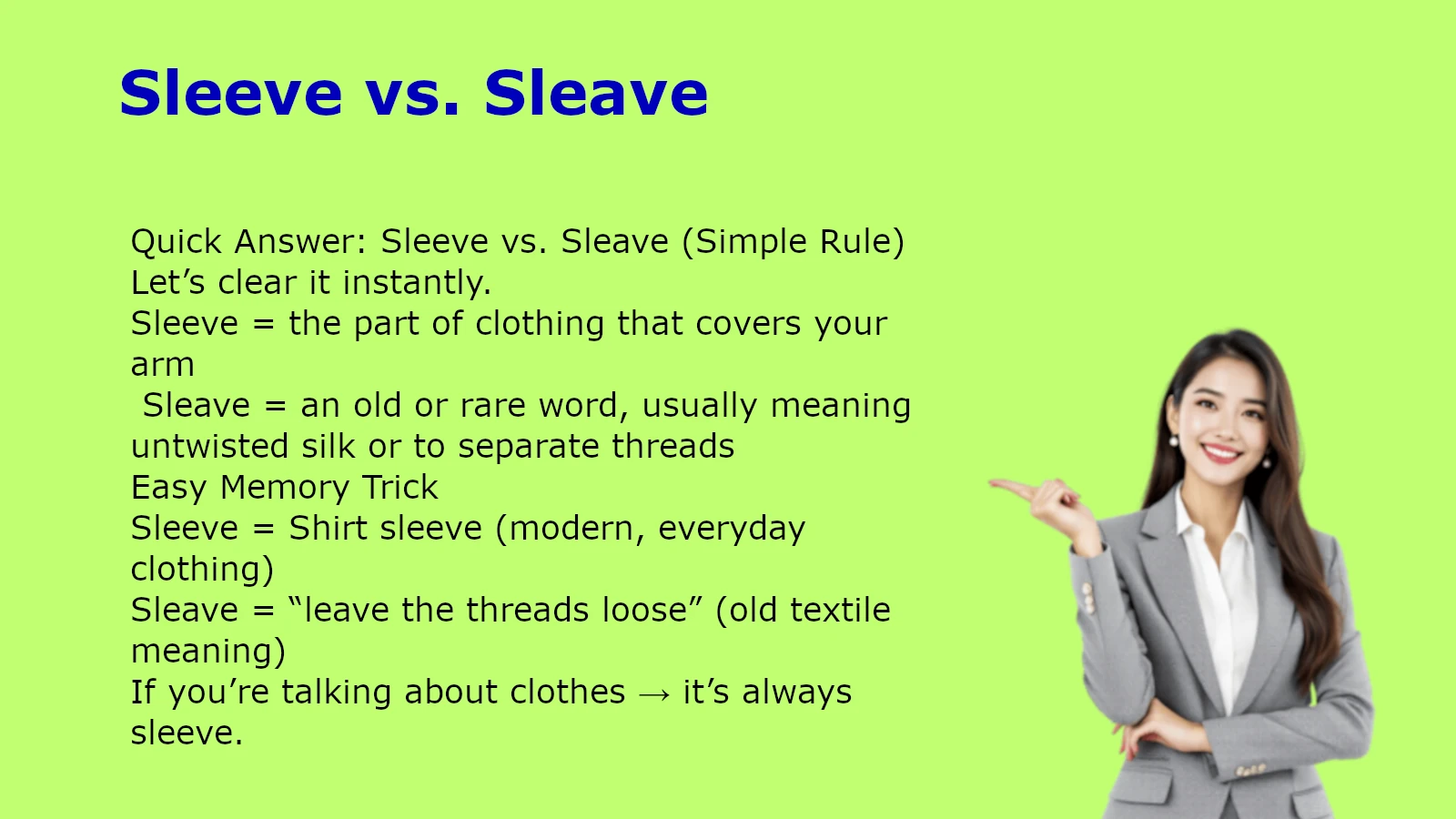
Quick Answer: Sleeve vs. Sleave (Simple Rule)
Let’s clear it instantly.
Sleeve = the part of clothing that covers your arm
Sleave = an old or rare word, usually meaning untwisted silk or to separate threads
Easy Memory Trick
- Sleeve = Shirt sleeve (modern, everyday clothing)
- Sleave = “leave the threads loose” (old textile meaning)
If you’re talking about clothes → it’s always sleeve.
Why “Sleeve” vs. “Sleave” Confuses People
The confusion is surprisingly simple:
- They are homophones (sound the same)
- Spelling difference is just one letter
- “Sleave” looks like a typo of “sleeve”
- Auto-correct often “fixes” it silently
But in reality, they are not interchangeable at all.
What “Sleeve” Means (Modern English Usage)
Let’s start with the one you actually use every day.
Standard Meaning
A sleeve is the part of a shirt, jacket, or dress that covers your arm.
Common Examples
- “He rolled up his sleeves before working.”
- “This shirt has long sleeves.”
- “I spilled coffee on my sleeve.”
Extended Meanings
“Sleeve” is also used in other contexts:
- Music sleeve → album cover
- Plastic sleeve → protective cover for documents
- Sleeve tattoo → tattoo covering the arm
Key Insight
In modern English, “sleeve” is always the correct word for clothing and coverings.
What “Sleave” Means (Rare / Historical Word)
Now the tricky one.
Old Meaning
“Sleave” is an old English word that refers to:
- Untwisted or loosely spun silk
- Separating threads or fibers
Example (Historical Style)
- “The silk was left in a soft sleave before weaving.”
Modern Usage
- Almost never used in everyday English
- Mostly found in literature, poetry, or dictionaries
- Sometimes appears in Shakespearean or archaic contexts
Key Insight
If you see “sleave” today, it’s usually:
- A historical reference
- A typo
- Or very niche textile terminology
The Biggest Mistake People Make
Here’s where confusion really happens.
People assume:
“Sleave” is just a fancy or alternative spelling of “sleeve.”
That’s incorrect.
What Goes Wrong
- Writers accidentally type “sleave”
- Spellcheck doesn’t always flag it properly in older tools
- Readers assume both are valid modern words
Real Example
Incorrect:
- “He pulled up his sleaves before the meeting.”
Correct:
- “He pulled up his sleeves before the meeting.”
Result
Small spelling error → credibility drop in writing
Sleeve vs. Sleave Side-by-Side Comparison
Here’s a quick breakdown you can scan anytime:
| Word | Meaning | Usage Level | Example |
| Sleeve | Part of clothing covering the arm | Very common | Shirt sleeve, jacket sleeve |
| Sleave | Untwisted silk or separated fibers | Rare / historical | Old textile descriptions |
Real-Life Examples of “Sleeve”
Let’s make it practical.
Everyday Use
- “I need a jacket with long sleeves.”
- “Her sleeve got caught in the door.”
- “He tattooed his entire arm sleeve.”
Professional Use
- “Document is stored in a plastic sleeve.”
- “Album sleeve design looks creative.”
Key Point
If you’re writing anything modern, “sleeve” is always the correct choice.
Real-Life Examples of “Sleave”
Now the rare one.
Historical or Literary Use
- “The silk was prepared in sleave form before spinning.”
- “Threads were separated into sleave for weaving.”
Modern Reality
In today’s writing:
- You will almost never need this word
- Most readers won’t recognize it
- It may look like a spelling mistake
Key Insight
Unless you are studying textile history, you probably won’t use “sleave” at all.
Why “Sleave” Still Exists in English
Even though it’s rare, it hasn’t disappeared completely because:
- It exists in historical dictionaries
- Appears in old literature
- Used in textile terminology discussions
- Preserved in etymology studies
But in real-world communication, it’s almost irrelevant.
The Biggest Real-World Confusion Scenario
Here’s what often happens:
Situation
A student writes:
“He rolled up his sleaves.”
What Happens Next
- Teacher marks it wrong
- Spellcheck may or may not catch it
- Student assumes both forms exist
Reality
Only one correct form exists in modern usage:
sleeves
How to Never Mix Them Up Again
Use this simple system:
Step 1: Ask the context
- Clothing? → Sleeve
- Historical textile writing? → Sleave
Step 2: Default rule
If unsure → always use sleeve
Step 3: Quick memory trick
- Sleeve = Shirt (modern life)
- Sleave = Silk (old world)
Quick Decision Guide
When writing or speaking:
- Clothing, fashion, everyday English → sleeve
- Anything modern → sleeve
- Rare historical textile reference → sleave
- Still unsure → choose sleeve
Simple. Safe. Correct.
FAQ: Sleeve vs. Sleave
Is “sleave” a typo of “sleeve”?
Not exactly. It’s a real word, but extremely rare and outdated in modern usage.
Can I use “sleave” in everyday writing?
No. It will almost always be seen as incorrect or confusing.
What is the most common mistake?
Writing “sleave” instead of “sleeve” in clothing contexts.
Which one should I always use?
Use sleeve unless you are studying historical textiles.
Final Takeaway: The One Rule That Never Fails
Here’s the simplest truth:
If you mean clothing or anything modern → always use “sleeve.”
“Sleave” belongs mostly to history books and specialized textile terminology.
So the next time you’re unsure, remember this:
You wear a sleeve, not a sleave.