Accessory vs. Accessary is a topic that often creates confusion because their similar spelling and pronunciation, and they are often mixed due to confused words in everyday contexts. An accessory is typically a useful item that enhances, aids, or contributes as an additional support in fashion or technology, while it is also seen as an alternative part of meaning hand, showing how language can lead to confusion even when words are fairly clear in usage.
Moreover, Accessary is used in legal contexts and refers to someone who is involved in a criminal act but not present at its occurrence, involving notion, complicity, intentional aid, and consent, and is applied only where applicable, mainly as a noun for persons and an adjective for actions, as explained in Examples like he was principal, accessaries were punished, and cases involving crime. In addition, Fowler’s Modern English Usage states that usage differs, and while some dictionaries are unfortunately aware or not fully aware of this variant, discussions in Modern English Usage show that people, I, and researchers have already looked up couple online dictionaries, asking Do you agree or Or possibly think it is a needless variant that should be avoided.
Finally, the distinction becomes clearer when we consider how book states, primarily applied, things, and people are separated in meaning, where Accessary relates to legal responsibility and Accessory connects with machine, clothing, and useful decorative purpose items in daily life. Therefore, although words, though separate histories, are confused, they still form a clear distinction line that can be out when carefully studied, helping us understand how language in British English usage, in summary, continues to evolve across useful examples, contexts, and practical communication.
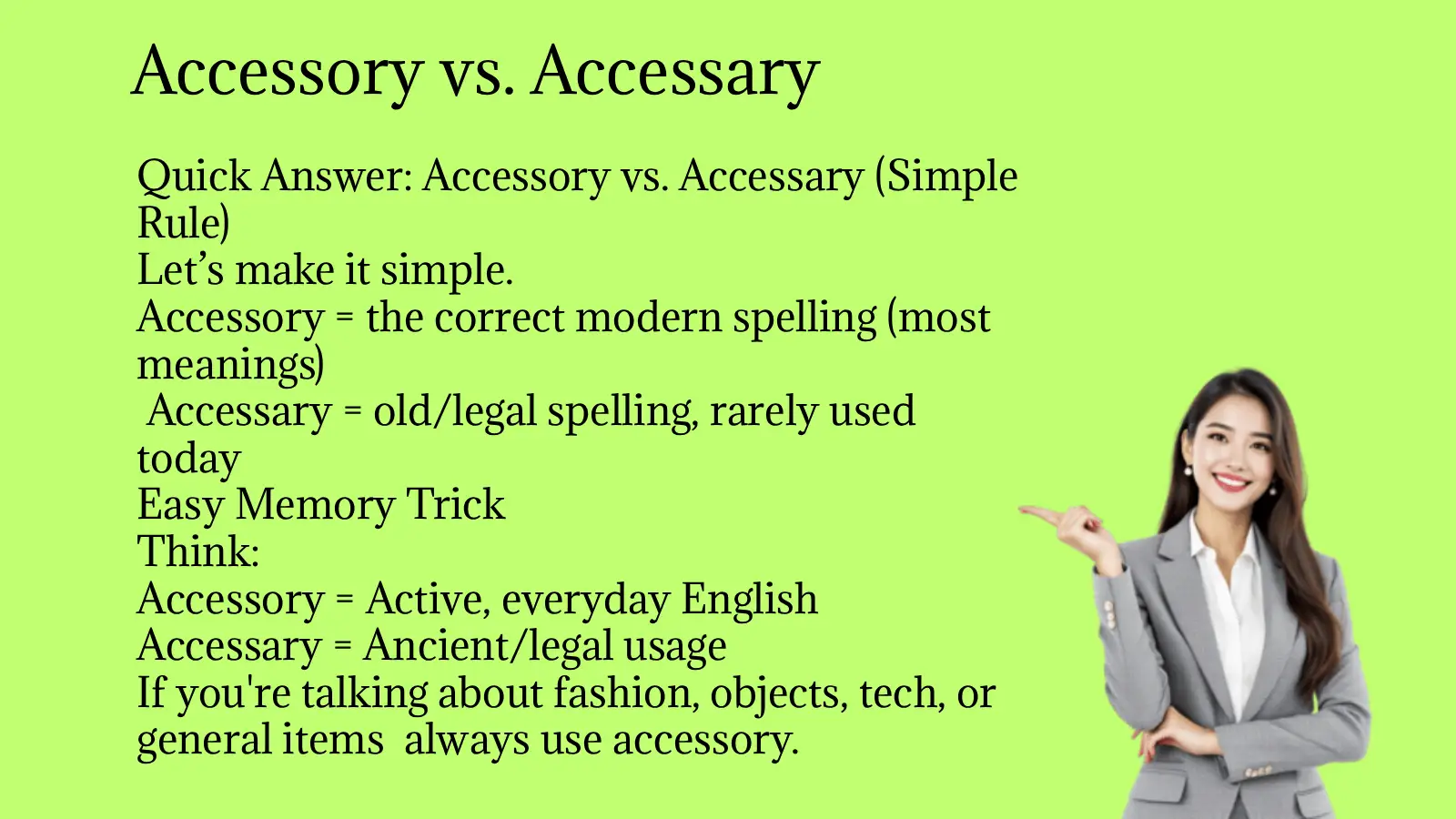
Quick Answer: Accessory vs. Accessary (Simple Rule)
Let’s make it simple.
Accessory = the correct modern spelling (most meanings)
Accessary = old/legal spelling, rarely used today
Easy Memory Trick
Think:
- Accessory = Active, everyday English
- Accessary = Ancient/legal usage
If you’re talking about fashion, objects, tech, or general items → always use accessory.
What Does “Accessory” Mean? (Modern Usage)
Accessory is the standard, widely accepted spelling in modern English.
It refers to something that:
- Adds usefulness
- Enhances appearance
- Is not essential but supportive
Common Meanings of “Accessory”
1. Fashion Items
- Bags
- Jewelry
- Belts
- Sunglasses
👉 Example:
“She bought a matching handbag as an accessory for her dress.”
2. Add-on Items (General Use)
- Phone cases
- Laptop chargers
- Camera lenses
👉 Example:
“This phone accessory improves battery life.”
3. Legal/Technical (Secondary Meaning)
Something that supports or contributes to a main item or action.
What Does “Accessary” Mean? (Old & Rare Usage)
Now here’s where things get tricky.
Accessary is an older spelling of accessory, but in modern English it has a very specific legal meaning.
Legal Meaning (Important Exception)
In law, accessary (or accessory) can mean:
A person who helps or contributes to a crime but does not directly commit it.
Example:
“He was charged as an accessary to the robbery.”
Why It’s Confusing
Because:
- “Accessary” looks like a typo of “accessory”
- But in legal contexts, it historically had meaning
👉 However, even in modern law, “accessory” is now preferred in most jurisdictions.
Key Difference Between Accessory and Accessary
Here’s a simple breakdown:
| Word | Meaning | Usage Today | Example |
| Accessory | Item that supports or enhances something | Very common | Fashion accessory, phone accessory |
| Accessary | Old/legal term for someone involved in a crime | Rare | Accessary to a crime |
Why “Accessory” Became the Standard Spelling
English evolved, and spelling simplified over time.
Here’s what happened:
- “Accessary” was used earlier in English
- Over time, “accessory” became the dominant spelling
- Dictionaries and modern usage standardized it
👉 Today, “accessory” is used in almost all contexts except some legal historical references.
Real-Life Examples of “Accessory”
Let’s see how it works in everyday English:
Fashion
- “She wore gold accessories with her outfit.”
Technology
- “Don’t forget your laptop accessories.”
Automotive
- “He added new accessories to his car.”
Lifestyle
- “Sunglasses are my favorite summer accessory.”
Real-Life Examples of “Accessary”
This is rare, but here are legal-style examples:
- “The suspect was found to be an accessary before the fact.”
- “She was charged as an accessary in the fraud case.”
👉 Again: this is mostly legal language or historical usage.
The Biggest Mistake People Make
Here’s the real problem:
People assume both words are interchangeable in everyday English.
What goes wrong:
- Writers accidentally use “accessary” in fashion or product descriptions
- This looks outdated or incorrect
- It can hurt professionalism in writing
👉 Example mistake:
❌ “Fashion accessary trends this season”
✔ Correct:
✅ “Fashion accessory trends this season”
Quick Comparison Summary
- Accessory = modern, correct, everyday English
- Accessary = outdated/legal-only usage
- In 99% of cases, choose accessory
When Should You Use Each Word?
Use “Accessory” When:
- Writing blogs
- Talking about fashion
- Describing products
- Writing business content
- SEO content or marketing
Use “Accessary” When:
- Writing legal documents (rare)
- Referring to historical legal terms
- Discussing criminal law terminology
Quick Decision Guide
If you’re unsure, follow this rule:
👉 Talking about items or products? → Accessory
👉 Talking about crime/legal history? → Accessary
👉 Still unsure? → Always choose Accessory
FAQ: Accessory vs. Accessary
Is “accessary” wrong?
Not technically, but it is outdated and rarely used outside legal contexts.
Which spelling should I use in writing?
Always use accessory unless you’re writing legal content.
Why do both spellings exist?
Because English evolved over time, and spelling became standardized around “accessory.”
Can I use “accessary” in fashion writing?
No. It will look incorrect or unprofessional.
Final Takeaway: The One Rule That Never Fails
Here’s the simplest way to remember it:
👉 Accessory = everything modern and everyday
👉 Accessary = old legal language you almost never need
So unless you’re studying law or reading historical texts, stick with accessory.
Because in real-world writing, clarity matters more than rare alternatives—and “accessory” is always the safe choice.