Immunize or immunise are two correct spellings of the same word. American English uses immunize, while British English generally uses immunise. Both mean to make someone or an animal protected against a disease, usually through vaccination. However, the word has several related uses, including immunization vs. vaccination, immunized child, immunized for COVID-19, and immunize meaning in law.
Understanding these terms helps you choose the right spelling, use the word naturally in a sentence, and distinguish medical protection from legal immunity. You’ll also learn the meaning of immunize in simple English, its synonyms, correct pronunciation, and what to know if you’re searching for an immunize tablet.
Immunize or Immunise: Which Spelling Is Correct?
Both immunize and immunise are correct English spellings. The main difference comes from regional spelling conventions, not meaning or pronunciation. American English typically uses immunize, whereas British English commonly uses immunise. Choose the spelling that matches your audience, publication, or preferred style guide.
Immunize vs. Immunise: The Main Difference
The difference between immunize and immunise is the letter z versus s. Both forms function as verbs and describe making someone or something immune to a particular disease or risk.
| Feature | Immunize | Immunise |
| Preferred variety | American English | British English |
| Part of speech | Verb | Verb |
| Meaning | To make immune or provide protection | To make immune or provide protection |
| Pronunciation | Generally the same | Generally the same |
| Example | The clinic will immunize the children. | The clinic will immunise the children. |
| Related noun | Immunization | Immunisation |
| Past tense | Immunized | Immunised |
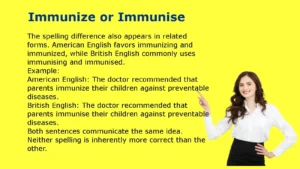
The spelling difference also appears in related forms. American English favors immunizing and immunized, while British English commonly uses immunising and immunised.
Example:
- American English: The doctor recommended that parents immunize their children against preventable diseases.
- British English: The doctor recommended that parents immunise their children against preventable diseases.
Both sentences communicate the same idea. Neither spelling is inherently more correct than the other.
Immunize or Immunise in US, UK, Canadian, and Australian English
Regional preferences can help you decide which spelling to use.
- United States: Immunize and immunization are the standard forms.
- United Kingdom: Immunise and immunisation are common British forms.
- Canada: Both spellings may appear, but immunize and immunization are widely used in Canadian medical and public health writing.
- Australia: Immunise and immunisation are standard forms in Australian English.
These preferences are not absolute rules for every publisher. A newspaper, university, healthcare organization, or government agency may follow its own style guide.
For example, if you’re writing an American healthcare article, use immunize throughout. If you’re preparing a British English vocabulary guide, immunise will usually fit better.
SEO writing tip: Match the spelling used by your target audience, then keep it consistent in your title, headings, body text, and related word forms. You can still mention the alternative spelling naturally to answer searches for both versions.
Immunization vs. Immunisation
The same regional pattern applies to the noun.
- Immunization: American English spelling.
- Immunisation: British English spelling.
Both words refer to the process of becoming protected against a disease or helping someone develop that protection.
Here are other related forms:
| American English | British English |
| Immunize | Immunise |
| Immunizes | Immunises |
| Immunized | Immunised |
| Immunizing | Immunising |
| Immunization | Immunisation |
The spelling choice does not change the underlying meaning. If you’re editing a document, check every related form rather than changing only the main verb.
Immunize Meaning and Definition
To immunize means to make a person or animal immune or better protected against a particular disease. In healthcare, the word usually refers to protection developed through vaccination. The term can also describe protecting someone from a particular consequence or risk in specialized contexts. Its exact meaning depends on how and where you use it.
What Does Immunize Mean in Simple English?
In simple English, immunize means to help protect someone against a disease.
Your immune system helps your body recognize and fight harmful germs. A vaccine can train this system to recognize a particular pathogen or part of it without requiring you to experience the disease in the usual way.
For example, when a child receives a vaccine against measles, the vaccine helps the child’s immune system develop protection against the virus.
However, immunization does not always provide complete or lifelong protection. The level of protection depends on the disease, vaccine, number and timing of doses, and individual immune response.
The word can also appear outside healthcare. A legal agreement might immunize someone from a specific liability, meaning it protects that person from certain legal consequences under defined conditions.
Simple definition: To immunize someone is to help make that person resistant or protected against a particular threat.
Immunize Meaning in a Sentence
Seeing the word in context makes its meaning easier to understand.
Medical examples
- The pediatrician advised the parents to immunize their child according to the recommended schedule.
- Public health teams worked to immunize people during the vaccination campaign.
- The vaccine helps immunize people against a specific infectious disease.
Everyday examples
- The organization trained its staff to help immunize the community against misinformation.
- Years of experience did not completely immunize him against criticism.
The first three sentences use immunize in a medical sense. The final two use it figuratively to describe protection from a nonmedical threat.
In figurative language, immunize does not mean that someone becomes literally immune. It suggests that a person or group has developed some resistance to an influence, problem, or experience.
Immunize as a Verb: Grammar and Word Forms
Immunize is a verb, which means it describes an action or process. It usually takes a person, animal, or group as its object.
For example:
- The nurse will immunize the patient.
- The clinic immunizes eligible children.
- The medical team immunized hundreds of people.
- The program is immunizing residents against a preventable disease.
The word follows regular English verb patterns.
| Grammatical form | American English | British English |
| Base form | Immunize | Immunise |
| Third-person singular | Immunizes | Immunises |
| Past tense | Immunized | Immunised |
| Present participle | Immunizing | Immunising |
| Noun | Immunization | Immunisation |
The noun immunity is related to the verb, but it serves a different grammatical purpose.
Compare these sentences:
- Verb: The vaccine can help immunize the patient.
- Noun: The patient received an immunization.
- Noun: The treatment may help the patient develop immunity.
Use immunize when describing the action or process. Use immunization when referring to the process as a noun, and immunity when referring to the state of being protected.
Origin of the Word Immunize
The word immunize is related to immune and immunity. These words developed from Latin terminology associated with exemption from certain duties or obligations.
Over time, immune acquired its familiar medical meaning: having protection against a disease or its effects. The verb immunize developed to describe the act of producing or helping establish that protection.
This history explains why the word appears in both medical and legal contexts. In medicine, it relates to protection against disease. In law, related terms can refer to exemption from specified legal obligations or consequences.
The shared idea is protection or exemption, although the practical meanings differ.
Immunize Synonyms and Related Words
Common synonyms and related expressions for immunize include vaccinate, inoculate, protect, and confer immunity. However, these terms do not always mean exactly the same thing. Vaccinate specifically refers to administering a vaccine, while immunize focuses on helping establish protection. The best synonym depends on the sentence and the type of protection you mean.
Common Synonyms for Immunize
Here are useful alternatives and their meanings.
| Synonym or related term | Meaning | Example |
| Vaccinate | Administer a vaccine | The clinic will vaccinate eligible patients. |
| Inoculate | Introduce a substance or agent to produce a biological response, often for protection | The veterinarian will inoculate the animals. |
| Protect | Keep someone or something safe from harm | The vaccine helps protect children against disease. |
| Confer immunity | Provide or establish immunity | The vaccine can help confer immunity against the disease. |
| Make resistant | Help someone or something resist a particular threat | The process may make the organism more resistant to infection. |
| Shield | Protect from a harmful effect | The policy shields qualifying individuals from certain liabilities. |
Some alternatives work better in medical writing than others. For example, vaccinate is usually the most direct choice when you specifically mean administering a vaccine. Protect works in everyday conversation because it does not require a technical explanation.
Immunize vs. Vaccinate vs. Inoculate
These three words overlap, but their meanings have different emphases.
Immunize focuses on developing or providing protection against a disease. In everyday healthcare conversations, people often use it to refer to vaccination.
Vaccinate specifically means administering a vaccine. It describes an action rather than guaranteeing the resulting level of immunity.
Inoculate has broader historical and technical uses. In modern healthcare, it can refer to introducing a vaccine or another biological agent, depending on the context.
Consider this example:
A nurse vaccinates a child. The vaccine stimulates the child’s immune system. The process helps immunize the child against a particular disease, although the degree of protection depends on the vaccine and the child’s immune response.
This example shows why the words are related without being perfect synonyms.
Which Synonym Should You Use?
Choose a word that describes the action or result you want to communicate.
- For medical instructions: Use vaccinate when you mean giving a vaccine.
- For general health information: Use immunize when discussing the process of establishing protection.
- For plain English: Use protect when technical detail is unnecessary.
- For scientific writing: Use develop immunity or induce an immune response when the distinction matters.
- For legal writing: Use grant immunity or shield from liability when describing a specific legal protection.
For example, “The vaccine immunized every patient” makes a stronger claim than “The clinic vaccinated every patient.” The second sentence reports an action, while the first suggests a protective outcome.
When accuracy matters, describe what happened rather than assuming that the intended result occurred in every case.
Immunized vs. Vaccinated: What’s the Difference?
Vaccinated means that someone has received a vaccine. Immunized generally means that someone has developed protection against a disease, often through vaccination. The terms overlap in everyday speech, but vaccination does not guarantee complete immunity. The distinction matters when interpreting medical records, discussing vaccine effectiveness, or describing someone’s protection against infection.
Does Being Vaccinated Mean You Are Immunized?
Not necessarily in the sense of having complete protection.
Vaccines train the immune system to recognize a particular pathogen or an important part of it. Depending on the vaccine, this process can lead to the production of antibodies, immune memory cells, or other protective responses.
However, the outcome varies. Some vaccines provide strong, long-lasting protection, while others require additional doses to maintain protection or improve the immune response.
A vaccinated person may still become infected. The vaccine may nevertheless reduce the likelihood of severe illness or other complications.
This distinction is important because people sometimes treat vaccination as a guarantee against infection. It is more accurate to understand vaccination as an intervention intended to produce protection, with results that vary by disease and vaccine.
Example: A person receives a vaccine against a respiratory virus. The vaccine helps the immune system recognize the virus, but it may not prevent every future infection. The person can still benefit from protection against more serious outcomes.
Can You Be Immunized Without Being Vaccinated?
Yes. Immunity can develop through different processes, although they do not offer identical levels of protection.
One example is naturally acquired immunity, which can develop after an infection. The immune system encounters a pathogen and may develop a response that helps it recognize the pathogen in the future.
Another example is passive immunity, which occurs when someone receives antibodies produced by another source. Maternal antibodies passed to a baby during pregnancy are one example. Certain antibody treatments can also provide passive protection in specific medical situations.
These processes differ from vaccination.
| Process | How it works | Important limitation |
| Vaccination | Stimulates an immune response using a vaccine | Protection varies by vaccine and individual |
| Immunity after infection | The immune system responds to an actual infection | Infection can cause serious illness and complications |
| Passive immunity | A person receives antibodies from another source | Protection may be temporary |
| Hybrid immunity | Protection develops through a combination of vaccination and infection | The level of protection varies and can change over time |
Natural infection is not a safe substitute for recommended vaccination. An infection can cause serious complications before the body develops any protective response.
The main point is that immunization describes protection, while vaccination is one important way to help establish it.
Examples of Immunized vs. Vaccinated in Everyday Usage
The distinction becomes clearer when you consider how people use the words.
In a medical record:
“The patient received the recommended vaccine.”
This statement records an action. It does not automatically establish the patient’s current level of immunity.
In a school form:
“The child is immunized against the diseases listed in the record.”
This statement suggests that the child has received the relevant immunizations or meets the specified protection requirements. The exact meaning depends on the form’s rules.
In everyday conversation:
“Have you been vaccinated against influenza?”
This is a straightforward question about receiving a vaccine.
“Are you immune to influenza?”
This asks about protection, which can depend on several factors beyond vaccination history.
When filling out a medical or school form, follow its specific definitions rather than assuming that vaccinated, immunized, and immune always mean the same thing.
What Does Immunized Child Mean?
An immunized child is a child who has received relevant immunizations or has developed protection against specified diseases. The phrase does not automatically mean the child has received every recommended vaccine or has complete protection against every infection. A child’s age, medical history, vaccination record, and local schedule determine which immunizations apply.
What Does It Mean for a Child to Be Fully Immunized?
The phrase fully immunized generally means that a child has received the doses required by a particular immunization schedule for their age and circumstances.
However, the phrase needs context. A child who has completed all currently recommended vaccines for their age may still need additional doses later. Some vaccines require boosters, and recommendations can change as public health guidance develops.
Parents and caregivers should consider these factors:
- Age: Some vaccines require doses at specific stages of childhood.
- Dose history: The number and timing of previous doses matter.
- Medical circumstances: Certain health conditions can affect vaccine recommendations.
- Local guidance: National schedules and school requirements may differ.
- Catch-up recommendations: A child who missed a dose may need a catch-up schedule.
A child may be up to date with the recommended schedule without having received every vaccine that will eventually apply to them.
For this reason, a vaccination record provides more useful detail than the phrase fully immunized alone.
How to Use Immunized Child in a Sentence
The phrase commonly appears in healthcare, education, and parenting contexts.
- Medical: The pediatrician reviewed the immunized child’s vaccination record during the appointment.
- School: Parents must provide the required immunization documentation before enrollment, subject to applicable exemptions.
- Public health: The program aims to increase the proportion of children who receive recommended immunizations.
- Everyday conversation: We checked whether our child was up to date with the recommended vaccines before traveling.
These examples show that immunized child is a descriptive phrase rather than a specific medical diagnosis.
Practical example: Suppose a school form asks whether your child is fully immunized. Instead of relying on memory, compare the child’s official vaccination record with the school’s stated requirements. If anything is unclear, ask the school or the child’s healthcare provider which documentation it accepts.
This approach avoids confusion between having received some vaccines and meeting a particular schedule’s requirements.
What Does Immunized for COVID-19 Mean?
Being immunized for COVID-19 generally means receiving a COVID-19 vaccine or having protection against the disease. The phrase does not necessarily mean someone cannot become infected or transmit the virus. Protection depends on factors such as vaccination history, the circulating variant, time since vaccination, and individual immune response.
Does Immunized for COVID-19 Mean Fully Vaccinated?
Not always. The meaning of fully vaccinated has varied across public health guidance, time periods, and specific programs.
In ordinary conversation, people may use immunized for COVID-19 to mean they have received a COVID-19 vaccine. A formal program, however, may define eligibility using particular doses, dates, age groups, or other requirements.
These differences matter when reading older documents or completing official forms.
For example, an employer might ask whether a worker meets a stated vaccination requirement. A travel program might apply a separate definition. Neither situation should be interpreted using a vague assumption about what immunized means.
When you need an official answer, check the current requirements of the relevant healthcare provider, employer, institution, or public health authority.
Can an Immunized Person Still Get COVID-19?
Yes. A person who has received a COVID-19 vaccine can still become infected.
Vaccines can reduce the risk of severe disease, but their ability to prevent infection can vary over time. Protection may also differ as the virus evolves and new variants emerge.
Three concepts help explain the difference:
- Protection against infection: Reduces the chance of becoming infected.
- Protection against symptomatic disease: Reduces the chance of developing symptoms after infection.
- Protection against severe disease: Reduces the chance of serious illness, hospitalization, or death.
These outcomes are related, but they are not identical.
Imagine two vaccinated people who encounter the same virus. One develops no symptoms, while the other becomes ill. Their different outcomes do not, by themselves, prove that vaccination had no effect. Individual immune responses, previous infections, age, health conditions, and exposure can all influence the result.
The same principle applies to other vaccines: protection is a matter of risk reduction, not always an absolute barrier against infection.
How to Interpret Immunization Status
If a document describes someone as immunized against COVID-19, consider the source and purpose of that statement.
Check the following:
- Date: When was the record issued?
- Dose history: Which vaccine doses does it document?
- Purpose: Is it a personal medical record, an employment form, or an official eligibility document?
- Definition: Does the organization explain what it means by immunized?
- Current requirements: Does the document refer to rules that may have changed?
Do not assume that an older vaccination certificate automatically satisfies a current requirement. If the wording affects healthcare or eligibility, verify it with the organization that issued the requirement.
Immunize Meaning in Law
In legal contexts, immunize can mean to protect someone from a particular legal consequence, liability, or obligation. The exact meaning depends on the applicable law and circumstances. For example, a statute may grant a witness immunity under specified conditions. This legal use differs from medical immunization, although both meanings share the general idea of protection.
What Does It Mean to Immunize Someone Legally?
To immunize someone legally means to give that person protection against a defined legal consequence. The protection may come from a statute, legal agreement, court order, or another recognized legal mechanism.
The term does not mean that the person becomes exempt from every law. Legal immunity usually has a specific scope, and the conditions attached to it matter.
For example, a witness may receive a form of immunity in exchange for providing testimony. Depending on the applicable legal framework, that protection may limit the prosecution’s ability to use certain testimony against the witness.
Similarly, a law may protect a public official from particular claims when the official meets specified conditions. The protection does not necessarily extend to every action the official takes.
The key question is always: Immunity from what, under which law, and subject to what conditions?
Immunize vs. Grant Immunity in Legal Writing
Although immunize is a valid verb, legal writers often use more specific expressions to explain the protection involved.
| Expression | Meaning | Example |
| Immunize someone | Protect someone from a specified legal consequence | The statute may immunize qualifying participants from certain claims. |
| Grant immunity | Formally provide legal protection | The agreement grants immunity within the limits established by law. |
| Shield from liability | Protect against specified legal responsibility | The provision may shield the organization from certain liabilities. |
| Exempt from a requirement | Remove an obligation that would otherwise apply | The regulation exempts eligible applicants from a particular requirement. |
| Confer legal protection | Establish a legal safeguard | The legislation confers protection on qualifying individuals. |
These expressions are not interchangeable in every legal situation. For example, immunity from prosecution is different from immunity from civil liability. An exemption from a regulatory requirement also differs from protection against a lawsuit.
Use the specific legal term that matches the situation rather than relying on immunize as a broad substitute.
Is Legal Immunity the Same as Being Exempt From All Liability?
No. Legal immunity is generally limited by the law or agreement that creates it.
A person might have immunity for certain statements, actions, or proceedings but remain legally responsible for unrelated conduct. A protection may also depend on whether the person satisfies specific conditions.
Consider a hypothetical example. A law protects a public employee from personal liability for certain decisions made within the scope of their official duties. That protection does not automatically cover actions outside the law’s conditions.
The same principle applies to witness immunity, diplomatic immunity, and other specialized legal protections. Each has its own rules, limits, and exceptions.
If you encounter immunize in a legal document, read the surrounding clause carefully. The document should identify the protected person or activity, the type of consequence covered, and any conditions that apply.
For a real dispute or legal decision, consult a qualified lawyer in the relevant jurisdiction. A general dictionary definition cannot establish whether a particular person actually has immunity.
Immunize Pronunciation
In American English, immunize is commonly pronounced /ˈɪm.jə.naɪz/. The word has three syllables, with the main stress on the first. The British spelling immunise is generally pronounced the same way. Although the written forms differ, the final sound and overall pronunciation usually remain unchanged.
How to Pronounce Immunize
Pronunciation
1×PlayStop
immunize
IM-yuh-nyze
Add to flashcards
Give feedback
The pronunciation has three syllables, and the first syllable carries the main stress.
Pay attention to the final sound. The word ends with a voiced z sound, not an s sound as in ice.
You can practice the word in a sentence:
“The clinic plans to immunize eligible patients.”
Read the sentence naturally instead of placing equal emphasis on every syllable. The first syllable should receive the strongest stress.
Immunize vs. Immunise Pronunciation
The spellings immunize and immunise generally share the same pronunciation. The spelling difference reflects regional writing conventions rather than a difference in meaning.
For example:
- American spelling: immunize
- British spelling: immunise
A British or American speaker may pronounce some vowels slightly differently because of their accent. However, you do not normally need to learn a separate pronunciation just because the word uses s instead of z.
This is similar to other spelling pairs such as organize/organise and realize/realise, where the written form may vary by region while the pronunciation remains broadly the same.
Common Pronunciation Mistakes
Learners sometimes make three mistakes when saying immunize.
- Incorrect stress: Giving the final syllable too much emphasis can make the word sound unnatural.
- Changing the final consonant: The final sound is normally a voiced /z/, not an unvoiced /s/.
- Adding an extra syllable: The word is usually spoken with three syllables, not four.
The easiest way to improve is to listen to a reliable pronunciation recording and repeat the word in a complete sentence. Practicing it alongside immunity and immunization can also help you recognize the related sound patterns.
What Is an Immunize Tablet?
The phrase immunize tablet does not identify a specific medicine on its own. Immunization commonly involves vaccines, which can be administered through different routes depending on the product. Some medicines or supplements affect immune function, but they are not automatically vaccines or proven methods of immunization. You need the exact product name to determine its purpose.
Is There a Tablet That Immunizes You?
Some vaccines can be administered orally, but that does not mean every tablet marketed for immune health provides immunization.
A vaccine contains components designed to stimulate an immune response against a particular disease. Depending on the vaccine, those components may include an inactivated pathogen, a weakened pathogen, a specific antigen, or instructions that help the body produce an antigen.
Oral vaccines exist for certain diseases. However, vaccine formulations and administration methods depend on the specific product. Many vaccines are administered by injection, and an ordinary tablet or supplement should not be assumed to provide the same protection.
Products advertised as supporting immune health may contain vitamins, minerals, herbs, or other ingredients. Their purpose and evidence vary. Supporting normal immune function is not the same as establishing specific immunity against a pathogen.
Before using a product, check:
- The exact brand and generic name.
- The active ingredient and intended purpose.
- The approved route of administration.
- The product’s official instructions and safety warnings.
- Whether a qualified healthcare professional recommends it for your situation.
Never swallow a product intended for injection or another route of administration. If a product’s identity is unclear, ask a pharmacist or healthcare professional to verify it before use.
How to Check an Immunization Product
Suppose someone recommends a tablet called an “immunizer.” The name alone cannot tell you whether the product is a vaccine, prescription medicine, supplement, or something else.
Follow these steps:
- Identify the product: Find the full name and active ingredients on the packaging.
- Check its purpose: Look for the condition it is intended to prevent or treat.
- Review the instructions: Confirm the approved dose, route, warnings, and storage requirements.
- Verify its status: Use the relevant national medicines regulator or ask a licensed pharmacist.
- Avoid unsupported claims: Be cautious of products that promise universal immunity or guaranteed protection against many unrelated infections.
For example, a vitamin supplement may help correct a nutrient deficiency. That does not mean it immunizes you against influenza, measles, or COVID-19.
If you are searching for a particular immunize tablet, the product’s exact name is essential. Without it, no reliable conclusion about its ingredients, effectiveness, or safety is possible.
Immunize or Immunise: Examples and Quick Reference
The easiest way to remember the difference is to separate spelling from meaning. Immunize is the usual American spelling, and immunise is the usual British spelling. Both refer to the same general idea of establishing protection. The correct form depends on your audience, while the precise meaning depends on the sentence.
Immunize vs. Immunise Examples
Compare these sentences to see how the spellings work in practice.
| American English | British English |
| The hospital will immunize eligible patients. | The hospital will immunise eligible patients. |
| Parents should review their child’s immunization record. | Parents should review their child’s immunisation record. |
| The program is immunizing residents. | The program is immunising residents. |
| The child was immunized last month. | The child was immunised last month. |
| The campaign aims to increase immunization rates. | The campaign aims to increase immunisation rates. |
Each pair communicates the same idea. The change affects spelling, not the intended meaning.
Quick Answers About Immunize and Immunise
| Question | Answer |
| Is immunize correct? | Yes. It is the standard American English spelling. |
| Is immunise correct? | Yes. It is common in British English. |
| Do the words have different meanings? | No. They generally mean the same thing. |
| Is immunization the same as vaccination? | Not exactly. Vaccination is one way to help establish immunity. |
| Can immunize have a legal meaning? | Yes. It can mean protecting someone from specified legal consequences. |
| Is an immunize tablet necessarily a vaccine? | No. You must identify the actual product and its intended use. |
Common Mistakes to Avoid
Even though the word is straightforward, several usage mistakes can lead to confusion.
Mistake: Treating one spelling as universally correct.
Both spellings are valid. Choose the form that matches your intended variety of English.
Mistake: Assuming vaccination guarantees immunity.
Vaccination aims to establish protection, but the degree of protection varies. Avoid absolute claims unless the evidence supports them.
Mistake: Using immunize and vaccinate as exact synonyms in every context.
Vaccination describes administering a vaccine. Immunization focuses on establishing protection and can have a broader meaning.
Mistake: Confusing medical immunity with legal immunity.
Medical immunity concerns protection against disease. Legal immunity concerns protection from specified legal consequences.
Mistake: Assuming an immune-support tablet prevents infection.
A supplement’s effects do not automatically establish disease-specific immunity. Check the product’s purpose and evidence.
Frequently Asked Questions About Immunize or Immunise
Is Immunize or Immunise Correct in English?
Both spellings are correct. Immunize is standard in American English, while immunise is common in British English. Both forms have the same general meaning, and the choice depends on your audience or style guide.
What Is the Difference Between Immunization and Vaccination?
Vaccination means administering a vaccine to stimulate an immune response. Immunization refers to the process of developing protection against a disease, often through vaccination. The terms overlap, but they are not identical in every medical context.
What Is Another Word for Immunize?
Common synonyms and related expressions include vaccinate, inoculate, protect, and confer immunity. In medical writing, vaccinate is often the most precise alternative when you mean administering a vaccine. In everyday conversation, protect may be simpler and more natural.
What Does Immunized Mean on a Medical Form?
On a medical form, immunized generally means that a person has received relevant immunizations or meets a specified protection requirement. The exact meaning depends on the disease, vaccination record, and organization’s rules. Check the form’s instructions if it requires a particular number of doses or dates.
What Does Immunized for COVID-19 Mean?
The phrase generally refers to receiving a COVID-19 vaccine or having protection against the disease. It does not guarantee that someone cannot become infected. The meaning of fully vaccinated or immunized may also depend on the date and requirements of the organization using the term.
How Do You Pronounce Immunize?
In American English, immunize is commonly pronounced with three syllables and stress on the first syllable. The final consonant has a voiced z sound. The British spelling immunise generally has the same pronunciation.
Conclusion: Should You Use Immunize or Immunise?
Both immunize and immunise are correct spellings. Choose immunize for American English and immunise for British English. The difference is regional, not semantic.
Remember these key points:
- Immunize meaning: To help establish protection against a disease or, in specialized contexts, a particular risk or legal consequence.
- Immunize synonym: Vaccinate is a close alternative in many medical contexts, but the words are not always interchangeable.
- Immunized vs. vaccinated: Vaccination is an action, while immunization focuses on the development of protection.
- Immunize meaning in law: The word can describe protection from specific legal consequences, depending on the applicable law.
- Immunize pronunciation: Both spellings generally sound the same.
If you’re writing an article, completing a medical form, or learning English vocabulary, start by identifying your audience and the context. Then choose the appropriate spelling and use the word precisely. For medical products or legal documents, verify the specific details rather than relying on the word alone.