Have you ever seen both “splendor” and “splendour” and wondered which spelling is correct? The answer depends on the type of English you are using. While Splendor vs Splendour can look like a spelling mistake at first glance, both forms are correct and have the same meaning.
Splendor is the standard American English spelling, while splendour is the standard British English spelling. Both words describe great beauty, magnificence, or impressive appearance.
Examples:
- The palace was admired for its splendor.
- The palace was admired for its splendour.
The confusion is understandable. People often search for splendor vs splendour, is it splendor or splendour, splendor meaning, or splendour meaning because the only visible difference is the letter “u.” And here’s the kicker: neither spelling is wrong. The right choice simply depends on the variety of English you follow.
In this guide, you’ll learn the complete Splendor vs Splendour difference, including their meaning, pronunciation, spelling, usage, and examples in sentences. You’ll also discover when to use splendor in American English, when to use splendour in British English, and how these two spellings compare in everyday writing.
Splendor vs. Splendour: The Quick Answer
Splendor and splendour are two regional spellings of the same noun.
The main distinction is:
- Splendor → American English
- Splendour → British English
- Meaning → the same
- Pronunciation → essentially the same, with differences mainly caused by accent
- Part of speech → noun
- Plural → splendors in American English and splendours in British English
For example:
American English: The palace has regained its former splendor.
British English: The palace has regained its former splendour.
Both sentences communicate exactly the same idea.
Oxford also treats the two forms as regional variants. Its American dictionary lists splendor and notes splendour as the usual Canadian form, while its British dictionary lists splendour and identifies splendor as the US spelling.
Which One Should You Use?
Use the spelling that matches your audience or style guide.
Choose splendor if:
- You’re writing in American English.
- Your audience is primarily in the United States.
- You’re following a US English style guide.
- The rest of your writing uses American spellings such as color, honor, and labor.
Choose splendour if:
- You’re writing in British English.
- Your audience is primarily in the United Kingdom.
- You’re following British spelling conventions.
- Your writing consistently uses forms such as colour, honour, and labour.
The golden rule is simple: be consistent.
What Does Splendor Mean?
Splendor is a noun that describes something exceptionally beautiful, impressive, magnificent, or brilliant.
Cambridge defines it as great beauty that attracts admiration and attention. Merriam Webster gives the word a broader range of meanings, including great brightness or luster, magnificence, and something splendid.
The word often describes things that feel impressive on a large or striking scale.
For example:
- The splendor of the mountain range amazed the visitors.
- We admired the splendor of the historic palace.
- The sunset filled the sky with breathtaking splendor.
- The museum has restored the building to its former splendor.
- The ceremony was conducted with remarkable splendor.
Notice that splendor isn’t limited to physical beauty. It can also describe grandeur, luxury, brilliance, richness, or impressive display.
A palace can have splendor. A landscape can have splendor. A historic city can have splendor. Even light can have splendor when it appears exceptionally brilliant.
Merriam Webster also records an older sense connected with brightness or brilliance, which helps explain why the word works naturally for both physical beauty and impressive grandeur.
What Does Splendour Mean?
Splendour means exactly the same thing as splendor. The extra u simply reflects British spelling.
Cambridge identifies splendour as the UK form and defines it as great beauty that attracts admiration and attention. Oxford likewise defines it as grand and impressive beauty.
Here are some examples:
- The cathedral was restored to its former splendour.
- Visitors admired the splendour of the ancient city.
- The garden was designed with great splendour.
- The palace stood in solitary splendour.
- The landscape revealed its natural splendour at sunrise.
If you replace splendour with splendor in those sentences, the meaning stays intact. Only the regional spelling changes.
Splendor vs. Splendour: What Is the Difference?
The easiest way to remember the distinction is this:
Splendor is American; splendour is British.
That’s the heart of the issue.
| Feature | Splendor | Splendour |
| Standard variety | American English | British English |
| Part of speech | Noun | Noun |
| Meaning | Great beauty or magnificence | Great beauty or magnificence |
| Singular | splendor | splendour |
| Plural | splendors | splendours |
| US usage | Standard | Not standard US spelling |
| UK usage | Less usual | Standard |
| Pronunciation | /ˈsplen.dɚ/ | /ˈsplen.də(r)/ |
Cambridge provides both US and UK pronunciations and explicitly cross references the two spellings.
Is the Meaning Different?
No.
This is not a situation where two similar words have subtly different definitions. Splendor and splendour are spelling variants of the same word.
Consider these sentences:
- The garden displayed its natural splendor.
- The garden displayed its natural splendour.
The speaker’s intended meaning remains the same.
The same principle applies to many other American and British spelling differences:
| American English | British English |
| color | colour |
| honor | honour |
| labor | labour |
| favor | favour |
| splendor | splendour |
That doesn’t mean every English speaking country follows one rigid spelling system. English usage varies by region, publication, institution, and individual style. Still, splendor vs. splendour follows the familiar American -or and British -our pattern.
Is Splendor American or British English?
Splendor is the standard American English spelling.
If you’re writing for readers in the United States, splendor is the natural choice.
For example:
The national park is famous for its natural splendor.
An American publication would normally use splendor rather than splendour.
Oxford’s American dictionary lists splendor as the American English noun and gives splendour as a Canadian English variant.
That distinction matters when you’re writing professionally. If an article uses color, favorite, and honor, suddenly switching to splendour can make the spelling system look inconsistent.
American English Examples
Here are several natural examples using splendor:
- We stopped to admire the splendor of the canyon.
- The building has been restored to its original splendor.
- The sunset revealed the full splendor of the coastline.
- The palace was designed to display wealth and splendor.
- The artist captured the splendor of the natural landscape.
Is Splendour British or American English?
Splendour is the standard British English spelling.
If you’re writing for a British audience, use splendour.
For example:
Visitors came from around the world to experience the splendour of the historic palace.
Oxford’s British dictionary lists splendour as the headword and identifies splendor as the US English form.
British English Examples
- The castle has retained much of its former splendour.
- We admired the splendour of the royal gardens.
- The cathedral was restored to its original splendour.
- The mountains appeared in all their natural splendour.
- The ceremony was celebrated with great splendour.
Again, nothing about the underlying meaning changes.
Splendor vs. Splendour Pronunciation
The two spellings are pronounced very similarly.
Cambridge gives the US pronunciation as approximately /ˈsplen.dɚ/ and the UK pronunciation as approximately /ˈsplen.də(r)/.
In simple terms, you can think of the pronunciation as:
SPLEN-der
The exact final sound depends on the speaker’s accent.
In many American accents, the final r is clearly pronounced. In many British accents, particularly non-rhotic varieties, the final r isn’t pronounced unless a following sound requires it.
So don’t let the spelling fool you. The extra u in splendour doesn’t create an entirely different pronunciation.
A Simple Pronunciation Guide
| Spelling | Approximate pronunciation |
| splendor | SPLEN-der |
| splendour | SPLEN-duh(r) |
The difference is primarily regional pronunciation rather than a difference between two separate words.
Splendor vs. Splendour in Sentences
Seeing the words side by side makes the distinction much easier.
| American English | British English |
| The palace regained its former splendor. | The palace regained its former splendour. |
| We admired the natural splendor of the valley. | We admired the natural splendour of the valley. |
| The city is known for its architectural splendor. | The city is known for its architectural splendour. |
| The ceremony was marked by great splendor. | The ceremony was marked by great splendour. |
| The sunset revealed the splendor of the coast. | The sunset revealed the splendour of the coast. |
The pattern is almost comically simple: change the spelling and leave everything else alone.
Splendor and Splendour in Different Contexts
The word works especially well when describing something impressive, beautiful, grand, or luxurious.
Architecture
The restoration returned the theater to its former splendor.
British version:
The restoration returned the theater to its former splendour.
Architecture is a natural context because historic buildings often combine beauty, scale, decoration, and craftsmanship.
Nature
We were amazed by the natural splendor of the mountains.
British version:
We were amazed by the natural splendour of the mountains.
Here, the word emphasizes more than simple attractiveness. It suggests a powerful or impressive kind of beauty.
Luxury
The hotel was decorated in a style that emphasized elegance and splendor.
The British version uses splendour.
In this context, the word suggests richness, grandeur, and luxury.
Light and Brilliance
The word can also refer to brilliance or radiance.
The splendor of the morning sunlight transformed the garden.
This sense connects with the word’s historical association with shining and brightness. Merriam Webster traces splendor through Middle English and Anglo French to Latin splendor, from splendēre, meaning to shine.
When Should You Use “Splendor”?
Use splendor when your writing follows American English conventions.
That includes most writing aimed at:
- Readers in the United States
- US schools and universities
- American businesses
- American newspapers and magazines
- US websites
- American style guides
- General American English content
For example, an American travel article might say:
The Grand Canyon reveals its full splendor at sunrise.
An American academic paper could write:
The architecture demonstrates the political splendor associated with the period.
The key isn’t that splendor is somehow better. It’s simply the spelling expected in American English.
When Should You Use “Splendour”?
Use splendour when your writing follows British English conventions.
That includes writing aimed at:
- Readers in the United Kingdom
- British schools and universities
- UK publications
- British businesses
- UK focused websites
- Publications that use British spelling
For example:
The palace stands as a reminder of the splendour of the period.
If the rest of your article uses colour, centre, and favourite, splendour fits naturally into that spelling system.
What About Canada?
Canadian English deserves a quick mention because it doesn’t always fit neatly into a US versus UK binary.
Oxford’s American dictionary specifically notes that Canadian English usually uses splendour.
That means Canadian writers may encounter or prefer splendour, even though Canadian English also shares some spelling practices with American English.
The practical lesson is useful: don’t assume every English speaking country follows American or British spelling perfectly.
When writing for a particular country, publication, or organization, check its preferred style.
Splendor vs. Splendour: Singular and Plural Forms
Both words can have singular and plural forms, although the singular noun is often used as an uncountable noun.
Singular
American English: splendor
British English: splendour
Example:
The palace was restored to its former splendor.
Here, splendor describes a general quality or state of magnificence.
Oxford classifies this principal sense as uncountable and defines it as grand and impressive beauty.
Plural
American English: splendors
British English: splendours
The plural form can refer to several beautiful or impressive features or qualities.
For example:
The splendors of Rome attract millions of visitors.
British version:
The splendours of Rome attract millions of visitors.
Cambridge specifically identifies splendors as the plural American form and splendours as the UK form.
Splendor vs. Splendour: When Is the Plural Appropriate?
The singular form often describes beauty or grandeur as a broad quality.
The palace was restored to its former splendor.
The plural can point to multiple impressive features.
Visitors explored the splendors of the ancient city.
Think of it this way:
Singular = the overall quality
Plural = individual impressive features
That distinction isn’t absolute in every sentence, but it provides a useful guide.
Common Phrases With Splendor and Splendour
Some constructions appear naturally with this noun.
| American English | British English |
| in all its splendor | in all its splendour |
| former splendor | former splendour |
| natural splendor | natural splendour |
| architectural splendor | architectural splendour |
| royal splendor | royal splendour |
| the splendors of Rome | the splendours of Rome |
| restored to its original splendor | restored to its original splendour |
| with great splendor | with great splendour |
One particularly established expression is “in solitary splendour.” Oxford lists it among the common phrases associated with the word.
For example:
The old castle stood in solitary splendour above the valley.
The American version would use splendor.
Splendor vs. Splendour vs. Splendid
These words are related, but they don’t perform the same grammatical job.
Splendor and splendour are nouns.
Splendid is an adjective.
Compare:
The palace has remarkable splendor.
Here, splendor is a noun.
The palace is splendid.
Here, splendid is an adjective describing the palace.
Merriam Webster defines splendid with senses including having or showing splendor, being impressive in beauty or grandeur, and being excellent.
Quick Comparison
| Word | Part of speech | Basic function | Example |
| splendor | Noun | Names beauty or magnificence | The palace has great splendor. |
| splendour | Noun | Same meaning in British English | The palace has great splendour. |
| splendid | Adjective | Describes something impressive | The palace looks splendid. |
Don’t use splendid simply because it looks related. The grammar changes with the word.
The Origin of Splendor and Splendour
The history of these spellings explains why they look so similar.
Merriam Webster traces splendor through Middle English splendure and Anglo French splendur to Latin splendor, from splendēre, meaning to shine. It records the first known English use of splendor in the 15th century.
Oxford similarly traces splendour to late Middle English, from Anglo Norman French splendur or Latin splendor, ultimately connected with splendere, meaning “shine” or “be bright.”
The history can be summarized like this:
Latin splendor → Anglo French forms → Middle English splendure → modern splendor/splendour
The word’s original connection with brightness also explains why modern English can use it for both radiance and magnificence.
Over time, the meaning expanded beyond literal brightness. It came to describe grandeur, richness, beauty, luxury, and impressive display.
Why Does American English Use “Splendor” Without the U?
The spelling difference fits a larger historical pattern in English.
American English commonly uses -or in several words where British English retains -our.
Examples include:
- color → colour
- honor → honour
- labor → labour
- favor → favour
- splendor → splendour
This doesn’t mean Americans simply “removed a letter” from every British word. English spelling developed through a long history involving French, Latin, regional usage, dictionaries, printing practices, and standardization.
In the case of splendor, both spellings have deep historical roots. The modern difference is best understood as a regional spelling convention, not as one country correcting the other.
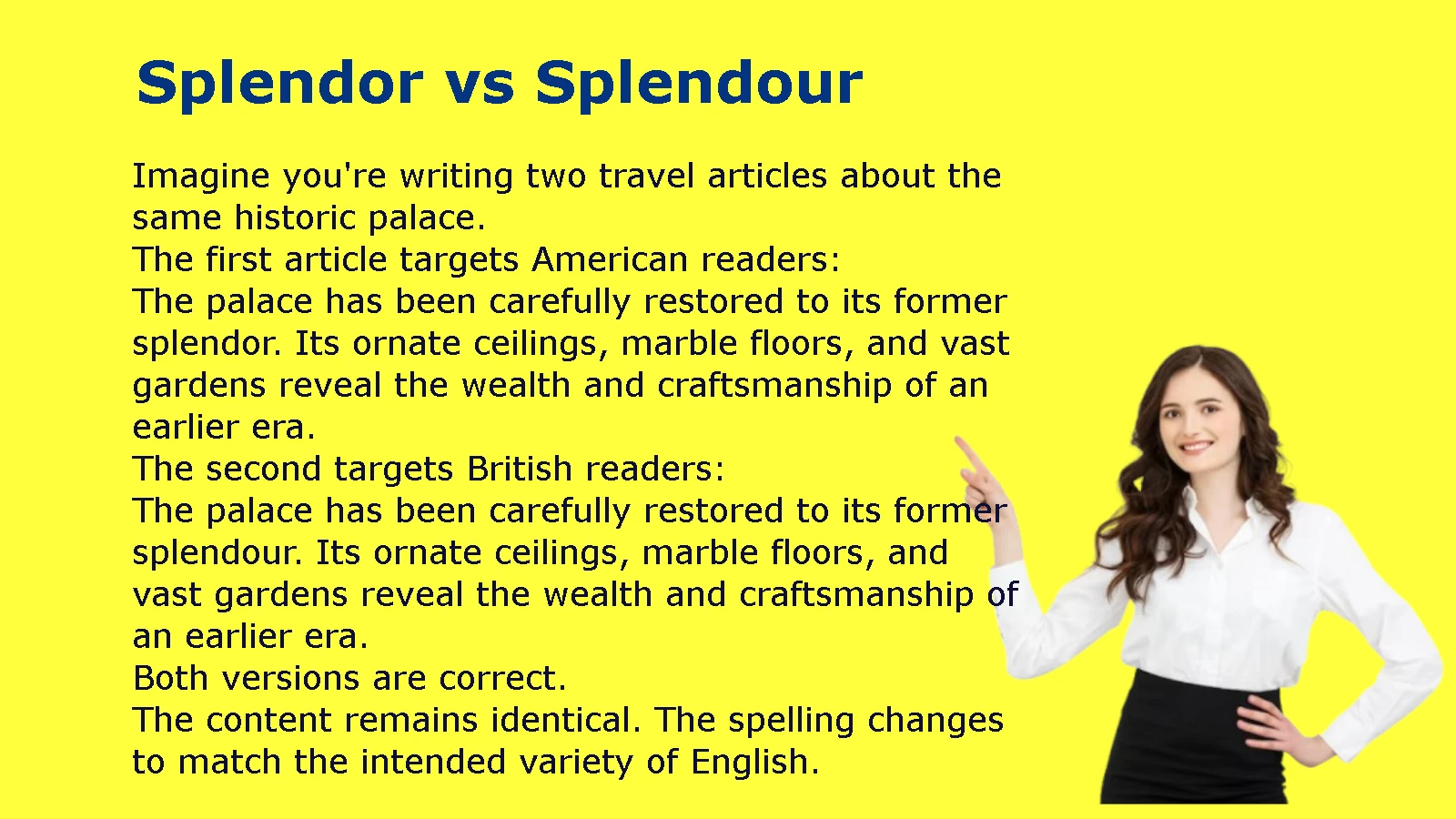
Splendor vs. Splendour: A Practical Case Study
Imagine you’re writing two travel articles about the same historic palace.
The first article targets American readers:
The palace has been carefully restored to its former splendor. Its ornate ceilings, marble floors, and vast gardens reveal the wealth and craftsmanship of an earlier era.
The second targets British readers:
The palace has been carefully restored to its former splendour. Its ornate ceilings, marble floors, and vast gardens reveal the wealth and craftsmanship of an earlier era.
Both versions are correct.
The content remains identical. The spelling changes to match the intended variety of English.
What If You Mix Them?
Suppose the article says:
The palace was restored to its former splendour. Its gardens are among the finest examples of natural splendor in the region.
A reader can understand the sentence without difficulty. Still, the mixed spelling looks inconsistent.
If the article uses American English elsewhere, choose splendor throughout.
If it uses British English, choose splendour throughout.
That’s a small editorial decision, but consistency makes polished writing feel deliberate.
Common Mistakes With Splendor and Splendour
Mistake: Treating One Spelling as Wrong
It’s incorrect to say that splendour is simply a misspelling of splendor.
Likewise, splendor isn’t an error when used in American English.
Both dictionaries and standard usage recognize the regional distinction.
Mistake: Assuming They Have Different Meanings
They don’t.
Splendor = splendour in meaning.
The spelling changes according to English variety.
Mistake: Mixing Spelling Systems
A single spelling doesn’t exist in isolation.
If you’re writing American English, you generally want a consistent set of American forms.
For example:
The color of the building added to its splendor.
British English:
The colour of the building added to its splendour.
Mixing systems isn’t always a serious error, especially in international writing, but consistency produces cleaner results.
Mistake: Using “Splendor” as an Adjective
Splendor is a noun.
You wouldn’t normally write:
The palace was splendor.
Instead, use:
The palace was splendid.
Or:
The palace displayed remarkable splendor.
The first uses an adjective. The second uses a noun.
Mistake: Assuming the Extra “U” Changes the Pronunciation Completely
It doesn’t.
The two forms have very similar pronunciations. Regional accents account for much of the audible difference. Cambridge lists separate US and UK pronunciations but treats the words as the same lexical item.
Splendor vs. Splendour: Synonyms
Because the word describes impressive beauty, grandeur, or magnificence, several related words can sometimes replace it.
Depending on context, useful alternatives include:
- grandeur
- magnificence
- majesty
- brilliance
- glory
- beauty
- elegance
- opulence
- luxury
- radiance
- luster
- glamour
However, these aren’t perfect substitutes in every sentence.
For example, radiance works particularly well when discussing light. Opulence emphasizes wealth and luxury. Grandeur focuses on impressive scale or dignity. Splendor can cover several of these ideas at once.
Merriam Webster’s thesaurus includes terms such as majesty, brilliance, glory, elegance, magnificence, and grandeur among words related to splendor.
Splendor vs. Splendour in Formal Writing
Both spellings work in formal writing as long as you choose the appropriate regional form.
The word itself often has a somewhat literary or elevated tone. You might see it in descriptions of:
- historic buildings
- royal ceremonies
- natural landscapes
- works of art
- architecture
- luxury
- historical periods
- grand celebrations
- impressive displays
For example:
The restoration preserved the architectural splendor of the nineteenth century.
That’s more formal than simply saying:
The building looks really nice.
The difference isn’t merely grammatical. Splendor carries a sense of scale and admiration.
Splendor vs. Splendour: Which Is More Correct?
Neither one is universally “more correct.”
The correct choice depends on the English variety you’re using.
Use splendor for American English
The city is famous for its architectural splendor.
Use splendour for British English
The city is famous for its architectural splendour.
If you’re unsure which one to choose, look at the spelling conventions already used in your document.
For example, if you’ve written:
- color
- center
- favorite
- honor
then splendor is the logical choice.
If you’ve written:
- colour
- centre
- favourite
- honour
then splendour fits the pattern.
Splendor vs. Splendour for Websites and SEO Content
If you’re writing online content, the target audience should guide your spelling.
Suppose a website targets readers in the United States and consistently publishes American English content. Splendor is the better choice.
If the website targets British readers, splendour is more appropriate.
Search engines can understand both forms, especially because they represent the same word. Still, your content should reflect the spelling your intended audience expects.
For example, an American article targeting the phrase “splendor vs splendour” can naturally explain both variants while using splendor throughout the surrounding American English copy.
A British publication can do the reverse.
The important thing is not to force the keyword into every sentence. Natural usage reads better and avoids the mechanical feel of keyword stuffing.
Quick Reference: Splendor vs. Splendour
| Question | Answer |
| Are splendor and splendour the same word? | Yes |
| Do they have the same meaning? | Yes |
| Which is American? | Splendor |
| Which is British? | Splendour |
| Are both spellings correct? | Yes |
| Are they both nouns? | Yes |
| Is splendors correct? | Yes, in American English |
| Is splendours correct? | Yes, in British English |
| Do they have substantially different pronunciations? | No |
| Does the extra u change the meaning? | No |
| Which should you use? | Match your audience and style guide |
Frequently Asked Questions About Splendor vs. Splendour
Is splendor or splendour correct?
Both are correct. Splendor is the standard American English spelling, while splendour is the standard British English spelling.
Does splendor mean the same as splendour?
Yes. Both mean great beauty, brilliance, magnificence, or grandeur.
The difference is spelling, not meaning.
Which spelling is American: splendor or splendour?
Splendor is the American English spelling.
For example:
The natural splendor of the park attracts visitors every year.
Which spelling is British: splendor or splendour?
Splendour is the standard British English spelling.
For example:
Visitors admired the natural splendour of the countryside.
Is splendor a noun?
Yes. Splendor is a noun.
It can describe great beauty, magnificence, brilliance, or grandeur. It can also refer to something splendid. Merriam Webster lists these senses and records splendors as the plural form.
What is the British spelling of splendor?
The British spelling is splendour.
What is the American spelling of splendour?
The American spelling is splendor.
What is the plural of splendor?
The American plural is splendors.
The British equivalent is splendours. Cambridge explicitly lists both plural forms.
Are splendor and splendour pronounced differently?
Only slightly, depending on accent.
Cambridge gives the US form as /ˈsplen.dɚ/ and the UK form as /ˈsplen.də(r)/.
The difference is mainly related to regional pronunciation rather than the spelling itself.
Is splendour old fashioned?
Not necessarily.
Splendour remains a standard British English spelling. It may sound somewhat formal or literary because the word itself often describes grandeur or magnificence, but the spelling isn’t obsolete. Oxford and Cambridge both continue to list it as the standard UK form.
Can I use splendor in British English?
Readers in Britain will understand splendor, but splendour is the conventional British spelling.
If you’re deliberately following British English, use splendour for consistency.
Can I use splendour in American English?
American readers will understand splendour, but splendor is the standard American spelling.
If you’re writing in American English, splendor is the better choice.
Is splendor related to splendid?
Yes.
Both words ultimately connect to Latin splendēre, meaning to shine. Splendid developed as an adjective, while splendor/splendour functions as a noun.
Compare:
The palace displayed remarkable splendor.
The palace looked splendid.
The words are related, but their grammatical roles differ.
Final Verdict: Splendor or Splendour?
The answer doesn’t need a coin toss.
Splendor and splendour are both correct spellings of the same word.
- Splendor = American English
- Splendour = British English
- Meaning = great beauty, brilliance, magnificence, or grandeur
- Part of speech = noun
- American plural = splendors
- British plural = splendours
So, if you’re writing for a US audience, write:
The palace has regained its former splendor.
For a British audience, write:
The palace has regained its former splendour.
Neither spelling wins the spelling bee. Audience and consistency decide the winner.