Monopolize vs Monopolise comes down to one main difference: monopolize is the standard American English spelling, while monopolise is the standard British English spelling. Both words mean to take exclusive control of something or dominate its use. You might monopolize a conversation, monopolise a company’s market, or monopolize everyone’s time during a meeting.
Understanding this spelling difference also helps explain related terms such as monopoly, market power, monopolisation, competition, and economic dominance. Although these words share the same root, they serve different purposes in everyday English, business writing, and economics. The term monopoly also appears in history and in the popular Monopoly board game, but those contexts have distinct meanings.
Monopolize vs Monopolise: What’s the Difference?
Monopolize and monopolise have the same meaning, pronunciation, and grammatical function. The difference is regional spelling. American English generally uses -ize, while British English commonly accepts -ise. Choose the form that matches your audience and use it consistently throughout your writing.
| Feature | Monopolize | Monopolise |
| Spelling convention | American English | British English |
| Meaning | To take exclusive control | To take exclusive control |
| Part of speech | Verb | Verb |
| Pronunciation | Essentially the same | Essentially the same |
| Example | He tends to monopolize meetings. | He tends to monopolise meetings. |
| Related noun | Monopoly | Monopoly |
| Common derived form | Monopolization | Monopolisation |
Both forms are correct. Neither spelling changes the meaning of the word.
Monopolize Is the American English Spelling
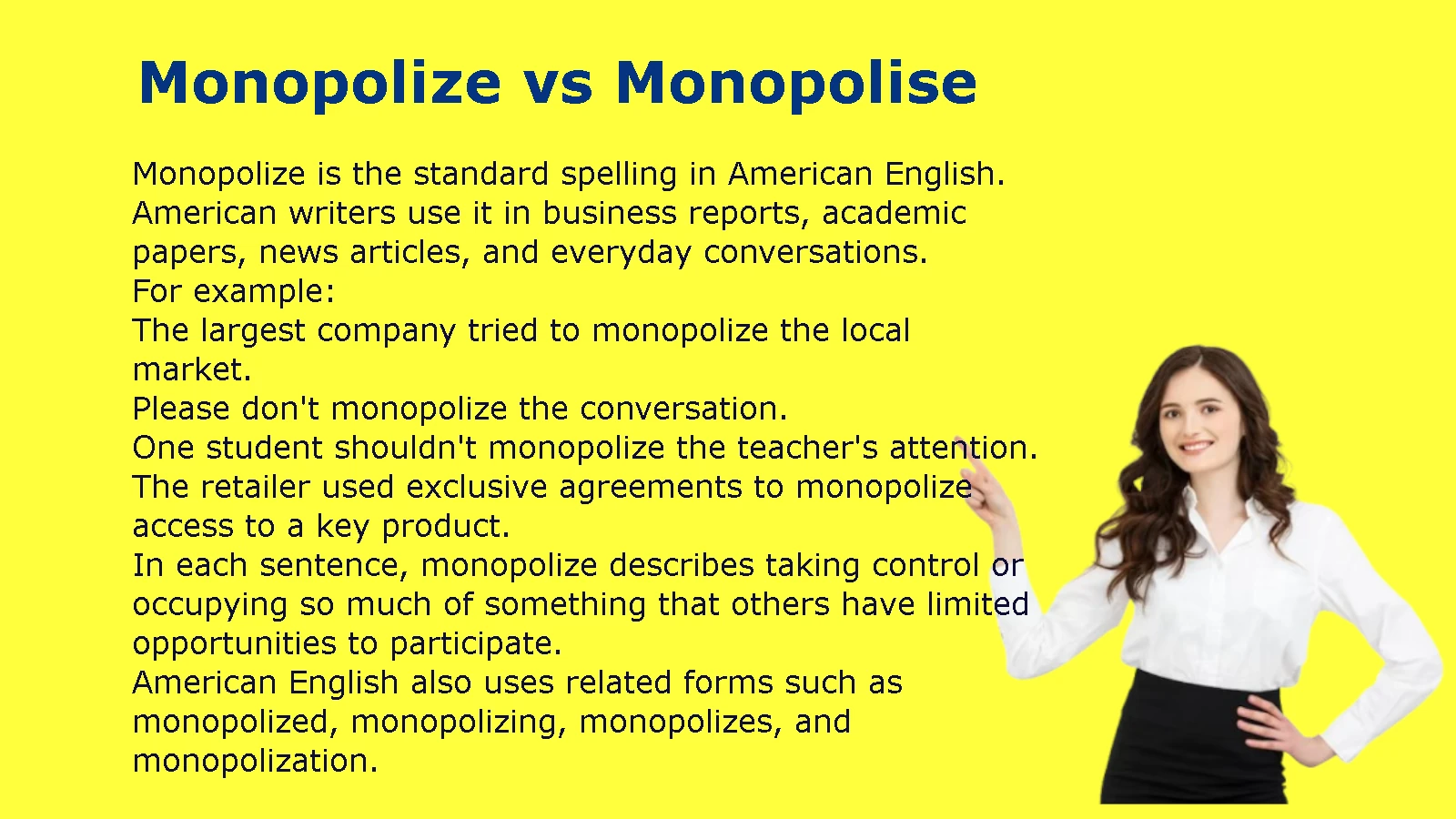
Monopolize is the standard spelling in American English. American writers use it in business reports, academic papers, news articles, and everyday conversations.
For example:
- The largest company tried to monopolize the local market.
- Please don’t monopolize the conversation.
- One student shouldn’t monopolize the teacher’s attention.
- The retailer used exclusive agreements to monopolize access to a key product.
In each sentence, monopolize describes taking control or occupying so much of something that others have limited opportunities to participate.
American English also uses related forms such as monopolized, monopolizing, monopolizes, and monopolization.
Monopolise Is the British English Spelling
Monopolise is the standard spelling commonly used in British English. It appears in writing from the United Kingdom and is also familiar in several other English-speaking regions that follow British spelling conventions.
Examples include:
- One speaker should not monopolise the discussion.
- The company attempted to monopolise the supply of raw materials.
- She tends to monopolise her friends’ time.
- The new policy aims to prevent businesses from monopolising essential services.
The meaning remains identical to the American form. Only the spelling changes.
British English commonly uses related forms such as monopolised, monopolising, monopolises, and monopolisation.
Monopolize vs Monopolise Examples
The easiest way to remember the distinction is to compare the same sentence in both spelling systems.
| American English | British English |
| He monopolizes every meeting. | He monopolises every meeting. |
| The firm monopolized the market. | The firm monopolised the market. |
| Stop monopolizing the discussion. | Stop monopolising the discussion. |
| The report examines monopolization. | The report examines monopolisation. |
| They want to monopolize the resource. | They want to monopolise the resource. |
Notice that the noun monopoly stays the same in both varieties of English. You do not write monopolye or change the spelling of the noun to match the verb.
Which Spelling Should You Use?
Choose your spelling based on the audience, publication, or style guide.
Use monopolize when writing for:
- American readers.
- US businesses and customers.
- American academic publications.
- Websites that consistently follow US English.
Use monopolise when writing for:
- British readers.
- UK businesses and customers.
- Publications that follow British spelling conventions.
- Websites that consistently use British English.
For example, an American business article might say, “The corporation tried to monopolize the supply chain.” A British article could express the same idea as, “The corporation tried to monopolise the supply chain.”
Both sentences communicate the same point. Consistency matters more than choosing one spelling as universally correct.
Monopolise Meaning and Definition
Monopolise means to take exclusive control of something or use so much of it that other people have little opportunity to participate. The word can describe a company controlling a market, a person dominating a conversation, or someone taking up a shared resource. American English spells the same verb monopolize.
The meaning depends on the context. In economics, monopolising a market involves control over commercial supply or competition. In everyday conversation, it usually means dominating an activity or taking more than a fair share.
What Does Monopolise Mean in Simple Words?
In simple terms, to monopolise something means to keep it mostly or entirely under your control.
Imagine a team meeting in which one employee speaks for 40 minutes while everyone else gets only a few seconds to contribute. You could say that the employee monopolised the meeting.
The word often suggests that the control is excessive or unfair, although the exact implication depends on the situation.
Consider these examples:
- Conversation: Mark monopolised the conversation by interrupting everyone.
- Time: My colleague monopolises the manager’s time with unnecessary questions.
- Resources: One department monopolised the conference room all afternoon.
- Business: The company tried to monopolise the market for a specialised product.
- Attention: The performer monopolised the audience’s attention.
Each example involves control over something that other people might reasonably want to use or share.
Monopolise Meaning in Everyday English
In everyday English, monopolise often describes behaviour that leaves little room for others.
Someone might monopolise a conversation by talking continuously, interrupting others, or redirecting every subject toward themselves. Another person might monopolise a shared workspace by occupying it for hours without allowing colleagues to use it.
The word can carry a negative tone because it suggests an imbalance.
For instance, compare these sentences:
- “Sarah led the discussion.”
- “Sarah monopolised the discussion.”
The first sentence describes leadership. The second suggests that Sarah dominated the discussion and prevented other people from contributing freely.
That distinction matters. Leading an activity does not automatically mean monopolising it. A person can guide a conversation while still making room for different opinions.
Monopolise Meaning in Business and Economics
In business, to monopolise a market means to gain or maintain unusually strong control over the supply of a product or service. In the strict economic sense, a monopoly exists when one supplier dominates a properly defined market and faces little effective competition from close substitutes.
However, people sometimes use monopolise more loosely to describe a company that holds a large market share.
For example, imagine a town with three grocery stores. One store attracts 60% of customers because it offers lower prices and better service. That business dominates the local market, but it does not necessarily have a monopoly because two competitors remain.
Now imagine a remote community with only one practical water-distribution network. If building a competing network would be prohibitively expensive, the provider may occupy a natural-monopoly position.
These examples show why market dominance and monopoly are not always interchangeable. The definition depends on competition, available substitutes, entry barriers, and the relevant market.
Monopolise in a Sentence
Here are original examples showing how the verb works in different contexts.
| Example sentence | Meaning |
| David monopolised the meeting with a lengthy presentation. | David took up too much of the meeting’s time. |
| The supplier attempted to monopolise access to the raw material. | The supplier tried to control access to the resource. |
| Don’t monopolise the television remote. | Let other people use the shared item. |
| The firm was accused of trying to monopolise distribution. | The firm allegedly tried to restrict competition or control supply. |
| She monopolises every conversation about travel. | She dominates those conversations. |
Grammar tip: Monopolise is a transitive verb, so it commonly takes an object.
For example, in “The company monopolised the market,” the company is the subject, monopolised is the verb, and the market is the object.
Monopolise Synonyms and Antonyms
Common synonyms for monopolise include dominate, control, corner, command, occupy, and hog. However, these words are not identical. Dominate can describe strong influence without exclusive control, while hog usually suggests selfish behaviour. Choose a synonym based on whether you mean economic control, social dominance, or excessive use of a shared resource.
Common Synonyms for Monopolise
The following words can replace monopolise in suitable contexts.
| Synonym | Meaning | Example |
| Dominate | Have a strong influence or leading position | One brand dominates the local market. |
| Control | Direct or determine how something operates | The firm controls access to the facility. |
| Corner | Gain control of most or all available supply | The trader tried to corner the market. |
| Command | Have authority or influence over something | The company commands a large share of the market. |
| Occupy | Take up space, time, or attention | The presentation occupied the entire afternoon. |
| Hog | Take more than a fair share | Don’t hog the microphone. |
| Take over | Assume control of an activity or organisation | One team took over the project. |
| Exclusively control | Prevent others from having comparable access | One provider exclusively controls the network. |
The best choice depends on your intended meaning.
Use dominate when you mean that someone or something has a strong influence. Choose control when the ability to direct an activity matters. Use corner when someone gains control over a large part of a supply, particularly in a market context.
For casual conversation, hog often sounds more natural than monopolise. You might say, “He’s hogging the conversation,” rather than “He’s monopolising the conversation.”
How to Choose the Right Monopolise Synonym
Consider the following situations.
When describing a conversation: Use dominate, take over, or hog.
- Natural: “He dominated the discussion.”
- Informal: “He hogged the microphone.”
- More formal: “He monopolised the discussion.”
When describing a business: Use control, dominate, or corner, depending on the facts.
- “The company controls the distribution network.”
- “The brand dominates its market segment.”
- “The trader attempted to corner the market.”
These sentences describe different degrees and types of control. A dominant brand may still face substantial competition, while cornering a market suggests an attempt to control available supply.
When describing time or attention: Use occupy, take up, or dominate.
For example, “The presentation took up most of the afternoon” sounds neutral. “The presentation monopolised the afternoon” more strongly suggests that it left little room for anything else.
Antonyms of Monopolise
Antonyms express the opposite idea: sharing, distributing, releasing control, or making something available to others.
| Antonym or opposite expression | Example |
| Share | The team shared the available resources. |
| Distribute | The organisation distributed supplies fairly. |
| Release | The company released access to the previously restricted resource. |
| Yield | She yielded the floor to another speaker. |
| Open up | The policy opened up the market to new competitors. |
| Give access to | The administrator gave access to all team members. |
There is no single antonym that works in every context. Share is a useful everyday opposite, while open up competition is more suitable for an economic discussion.
Monopolise vs. Dominate vs. Control
These words overlap, but they differ in emphasis.
| Word | Main emphasis | Does it imply exclusive control? |
| Monopolise | Taking control or leaving little room for others | Often suggests it |
| Dominate | Having the strongest influence or position | No |
| Control | Having the power to direct or regulate something | Not necessarily |
| Corner | Gaining control of most available supply | Usually suggests extensive control |
| Hog | Taking more than a fair share | Often implies selfishness |
For example, a company can dominate a market because customers prefer its products. That does not automatically mean the company has monopolised the market.
Likewise, a manager can control a project without monopolising every decision. The first statement describes authority, while the second suggests that the manager prevents others from participating.
What Is a Monopoly in Economics?
A monopoly in economics is a market structure in which a single supplier has substantial control over a relevant market and faces little effective competition from close substitutes. Monopolies can arise from high entry costs, exclusive rights, control of essential resources, or strong network effects. Their market power may affect prices, output, innovation, and consumer choice.
Definition of a Monopoly in Economics
A monopoly exists when one seller supplies a market with no close competitors capable of placing substantial competitive pressure on it.
Economists examine the relevant market before classifying a business as a monopolist. A company might be the only seller of one specialised product but still face competition from alternative products that satisfy the same customer needs.
For example, a company might be the only producer of a particular type of industrial component. However, if manufacturers can easily replace that component with another material, the company’s effective market power may be limited.
A monopoly generally has greater pricing power than a business operating in a competitive market. Yet that power is not unlimited. Customers may reduce purchases, seek substitutes, or delay buying if the price becomes too high.
Key Characteristics of a Monopoly
Economists typically examine several features when assessing a possible monopoly.
One dominant supplier: A single firm supplies the relevant market or holds a position that leaves it without meaningful direct competition.
High barriers to entry: Potential competitors face obstacles such as enormous startup costs, legal restrictions, patents, control of infrastructure, or strong network effects.
Limited substitutes: Customers cannot easily switch to another product or service that meets the same need.
Pricing power: The supplier has some ability to influence prices because customers have few practical alternatives.
Potentially restricted output: A profit-maximising monopolist may supply less than a competitive market would under comparable conditions.
These characteristics work together. A large company does not automatically qualify as a monopoly simply because it sells more than its competitors.
How Does a Monopoly Set Prices?
A monopolist faces the market demand curve, which shows how much customers will buy at different prices. To sell more units, the business generally needs to lower its price. That relationship influences its output and profit decisions.
In the standard economic model, a profit-maximising monopolist chooses output where marginal revenue equals marginal cost. It then uses the demand curve to determine the price customers will pay for that output.
<LearningViz type_id=”MONOPOLY_PRICING”/>
This differs from the simplest model of perfect competition, where an individual firm takes the market price as given.
Imagine a company selling a specialised machine. If it raises the price too far, customers may postpone purchases or adopt a substitute. If it lowers the price, it may sell more units but earn less on each unit. The firm must weigh these effects against its costs.
A monopoly therefore does not mean a business can charge any price it wants. Its pricing power depends on customer demand, substitutes, costs, regulation, and potential competition.
Monopoly vs. Perfect Competition
Monopoly and perfect competition represent two different market structures.
| Feature | Monopoly | Perfect competition |
| Number of suppliers | One dominant supplier in the model | Many buyers and sellers |
| Pricing power | Substantial in the standard model | Individual firms have little pricing power |
| Entry barriers | Often high | Low or absent in the idealised model |
| Product substitutes | Few close substitutes | Products are treated as identical |
| Output | May be lower than the efficient benchmark | Efficient output under standard assumptions |
| Long-run economic profit | Possible when barriers protect market power | Driven toward zero in the basic model |
| Consumer choice | May be limited | Many suppliers are available |
Real markets rarely match either textbook model perfectly. Economists use these models to understand how market structure can affect prices, production, innovation, and welfare.
A monopoly may benefit from economies of scale, but its market power can also reduce output or weaken incentives to improve products. The result depends on the industry and the conditions under which the firm operates.
Are All Monopolies Illegal?
No. A monopoly is not automatically illegal simply because one business controls a market. Competition laws generally focus on specific conduct, such as unlawful exclusion of rivals, certain anti-competitive agreements, or abuse of a dominant position. The rules vary by jurisdiction.
A company might become dominant because it develops a superior product or operates more efficiently than competitors. That outcome is different from using exclusionary practices to prevent rivals from competing.
For example, a business might hold a temporary advantage because it owns a valid patent. Another company might face scrutiny if it uses restrictive contracts or other unlawful methods to block competition.
To evaluate a real case, examine:
- The relevant product and geographic market.
- The availability of close substitutes.
- The company’s market position.
- Barriers that prevent new competitors from entering.
- The specific conduct under investigation.
- The applicable competition laws.
Market share can help describe a firm’s position, but it does not settle every legal or economic question.
What Is a Monopoly in Business?
A monopoly in business occurs when one company has substantial control over a defined market and faces little effective competition. The company may benefit from economies of scale, exclusive rights, control of essential infrastructure, or strong network effects. However, a large market share alone does not prove that a business has a monopoly.
How a Business Becomes a Monopoly
Businesses can acquire market power in several ways. Understanding the source of that power helps explain why some monopolies develop naturally while others raise competition concerns.
Economies of scale: A business may serve customers at a lower average cost as production expands. In industries with expensive infrastructure, one large provider may be more practical than several competing networks.
Patents and exclusive rights: Legal protection can give a business temporary exclusive rights to certain inventions or activities. Such rights can encourage innovation, although their scope and duration matter.
Network effects: A service may become more valuable as more people use it. A communication platform, for example, becomes more useful when a customer’s contacts already use the same service.
Control of essential resources: A company that controls a scarce input may make it difficult for rivals to compete.
Mergers and acquisitions: Buying competitors can reduce competition, although the legal and economic effects depend on the market and the transaction.
Government-granted exclusivity: A public authority may grant a company exclusive rights to provide a service in a defined area.
These mechanisms do not all have the same consequences. A patent can support research and development, while exclusionary conduct may prevent competitors from offering better alternatives.
Types of Business Monopolies
| Type | Explanation | Illustrative example |
| Natural monopoly | One network may serve a market more efficiently because fixed infrastructure costs are high | A local water-distribution network |
| Legal monopoly | Law grants specific exclusive rights | A patented invention within the patent’s scope |
| Technological monopoly | A firm gains a strong advantage from proprietary technology or technical expertise | A specialised system with difficult-to-replicate capabilities |
| Geographic monopoly | A provider faces little competition in a defined location | The only practical supplier of a service in a remote area |
| Resource-based monopoly | One firm controls a critical input that rivals cannot readily obtain | Exclusive control of a scarce industrial resource |
These categories can overlap. A utility may be a natural monopoly and operate under a government-granted service arrangement. A technology business may enjoy strong network effects without having a legally recognised monopoly.
The examples are illustrative, not automatic classifications. Actual market conditions determine whether a business has monopoly power.
Advantages and Disadvantages of a Monopoly
Monopolies can create benefits in some circumstances, but concentrated market power can also create problems.
| Potential advantages | Potential disadvantages |
| Economies of scale may lower average costs | Consumers may face higher prices |
| Large profits may support investment | Reduced competition may weaken innovation incentives |
| One infrastructure network may avoid wasteful duplication | Customers may have fewer alternatives |
| Stable revenue may support long-term planning | Poor service may persist when customers cannot switch |
| A patent can reward research and development | Exclusive control may restrict market entry |
Consider a water network serving a small town. Building three separate pipe systems would probably cost more than maintaining one network. A single provider may therefore offer practical efficiency benefits.
However, residents still need reliable service and fair pricing. Regulation may help protect customers when ordinary market competition cannot effectively discipline the provider.
Monopoly vs. Oligopoly vs. Monopolistic Competition
A monopoly is only one possible market structure.
| Market structure | Number of firms | Main characteristic | Example category |
| Monopoly | One dominant supplier in the model | Limited effective competition | A protected local utility market |
| Oligopoly | A few major firms | Each firm’s decisions affect its rivals | An industry dominated by a small number of airlines |
| Monopolistic competition | Many firms | Products differ by brand, features, or service | Restaurants in a large city |
| Perfect competition | Many small firms in the idealised model | Firms have little individual pricing power | A textbook agricultural market |
An oligopoly can exist even when several companies compete actively. Monopolistic competition also differs from monopoly because consumers have multiple alternatives, although businesses may distinguish their products.
When analysing a company, ask whether customers can switch, whether rivals can enter, and how much influence the company has over prices. These questions are more useful than relying on the word monopoly alone.
Monopoly Examples in Real Life
Monopoly examples include markets where one supplier controls an essential network, historical trading arrangements that granted exclusive rights, and everyday situations where someone takes over a shared resource. The term should be applied carefully: a company with a large market share or a leading brand is not automatically a monopoly.
Historical Monopoly Examples
Historical monopolies show how exclusive control can develop through government privileges, resource ownership, and industrial consolidation.
The British East India Company
The British East India Company received a royal charter in 1600 that granted it trading privileges in parts of Asia. Over time, it developed extensive commercial and political power in India.
Its history illustrates how government-granted privileges can support concentrated economic power. It also shows that historical monopolies sometimes extended beyond ordinary commerce into territorial rule and political authority.
Standard Oil
Standard Oil became a major force in the American petroleum industry during the late 19th century. Its expansion involved consolidation, control over parts of the supply chain, and business practices that attracted antitrust scrutiny.
In 1911, the US Supreme Court ordered the company to be broken up under antitrust law. The case remains an important historical example of how governments may respond to the concentration of market power.
These examples arose in different economic and political settings. They should not be treated as identical business models, but both demonstrate how concentrated control can shape markets and public policy.
Modern Monopoly and Market-Dominance Examples
Modern examples require more care because companies operate across overlapping markets and compete with different kinds of substitutes.
Local water distribution: A town may have one practical water network because duplicating underground pipes would be expensive. This can create a natural monopoly, although the provider’s legal and regulatory status depends on the jurisdiction.
Rail infrastructure: A particular railway line or station may be controlled by one infrastructure operator. That does not necessarily mean the operator controls every form of passenger or freight transport.
Digital platforms: A platform may become difficult to challenge because users attract other users, businesses depend on its reach, or switching costs are high. However, a large user base does not by itself establish a monopoly.
Patented products: A patent can temporarily prevent competitors from making or selling a protected invention within its legal scope. That exclusivity does not necessarily establish a monopoly over the wider market if alternative products exist.
The key lesson is that market definition matters. A business may control one narrow market while facing significant competition in a broader one.
Everyday Examples of Monopolising Something
The verb monopolise also works outside economics.
Imagine three situations:
- At work: One employee answers every question and prevents colleagues from sharing ideas.
- At home: One family member occupies the television for the entire evening.
- At school: A student takes all the available equipment during a group activity.
In each case, one person takes up a disproportionate share of a resource, time, or attention.
These examples help explain the emotional tone of the word. Calling someone’s behaviour monopolising often suggests that they should leave more room for others.
How to Identify a Monopoly Example
Use this practical framework when evaluating a business or market.
Define the market. Identify the product or service and the geographic area. A company may have few competitors in one town but many in the wider region.
Check for substitutes. Determine whether customers can switch to alternative products or providers without significant cost or inconvenience.
Assess entry barriers. Consider infrastructure costs, legal restrictions, patents, network effects, and control of important resources.
Examine pricing power. Ask whether the business can raise prices without losing enough customers to make the increase unprofitable.
Consider regulation and conduct. Determine whether the business operates under exclusive rights, public oversight, or competition-law restrictions.
This framework prevents a common mistake: labelling every successful or powerful business a monopoly.
Monopoly in History
Monopolies have shaped trade, industry, and government policy for centuries. Rulers and governments have granted exclusive trading rights, while industrial companies have gained market power through consolidation, infrastructure, and control of supply chains. Modern competition policy developed partly in response to concerns about how concentrated economic power affects consumers and rivals.
Early Trading Monopolies
Governments historically granted merchants exclusive rights to trade particular goods or operate in specific regions. These arrangements could help finance exploration, secure trade routes, and support state revenue.
However, exclusive trading rights also limited access for competing merchants. In colonial settings, powerful trading companies sometimes combined commercial privileges with political and military authority.
The British East India Company illustrates this overlap between commerce and government. Its chartered privileges helped it establish a powerful position in Asian trade, while its later political role made its influence much broader than that of a typical private company.
Historical monopolies therefore cannot be understood through price and competition alone. Government authority, colonial expansion, taxation, and control of territory often played major roles.
Industrial Monopolies in the 19th and 20th Centuries
Industrialisation created new opportunities for businesses to consolidate production and distribution. Railways, petroleum, steel, and other capital-intensive industries often required substantial investment.
Large companies could lower costs by coordinating production, purchasing, transport, and distribution. Yet the same advantages could make it harder for smaller rivals to survive.
In the United States, the Sherman Antitrust Act of 1890 established a major federal framework against certain restraints of trade and monopolisation. Later enforcement and court decisions helped shape how the country addresses anti-competitive conduct.
Standard Oil became a prominent example of this era. Its breakup in 1911 demonstrated that industrial scale and efficiency did not place a company beyond antitrust scrutiny.
How Monopoly Regulation Has Changed
Modern competition policy focuses on market structure as well as business conduct.
Authorities may examine whether a merger would substantially reduce competition, whether a dominant business unlawfully excludes rivals, or whether an agreement restricts market access.
Digital markets create additional questions. A platform may offer a service at no monetary price while collecting revenue through advertising, subscriptions, or business fees. Analysts may therefore examine data access, switching costs, network effects, and control over distribution in addition to consumer prices.
Competition rules differ between countries. A practice that raises concerns in one jurisdiction may be assessed under different legal standards elsewhere.
The historical pattern remains clear: governments have repeatedly tried to balance the benefits of large-scale business with the risks of concentrated market power.
What Does Monopoly Mean in the Board Game?
Monopoly is a property-trading board game in which players buy properties, collect rent, develop their holdings, and try to leave their opponents financially unable to continue. Its name comes from the economic concept of monopoly, where control over a market can limit competition. The game uses simplified property rules rather than modelling a complete economy.
What Is the Monopoly Board Game?
In the Monopoly board game, players move around a board, purchase available properties, and collect rent when opponents land on their holdings.
Players can improve eligible properties by building houses and hotels. Owning a complete colour group generally creates opportunities to develop those properties and increase the rent charged under the game’s rules.
The main objective is to outlast opponents financially. Players try to build valuable property portfolios while managing cash, rent obligations, and other expenses.
The game turns property ownership into a competitive strategy. A player may own many properties but still run out of cash, while another player may hold a smaller portfolio that produces enough rent to remain financially secure.
Why Is the Game Called Monopoly?
The name refers to the economic idea of gaining control over property or commercial opportunities.
In the game, players compete to acquire properties and build collections that give them greater earning power. When one player controls a complete colour group and develops it, opponents may face higher rent costs.
That mechanic resembles the broader idea of concentrated ownership, but the comparison has limits. The board game uses fixed rules, a limited property set, and a simplified financial system.
In a real economy, firms compete across changing markets, customers can sometimes switch products, governments can regulate businesses, and innovation can create new alternatives. Monopoly is a useful illustration of concentrated control, not a complete economic simulation.
Monopoly Game vs. Monopoly in Economics
| Feature | Monopoly board game | Monopoly in economics |
| Main setting | A fixed game board | A real or theoretical market |
| What players or firms control | Properties and colour groups | Supply of a product or service |
| How money is earned | Rent and other game transactions | Sales revenue and other business income |
| Competition | Players compete within fixed rules | Firms face market, technological, and regulatory conditions |
| How control develops | Buying properties and building developments | Barriers to entry, exclusive rights, resources, and other factors |
| Outcome | Usually one financially surviving player | Outcomes vary; a firm can remain dominant for years |
Owning several properties in Monopoly does not automatically represent an economic monopoly. The game’s purpose is to create a competitive property-trading experience, while economics studies how market structures affect production, pricing, and welfare.
Common Mistakes When Using Monopolize and Monopolise
The most common mistakes involve mixing up the verb and noun, switching between regional spellings, and using monopolise when a less forceful word would communicate the intended meaning more accurately.
Confusing Monopolize With Monopoly
Monopolize is a verb. Monopoly is a noun.
Compare the following sentences:
- Correct: The company wants to monopolize the market.
- Correct: The company wants to establish a monopoly.
- Incorrect: The company wants to monopoly the market.
The verb describes the action. The noun describes the market position or situation.
You can also use monopolistic as an adjective when describing something related to monopoly power. For example, “The researchers studied monopolistic pricing.”
Mixing American and British Spelling
Writers sometimes use monopolize in one paragraph and monopolise in the next. Although readers will understand both, inconsistent spelling can make an article look poorly edited.
Use the spelling that matches your intended audience:
- American English: monopolize, monopolized, monopolizing, monopolization.
- British English: monopolise, monopolised, monopolising, monopolisation.
The same general distinction appears in words such as organize/organise and realize/realise. Some British style guides also accept -ize forms, so follow the publication’s actual spelling policy rather than assuming every British publication uses -ise.
Using Monopolize When Dominate Is More Accurate
The words monopolize and dominate overlap, but they do not always mean the same thing.
Suppose a company sells 45% of the products in a market while several strong competitors sell the rest. Saying that the company dominates the market may be reasonable if it leads in sales or influence. Saying that it monopolises the market could overstate its control.
Likewise, a manager who leads most meetings may dominate discussions without completely preventing other people from contributing.
Use monopolise when you want to emphasise exclusive or disproportionate control. Choose dominate when you mean strong influence or a leading position.
Monopolize vs Monopolise: Quick Grammar Guide
The verb follows ordinary English conjugation patterns.
| Grammatical form | American English | British English |
| Base form | Monopolize | Monopolise |
| Third-person singular | Monopolizes | Monopolises |
| Past tense | Monopolized | Monopolised |
| Present participle | Monopolizing | Monopolising |
| Noun | Monopolization | Monopolisation |
| Person or company performing the action | Monopolizer | Monopoliser |
Examples:
- Present: The retailer monopolizes the local market.
- Past: The retailer monopolized the local market.
- Continuous: The retailer is monopolizing the local market.
- Noun: The investigation examined possible monopolization.
- British form: The investigation examined possible monopolisation.
When using these words in an article, keep the regional spelling consistent across the main text, headings, image descriptions, and other editorial content where practical.
Frequently Asked Questions
Is It Monopolize or Monopolise?
Both spellings are correct. Monopolize is the standard American English spelling, while monopolise is the standard British English spelling. Both mean to take exclusive control of something or dominate its use.
What Does Monopolise Mean in Simple Words?
Monopolise means to take control of something or use so much of it that others have little opportunity to participate. It can describe a person dominating a conversation or a business controlling access to a market.
What Is a Synonym for Monopolise?
Common synonyms include dominate, control, corner, occupy, and hog. The best choice depends on context. Use dominate for strong influence, control for the power to direct something, and hog for informally describing someone who takes more than a fair share.
What Is a Monopoly in Economics?
A monopoly is a market structure in which one supplier has substantial control over a defined market and faces little effective competition from close substitutes. High entry barriers and limited alternatives often help maintain that position.
What Is an Example of a Monopoly?
A local water-distribution network may be a natural monopoly when the high cost of building duplicate infrastructure makes competing networks impractical. Whether a particular provider qualifies depends on the market, available alternatives, and regulatory conditions.
Is the Monopoly Game Based on the Economic Concept?
Yes. The board game’s property ownership and rent collection reflect the idea of concentrated control over economic resources. However, its rules simplify real-world markets and do not represent every feature of monopoly economics.
Conclusion: Choose the Right Spelling and Meaning
Monopolize and monopolise mean the same thing; the main difference is regional spelling. Use monopolize for standard American English and monopolise for standard British English, while keeping your spelling consistent throughout your writing.
The related noun monopoly describes a market structure in which one supplier has substantial control and faces little effective competition. In everyday English, the verb can also describe someone taking over a conversation, dominating a meeting, or using too much of a shared resource. The Monopoly board game draws on the idea of concentrated property ownership but uses its own simplified rules.
When writing about the topic, start by identifying your intended meaning. Choose a synonym that matches the context, distinguish market dominance from a true monopoly, and avoid treating every successful company as a monopolist.