Likable and likeable are both correct spellings of the same word. The main difference is regional: likable is the preferred spelling in American English, while likeable is more common in British English. Both forms mean pleasant, friendly, or easy to like.
The spelling choice follows a broader pattern in English grammar involving the suffix -able, silent letters, and regional spelling conventions. Understanding the difference between American and British English, learning the definition of likable, and comparing related words such as lovable and moveable can help you choose the right spelling for your writing.
Likable vs. Likeable: The Quick Answer
Use likable when writing for an American audience and likeable when writing for a British audience. Neither spelling is inherently wrong, and both have the same meaning and pronunciation.
Here is the basic rule:
- Likable: Preferred in American English, particularly in US publications and formal writing.
- Likeable: Preferred in British English and widely used in Commonwealth English.
- Meaning: Pleasant, appealing, friendly, or easy to like.
- Part of speech: Adjective.
- Pronunciation: Both spellings are pronounced the same way in ordinary speech.
For example:
- American English: The new manager has a likable personality.
- British English: The new manager has a likeable personality.
Both sentences are grammatically correct. The spelling changes, but the meaning does not.
If you are writing an article for an American website, choose likable. For a British publication, likeable is usually the better choice. When writing for an international audience, follow the spelling convention used throughout the rest of your document.
Regional Differences: Likable vs. Likeable in US and UK English
The difference between likable and likeable reflects a common variation between American and British spelling. Although English speakers in both regions understand the two forms, their preferred spellings differ.
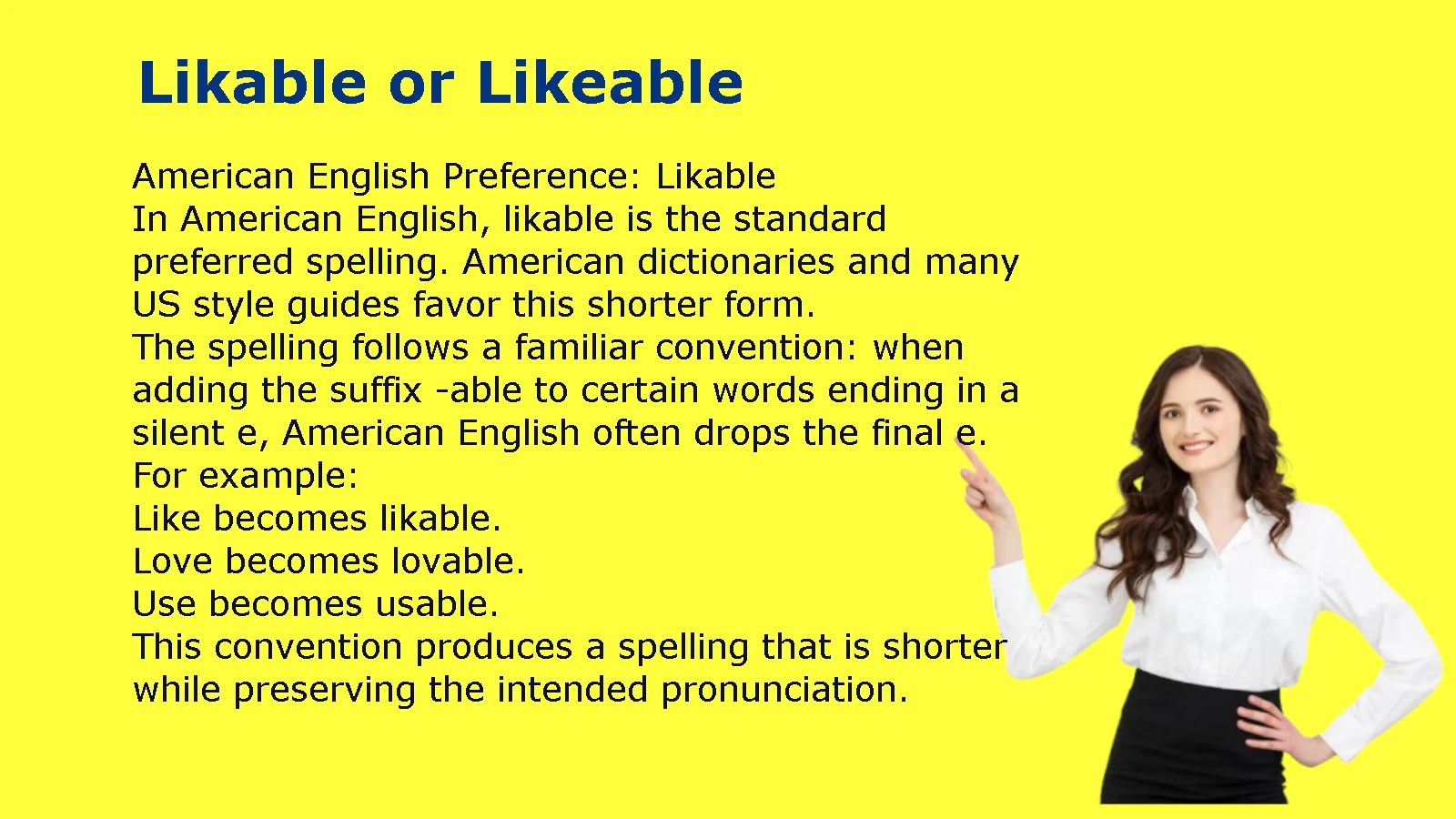
American English Preference: Likable
In American English, likable is the standard preferred spelling. American dictionaries and many US style guides favor this shorter form.
The spelling follows a familiar convention: when adding the suffix -able to certain words ending in a silent e, American English often drops the final e.
For example:
- Like becomes likable.
- Love becomes lovable.
- Use becomes usable.
This convention produces a spelling that is shorter while preserving the intended pronunciation.
Example sentences in American English:
- Everyone on the team considers Maya a likable person.
- The main character is funny, honest, and surprisingly likable.
- His likable personality helped him build strong relationships with customers.
- The candidate came across as confident and likable during the interview.
In each sentence, likable describes a person or character who attracts positive feelings from others.
Although likeable is recognizable and acceptable in American English, likable is generally the safer choice for US-focused content.
British English Preference: Likeable
In British English, likeable is a widely preferred spelling. The word retains the final e from like before adding -able.
British English often preserves this letter in words where American English tends to remove it. However, the difference is not universal, and British spelling conventions do not require keeping every silent e before every suffix.
For example:
- Like becomes likeable.
- Live becomes liveable in British usage, although livable is also understood.
- Size becomes sizeable in a spelling convention that preserves the e.
Example sentences in British English:
- She is a warm and likeable colleague.
- The author created a thoroughly likeable character.
- Despite his nervousness, he came across as quite likeable.
- The new teacher is approachable, patient, and likeable.
The spelling likeable is also common in other varieties of English, including Australian and New Zealand English. Canadian English uses both forms, so the preferred choice can depend on the publication or style guide.
Likable vs. Likeable: Regional Spelling Comparison
| Country or region | Common spelling preference | Example |
| United States | Likable | She has a very likable personality. |
| United Kingdom | Likeable | He is a thoroughly likeable character. |
| Canada | Both; check the style guide | The new teacher seems quite likeable. |
| Australia | Likeable is common | Our new neighbor is very likeable. |
| New Zealand | Likeable is common | The main character is instantly likeable. |
| International English | Depends on the audience | Choose one form and use it consistently. |
These are general preferences rather than absolute rules for every publication. Canadian English, in particular, combines American and British spelling conventions.
The easiest rule to remember is simple: use likable for American English and likeable for British English.
The Grammar Rule Behind Likable and Likeable
The difference between likable and likeable becomes easier to understand when you examine the word’s structure.
The adjective consists of the base word like and the suffix -able. The suffix creates adjectives that describe something or someone capable of receiving a particular action or possessing a particular quality.
In this case, likable or likeable describes someone who is easy to like.
What Happens When You Add the Suffix -Able?
The suffix -able often means “capable of being” or “worthy of being.”
Consider these examples:
- Read + -able = readable, meaning easy to read.
- Understand + -able = understandable, meaning possible to understand.
- Enjoy + -able = enjoyable, meaning pleasant to experience.
- Like + -able = likable or likeable, meaning easy to like.
When the base word ends in a silent e, the spelling may change as the suffix is added.
American English often drops the final e when the resulting spelling remains clear and the pronunciation stays correct. British English sometimes retains it.
This is a spelling convention, not a change in the word’s grammatical function. Both likable and likeable remain adjectives.
Why Does American English Drop the E?
American English frequently removes a silent final e before a suffix that begins with a vowel. This practice can simplify spelling without changing the pronunciation.
For example:
| Base word | Common American spelling | Meaning |
| Like | Likable | Easy to like |
| Love | Lovable | Inspiring affection |
| Use | Usable | Suitable for use |
| Live | Livable | Suitable for living |
| Value | Valuable | Worth a great deal |
However, this pattern is not automatic. Some words retain the e because removing it could change pronunciation or make the spelling less clear.
For instance, noticeable retains the e in notice to preserve the soft sound of c. Similarly, changeable retains the e to preserve the soft sound of g.
These examples illustrate why you should treat the rule as a useful spelling pattern rather than an exception-free formula.
Why Does British English Keep the E?
British English sometimes preserves the silent e before -able, particularly in words where the longer spelling remains familiar and established.
Examples include:
- Likeable
- Liveable
- Sizeable
- Saleable
Nevertheless, British English also drops the e in many words, such as lovable and usable. Therefore, the distinction between American and British spelling is based on established word usage, not a rule that one variety always removes the letter while the other always keeps it.
Is the Final E Necessary for Correct Pronunciation?
No. The final e in likeable does not represent an additional spoken syllable.
Both spellings have the same pronunciation. The e is a spelling difference, not a sound difference.
Compare the following forms:
| Spelling | Syllables | Part of speech |
| Likable | Three | Adjective |
| Likeable | Three | Adjective |
| Likability | Four | Noun |
| Likeability | Four | Noun |
Both forms of the adjective follow the same basic pronunciation pattern. The related nouns, likability and likeability, also differ mainly by spelling convention.
Likable Definition: What Does Likable Mean?
Likable means pleasant, appealing, friendly, or easy to like. It describes a person, character, or sometimes a thing that creates a favorable impression.
The word usually expresses a positive quality. A likable person may be kind, approachable, humorous, considerate, or easy to spend time with.
However, being likable does not mean being perfect. A character can make mistakes, have weaknesses, and still be likable because readers understand or sympathize with that character.
Likable as an Adjective
An adjective describes a person, place, thing, or idea. Likable performs this function by identifying a quality that makes someone or something appealing.
For example:
- Jordan is a likable teammate who always encourages others.
- The movie features a likable hero with believable flaws.
- Her friendly attitude makes her instantly likable.
- The product has a simple design and a likable appearance.
In these examples, the adjective describes a favorable impression rather than a measurable physical feature.
What Makes a Person Likable?
People may find someone likable for several reasons. The exact qualities depend on the situation, culture, and individual preferences.
Common characteristics include:
- Kindness: Treating people with care and consideration.
- Approachability: Making others feel comfortable starting a conversation.
- Humor: Helping people relax through appropriate jokes or lighthearted comments.
- Honesty: Communicating openly without being unnecessarily harsh.
- Empathy: Recognizing and respecting other people’s feelings.
- Reliability: Following through on promises and responsibilities.
- Humility: Acknowledging mistakes and appreciating other people’s contributions.
A likable person does not need to possess every one of these traits. Often, a few genuine qualities make a stronger impression than an attempt to please everyone.
For example, a quiet coworker who listens carefully and helps others solve problems may be just as likable as an outgoing colleague who makes everyone laugh.
Likable vs. Popular: What Is the Difference?
Likable and popular are related, but they do not mean exactly the same thing.
Someone is likable when others find that person pleasant or appealing. Someone is popular when many people know, admire, support, or associate with that person.
| Word | Meaning | Example |
| Likable | Easy to like | Priya is a likable coworker who listens carefully. |
| Popular | Liked or known by many people | Priya is popular throughout the company. |
| Friendly | Kind and approachable | Priya is friendly to new employees. |
| Charming | Pleasant in an engaging or attractive way | Priya has a charming sense of humor. |
| Respectable | Deserving respect | Priya is a respectable leader. |
A person can be likable without being popular. For example, a new employee may have a warm personality but know only a few coworkers.
Likewise, a popular person may not be equally likable to everyone. Popularity can depend on status, visibility, achievement, or social influence.
Likable Synonyms and Related Words
Several words share a meaning with likable, but each carries a slightly different tone or emphasis.
Choosing the right synonym can make your writing more precise and less repetitive.
Common Synonyms for Likable
| Synonym | Meaning | Example sentence |
| Amiable | Friendly and pleasant | Our amiable host welcomed every guest. |
| Affable | Easy to talk to and approachable | The affable professor answered every question patiently. |
| Charming | Pleasant in an engaging or attractive way | Her charming smile put everyone at ease. |
| Pleasant | Enjoyable or agreeable | We had a pleasant conversation after lunch. |
| Agreeable | Pleasant, cooperative, or easy to get along with | He is an agreeable colleague who works well with others. |
| Approachable | Easy to speak to | The approachable manager encouraged employees to share ideas. |
| Endearing | Inspiring affection or fondness | His endearing honesty made him a favorite among readers. |
| Engaging | Interesting and able to hold attention | The engaging speaker kept the audience interested. |
| Winning | Appealing in a way that attracts approval | Her winning personality helped her connect with strangers. |
| Personable | Friendly and pleasant in social situations | The personable receptionist made visitors feel welcome. |
Although these words overlap, they are not interchangeable in every sentence.
For example, affable emphasizes ease of conversation, while endearing suggests that someone inspires affection. The word engaging can describe a person who holds attention even when friendliness is not the main quality.
Likable vs. Friendly
Likable describes someone who is easy to like. Friendly describes someone who behaves in a warm, welcoming, or kind way.
Consider these examples:
- Alex is friendly to everyone who visits the office.
- Alex is a likable person whose honesty earns people’s trust.
The first sentence emphasizes behavior. The second describes the overall impression Alex makes.
A person can act friendly in a particular situation without necessarily becoming likable to everyone. Likewise, someone who is shy may still be likable because of their kindness and sincerity.
Likable vs. Charming
Charming often suggests an attractive personality, engaging manner, or ability to make a favorable impression. Likable is broader and does not require a person to be especially charismatic.
For example:
- The charming host entertained the entire room.
- The likable host listened carefully to every guest.
The first person wins attention through charm. The second earns affection through approachable behavior.
Likable vs. Amiable
Amiable usually emphasizes a naturally friendly, pleasant temperament. Likable simply means easy to like.
For example:
- Our amiable neighbor always greets people with a smile.
- The film’s likable protagonist makes even ordinary scenes enjoyable.
Amiable can sound slightly more formal than likable, making it useful in descriptive essays, reviews, and professional writing.
Likable vs. Likeable in Different Types of Writing
Your audience and purpose should guide your spelling choice. The best approach is to follow the conventions of the publication or organization you are writing for.
Academic Writing
In academic writing, consistency matters more than choosing one universally superior spelling.
If your university or journal uses American English, choose likable. If it follows British English, likeable may be preferred.
For example:
American English: The researcher developed a likable fictional character to explore social behavior.
British English: The researcher developed a likeable fictional character to explore social behaviour.
Notice that the regional differences can extend beyond this one word. American English uses behavior, while British English commonly uses behaviour.
Business and Professional Writing
For emails, reports, presentations, and company websites, follow your organization’s style guide.
If you are unsure which spelling to use, consider the intended audience.
- A US company will generally favor likable.
- A UK company will commonly favor likeable.
- An international company should follow its established editorial conventions.
Example:
Our new account manager is knowledgeable, approachable, and likable.
The sentence works well in American business writing. A British publication would commonly use likeable instead.
Creative Writing
In fiction, either spelling is correct. The appropriate choice depends on the manuscript’s language convention and intended readership.
For example:
The detective was not particularly charming, but his dry humor made him likable.
In a British novel, the same sentence might use likeable.
Writers should also consider the narrator’s voice. If a manuscript uses British spelling throughout, switching to the American form without a reason may distract readers.
SEO Content and Website Writing
For website owners, the decision should reflect the target audience and the site’s existing spelling conventions.
If your website primarily targets US readers, use likable in the title, headings, examples, and body text. If it targets UK readers, likeable is a natural choice.
For an article targeting the keyword likable vs likeable, include both spellings because the comparison itself is the topic. Use each form where it makes sense rather than forcing either spelling into every paragraph.
A useful approach is to answer the searcher’s main question immediately:
Both spellings are correct, but American English generally prefers likable, while British English commonly prefers likeable.
This direct explanation serves readers who want a quick answer and provides a clear foundation for the rest of the article.
Related Words: Lovable vs. Loveable and Movable vs. Moveable
The spelling difference between likable and likeable appears in other English words, too. However, the preferred form varies from word to word.
Lovable vs. Loveable
Both lovable and loveable are recognized spellings, but lovable is the more common form in both American and British English.
Examples:
- The puppy is playful and lovable.
- The novel features a lovable character who learns from his mistakes.
Although loveable preserves the final e, it is less common in everyday writing.
This example shows why you should not assume that British English always retains the silent e before -able.
Movable vs. Moveable
Both movable and moveable are correct, though movable is widely used and often preferred.
Examples:
- The office has movable partitions.
- The museum displayed a collection of moveable objects.
The two forms share the same basic meaning. Depending on the context, movable may refer to something that can be moved or to the legal category of movable property.
Livable vs. Liveable
Both livable and liveable describe something suitable or pleasant enough to live in.
Examples:
- American English: The city is becoming more livable for families.
- British English: The town is working toward a more liveable environment.
Regional preferences can influence which form appears more natural, although both spellings are understood.
Sizeable vs. Sizable
Both sizeable and sizable mean fairly large or substantial.
Examples:
- The company made a sizable investment in new equipment.
- The charity received a sizeable donation from local businesses.
American English commonly uses sizable, while sizeable is also established, particularly in British usage.
Comparing These Spelling Patterns
| Base word | Common US form | Alternative form | Meaning |
| Like | Likable | Likeable | Easy to like |
| Love | Lovable | Loveable | Inspiring affection |
| Move | Movable | Moveable | Capable of being moved |
| Live | Livable | Liveable | Suitable for living |
| Size | Sizable | Sizeable | Fairly large |
These examples reveal an important point: English spelling conventions have patterns, but individual words also develop established preferences through usage.
When in doubt, check the spelling used by your chosen dictionary or style guide.
Common Mistakes When Using Likable and Likeable
Although the difference is straightforward, writers sometimes make mistakes when deciding which form to use.
Treating One Spelling as Incorrect
The most common mistake is assuming that one form is universally wrong.
Incorrect claim: Likeable is always misspelled because American English drops the e.
Correct explanation: Both likable and likeable are correct. Their use depends largely on regional spelling preferences.
The spelling likeable is not an error simply because an American publication prefers likable.
Mixing American and British Spellings
Using both forms in the same article can make the text look inconsistent.
For example:
The new employee is very likable. Her likeable personality makes teamwork easier.
Neither word is incorrect, but the shift is unnecessary if both sentences follow the same regional convention.
A more consistent American version would be:
The new employee is very likable. Her likable personality makes teamwork easier.
A British version would use likeable in both sentences.
Assuming the Spelling Changes the Meaning
The two spellings do not describe different personality traits. They are spelling variants of the same adjective.
You should not use likable to mean friendly and likeable to mean charming. Both forms carry the same meaning.
Forgetting Related Word Forms
The noun forms likability and likeability also exist.
Examples:
- Her likability helped her connect with the audience.
- The character’s likeability makes the story more engaging.
These nouns describe the quality of being likable or likeable.
Similarly, the adverb likably exists, although it is much less common than the adjective. Writers can often use a more natural expression, such as in a likable way, depending on the sentence.
Practical Examples of Likable and Likeable in Sentences
Seeing the words in context can help you recognize how they work in everyday writing.
The following examples show the same adjective used in different situations.
Examples About Personality
- Her likable personality made the first day at work much easier.
- The new coach is friendly, patient, and likable.
- Despite his quiet nature, he is a likable member of the team.
- His likeable manner helped him make friends quickly.
- She has a warm, likeable personality that puts people at ease.
Fiction and Entertainment
- The film’s main character is flawed but still likable.
- Readers often remember a likable protagonist long after finishing a novel.
- The actor gave the character a likable combination of humor and honesty.
- The British television series features a surprisingly likeable villain.
- A character does not need to be perfect to be likeable.
Examples About Work and School
- A likable teacher can help students feel more comfortable asking questions.
- The candidate seemed confident and likable during the interview.
- Her likable attitude made group projects easier to manage.
- The new headteacher is approachable and likeable.
- The presenter was knowledgeable, clear, and likeable.
Examples in Different Tenses and Structures
Because likable and likeable are adjectives, they can appear after linking verbs or before nouns.
Before a noun:
She is a likable colleague.
After a linking verb:
She seems likable.
With an intensifier:
He is extremely likeable.
In a comparison:
The second character is more likable than the first.
With a negative expression:
The protagonist is not especially likeable at the beginning of the story.
These structures work with either spelling. The choice does not affect sentence grammar.
A Simple Case Study: Choosing the Right Spelling for a Website
Imagine a grammar website that publishes spelling guides for readers in the United States and the United Kingdom.
The editor plans to publish an article comparing likable and likeable. The goal is to answer readers’ spelling questions without confusing them.
Scenario One: A US-Focused Website
The website targets American students, professionals, and general readers.
The editor chooses likable as the main form in the title, examples, and explanatory sections. The article still includes likeable because readers need to understand the alternative spelling.
A suitable sentence is:
In American English, likable is the preferred spelling, although likeable is also recognized.
This approach supports regional consistency while directly addressing both forms.
Scenario Two: A UK-Focused Website
The same website targets British readers.
The editor uses likeable in the title, examples, and main explanations. The article explains that American English generally favors likable.
A suitable sentence is:
British English commonly uses likeable, while American English generally prefers likable.
This version answers the same question but adapts the preferred spelling to the audience.
Scenario Three: An International Website
The website serves readers in several countries.
The editor chooses a consistent house style and explains both forms in the opening section. The article uses each spelling deliberately when discussing the regional differences.
The lesson is simple: choose your primary spelling based on your audience, then apply that choice consistently. The same principle works for other spelling differences, such as color versus colour and organize versus organise.
Frequently Asked Questions About Likable vs. Likeable
Is Likeable a Real Word?
Yes. Likeable is a correct English spelling used particularly in British English and other varieties that commonly favor this form. It has the same meaning as likable: pleasant, appealing, or easy to like.
Is It Likable or Likeable?
Both spellings are correct. Use likable for standard American English and likeable for standard British English unless your publication specifies another preference.
How Do You Spell Likable?
In American English, spell the word l-i-k-a-b-l-e: likable. The final e in like is dropped before the suffix -able.
In British English, likeable is also a common and correct spelling.
Which Spelling Should I Use in Canada?
Canadian English uses both likable and likeable. The preferred spelling can vary by publisher and style guide, so do not assume that every Canadian publication follows British spelling in this case.
If you are writing for a Canadian organization, check its editorial guidelines. When no preference exists, choose one spelling and use it consistently.
Is Likable American or British English?
Likable is the preferred spelling in American English. It is also understood in British English, where likeable is commonly preferred.
Does Likable Mean the Same as Likeable?
Yes. Both words mean pleasant, appealing, or easy to like. The difference is orthographic, not semantic.
Are There Exceptions to the American Rule for Dropping the E?
Yes. American English does not drop the silent e in every word before -able. For example, noticeable and changeable retain the e to help preserve the soft sounds of c and g.
The spelling of each word reflects established conventions, so it is best to learn common forms rather than apply the rule mechanically.
What Is the Difference Between Likable and Likability?
Likable is an adjective that describes someone or something easy to like. Likability is a noun that refers to the quality of being likable.
For example:
- Adjective: The character is likable.
- Noun: The character’s likability makes the story enjoyable.
The alternative noun spelling likeability is also used.
Is Likably a Word?
Yes. Likably is an adverb formed from likable. It describes an action or manner that makes someone appear likable, although the word is relatively uncommon.
For example: The actor portrayed the character likably.
In everyday writing, a phrase such as in a likable way may sound more natural.
Can I Use Likable in Formal Writing?
Yes. Likable is suitable for formal and informal writing. It can describe people, fictional characters, public figures, and other things that create a favorable impression.
The key is to follow the spelling convention appropriate for your intended audience.
What Are the Best Synonyms for Likable?
Common synonyms include amiable, affable, charming, pleasant, agreeable, approachable, and personable. The best alternative depends on the quality you want to emphasize.
For example, use approachable when someone is easy to talk to and charming when someone has an engaging or attractive manner.
Final Verdict: Likable or Likeable?
Both likable and likeable are correct. The difference comes down to regional spelling preferences, not meaning or grammar.
Remember these three points:
- American English: Prefer likable.
- British English: Prefer likeable.
- Meaning: Both describe someone or something pleasant, appealing, or easy to like.
The spelling rule is useful, but consistency matters most. Choose the form that matches your audience, follow your publication’s style guide, and use that form throughout your writing.