The decennium vs decennia distinction is simple: “decennium” refers to one period of ten years, while “decennia” refers to multiple periods of ten years. For example, you might say, “A decennium has passed since the project began,” but “Several decennia have passed since the historic event.” Because decennium is singular, it takes singular verbs, such as is or has. In contrast, decennia is plural and takes plural verbs, such as are or have. Although “decades” is more common in everyday English, decennia is useful in formal, historical, and academic writing.
A decennium is a period of ten years, while decennia is the plural form used to describe two or more ten year periods. If you’ve come across the terms “decennium” and “decennia” and wondered which one is correct, the difference comes down to singular and plural agreement, grammar, and word usage. These terms are closely connected to decades, time periods, chronology, history, calendars, and the measurement of time.
In this guide, you’ll learn the difference between decennium and decennia, how singular and plural agreement works, how to use both words in sentences, and which verb forms agree with each term. You’ll also see clear examples and comparisons to help you avoid common grammar mistakes.
By the end, you’ll know exactly when to use decennium or decennia and how to maintain correct singular and plural agreement in your writing.
What Is the Difference Between Decennium and Decennia?
Decennium is a singular noun that means a period of ten years. Decennia is its traditional Latin plural form and refers to two or more ten-year periods. Both words describe spans of time, but they differ in grammatical number. In everyday English, decade and decades are more familiar alternatives.
The easiest way to remember the distinction is to focus on how many periods you are describing. If you mean one ten-year period, use decennium. If you mean several ten-year periods, use decennia.
For example, a historian might examine one particular decennium to understand a period of political change. If the historian compares several ten-year periods, the plural decennia may be appropriate.
Decennium Meaning and Definition
Decennium means a period of ten years. It is a singular noun used when referring to one specific or general ten-year span.
The word has Latin roots. It combines elements associated with the number ten and the year. Its meaning is closely related to the more familiar English word decade.
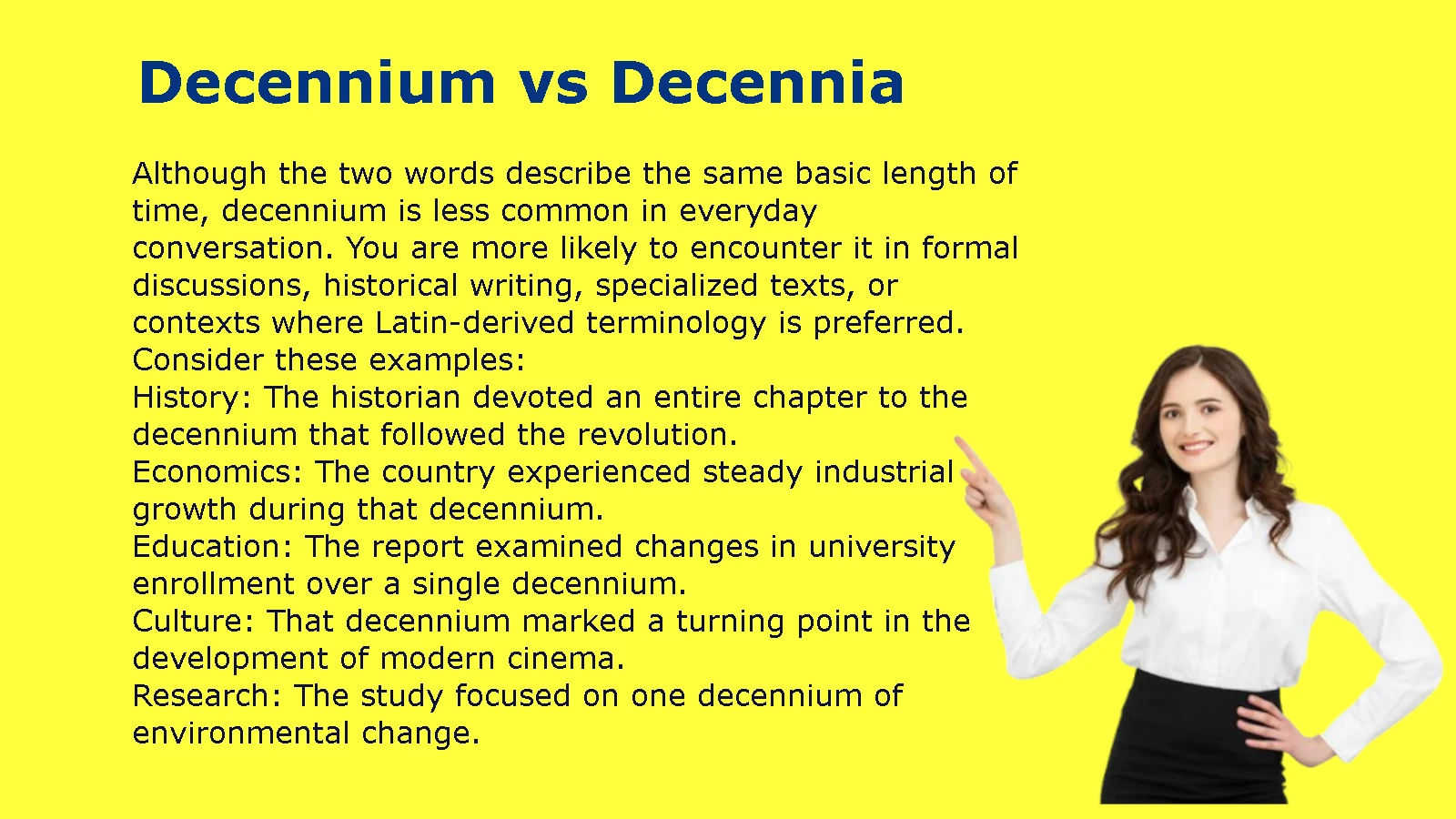
Although the two words describe the same basic length of time, decennium is less common in everyday conversation. You are more likely to encounter it in formal discussions, historical writing, specialized texts, or contexts where Latin-derived terminology is preferred.
Consider these examples:
- History: The historian devoted an entire chapter to the decennium that followed the revolution.
- Economics: The country experienced steady industrial growth during that decennium.
- Education: The report examined changes in university enrollment over a single decennium.
- Culture: That decennium marked a turning point in the development of modern cinema.
- Research: The study focused on one decennium of environmental change.
In each sentence, decennium refers to one ten-year period. The word does not automatically identify a particular calendar decade, such as the 1980s or 1990s. The surrounding context tells the reader which ten-year span you mean.
For example, the sentence “The company changed its strategy during that decennium” requires the reader to know which period the writer has already discussed.
Key takeaway: Use decennium when you want to refer to one ten-year period, especially in formal or specialized writing.
Decennia Meaning and Definition
Decennia is the traditional Latin plural of decennium. It refers to multiple periods of ten years and is used when discussing long-term changes, historical patterns, or developments across several ten-year spans.
The word follows a Latin pluralization pattern in which certain nouns ending in -um change to -a in the plural. English has retained this pattern in several familiar words, including millennium and millennia.
Here are some original examples of decennia in sentences:
- History: The archives reveal how political alliances changed across several decennia.
- Archaeology: Researchers studied the settlement’s development over multiple decennia.
- Economics: The report compared inflation patterns across successive decennia.
- Social change: Family structures evolved considerably over the following decennia.
- Environmental research: The scientists examined rainfall patterns across several decennia to identify long-term trends.
In each example, the plural form indicates more than one ten-year period. The word is particularly useful when the discussion involves historical comparison or long-term change.
However, decennia is not limited to academic writing. You can use it in any suitable context where multiple ten-year periods are being discussed. The main consideration is whether the word fits your audience and writing style.
For instance, “The city changed dramatically over several decades” sounds natural to most English speakers. “The city changed dramatically over several decennia” is also understandable, but it sounds more formal and less familiar.
Key takeaway: Use decennia when referring to multiple ten-year periods, particularly when a formal tone suits the context.
Why Does Decennium Become Decennia?
The change from decennium to decennia comes from Latin grammar. In Latin, many neuter nouns ending in -um form their nominative plural by changing that ending to -a. English has retained several of these traditional plural forms.
The pattern is easy to recognize when you compare familiar words:
| Singular | Plural | Meaning |
| Decennium | Decennia | Ten-year periods |
| Millennium | Millennia | Thousand-year periods |
| Datum | Data | Individual pieces or units of information |
| Bacterium | Bacteria | Individual bacterial organisms |
| Curriculum | Curricula | Courses or organized programs of study |
These words illustrate a historical grammatical pattern. They do not all behave identically in modern English, however. For example, data is often treated as a mass noun in everyday writing, while bacteria is normally plural.
The important point is that decennia is not an arbitrary spelling. It follows an established Latin plural pattern that English has preserved.
Why does this matter? Because adding -s to every singular noun is not always the best way to form a plural. Some words retain traditional forms because of their origins and continued use.
For decennium, the traditional plural is decennia. The English alternative decenniums is also used, but it is less traditional.
Decennium vs. Decade: Are They the Same?
Yes, decennium and decade both refer to a period of ten years. The main difference is usage. Decade is the standard word in everyday English, while decennium is less common and often sounds more formal. In most general writing, decade is the clearer choice.
Although the words share a meaning, choosing between them can affect the tone of a sentence. A word that works well in a historical paper may sound unnecessarily technical in a casual conversation.
Meaning and Similarities Between Decennium and Decade
Both decennium and decade describe ten years. Neither word inherently means a century, a generation, or a specific historical era.
Compare these sentences:
- Using decade: The decade brought major improvements in public transportation.
- Using decennium: The decennium brought major improvements in public transportation.
Both sentences communicate the same basic idea. The second simply uses a less familiar term.
Here are additional comparisons:
| Using decade | Using decennium |
| The decade saw a rise in online shopping. | The decennium saw a rise in online shopping. |
| She spent a decade studying ancient languages. | She spent a decennium studying ancient languages. |
| The company expanded during that decade. | The company expanded during that decennium. |
The meaning remains largely the same, although the sentences using decennium may sound more formal or unusual to many readers.
One important distinction is that neither word automatically means ten complete calendar years beginning on January 1 and ending on December 31. A ten-year period can begin or end at another point, depending on the context.
For example, if a researcher studies a business from July 2015 through June 2025, the researcher is examining a ten-year span. Calling it a decade is natural, even though it does not align with ten complete calendar years.
Key Differences in Usage
The main difference between decennium and decade is not their length. It is their familiarity and typical use.
Decade is common in:
- Everyday conversation
- News articles and general-interest blogs
- Business reports
- Personal reflections
- Discussions about music, fashion, technology, and culture
Decennium is more likely to appear in:
- Formal historical discussions
- Specialized academic writing
- Certain legal or institutional contexts
- Texts that use traditional Latin-derived terminology
These are tendencies rather than strict rules. You can use decade in academic writing and decennium in other formal contexts if it fits your meaning.
Consider a practical example involving a business report.
A report written for customers might say:
“The company has expanded its services over the past decade.”
The wording is familiar and direct. A historical analysis of the same company might use decennium when discussing a specific period within a broader chronology.
Neither word is inherently more accurate. The best choice depends on the audience, context, and desired tone.
Which Word Should You Choose?
Choose the word that communicates your meaning most clearly.
Use this simple guide:
| Situation | Recommended word | Example |
| Everyday conversation | Decade | I’ve worked in this industry for a decade. |
| General business writing | Decade | The company grew rapidly during the last decade. |
| Historical analysis | Decennium or decade | The decennium marked a period of political change. |
| Discussion of multiple periods | Decades or decennia | The study compared several decades of growth. |
| Writing for a broad audience | Decade | Three decades of research shaped the project. |
For most readers, decade is the safest option because it is familiar, concise, and widely understood.
However, there is no need to avoid decennium simply because it is uncommon. If the term fits your subject and audience, it is a valid choice.
The same principle applies to decennia. Use it when its traditional plural form suits the tone of your writing, but consider decades if your primary goal is immediate clarity.
Decennium vs Decennia: Quick Comparison Table
The following table summarizes the main differences between the two terms.
| Feature | Decennium | Decennia |
| Grammatical number | Singular | Plural |
| Basic meaning | One ten-year period | Multiple ten-year periods |
| Word origin | Latin-derived | Traditional Latin plural |
| Typical context | Formal or specialized writing | Formal discussions of multiple periods |
| Example phrase | A single decennium | Several decennia |
| Common English alternative | Decade | Decades |
The most important difference is grammatical number. Decennium refers to one period, whereas decennia refers to more than one.
An Easy Rule to Remember
Remember this three-part rule:
- One period: Use decennium.
- Multiple periods: Use decennia.
- Everyday English: Consider decade or decades.
For example:
“The researcher examined one decennium of economic data before comparing it with the next two decennia.”
This sentence uses the singular form for one period and the plural form for multiple periods. However, for a general audience, the sentence may sound more natural as:
“The researcher examined one decade of economic data before comparing it with the following two decades.”
Both versions express the same basic relationship between the periods.
A useful editing trick is to replace decennium temporarily with “one ten-year period” and decennia with “multiple ten-year periods.” If the sentence still makes sense, you have probably selected the correct grammatical form.
How to Use Decennium and Decennia in a Sentence
Use decennium when the noun refers to one ten-year period and decennia when it refers to multiple periods. Check the surrounding words for clues. Expressions such as a single and that particular generally call for the singular, while several and multiple generally call for the plural.
The examples below show how these terms work in different contexts.
Examples of Decennium in a Sentence
Here are original sentences demonstrating the singular form.
Historical writing
- The final decennium of the dynasty was marked by political instability.
- Historians often examine each decennium separately to understand how public attitudes changed.
- The museum’s latest exhibition focuses on a decennium of rapid technological development.
Business and economics
- The company introduced three major products during that decennium.
- Economic growth slowed during the final years of the decennium.
- The analyst compared the industry’s performance with its results from the previous decennium.
Education and research
- The research team examined one decennium of school enrollment data.
- The university expanded its science programs during that decennium.
- The study focused on a decennium in which average temperatures rose steadily.
Culture and society
- That decennium transformed the country’s music industry.
- The author describes the decennium as a period of major social change.
- The documentary explores how television developed during a single decennium.
In all these examples, decennium refers to one ten-year span. Words such as one, that, and single help establish the singular meaning.
Examples of Decennia in a Sentence
The following examples show how to use the plural form.
History and archaeology
- The ruins reveal how the settlement expanded over several decennia.
- Researchers compared pottery styles from different decennia to identify cultural changes.
- The archive contains records spanning multiple decennia of political conflict.
Economics and business
- The report examines how trade relationships changed across successive decennia.
- The industry experienced several major shifts over the past few decennia.
- Economists compared investment patterns across three decennia.
Science and the environment
- The team studied rainfall measurements collected over several decennia.
- The data reveal changing migration patterns across multiple decennia.
- Scientists analyzed temperature records from successive decennia to identify long-term trends.
Culture and society
- The novel explores family traditions that survived across several decennia.
- The city’s architecture reflects influences from different decennia.
- Social attitudes changed considerably over the following decennia.
These examples show that decennia works best when the sentence clearly refers to multiple ten-year periods.
Common Grammar Mistakes to Avoid
Even when readers understand the meanings of these words, a few errors can make a sentence confusing or awkward.
Mistake: Using the plural for one period
Incorrect: The historian focused on one decennia.
Correct: The historian focused on one decennium.
The word one indicates a single period, so the singular noun is required.
Mistake: Using the singular for several periods
Incorrect: The study covered several decennium.
Correct: The study covered several decennia.
The word several indicates more than one period. The noun must therefore be plural.
Mistake: Assuming a decennium must match a calendar decade
Incorrect assumption: A decennium must refer to a period such as the 1990s.
Correction: A decennium can refer to any ten-year span. Its starting and ending points depend on the context.
For example, a study covering September 2012 through August 2022 examines a ten-year period, even though it does not correspond to ten complete calendar years.
Mistake: Choosing an unfamiliar word when a simpler one works better
Awkward for a general audience: The project continued throughout the decennium.
More natural: The project continued throughout the decade.
The first sentence is grammatically understandable. The second is more familiar to most English readers.
Mistake: Treating the words as interchangeable in every sentence
Although decennium and decennia share a meaning, they do not share the same grammatical number. A sentence must use the form that agrees with its intended meaning.
A quick proofreading checklist can help:
- Does the sentence describe one ten-year period or several?
- Do words such as one, several, or multiple agree with the noun?
- Would decade or decades communicate the idea more naturally?
- Is the time span clear from the surrounding context?
Answering these questions will help you avoid most errors.
Is Decenniums a Correct Word?
Yes, decenniums is used as an English plural form of decennium. However, decennia is the traditional Latin plural, so it is often the better choice when you want to follow the established Latin form. The choice depends on your audience, preferred style, and the consistency of your writing.
This distinction matters because English has borrowed words from Latin and adapted some of them to ordinary English grammar.
For many borrowed words, adding -s or -es is the standard way to make a plural. Other words retain their original Latin or Greek plural forms. Some have both traditional and anglicized alternatives.
Decennium belongs to the group for which more than one plural form is encountered.
Decennia vs. Decenniums
Both forms can communicate the idea of multiple ten-year periods, but they differ in their formation and style.
| Feature | Decennia | Decenniums |
| Formation | Traditional Latin plural | English plural ending in -s |
| Meaning | Multiple ten-year periods | Multiple ten-year periods |
| Style | Traditional and formal | Anglicized |
| Best approach | Use when following the Latin form | Use if accepted by your chosen style guide |
For example:
- Traditional plural: The historian compared three decennia of political development.
- Anglicized plural: The historian compared three decenniums of political development.
The first sentence follows the traditional Latin plural pattern. The second uses an English plural ending.
If you are writing an academic paper, a history article, or a formal report, decennia is a sensible default. If you encounter decenniums in a text, however, you should not automatically assume that the writer has made a grammatical error.
Practical recommendation: Choose decennia for consistency with the traditional Latin plural. If your publication or organization has a style guide, follow its preferred form.
A Practical Case Study: Choosing the Correct Form
Imagine that a historian is preparing a report about changes in a coastal city over thirty years. The report divides the timeline into three ten-year periods and compares population growth, transportation, and local business activity.
The historian must decide whether to use decennium, decennia, or decade.
Scenario: One Period vs. Multiple Periods
Suppose the report contains these statements:
- “The first decennium saw a steady increase in population.”
- “The next two decennia brought major changes to public transportation.”
- “Across the three decades, local businesses expanded into new neighborhoods.”
Each sentence uses a suitable form.
The first statement refers to one ten-year period, so decennium is singular. The second refers to two periods, so decennia is plural. The third uses decades, a familiar plural that works well for a broad audience.
The historian could also use decades throughout the report. The decision to use decennium and decennia depends on the intended tone and terminology, not on a difference in the length of time.
What This Example Teaches
This scenario illustrates three practical lessons:
- Grammar comes first: The singular and plural forms must match the number of periods.
- Audience matters: General readers may find decade and decades easier to understand.
- Consistency improves clarity: A report should use terminology in a consistent way unless there is a clear reason to change it.
The same principles apply to research papers, historical timelines, company reports, and discussions of long-term social change.
Conclusion: Remember the Difference Between Decennium and Decennia
The difference between Decennium vs Decennia is simple once you understand their grammatical number. A decennium is one ten-year period, while decennia is the traditional plural used for multiple ten-year periods. Both words share the same basic meaning as decade and decades, although they are less common in everyday English.
Use decennium when discussing a single period and decennia when comparing or describing several periods. Remember that decenniums is also used as an English plural variant, but decennia follows the traditional Latin pattern.
For most everyday writing, decade remains the clearest option. In formal or historical writing, however, decennium and decennia can fit naturally when used correctly.
Your next step: Check your own writing for references to ten-year periods. Make sure each noun matches the number of periods you mean, then choose the wording that best suits your audience.
Frequently Asked Questions
Is Decennia a Real Word?
Yes. Decennia is the traditional plural of decennium. It refers to multiple ten-year periods and can be used in formal, historical, and other appropriate contexts.
What Is the Plural of Decennium?
The traditional Latin plural of decennium is decennia. The English plural decenniums is also used, although decennia preserves the traditional Latin form.
What Is the Difference Between Decennium and Decade?
Both words refer to a period of ten years. Decade is more common in everyday English, while decennium is less common and often sounds more formal.
How Do You Pronounce Decennia?
Decennia is commonly pronounced dih-SEN-ee-uh, with the stress on the second syllable. Pronunciation can vary slightly by accent.
What Is the Origin of the Word Decennium?
Decennium comes from Latin elements associated with ten and year: decem, meaning “ten,” and annus, meaning “year.” The word therefore refers to a ten-year period.
Can Decennia Be Used in Everyday English?
Yes. Decennia is grammatically valid, but it is relatively uncommon. In casual conversation and general writing, decades is usually more familiar and easier for readers to understand.