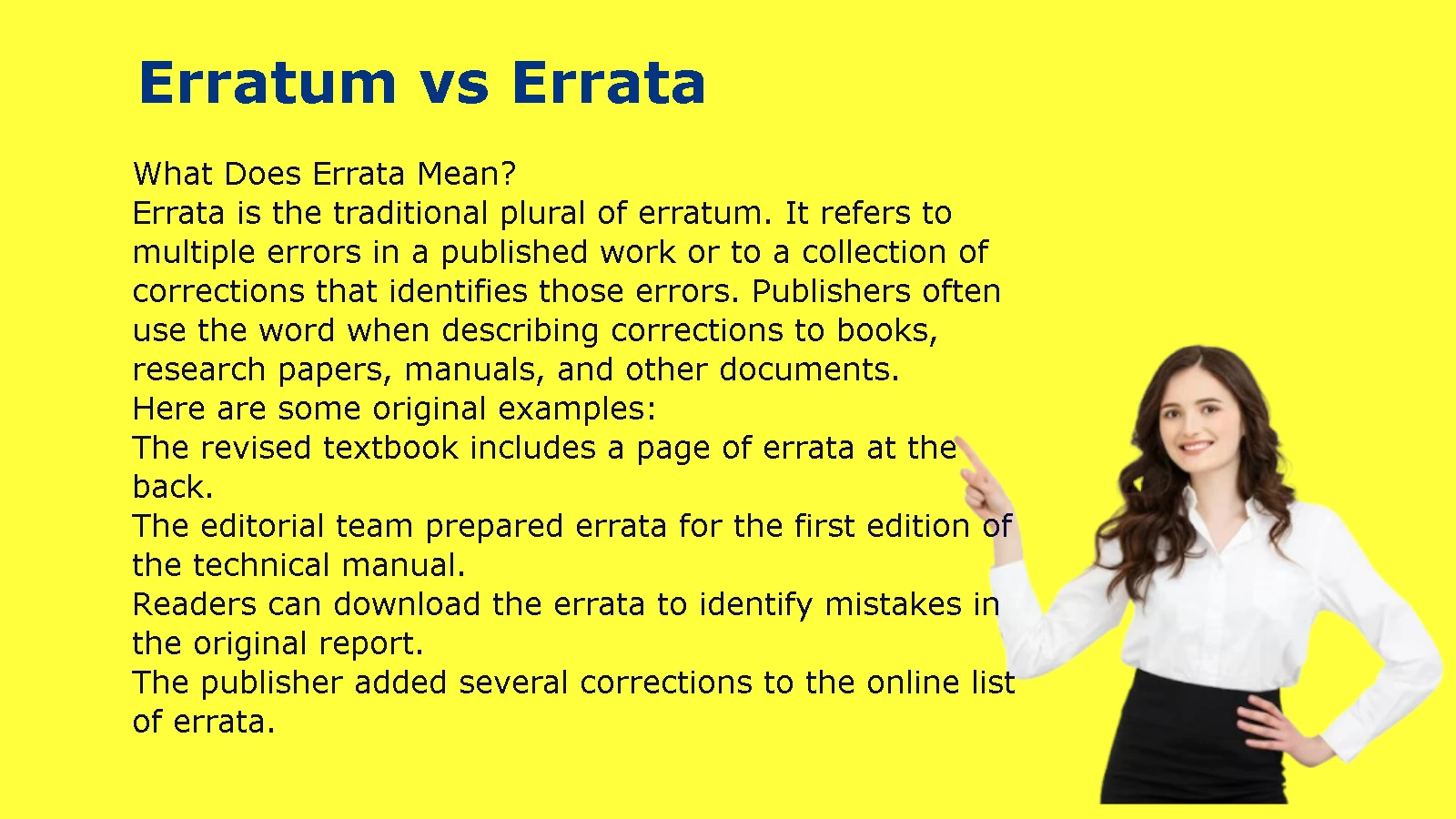
The erratum vs errata distinction is simple: “erratum” refers to one error, while “errata” refers to two or more errors. For example, you might publish an erratum to correct a spelling mistake in a book, but provide a list of errata to address several mistakes. When using these terms, it is important to maintain singular and plural agreement. Use a singular verb with erratum and a plural verb with errata when the words refer to individual errors or corrections. For example, “The erratum is listed below” and “The errata are listed below.”
An erratum is a mistake in a printed or published work, while errata is the plural form used to refer to multiple errors. If you’ve come across the terms “erratum” and “errata” and wondered which one to use, the difference comes down to singular and plural agreement, grammar, and context. These terms are closely connected to proofreading, editing, publishing, corrections, academic writing, and grammatical number.
In this guide, you’ll learn the difference between erratum and errata, how to use each word in sentences, how singular and plural agreement works, and when to use these terms in academic and professional writing. You’ll also see clear examples to help you understand their meanings and grammatical uses.
By the end, you’ll know exactly when to use erratum or errata and how to maintain correct singular and plural agreement in your writing.
What Is the Difference Between Erratum and Errata?
The main difference between erratum and errata is grammatical number. Erratum is the singular form, used for one error or one correction notice. Errata is the traditional plural form, used for multiple errors or a collection of corrections. Both terms are common in publishing and academic writing, where accuracy and clear correction records matter.
For example, a journal might publish an erratum to correct one incorrect date in an article. However, if a book contains several printing mistakes, its publisher might provide a list of errata.
The distinction becomes easier when you connect each word to the number of errors being discussed.
| Feature | Erratum | Errata |
| Grammatical number | Singular | Plural |
| Basic meaning | One error or correction notice | Multiple errors or corrections |
| Word origin | Latin | Latin |
| Common context | Academic journals and published works | Books, reports, and correction lists |
| Example | The editor issued an erratum. | The publisher released a list of errata. |
Remember this simple rule: one erratum, several errata.
However, context also matters. An erratum can refer to the mistake itself or the formal notice that identifies it. Similarly, errata can refer to several mistakes or a list of corrections. The surrounding sentence helps readers understand the intended meaning.
What Does Erratum Mean?
An erratum is a noun that refers to an error in a printed or published work. It can also mean an official notice that identifies and corrects that error. The word is especially common in academic journals, textbooks, technical manuals, and other publications where readers need accurate information.
Consider these examples:
- The journal published an erratum to correct the spelling of a researcher’s surname.
- An erratum appeared online after the publisher discovered an incorrect figure caption.
- The editor issued an erratum because the original article listed the wrong publication date.
- A single erratum corrected the reference to the previous edition of the textbook.
Each sentence uses erratum because it refers to one error or one correction notice.
The word often appears in formal writing because it provides a precise way to discuss a mistake in an established publication. Instead of writing, “The journal made a correction,” you can write, “The journal published an erratum.”
The second sentence sounds more specific because it identifies the correction as a formal publishing notice.
An erratum does not necessarily mean that an entire document is unreliable. A small typographical error, such as a misspelled name, may require a simple correction. A mistake involving a table, equation, or research result may require more detailed editorial review.
What Does Errata Mean?
Errata is the traditional plural of erratum. It refers to multiple errors in a published work or to a collection of corrections that identifies those errors. Publishers often use the word when describing corrections to books, research papers, manuals, and other documents.
Here are some original examples:
- The revised textbook includes a page of errata at the back.
- The editorial team prepared errata for the first edition of the technical manual.
- Readers can download the errata to identify mistakes in the original report.
- The publisher added several corrections to the online list of errata.
In each example, the word refers to more than one error or correction.
You may also encounter the heading Errata on a publisher’s website. This heading usually introduces a page containing corrections to one or more publications. The list might include page numbers, incorrect wording, corrected wording, and explanations where needed.
For example, an errata list for a textbook could contain these entries:
| Page | Original text | Correction |
| 18 | 2018 | 2019 |
| 47 | 15 kilometers | 18 kilometers |
| 92 | Figure 3.2 | Figure 3.3 |
This list contains several corrections, so errata is appropriate.
One important detail is that errata does not always mean that the errors appear in separate documents. Several mistakes can occur within a single book, and the publisher can collect them in one errata list.
Why Is Erratum Pluralized as Errata?
The plural form errata comes from Latin grammar. In Latin, erratum is a neuter noun, and its traditional plural ends in -a rather than the English plural ending -s.
English has retained this pattern in several familiar words. For example:
| Singular | Traditional plural | Meaning |
| Erratum | Errata | Error or correction |
| Bacterium | Bacteria | A single bacterium or multiple bacteria |
| Curriculum | Curricula | A course of study or multiple courses of study |
| Datum | Data | A single piece of information or multiple pieces of information |
| Memorandum | Memoranda | A written note or multiple notes |
These words demonstrate why errata may look unusual to English speakers. The plural follows a historical Latin pattern rather than the more familiar English rule of adding -s.
In modern English, some Latin-derived words have developed alternative plural forms. Nevertheless, errata remains the established choice in formal academic and publishing contexts.
If you are preparing a journal manuscript, editing a textbook, or writing a professional report, using errata is the safest way to follow traditional usage.
How to Use Erratum and Errata in a Sentence
Use erratum when referring to one error or one formal correction notice. Use errata when referring to multiple errors or a collection of corrections. The choice depends on what the noun describes, not simply on whether the document contains many pages.
For example, a 300-page book may need only one erratum. A short two-page report may contain several errors and require an errata list.
Examples of Erratum in a Sentence
The following examples show how to use erratum in academic, professional, and everyday publishing contexts.
- The publisher issued an erratum to correct an incorrect chapter title.
- An erratum clarified the date of the historical event discussed in the article.
- The journal added an erratum after discovering a missing word in the abstract.
- The author referred readers to an erratum correcting the original publication.
- A brief erratum appeared beside the online version of the report.
- The editor requested an erratum to correct the spelling of the institution’s name.
Notice that each example refers to a single error or correction notice.
You can also use the word in more complex sentences:
“The journal published an erratum explaining that the article’s second table contained an incorrect unit of measurement.”
Here, erratum identifies the formal notice, while the rest of the sentence explains its purpose.
Another example is:
“Before citing the study, Maya checked the journal website to see whether an erratum had corrected the original data.”
This sentence shows how readers can use correction notices when evaluating published research.
Examples of Errata in a Sentence
Use errata when referring to several mistakes or a list of corrections.
- The publisher uploaded the errata for the first edition of the handbook.
- A list of errata appears after the index in the printed textbook.
- The editor reviewed the errata before approving the next printing.
- Researchers checked the published errata before quoting the disputed passage.
- The technical team released errata correcting several labels in the product manual.
- The revised edition addressed the most important errata from the original release.
You can also use the word in a longer sentence:
“The publisher prepared a detailed list of errata so readers could correct the page references, dates, and figure labels in the original edition.”
The sentence refers to multiple corrections, so errata is the appropriate choice.
Another example is:
“After discovering several typographical errors, the editorial team posted the errata on the publisher’s website.”
Here, the plural form matches the several errors mentioned earlier.
Erratum in a Research Paper
An erratum in a research paper is a formal notice that identifies and corrects an error in a published academic article. Depending on the journal’s policies and the nature of the mistake, the notice may correct a name, date, figure, equation, reference, or other published detail.
For example, imagine that a journal publishes a paper about renewable energy. After publication, the editorial team discovers that one chart labels kilowatts as megawatts.
If the journal handles the mistake through a formal correction notice, that notice may be called an erratum.
A typical notice might read:
Erratum: In Figure 2 of the article, the unit label should read “kilowatts” rather than “megawatts.” The figure caption has been corrected in the online version.
This example illustrates the basic structure of a correction notice. It identifies the location of the error, states the correction, and points readers toward the affected content.
In academic publishing, the correction process may involve several steps:
- Identify the error: A reader, author, editor, or reviewer notices a problem.
- Verify the mistake: The author and editorial team establish what is incorrect.
- Assess its significance: They determine whether the error affects interpretation, results, or conclusions.
- Publish a correction: The journal issues an appropriate notice when required.
- Link the records: The correction is connected to the original article so readers can find it.
Not every mistake requires the same response. A spelling error in an author’s affiliation is different from a numerical error that changes the interpretation of an experiment.
If an error affects the validity of the research, a correction notice alone may not be sufficient. The journal may need to investigate further and consider another editorial action, depending on its policies and the circumstances.
Readers should also distinguish an erratum from a new edition of a paper. A correction notice documents a change to an existing publication. It does not automatically mean that the entire original article has been replaced.
What Is an Errata Page or Errata Sheet?
An errata page or errata sheet is a list of errors found in a published work, together with the correct information. Traditionally, publishers used printed correction slips to alert readers to mistakes discovered after a book had been printed. Today, publishers may provide the same information through digital correction pages.
The purpose is simple: readers need a reliable way to identify errors without guessing what the author or publisher intended.
Printed Books and Traditional Errata Sheets
In traditional printing, publishers sometimes discovered errors only after a book had been printed or bound. Reprinting the entire book could be expensive, especially when the mistakes were minor.
A publisher could instead prepare a small errata sheet containing the corrections and insert it into copies of the book before distribution. Some publishers placed the list near the front or back of the book, while others attached a loose slip of paper.
A traditional entry might look like this:
| Page | Line | Incorrect text | Correct text |
| 24 | 6 | 1996 | 1998 |
| 63 | 12 | Northern region | Southern region |
| 105 | 3 | 2.5 meters | 2.8 meters |
This format tells readers exactly where the mistake appears and what they should read instead.
An errata sheet can be useful when the original printing remains in circulation. However, its effectiveness depends on whether readers notice the sheet and apply the corrections.
A later edition may incorporate the corrections directly into the text. The publisher might still maintain a record of earlier corrections for readers who own the original edition.
Digital Errata and Academic Publishing
Digital publishing has made correction notices easier to distribute and locate. Instead of inserting a paper slip into each physical copy, a publisher can post a correction notice on the journal’s website and connect it to the original article.
A Digital Object Identifier (DOI) is a persistent identifier used to identify a digital publication or other object. When an article has a DOI, publishers and scholarly databases can use that identifier to help readers locate the original work and its related publication records.
For example, a journal may provide:
- The original article’s title and DOI.
- The correction notice’s title and publication date.
- A description of the error and the corrected information.
- A link between the original article and the correction notice.
Academic discovery services and publisher platforms may display links to related corrections, although the exact presentation varies by service. PubMed, for example, records publication information for biomedical literature, while IEEE provides publishing services and article records for engineering and technology research.
Readers should not assume that every database displays corrections in the same way. When accuracy matters, check the journal’s official article page and the associated correction notice.
Digital corrections also support transparency. Instead of silently changing an important detail, a publisher can document what changed and help readers understand the publication history.
Erratum vs. Corrigendum: What Is the Difference?
Erratum and corrigendum both refer to corrections associated with published material. Traditionally, some publishers use erratum for a publisher-introduced error and corrigendum for an author-introduced error. However, this distinction is not universal, so readers should follow the terminology and correction policies of the specific publisher or journal.
The two words can overlap in meaning, which explains why they are sometimes used inconsistently.
When Is Erratum Used?
Traditionally, an erratum may identify an error introduced during typesetting, printing, formatting, or another stage of publication.
For example, an author may submit a manuscript containing the correct figure caption. During production, the caption might accidentally be placed beneath the wrong image.
If the publisher uses erratum for production errors, it may issue a correction notice explaining the problem.
Other possible examples include:
- A missing sentence introduced during typesetting.
- An incorrectly formatted reference.
- A spelling error in a heading added during production.
- A figure label altered accidentally during layout.
The defining issue in this traditional distinction is that the mistake occurred during the publication process rather than in the author’s original manuscript.
However, you should not assume that every publisher follows this rule. Some journals use correction, erratum, or another label more broadly.
When Is Corrigendum Used?
A corrigendum is a correction notice, traditionally associated with an error made by an author. Its plural form is corrigenda.
Imagine that a researcher accidentally enters the wrong number in a table while preparing a manuscript. The journal publishes the article, and the author later discovers the mistake.
A journal that distinguishes the terms by responsibility might classify the notice as a corrigendum.
Other examples could include:
- An incorrect equation entered by the author.
- A mistaken description of a method.
- An incorrect author-supplied affiliation.
- A numerical value that was entered incorrectly in a table.
The seriousness of the error matters. A minor mistake may require a straightforward correction, while an error affecting the study’s conclusions may require a more detailed editorial assessment.
A corrigendum does not automatically mean that a paper’s conclusions are invalid. It indicates that published information needs correction, although the implications depend on the particular case.
Errata vs. Corrigenda
The difference between errata and corrigenda involves both grammar and publishing terminology.
| Feature | Errata | Corrigenda |
| Singular form | Erratum | Corrigendum |
| Grammatical number | Plural | Plural |
| General purpose | Identifies multiple errors or corrections | Identifies multiple corrections |
| Traditional distinction | Often associated with publisher errors | Often associated with author errors |
| Current usage | Varies by publisher | Varies by publisher |
The terms are not always interchangeable within a particular journal. A publisher may define them separately, while another may use one term for a wider range of corrections.
Practical tip: When submitting a correction request or citing a correction notice, use the term shown in the journal’s official record. This approach avoids imposing a grammatical or editorial distinction that the publisher does not follow.
Erratum vs. Errata: Quick Comparison Table
The following table summarizes the main differences and provides a quick reference for choosing the correct word.
| Feature | Erratum | Errata |
| Grammatical form | Singular | Plural |
| Number of errors | One | More than one |
| Traditional Latin pattern | Singular noun ending in -um | Plural noun ending in -a |
| Typical phrase | An erratum notice | A list of errata |
| Book example | The book contains an erratum. | The book contains several errata. |
| Academic example | The journal issued an erratum. | The editor reviewed the errata. |
| Correction format | One correction notice or error | A list or collection of corrections |
Here is another way to understand the distinction:
- One error: “The editor published an erratum correcting the table heading.”
- Several errors: “The editor published a list of errata correcting the table headings and page references.”
Both sentences are grammatically correct because the noun agrees with the intended number.
Be careful with the phrase “a list of errata.” Although list is singular, the word errata remains plural because it refers to the multiple errors or corrections contained in the list.
Is “Erratums” Correct English?
Erratums is an occasional English plural variant, but errata is the traditional and preferred plural in formal academic and publishing contexts. If you are writing a research paper, preparing a correction notice, or editing a professional document, use errata unless the relevant style guide specifies otherwise.
English sometimes adapts words borrowed from Latin to follow ordinary English plural rules. That is why readers may encounter forms ending in -s alongside traditional Latin plurals.
However, the existence of an alternative form does not mean both choices are equally suitable in every context.
Consider these examples:
- Preferred in formal publishing: “The publisher released a list of errata.”
- Less suitable for traditional academic writing: “The publisher released a list of erratums.”
The first version follows the established convention used in formal publishing.
When Should You Use Errata Instead?
Choose errata in contexts where traditional scholarly terminology is expected.
Academic papers and journal articles: Use erratum for a single correction notice and errata for multiple corrections, while following the journal’s own terminology.
Books and technical manuals: Use errata for a collection of mistakes and their corrections in a published edition.
Professional reports: Use errata when preparing a formal list of errors in a document or an earlier release.
Editorial correspondence: Refer to an erratum or errata list using the terminology adopted by the publisher.
For ordinary communication, you can often avoid the question entirely by using words such as error, correction, or correction notice. For example, “The publisher issued three corrections” is clear and natural.
Nevertheless, if the subject is academic publishing or formal editorial practice, knowing the traditional distinction helps you communicate more precisely.
Common Mistakes When Using Erratum and Errata
Even experienced writers can confuse these terms because their plural forms do not follow the most familiar English pattern.
Avoid these common mistakes:
- Using errata for one error: Write “The journal issued an erratum” when referring to one correction notice.
- Using erratum for several errors: Write “The book contains several errata” when referring to multiple errors.
- Assuming every publisher uses the same correction labels: Check the journal’s editorial policy before deciding whether a notice is an erratum or corrigendum.
- Treating an errata list as a new edition: An errata list documents corrections but does not necessarily replace the original publication.
- Using erratums in formal academic writing: Prefer the traditional plural errata unless a specific style guide directs otherwise.
A quick proofreading check can help. Find each occurrence of erratum and errata, then ask whether the sentence refers to one error or multiple errors. Next, check whether the term describes the mistake itself or a formal notice about that mistake.
This small step can prevent awkward wording in manuscripts, reports, and professional correspondence.
Frequently Asked Questions About Erratum vs. Errata
Is errata singular or plural?
Errata is traditionally plural. Its singular form is erratum. Use erratum for one error or correction notice and errata for multiple errors or corrections.
What is the plural of erratum?
The traditional plural of erratum is errata. The word follows a Latin pluralization pattern, similar to bacterium becoming bacteria. This form is preferred in formal academic and publishing contexts.
What is the difference between erratum and corrigendum?
Both words refer to corrections in published material. Traditionally, an erratum may refer to a publisher’s error, while a corrigendum may refer to an author’s error. However, individual publishers may use these terms differently.
Can I use erratums instead of errata?
Erratums appears as an English plural variant, but errata is the conventional choice in formal academic writing and publishing. Use errata when you want to follow traditional scholarly usage.
What does an erratum notice do?
An erratum notice identifies an error in a published work and states the correct information. It helps readers recognize the mistake and locate the correction without confusing the notice with the original publication.
How do you cite an erratum in a research paper?
Follow the citation style required by your institution or journal. Include the correction notice’s available bibliographic details, such as its title, publication date, journal information, and DOI. Make sure readers can distinguish the correction notice from the original article.
Conclusion: Remember the Difference Between Erratum and Errata
The difference between erratum vs errata comes down to grammatical number and context. Erratum is the traditional singular form, while errata is the traditional plural form. Both words help writers and publishers identify errors and communicate corrections in books, academic journals, technical manuals, and professional documents.
Remember these key points:
- Use erratum for one error or one correction notice.
- Use errata for multiple errors or a collection of corrections.
- Use corrigendum and corrigenda according to the terminology adopted by the relevant publisher.
- Prefer errata over erratums in formal academic and publishing contexts.
- Check the official correction notice when accuracy and publication history matter.
If you are editing a manuscript, reviewing a research paper, or preparing a correction list, choose the term that matches the number of errors and the publisher’s conventions. This simple habit will make your writing clearer, more accurate, and more professional.













