Usufruct means the legal right to use and enjoy someone else’s property or assets without owning them, as long as you do not damage or destroy them. A person who has this right can generally use the property and benefit from it, subject to the terms of the usufruct.
If you’re searching for “usufruct meaning,” “what does usufruct mean,” or “usufruct definition,” you’re likely looking for a simple explanation of this legal term. In most contexts, usufruct refers to a temporary legal right to use property and receive benefits from it while ownership remains with someone else.
| Question | Answer |
| What does usufruct mean? | The legal right to use and benefit from property owned by someone else. |
| What is the meaning of usufruct? | A right to use and enjoy another person’s property without owning it. |
| Is usufruct the same as ownership? | No. The usufructuary can use and benefit from the property, while another person retains ownership. |
| What is a synonym for usufruct? | Right of use, right of enjoyment, or beneficial use. |
What Does Usufruct Mean?
The basic usufruct meaning is the legal right to use another person’s property and obtain its benefits without becoming the full owner of the property.
For example, suppose Maria owns a house. She gives Daniel a lifetime usufruct over that house.
Daniel may have the right to live in the house and enjoy its permitted benefits. Maria remains the owner. Daniel cannot simply treat the house as though he owned it outright.
The concept has two important parts:
- Use: The usufructuary can use the property according to the terms of the usufruct and applicable law.
- Enjoyment: The usufructuary can generally receive the benefits or income produced by the property.
- Preservation: The usufructuary generally has a duty to preserve the property’s substance rather than destroy or fundamentally alter it.
This creates a legal split between ownership and enjoyment.
Usufruct in simple terms
A useful way to remember the meaning is:
Usufruct = the right to use and enjoy property that belongs to someone else.
Consider a rental house. The tenant can use the property, but a usufruct can involve a broader legal interest than an ordinary tenancy. Depending on the governing law, the usufructuary may also have a right to collect income or other benefits generated by the property.
The important point is that the property belongs to someone else.
Usufruct Meaning in Law
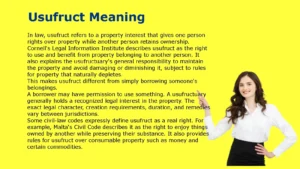
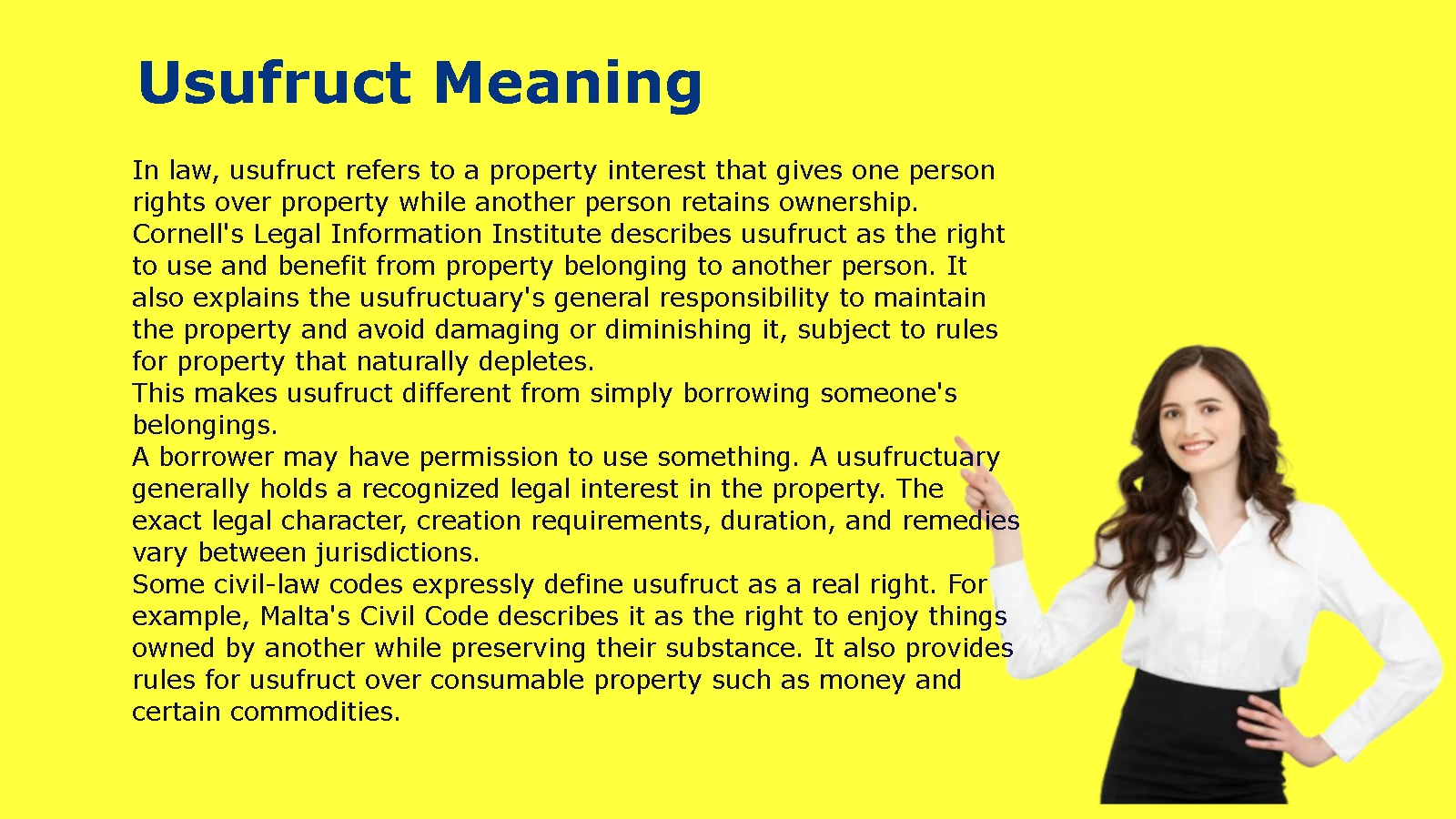
In law, usufruct refers to a property interest that gives one person rights over property while another person retains ownership.
Cornell’s Legal Information Institute describes usufruct as the right to use and benefit from property belonging to another person. It also explains the usufructuary’s general responsibility to maintain the property and avoid damaging or diminishing it, subject to rules for property that naturally depletes.
This makes usufruct different from simply borrowing someone’s belongings.
A borrower may have permission to use something. A usufructuary generally holds a recognized legal interest in the property. The exact legal character, creation requirements, duration, and remedies vary between jurisdictions.
Some civil-law codes expressly define usufruct as a real right. For example, Malta’s Civil Code describes it as the right to enjoy things owned by another while preserving their substance. It also provides rules for usufruct over consumable property such as money and certain commodities.
Puerto Rico’s Civil Code similarly defines usufruct as the right to enjoy another person’s property and receive its products, utilities, and advantages while preserving its form and substance unless the governing law or constituting deed provides otherwise.
Why the legal distinction matters
Ownership usually carries a broad collection of rights. A usufruct gives the usufructuary only the rights recognized by the relevant law or legal instrument.
That means you cannot determine every right simply from the word usufruct.
The governing jurisdiction may determine:
- Whether the usufruct must be registered
- Whether it can be sold or transferred
- Whether the usufructuary can lease the property
- Who pays taxes
- Who handles ordinary repairs
- Who pays extraordinary expenses
- How long the usufruct lasts
- What happens when the usufruct ends
For an actual property transaction, the deed, will, contract, and applicable law matter more than a dictionary definition.
Usufruct Meaning in English
In plain English, usufruct means having the right to use someone else’s property and enjoy its benefits without owning the property outright.
There isn’t always a single ordinary English word that captures the entire concept.
You might explain it as:
- A right to use and enjoy another person’s property
- A legal right to use property and receive its benefits
- A temporary property interest in another person’s property
- A right of enjoyment without full ownership
The word itself is uncommon in everyday conversation. It appears much more often in property law, inheritance law, civil law, estate planning, and real estate documents.
That’s why a reader who encounters the term in a deed or legal document may need more than a one-line dictionary definition.
Usufruct Example
The easiest way to understand usufruct is to look at a realistic property arrangement.
Example: A family home
Suppose a father owns a house. He transfers the underlying ownership to his daughter but gives his wife a lifetime usufruct.
The arrangement could work like this:
| Person | Interest |
| Wife | Usufructuary |
| Daughter | Underlying or bare owner, depending on the legal system |
| House | Property subject to the usufruct |
| Wife’s right | Use and enjoyment during the usufruct |
| Daughter’s ownership | Subject to the usufruct until it ends |
The wife may have the right to live in the home and enjoy the property according to the governing law.
The daughter owns the property, but her ownership is subject to the wife’s usufruct.
When the usufruct ends, the daughter’s ownership may become fully possessory, depending on the applicable legal system and the terms that created the usufruct.
Example: Rental property
Now imagine that Alex owns an apartment building and grants Jordan a usufruct.
If the applicable law permits it, Jordan may have the right to collect rental income generated by the property.
Jordan still isn’t necessarily the underlying owner.
This illustrates an important part of usufruct: the benefit can include income produced by property, not merely physical use of it. Civil-law sources commonly describe these benefits as the property’s “fruits,” which can include natural or civil fruits such as crops or income.
Example: Agricultural land
Suppose an owner grants a farmer a usufruct over farmland.
The farmer may be entitled to use the land and take the crops produced by it, subject to the governing law and the conditions of the usufruct.
The farmer’s right does not automatically mean that the farmer owns the land.
That distinction becomes especially important when the usufruct expires.
How Does Usufruct Work?
A usufruct separates two sets of property interests.
The first belongs to the usufructuary, who receives the right to use and enjoy the property.
The second belongs to the owner, who retains the underlying ownership.
You can picture the relationship like this:
PROPERTY
│
┌─────────┴─────────┐
│ │
OWNERSHIP USUFRUCT
│ │
Owner / bare owner Usufructuary
│ │
│ Use + enjoyment
│ + permitted benefits
│
Underlying title
The two interests can exist at the same time.
What can a usufructuary generally do?
Depending on the applicable law and the document creating the usufruct, a usufructuary may have rights to:
- Use the property
- Possess the property
- Live in the property
- Receive income or other benefits from it
- Take natural or civil fruits produced by it
- Exercise other rights specifically granted by law or the constituting instrument
However, those rights come with limits.
What generally limits a usufructuary?
A usufructuary generally cannot treat the property as unrestricted personal property.
For example, the usufructuary may not have the right to:
- Destroy the property
- Fundamentally change its nature without authorization
- Transfer the underlying ownership as though they were the owner
- Ignore maintenance obligations
- Use the property in a manner prohibited by the legal instrument or applicable law
Cornell’s Wex specifically notes the general duty to maintain the property responsibly and avoid damage or diminution, subject to rules concerning natural depletion.
Usufructuary Meaning
A usufructuary is the person who holds a usufruct.
The easiest distinction is:
Usufruct = the right.
Usufructuary = the person who holds the right.
For example:
Maria owns the apartment. James has the usufruct.
In that sentence, James is the usufructuary.
The usufructuary may have the right to use the apartment and enjoy permitted benefits from it. Maria retains ownership.
The word usufructuary can also function as an adjective in legal writing, such as “usufructuary rights” or “usufructuary interest.”
Rights of a Usufructuary
The precise rights vary by jurisdiction, but several ideas appear repeatedly in legal definitions of usufruct.
Right to use the property
The usufructuary can generally use the property for its intended or legally permitted purpose.
If the usufruct covers a house, that may include living in the house.
If it covers agricultural land, it may include using the land for agriculture.
The terms of the usufruct and the law determine the boundaries.
Right to enjoy the property’s benefits
The usufructuary may also receive the economic benefits generated by the property.
These benefits can include:
- Rent
- Crops
- Produce
- Certain profits
- Other legally recognized “fruits”
This concept explains why usufruct can be valuable even when the usufructuary doesn’t own the underlying asset.
Right to possession
Many usufruct arrangements give the usufructuary possession or control necessary to exercise the usufruct.
However, possession doesn’t automatically equal ownership.
That distinction matters because someone can lawfully possess and use property without holding the underlying title.
Possible right to lease or transfer the usufruct
Some legal systems allow a usufructuary to lease the property or transfer certain usufruct rights.
That doesn’t mean the usufructuary can sell the owner’s underlying title.
The answer depends on the applicable law and the terms creating the usufruct.
This is one area where a general definition cannot replace jurisdiction-specific legal advice.
Responsibilities of a Usufructuary
Rights and responsibilities go hand in hand.
A usufructuary usually cannot simply take the benefits of property while ignoring its condition.
Preserve the property
The central principle is preservation.
A usufructuary generally must respect the property’s substance and intended character. Cornell’s legal definition specifically identifies preservation as a core obligation.
For example, someone with a usufruct over a house generally can’t demolish it simply because they have the right to enjoy it.
Maintain the property
Ordinary maintenance may fall on the usufructuary under the applicable law.
The precise division between ordinary and extraordinary repairs varies between legal systems.
Pay applicable expenses
Taxes, insurance, maintenance costs, and major repairs can be allocated differently depending on the jurisdiction and the document creating the usufruct.
A person should never assume that one country’s rules automatically apply somewhere else.
Return or preserve the property when the usufruct ends
When the usufruct expires, the usufructuary’s rights end according to the applicable legal rules.
The property itself remains subject to the owner’s rights.
Usufruct vs. Ownership
The biggest difference is simple: a usufruct gives rights over property without necessarily giving ownership of the property itself.
| Feature | Usufruct | Full ownership |
| Owns the underlying property | Usually no | Yes |
| Can use the property | Generally yes | Yes |
| Can receive permitted benefits | Generally yes | Yes |
| Can treat the property as unrestricted personal property | No | Generally broader rights |
| Can destroy or fundamentally alter it | Generally restricted | Broader authority, subject to law |
| Can transfer underlying ownership | Generally no | Generally yes |
| Duration | Often limited | Usually broader and potentially indefinite |
| Legal rights | Defined by law or instrument | Broad bundle of ownership rights |
In common-law property terminology, a fee simple represents the broadest traditional property interest in land. Cornell’s Wex describes fee simple as the greatest possible property interest in land.
A usufruct is much narrower.
Usufruct vs. Life Estate
Usufruct and life estate are related concepts, but they aren’t automatically identical.
A life estate is a property interest that lasts for the life of a specified person. Cornell’s Wex explains that a life-estate holder generally has the right to possess and use the property during the life estate.
Usufruct comes from civil-law traditions and can have different legal characteristics.
One major distinction is that usufruct can be created for a specified period in legal systems that recognize that form. Some civil codes expressly allow usufruct for a specified period or condition.
Simple comparison
| Usufruct | Life estate |
| Strongly associated with civil-law systems | Common-law property concept |
| Gives use and enjoyment of another’s property | Gives possession and use for a person’s life |
| May be limited to a specified term depending on law | Usually measured by a person’s life |
| Rules vary by civil-law jurisdiction | Rules vary by common-law jurisdiction |
| May include rights to property income | Can include possession and use |
So while the concepts can resemble one another, “usufruct = life estate” is too broad a statement.
Usufruct vs. Easement
An easement generally gives someone a limited right to use another person’s land for a particular purpose.
For example, an easement might allow someone to cross another person’s land to reach a road.
A usufruct generally goes much further.
| Usufruct | Easement |
| Broad right to use and enjoy property | Usually a specific limited use |
| May include economic benefits | Usually concerns a defined use or access |
| Can involve possession depending on the law | Usually does not transfer general possession |
| Often concerns the overall enjoyment of property | Usually concerns a particular right over property |
The distinction is practical.
If Sarah has a right to walk across John’s driveway, that doesn’t mean Sarah has a usufruct over John’s property.
If Sarah has a usufruct over John’s house, her rights could be substantially broader.
Usufruct and Bare Ownership
Bare ownership describes an ownership interest that remains subject to another person’s usufruct in legal systems using this terminology.
The arrangement can look like this:
ONE PROPERTY
│
┌─────────┴─────────┐
│ │
USUFRUCTUARY BARE OWNER
│ │
Use + enjoyment Underlying title
│ │
└─────────┬─────────┘
│
Usufruct eventually ends
│
▼
Owner’s rights become
fully possessory, subject
to applicable law
Imagine that a mother gives her son ownership of a house but retains a lifetime usufruct.
The son may hold the underlying ownership while the mother retains the right to use and enjoy the property.
This arrangement can become particularly important in inheritance and estate planning.
Usufruct in Inheritance
Inheritance is one of the clearest situations in which separating ownership from enjoyment can make practical sense.
Suppose a parent wants a child to ultimately own a house but wants a surviving spouse to have the right to live there for life.
A legal arrangement may separate those interests:
- The child receives the underlying ownership.
- The spouse receives a usufruct.
- The spouse can use and enjoy the property during the usufruct.
- The child remains the underlying owner.
- When the usufruct ends, the child’s rights become broader according to the applicable law.
The exact arrangement depends on local inheritance law and the document creating the rights.
Civil-law systems may have specific succession rules that affect how usufruct can be created or combined with ownership.
Why families use this structure
The concept can address two different goals at once:
Current enjoyment: One person gets the right to use the property.
Future ownership: Another person retains or receives the underlying ownership.
That separation can be useful in estate planning, but the legal consequences depend heavily on local law.
Usufruct in Business
The usufruct meaning in business depends on the type of asset and the legal system involved.
The underlying idea remains the same: one party may have a legally recognized right to use an asset or receive its benefits while another party retains ownership.
For example, an arrangement could involve an income-producing asset where the usufructuary receives the economic benefits while another party holds the underlying ownership.
However, business assets raise additional questions.
These may include:
- Who receives income?
- Who manages the asset?
- Who pays expenses?
- Who bears losses?
- Can the usufruct be transferred?
- What happens when the usufruct expires?
- Does the arrangement require registration?
- How does the arrangement affect third-party rights?
The word usufruct therefore shouldn’t be treated as a universal business term with one fixed effect.
A company’s shares, partnership interests, equipment, intellectual property, and real estate can all involve different legal rules.
Usufruct and Mortgage
A usufruct mortgage is not a single universal legal concept. The relationship between a usufruct and a mortgage depends on the jurisdiction, the type of property interest, and the documents involved.
A mortgage generally creates a security interest connected to a debt.
A usufruct, by contrast, creates a right to use and enjoy property.
Those are fundamentally different concepts.
| Usufruct | Mortgage |
| Property-use and enjoyment right | Security interest connected to debt |
| Usually benefits a usufructuary | Protects a creditor’s interest |
| Can involve possession or income | Usually supports repayment of a loan |
| May be temporary | Usually continues until the debt is paid or the security interest otherwise ends |
The tricky part comes when multiple legal interests affect the same property.
For example, a property might have an owner, a usufructuary, and a mortgage creditor. The priority and enforcement consequences depend on local law.
That’s why a generic online definition isn’t enough to determine whether a particular usufruct takes priority over a mortgage or how foreclosure would affect it.
Types of Usufruct
Legal systems can classify usufruct in different ways, but two traditional categories are especially useful.
Perfect usufruct
A perfect usufruct generally involves property that the usufructuary can use without destroying or consuming its substance.
A house is an easy example.
The usufructuary can live in the house without consuming the house itself.
Imperfect usufruct or quasi-usufruct
An imperfect usufruct, sometimes called a quasi-usufruct, concerns property that cannot be used normally without being consumed or changed.
Money is the classic example.
You can’t meaningfully use a quantity of money while leaving every individual bill or coin untouched forever.
Some legal systems therefore impose special rules requiring the usufructuary to return equivalent value or an equivalent quantity and quality when the usufruct ends. Cornell’s Wex describes this distinction and gives consumable items such as money and food as examples.
Malta’s Civil Code provides a similar approach for consumable things, requiring repayment of their value or return of equivalent items under the circumstances specified by the law.
How Long Does Usufruct Last?
There isn’t one universal duration.
A usufruct may be:
- For a fixed period
- For a person’s lifetime
- Conditional
- Created by law
- Created by agreement
- Created through a will or other legal instrument
Some civil-law codes expressly allow a usufruct to exist for a specified period.
A lifetime usufruct usually ends when the measuring person’s life ends, subject to the applicable law.
The document creating the usufruct can also contain important conditions.
For that reason, the question “How long does usufruct last?” cannot be answered accurately with one number.
What Happens When Usufruct Ends?
When the usufruct ends, the usufructuary’s special right to use and enjoy the property terminates according to the applicable legal rules.
Several events can potentially end a usufruct, including:
- Expiration of a fixed term
- Death of the usufructuary in a lifetime arrangement
- Merger of the usufruct and ownership
- Renunciation where permitted
- Destruction of the property in circumstances recognized by law
- Another termination event specified by law or the document creating the usufruct
The exact consequences depend on the jurisdiction.
The basic idea, however, is straightforward: the temporary right of enjoyment ends, while the underlying ownership continues according to the applicable property rules.
Usufruct Etymology
The word usufruct has ancient roots.
It comes from Late Latin usufructus, derived from Latin terms associated with use and enjoyment. Etymological sources trace it to usus, meaning use, and fructus, referring to enjoyment, fruits, or proceeds.
That origin fits the legal meaning surprisingly well.
The word essentially combines the ideas of:
use + enjoyment
In property law, the “fruits” of property can refer to what the property produces. Depending on the legal system and asset, that can include things such as crops, rent, or other economic benefits.
The English word has been used since the early modern period, while the underlying legal concept reaches much further back through Roman law.
Usufruct Pronunciation
In American English, usufruct is commonly pronounced:
/ˈjuː.zʊ.frʌkt/
A simple pronunciation guide is roughly YOO-zuh-frukt.
Cambridge lists the US pronunciation as /ˈjuː.zʊ.frʌkt/ and also gives a UK pronunciation with a different middle sound.
The stress falls on the first syllable.
Because the word is uncommon outside legal writing, pronunciation can feel less obvious than its spelling suggests.
Usufruct in a Sentence
Here are several natural examples of how usufruct can appear in writing:
- The agreement granted her a lifetime usufruct over the family home.
- He retained the usufruct while transferring the underlying ownership to his daughter.
- The farmer received a usufruct over the agricultural land.
- The will created a usufruct allowing the surviving spouse to use the property.
- The usufructuary could receive income from the property but did not own it outright.
Notice that the word usually appears in a legal or property context.
Usufruct Synonyms and Related Terms
Finding an exact synonym for usufruct can be tricky because it describes a specific legal interest.
Terms such as right of use, life interest, and life estate may overlap with parts of the concept, but they aren’t necessarily interchangeable.
| Term | Basic meaning | Exact synonym for usufruct? |
| Usufruct | Right to use and enjoy another’s property | Yes, the target term |
| Usufructuary | Person holding the usufruct | No |
| Bare ownership | Underlying ownership subject to usufruct | No |
| Life estate | Property interest lasting for a person’s life | No |
| Easement | Limited right to use another’s land | No |
| Right of use | Right to use property, often more limited | No |
| Life interest | Interest lasting for a person’s lifetime | Related, but not always identical |
The safest approach is to describe usufruct rather than force an imperfect synonym into the sentence.
Common Misunderstandings About Usufruct
Usufruct does not mean full ownership
This is the most important point.
A usufructuary can have extensive rights without becoming the underlying owner.
A usufructuary cannot necessarily sell the property
The right to use and enjoy property isn’t the same as owning the property.
Whether a usufructuary can transfer or lease the usufruct itself depends on the governing law.
Usufruct isn’t simply renting
A rental agreement creates a landlord-tenant relationship.
A usufruct is a distinct property-law concept that can arise through law, a legal instrument, inheritance arrangements, or other recognized means depending on the jurisdiction.
The rules aren’t identical everywhere
A definition from one civil code shouldn’t automatically be applied to another country.
For example, laws can differ regarding registration, duration, repairs, taxes, transferability, and the treatment of consumable property.
That’s why usufruct meaning in law needs a jurisdictional qualifier when you’re dealing with an actual legal dispute or transaction.
Frequently Asked Questions About Usufruct
What does usufruct mean in simple terms?
Usufruct means having the legal right to use and enjoy property that belongs to someone else, usually while preserving the property’s substance. The person holding the right is the usufructuary.
What does usufruct mean in law?
In law, usufruct is a recognized property interest that generally allows one person to use and benefit from property owned by another. The exact rights and obligations depend on the applicable legal system.
What is an example of usufruct?
A common example involves a house. One person retains ownership while another person receives the right to live in the house and enjoy it for life or for a specified period.
What is a usufructuary?
A usufructuary is the person who holds a usufruct.
Does usufruct mean ownership?
No. Usufruct and ownership are different interests. A usufructuary generally receives rights to use and enjoy property while another person retains ownership.
Can a usufructuary sell the property?
A usufructuary generally cannot sell the underlying property as though they were its owner. Whether the usufructuary can transfer or assign the usufruct itself depends on applicable law and the terms creating it.
Can a usufructuary rent out the property?
In some legal systems, a usufructuary can lease property or receive rental income. The answer depends on the governing law and the terms of the usufruct.
How long does usufruct last?
It may last for a specified period, for a person’s lifetime, or for another duration recognized by the applicable law or legal instrument.
What happens to usufruct when the usufructuary dies?
A lifetime usufruct generally ends when the usufructuary dies. The exact legal consequences depend on the jurisdiction and the document that created the usufruct.
What is bare ownership?
Bare ownership is the underlying ownership interest in property that remains subject to another person’s usufruct in legal systems that use this terminology.
What is the difference between usufruct and an easement?
A usufruct generally provides a broader right to use and enjoy property and may include its economic benefits. An easement usually grants a narrower, specific right over another person’s property, such as a right of way.
Is usufruct the same as a life estate?
Not exactly. Both can give someone rights to use property without giving them unrestricted ownership, but usufruct belongs primarily to civil-law traditions while life estates are associated with common-law property systems. The legal details vary by jurisdiction.
Key Takeaway: What Does Usufruct Mean?
Usufruct means the legal right to use and enjoy property owned by another person while generally preserving the property’s substance.
The person who holds that right is the usufructuary. The underlying owner retains ownership even though another person may have possession, use, and the right to receive benefits from the property.
A simple way to remember the concept is:
The owner owns it. The usufructuary enjoys it.
That doesn’t mean the usufructuary has unlimited freedom. The right normally comes with duties to respect and preserve the property, and the precise rules depend on the jurisdiction and the legal document creating the usufruct.
For that reason, usufruct meaning in law is best understood as a legal relationship rather than merely a fancy synonym for ownership, renting, or a life estate.