Have you ever wondered whether kidnapped or kidnaped is the correct spelling? Both forms may look right, but the spelling you should use depends on the variety of English you’re writing in and the style you follow.
Kidnapped and kidnaped are both past tense and past participle forms of the verb kidnap, meaning to take someone away illegally and hold them against their will. Kidnapped is the standard spelling in American and British English, while kidnaped is a less common variant that may appear in some dictionaries or older writing.
Examples:
- police said the child had been kidnapped.
- victim was kidnapped while walking home.
The confusion is understandable. English spelling often changes when a verb ends in a single consonant after a stressed vowel. That’s why people may wonder whether kidnap should become kidnapped or kidnaped.
In this guide, you’ll learn the difference between kidnapped or kidnaped, their meanings, correct spelling, pronunciation, and usage. You’ll also discover which spelling is preferred in American English, how British English treats the word, and how to use kidnapped correctly in sentences.
Is It Kidnapped or Kidnaped?
If you’re wondering which spelling to use, choose kidnapped.
The word kidnapped is the past tense and past participle of kidnap. Cambridge lists kidnapped as the past tense and past participle, while Collins records kidnaped as an American variant alongside kidnapped.
That distinction matters. A variant can be correct without being the form most writers should choose.
Think of it like two roads leading to the same destination. Both spellings get you there, but kidnapped is the main road. It’s the form most readers expect to see.
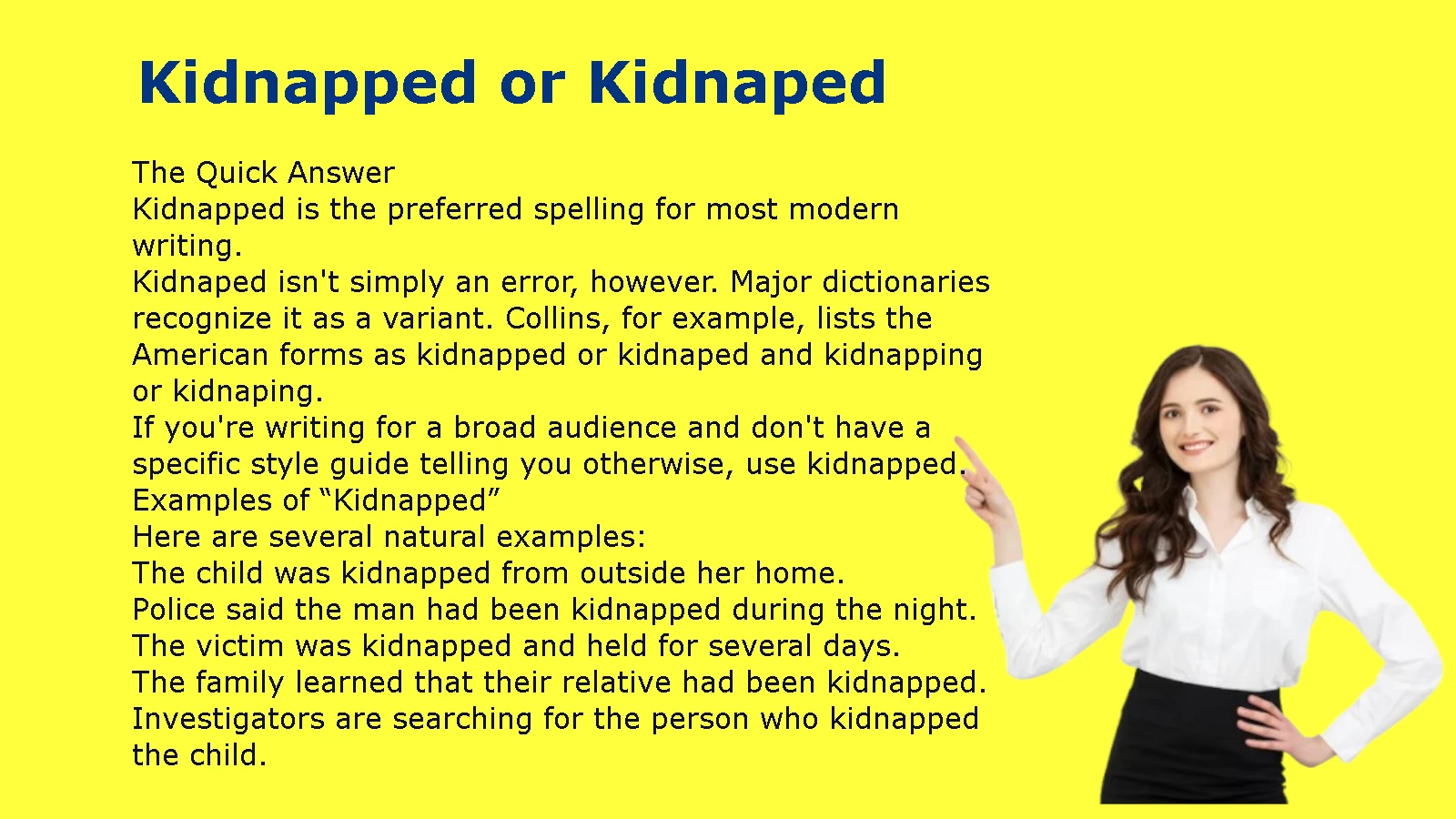
The Quick Answer
Kidnapped is the preferred spelling for most modern writing.
Kidnaped isn’t simply an error, however. Major dictionaries recognize it as a variant. Collins, for example, lists the American forms as kidnapped or kidnaped and kidnapping or kidnaping.
If you’re writing for a broad audience and don’t have a specific style guide telling you otherwise, use kidnapped.
Examples of “Kidnapped”
Here are several natural examples:
- The child was kidnapped from outside her home.
- Police said the man had been kidnapped during the night.
- The victim was kidnapped and held for several days.
- The family learned that their relative had been kidnapped.
- Investigators are searching for the person who kidnapped the child.
- The missing man was later found after being kidnapped.
Notice that the spelling stays the same whether kidnapped functions as a past tense verb or a past participle.
What Does “Kidnapped” Mean?
Kidnapped is the past tense and past participle of the verb kidnap.
To kidnap someone means to take that person away illegally, usually by force, and often hold them against their will. The act may involve a demand for money or another condition in exchange for the person’s release. Cambridge defines kidnap as taking a person away illegally by force, usually to demand money for their release.
For example:
The businessman was kidnapped and held for ransom.
Here, kidnapped tells you that the illegal taking happened in the past.
The word can also appear in passive constructions:
The tourist was kidnapped while traveling abroad.
In this sentence, was kidnapped means someone took the tourist illegally. The focus falls on the person who experienced the action rather than the person who carried it out.
Kidnapped as a Past Tense Verb
When you use kidnapped to describe an action completed in the past, it functions as the past tense of kidnap.
For example:
- Someone kidnapped the businessman.
- The group kidnapped the traveler.
- Police said the suspects kidnapped the victim.
The basic pattern is:
kidnap → kidnapped
Kidnapped as a Past Participle
Kidnapped also works as the past participle.
You’ll commonly see it after forms of have:
- The police have kidnapped? No. This construction changes the meaning because the police would be the ones performing the action.
- The suspects have kidnapped the victim.
- The suspects had kidnapped the victim before police arrived.
It also appears in passive constructions:
- The victim was kidnapped.
- The child had been kidnapped.
- Several people were kidnapped.
Cambridge identifies kidnapped as both the past tense and past participle of kidnap.
What Does “Kidnaped” Mean?
Kidnaped means the same thing as kidnapped.
The only difference is spelling.
Collins lists kidnaped as an American variant of kidnapped. Webster’s New World College Dictionary, as reproduced by Collins, also lists kidnapped or kidnaped as the past forms of kidnap.
So these two sentences have the same basic meaning:
- The child was kidnapped.
- The child was kidnaped.
The first sentence uses the more familiar spelling. The second uses the recognized variant.
Is “Kidnaped” a Correct Word?
Yes.
If a dictionary recognizes a spelling as a variant, you shouldn’t automatically label it incorrect. Kidnaped is an established variant of kidnapped in American English dictionaries.
However, there’s an important difference between correct and preferred.
A spelling can exist in English without being the form you should normally choose. That’s exactly the situation here. Kidnaped is recognized, but kidnapped is the more familiar choice for contemporary general writing.
For school assignments, professional documents, websites, and everyday communication, kidnapped keeps things straightforward.
Why Does “Kidnapped” Have Two P’s?
The spelling becomes easier to understand when you start with the base verb:
kidnap + ed = kidnapped
The final p is doubled before the -ed ending in the standard spelling.
The same pattern appears with -ing:
kidnap + ing = kidnapping
That gives you the familiar forms:
- kidnap
- kidnaps
- kidnapped
- kidnapping
English spelling rules often involve doubling a final consonant before a suffix. Yet the rules aren’t completely uniform across the language. That’s one reason spelling questions like this can feel trickier than they look.
Kidnap + -ed = Kidnapped
The standard formation is:
| Base word | Ending | Standard result |
| kidnap | -ed | kidnapped |
| kidnap | -ing | kidnapping |
| kidnap | -s | kidnaps |
The important point is that kidnapped isn’t an arbitrary spelling. It’s the established inflected form of kidnap.
Cambridge’s entry for kidnap displays -pp- as part of the spelling information and gives kidnapped as the past form.
Kidnapped vs. Kidnaped in American English
For American English, kidnapped is the spelling to reach for first.
Collins explicitly records both forms in American English:
kidnapped or kidnaped
It also records kidnapping or kidnaping as alternative forms.
That doesn’t mean American writers regularly switch between the two spellings at random. In ordinary modern writing, kidnapped is the form you’re far more likely to encounter.
Which One Should You Use?
Use kidnapped unless you have a particular reason to use the variant.
That recommendation works well for:
- School assignments
- College papers
- Business writing
- Blog posts
- News style writing
- General websites
- Emails
- Social media posts
- Everyday communication
If you encounter kidnaped in an older text, a particular publication, or a dictionary, don’t assume you’ve found a typo. It’s a recognized variant.
Kidnapped vs. Kidnaped in British English
The regional picture is slightly more nuanced than a simple American-versus-British split.
Collins lists kidnapped as the British past tense and past participle of kidnap. It also notes kidnaped and kidnaping as American variants in its British English entry.
In practical terms, kidnapped works comfortably in both American and British English.
That makes it an especially useful choice when you’re writing for an international audience. You don’t need to worry that readers in the United Kingdom will find the double-p spelling strange.
A Simple Regional Guide
| Variety | Recommended form |
| American English | kidnapped |
| British English | kidnapped |
| International English | kidnapped |
| Recognized American variant | kidnaped |
The key takeaway is simple: kidnapped is the broadly useful spelling.
What Is the Past Tense of Kidnap?
The past tense of kidnap is kidnapped.
The verb forms are:
| Verb form | Word |
| Base form | kidnap |
| Third person singular | kidnaps |
| Present participle | kidnapping |
| Past tense | kidnapped |
| Past participle | kidnapped |
For example:
Present:
Criminals sometimes kidnap people for ransom.
Past:
The criminals kidnapped the victim.
Past participle:
The victim had been kidnapped.
Cambridge directly identifies kidnapped as both the past tense and past participle of kidnap.
Is “Kidnaped” Also a Past Tense?
Yes.
Because kidnaped is a recognized variant, you can encounter it as a past form:
The man was kidnaped during the journey.
However, kidnapped remains the better general choice:
The man was kidnapped during the journey.
The meaning doesn’t change. Only the spelling does.
What Is the Past Participle of Kidnap?
The past participle of kidnap is kidnapped.
The past participle appears in several important grammatical structures.
With “Have,” “Has,” and “Had”
- The suspects have kidnapped the victim.
- The group has kidnapped several people.
- The criminals had kidnapped the man before police arrived.
In Passive Voice
- The child was kidnapped.
- The victim was kidnapped from his home.
- Several people had been kidnapped.
The same word, kidnapped, serves both functions.
That can make the grammar look more complicated than it really is. Once you remember that the past tense and past participle have the same form, the pattern becomes easy.
Kidnapping or Kidnaping?
The same spelling question appears when you add -ing.
The preferred form is kidnapping.
Kidnaping is also a recognized variant, particularly in American English dictionaries. Collins lists kidnapping or kidnaping among the forms of kidnap.
| Preferred form | Variant |
| kidnapping | kidnaping |
| kidnapped | kidnaped |
The double p appears in both of the common forms:
- kidnapping
- kidnapped
So if you’re trying to maintain consistent modern spelling, use the double-p versions.
Examples of “Kidnapping”
- The police launched an investigation into the kidnapping.
- The suspect was charged with kidnapping.
- The family received a ransom demand after the kidnapping.
- Authorities are investigating an attempted kidnapping.
- The documentary examines the circumstances surrounding the kidnapping.
Kidnapper or Kidnaper?
There’s another related spelling variation: kidnapper versus kidnaper.
The standard form most readers expect is kidnapper.
Collins lists kidnapper and identifies kidnaper as an American variant. Cambridge’s American Dictionary likewise gives kidnapper, with kidnaper as an alternative.
| Form | Recommendation |
| kidnapper | Preferred |
| kidnaper | Recognized variant |
For most modern writing, kidnapper is the obvious choice.
Example Sentences
- Police arrested the suspected kidnapper.
- The kidnapper demanded a ransom.
- Investigators identified the alleged kidnapper.
- The victim later described the kidnapper to police.
Again, the double-p spelling is the form most readers will recognize immediately.
Why Do Some Dictionaries List “Kidnaped”?
This is where dictionary usage can seem confusing.
You might open a dictionary expecting one correct spelling and discover two. That doesn’t mean the dictionary has made a mistake. Dictionaries record real forms that speakers and writers use.
In the case of kidnaped, major dictionary sources recognize the spelling as a variant. Collins gives both kidnapped and kidnaped in its American English entry.
The important distinction is:
Recognized does not always mean equally common.
English contains many spelling variants. Some remain common across regions. Others survive as alternatives without becoming the dominant form.
For this word, kidnapped is the practical choice when you want the spelling that will look most natural to a broad modern audience.
Kidnapped vs. Kidnaped: A Closer Look at Usage
The difference becomes clearer when you separate dictionary status from writing preference.
Dictionary status
Both forms are recognized in relevant dictionary sources.
General writing preference
Kidnapped is the stronger choice for contemporary standard writing.
Meaning
Both forms mean the same thing.
Grammar
Both forms can function as the past tense and past participle.
Audience
Kidnapped is the safer choice for readers across different English speaking regions.
That gives you a straightforward rule:
When you need one spelling, choose “kidnapped.”
You don’t need to overthink it.
Kidnapped vs. Abducted: Are They the Same?
Kidnapped and abducted overlap in meaning, but they aren’t simply two spellings of the same word.
To abduct someone means to take that person away illegally, often by force or threats. Cambridge lists kidnap as a synonym of abduct.
For example:
- The man was kidnapped.
- The man was abducted.
Both sentences can describe an illegal taking.
However, abducted has another specialized meaning in medicine. In anatomy, abduct can describe moving a body part away from the body’s central axis. Cambridge specifically distinguishes this medical sense from the meaning involving taking a person.
That second meaning doesn’t apply to kidnap.
Kidnapped vs. Abducted
| Word | Main meaning | Example |
| kidnapped | Taken away illegally, often by force and sometimes for ransom | The businessman was kidnapped. |
| abducted | Taken away illegally, often by force or threats | The businessman was abducted. |
In everyday writing, kidnapped is often the more direct word when the situation specifically involves kidnapping.
Common Mistakes With “Kidnapped”
The biggest mistake is treating kidnaped as unquestionably wrong.
It isn’t.
Dictionaries recognize it as a variant. The better advice is to distinguish between the recognized variant and the preferred modern form.
Mistake: Assuming “Kidnaped” Has a Different Meaning
It doesn’t.
Kidnaped and kidnapped refer to the same verb form and the same basic action.
Mistake: Writing “Kidnaping” When You Mean the Common Form
The more familiar spelling is:
kidnapping
The variant kidnaping exists, but the double-p spelling is the better general choice.
Mistake: Writing “Kidnaper” in Ordinary Modern Prose
Kidnaper is recognized, but kidnapper is the more familiar form.
Unless a source, quotation, or style requirement calls for kidnaper, stick with kidnapper.
Mistake: Treating “Kidnapped” and “Kidnaped” as Different Tenses
They aren’t.
Both can represent the past form of kidnap.
The difference is spelling, not tense.
Examples of “Kidnapped” in a Sentence
Seeing the word in different grammatical structures can make the distinction much easier.
Simple Past
The criminals kidnapped the businessman.
Here, kidnapped describes a completed action in the past.
Police said the group kidnapped the victim after midnight.
Again, the word functions as the simple past tense.
Passive Voice
The businessman was kidnapped while traveling.
The person who carried out the action isn’t the focus.
The child was kidnapped from outside the house.
The construction was kidnapped uses the past participle.
Present Perfect
The suspects have kidnapped several people.
The past action connects to the present situation.
Past Perfect
The suspects had kidnapped the victim before the police arrived.
The past perfect shows that one past event happened before another past event.
As a Descriptive Modifier
Police searched for the kidnapped man.
Here, kidnapped describes the man.
Past participles often work this way. Cambridge notes that past participles can appear in passive constructions and can also function in adjective like roles.
Examples of “Kidnaped” in a Sentence
Because kidnaped is a recognized variant, you may encounter sentences such as:
The child was kidnaped from her home.
The newspaper reported that the man had been kidnaped.
Police searched for the kidnaped victim.
These sentences use the same grammar and meaning as their double-p equivalents:
The child was kidnapped from her home.
The newspaper reported that the man had been kidnapped.
Police searched for the kidnapped victim.
For contemporary general writing, the second set is usually the better choice.
A Simple Rule for Remembering the Spelling
If you want an easy memory trick, keep the common forms together:
kidnap → kidnapped → kidnapping → kidnapper
Each of the main forms keeps the double p.
You can think of the final p as bringing a friend along when the word takes -ed, -ing, or -er:
- kidnap → kidnapped
- kidnap → kidnapping
- kidnap → kidnapper
This isn’t a complete rule for every English word. It’s simply a useful way to remember the standard forms of kidnap.
Kidnapped or Kidnaped: Quick Comparison
| Question | Answer |
| Which spelling is more common? | Kidnapped |
| Is kidnaped a word? | Yes |
| Is kidnaped recognized by dictionaries? | Yes |
| Does kidnaped have a different meaning? | No |
| What is the past tense of kidnap? | Kidnapped |
| What is the past participle? | Kidnapped |
| What is the common -ing form? | Kidnapping |
| Is kidnaping recognized? | Yes, as a variant |
| What is the common noun for a person who kidnaps? | Kidnapper |
| Is kidnaper recognized? | Yes, as a variant |
| Which form should you use in general US English? | Kidnapped |
Why “Kidnapped” Is the Better Default
Choosing kidnapped isn’t about declaring every other spelling invalid. It’s about choosing the form that gives your reader the least friction.
When someone sees kidnapped, the word is immediately familiar. There’s no pause. No mental speed bump.
Kidnaped may make some readers wonder whether they’ve spotted a typo, even though dictionaries recognize it. That’s exactly why kidnapped makes sense as the default in broad audience writing.
This matters especially in published content. A spelling variant can be technically valid while still looking unusual to readers.
When clarity is the goal, familiar wins.
Kidnapped or Kidnaped: Final Verdict
So, is it kidnapped or kidnaped?
The answer is both, with an important difference in preference.
Kidnapped is the standard form most writers should use. Kidnaped is a recognized variant, particularly documented in American English dictionaries. The two spellings have the same meaning and can represent the same past tense or past participle of kidnap.
The same pattern applies to the related words:
- kidnapped → preferred
- kidnaped → variant
- kidnapping → preferred
- kidnaping → variant
- kidnapper → preferred
- kidnaper → variant
If you’re unsure which spelling to put on the page, choose kidnapped.
It’s familiar, clear, widely accepted, and easy for readers to recognize.
Frequently Asked Questions About Kidnapped or Kidnaped
Is “kidnaped” spelled correctly?
Yes. Kidnaped is a recognized spelling variant of kidnapped. Major dictionary sources record both forms.
Is “kidnapped” the correct spelling?
Yes. Kidnapped is the preferred and widely used spelling of the past tense and past participle of kidnap. Cambridge lists it as the past tense and past participle.
Which is correct, kidnapped or kidnaped?
Both are recognized, but kidnapped is the better choice for general modern writing. Kidnaped is a variant rather than a different word.
What is the past tense of “kidnap”?
The past tense is kidnapped. Kidnaped is also recorded as a variant.
What is the past participle of “kidnap”?
The past participle is kidnapped. For example: “The victim had been kidnapped.”
Does kidnapped have two P’s?
Yes. The standard spelling is kidnapped, with two p’s.
Is it kidnapping or kidnaping?
Kidnapping is the preferred form for general writing. Kidnaping is a recognized variant in American English.
Is it kidnapper or kidnaper?
Kidnapper is the preferred and more familiar form. Kidnaper is also recognized as a variant.
Are kidnapped and abducted synonyms?
They can be synonyms when they describe illegally taking a person away. Cambridge lists kidnap as a synonym of abduct.
Should you use “kidnaped” in American English?
You can, because dictionaries recognize it. However, kidnapped is the better default for contemporary general American English.
Is “kidnapped” used in British English?
Yes. Collins lists kidnapped as the British past tense and past participle of kidnap.
The Bottom Line
Kidnapped is the spelling to use when you want the clearest and most familiar form.
So the easiest rule is:
Use “kidnapped” unless you have a specific reason to use the variant “kidnaped.”
That same preference carries through the related forms: kidnapping and kidnapper are the best default spellings for most modern English writing.