Have you ever wondered whether you should write “apart” or “a part” in a sentence? While Apart vs A Part may look like a small difference, these two expressions have completely different meanings and uses.
Apart is an adverb that means separated, away from each other, or to a separate position. A part is a phrase made up of an article and noun that means one piece, section, or member of something larger.
Examples:
- The two friends sat apart from each other.
- She is a part of our team.
The confusion is understandable. People often search for apart vs a part, a part vs apart, is it apart or a part, or when to use apart and a part because the two forms sound almost identical in everyday speech. And here’s the kicker: adding just one space can change the meaning of the entire sentence.
In this guide, you’ll learn the complete difference between Apart vs A Part, including their meanings, definitions, grammar, correct usage, and examples in sentences. You’ll also discover when to use apart or a part, common mistakes to avoid, and an easy trick to remember the difference.
Apart vs A Part: The Quick Difference
The fastest way to understand Apart vs A Part is to look at what the expression means in the sentence.
Apart focuses on separation.
The children sat apart.
The children aren’t sitting together. They are separated.
A part focuses on a component or portion of something larger.
A part of the cake was missing.
The sentence identifies one portion of the cake.
Merriam Webster defines apart as an adverb indicating separation, distance, division, or independence. It also recognizes apart as an adjective meaning separate or divided. By contrast, a part is a noun phrase referring to one of the units into which something is divided.
A simple comparison
| If you mean… | Use… | Example |
| separate | apart | The twins stood apart. |
| away from each other | apart | The buildings are miles apart. |
| into pieces | apart | He took the clock apart. |
| a piece | a part | A part of the clock was missing. |
| a portion | a part | She ate a part of the meal. |
| a role | a part | He played a part in the decision. |
| inclusion | part of / a part of | She is part of the committee. |
The difference is not about pronunciation alone. It’s about meaning and grammatical function.
What Does “Apart” Mean?
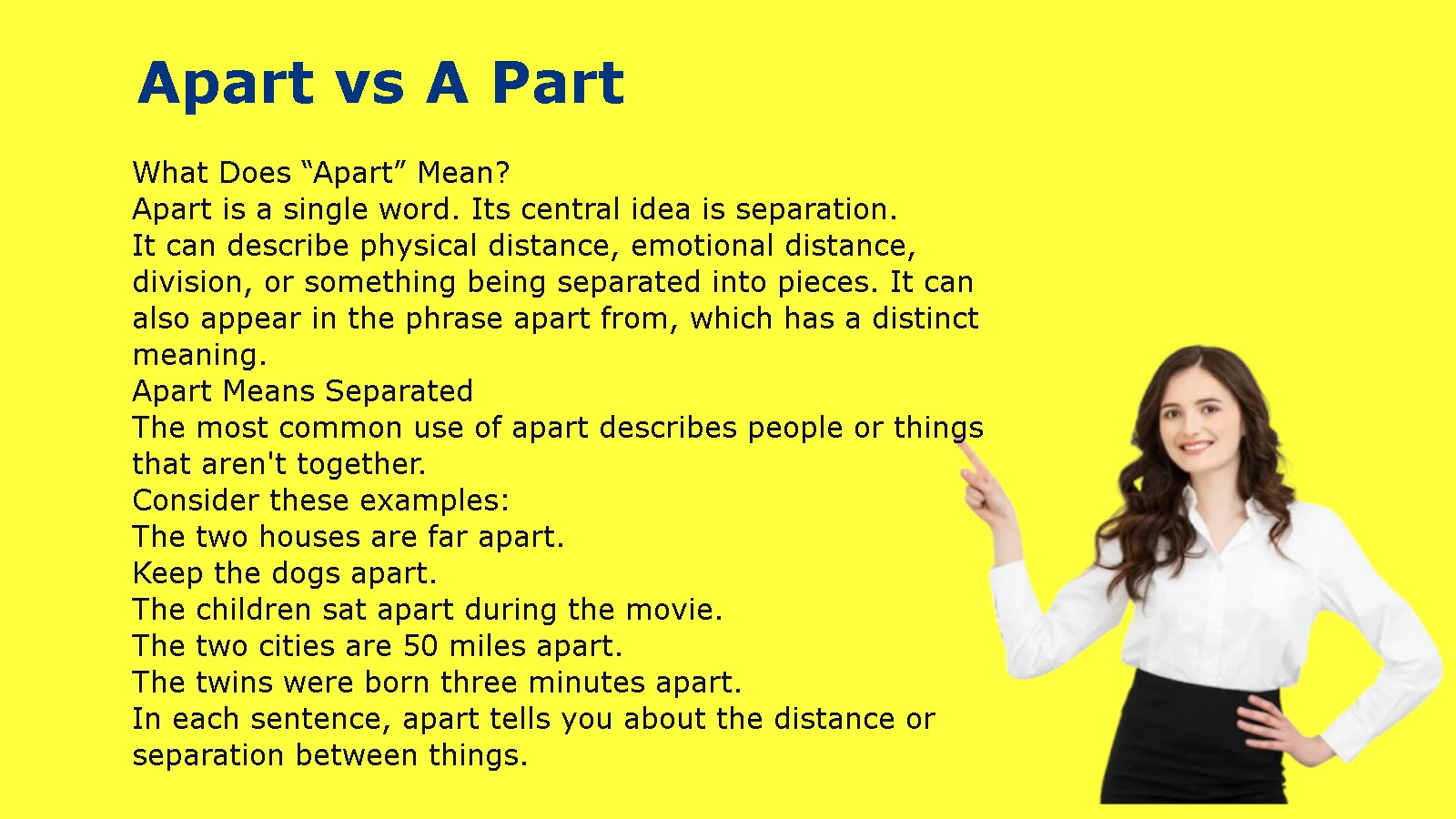
Apart is a single word. Its central idea is separation.
It can describe physical distance, emotional distance, division, or something being separated into pieces. It can also appear in the phrase apart from, which has a distinct meaning.
Apart Means Separated
The most common use of apart describes people or things that aren’t together.
Consider these examples:
- The two houses are far apart.
- Keep the dogs apart.
- The children sat apart during the movie.
- The two cities are 50 miles apart.
- The twins were born three minutes apart.
In each sentence, apart tells you about the distance or separation between things.
Merriam Webster gives examples such as towns being miles apart and people living apart after separating.
Apart Can Describe Something Coming Into Pieces
Apart doesn’t always describe two separate objects. It can also describe one object breaking, separating, or being dismantled.
For example:
- The old chair fell apart.
- The box came apart at the bottom.
- He took the engine apart.
- The toy broke apart.
- The rope began to come apart.
Here, the word expresses movement from one whole into separate pieces.
That’s why these sentences work:
The machine came apart.
The machine was missing a part.
The first sentence describes separation. The second identifies a component.
This contrast is one of the clearest ways to understand Apart vs A Part.
Apart Can Describe Emotional Distance
English also uses apart figuratively.
Two people can be physically close but emotionally distant. In that situation, apart describes the relationship rather than physical space.
Examples include:
- They slowly grew apart.
- The argument drove them apart.
- The experience pulled the friends apart.
- After college, they moved apart emotionally.
- Their political views are worlds apart.
The expression worlds apart is especially useful because it shows that apart doesn’t require literal physical distance.
Two ideas can be worlds apart. Two opinions can be far apart. Two approaches can be miles apart.
The underlying idea remains the same: separation or difference.
What Does “A Part” Mean?
A part contains two separate words:
- a = an indefinite article
- part = a noun
Together, a part means one piece, portion, section, component, or role within a larger whole.
Merriam Webster describes a part as one of the units into which something is divided.
A Part Means a Piece or Portion
Use a part when you’re talking about one piece of something larger.
Examples:
- A part of the wall was damaged.
- A part of the cake was missing.
- A part of the report needs revision.
- A part of the machine stopped working.
- A part of the road was closed.
Think of a pizza.
The whole pizza is one thing. One slice is a part of that pizza.
You could say:
A part of the pizza was left on the table.
You wouldn’t say:
Apart of the pizza was left on the table.
The second version incorrectly turns a noun phrase into the unrelated word apart.
A Part Can Mean a Role
A part can also describe someone’s role or contribution.
For example:
- She played a part in the company’s success.
- He had a part in the decision.
- Everyone played a part in the project.
- The coach played a part in the team’s improvement.
- The teacher had a part in shaping the program.
This use isn’t about a physical piece. Instead, part refers to a person’s role or contribution.
The meaning still connects to the larger idea of a whole. A person’s contribution is one element within a larger outcome.
A Part Can Refer to Membership or Inclusion
You can also use a part of to describe belonging to something larger.
Examples:
- She is a part of the team.
- He became a part of the community.
- They are a part of the organization.
- This tradition is a part of American culture.
- Everyone wants to feel like a part of something meaningful.
However, English often drops the article in these constructions:
She is part of the team.
That sentence is completely natural.
So both part of and a part of can be correct, depending on the sentence and emphasis.
Apart vs A Part: Side by Side Examples
Putting the expressions next to each other makes the distinction much easier to see.
Physical Separation
The two cars are apart.
The cars are separated.
A part of the car is damaged.
One component of the car is damaged.
Relationships
The friends grew apart.
Their relationship became more distant.
She wanted to be a part of his life.
She wanted to belong in his life.
Organizations
The two departments work apart.
They operate separately.
She is a part of the marketing department.
She belongs to that department.
Objects
The toy fell apart.
The toy broke into separate pieces.
A part of the toy was missing.
One component was absent.
The same spelling distinction keeps appearing because the underlying meanings remain consistent.
Apart separates. A part identifies a piece.
Is “Apart Of” Correct?
No. “Apart of” is incorrect when you mean “a piece of,” “included in,” or “belonging to.”
This is probably the most important mistake to avoid in this topic.
Incorrect:
She is apart of the team.
Correct:
She is a part of the team.
Also correct and often more natural:
She is part of the team.
The reason is straightforward. Apart already has its own meaning. It describes separation. It doesn’t mean “a piece of” or “a member of.”
Incorrect vs. Correct
| Incorrect | Correct |
| I am apart of the team. | I am a part of the team. |
| She is apart of the project. | She is a part of the project. |
| He became apart of the community. | He became a part of the community. |
| This is apart of the process. | This is a part of the process. |
| They are apart of the organization. | They are a part of the organization. |
Scribbr specifically recommends remembering that “apart of” is never the correct spelling when the intended meaning is a part of something.
Why the mistake happens
The confusion usually comes from pronunciation.
Apart and a part sound very similar in ordinary speech. When people hear the phrase rather than see it written, the boundary between the words can disappear.
That creates a classic English problem: two expressions can sound alike while functioning differently on the page.
Writing forces you to make the distinction visible.
Apart From vs. A Part Of
Another major source of confusion is the difference between apart from and a part of.
They look similar. Their meanings are not.
What Does “Apart From” Mean?
Apart from commonly means:
- except for
- besides
- separate from
Scribbr identifies apart from as a prepositional phrase that can mean “except for” or “besides.”
For example:
Apart from Sarah, everyone agreed.
Here, apart from means except for Sarah.
Another example:
Apart from the weather, the trip was excellent.
Here, the speaker is excluding the weather from the otherwise positive assessment.
What Does “A Part Of” Mean?
A part of means that something is a component, portion, role, or member of a larger whole.
Sarah is a part of the team.
Sarah belongs to the team.
This chapter is a part of the book.
The chapter is one section of the larger book.
The Difference in One Table
| Phrase | Meaning | Example |
| apart from | except for | Apart from Tom, everyone came. |
| apart from | separate from | The cabin stands apart from the main building. |
| a part of | a piece of | This chapter is a part of the book. |
| a part of | included in | She is a part of the team. |
A useful visual trick is to focus on the preposition:
apart FROM → separation or exception
a part OF → belonging or inclusion
That isn’t a universal grammar rule for every imaginable construction, but it works well for the common phrases that cause this confusion.
When Should You Use “Part” Instead of “A Part”?
Here’s where the distinction gets more interesting.
You don’t always need the article a before part.
Both of these can be grammatical:
She is part of the team.
She is a part of the team.
The first often sounds more natural when part of means membership or inclusion.
Compare the emphasis
She is part of the team.
This emphasizes her membership.
She is a valuable part of the team.
This emphasizes her role as one component of the team.
The adjective valuable makes the noun phrase more specific.
Other examples include:
- He is part of the committee.
- He is an important part of the committee.
- Trust is part of a healthy relationship.
- Trust is a crucial part of a healthy relationship.
- Exercise is part of her routine.
- Exercise is a major part of her routine.
Scribbr notes that in many instances, the article a can be dropped without changing the basic meaning.
A Useful Pattern
When part of means included in, the article is often optional:
She is part of the group.
She is a part of the group.
When part is modified by an adjective, a commonly appears:
She is an important part of the group.
He played a significant part in the project.
The article isn’t simply there because the word is “part.” English noun phrases depend on how the noun functions in the sentence.
How to Remember Apart vs A Part
You don’t need a complicated mnemonic.
Two simple ideas will cover most cases.
Memory Trick: Apart Means Away
Think:
Apart = away or separated.
Examples:
- The chairs are apart.
- The siblings live apart.
- The pieces fell apart.
- The friends grew apart.
If the sentence involves separation, apart is likely the word you need.
Memory Trick: A Part Means a Piece
Think:
A part = a piece.
Try replacing part with piece.
A part of the machine is broken.
Becomes:
A piece of the machine is broken.
The meaning still works.
That makes a part the logical choice.
Scribbr recommends this substitution test as a practical way to determine whether a part is appropriate.
The Fastest Test
Ask yourself:
Does the sentence mean “separate”?
Use apart.
Does it mean “a piece,” “portion,” or “component”?
Use a part.
For example:
The books are ___.
They are separated → apart
___ of the book is missing.
A portion is missing → a part
This two question test handles most everyday cases.
Common Mistakes With Apart and A Part
The same errors appear repeatedly because the two expressions sound alike.
Mistake: “Apart of the Team”
❌ She is apart of the team.
✅ She is a part of the team.
✅ She is part of the team.
The sentence describes membership, not separation.
Mistake: “They Live a Part”
❌ They live a part.
✅ They live apart.
Here, the intended meaning is that they live separately.
Mistake: “The Machine Came a Part”
❌ The machine came a part.
✅ The machine came apart.
The machine separated into pieces.
Mistake: “A Part From”
❌ A part from the cost, everything was fine.
✅ Apart from the cost, everything was fine.
Here, the intended meaning is except for.
Mistake: “The Two Groups Are a Part”
❌ The two groups are a part.
If the intended meaning is that they are separated, use:
✅ The two groups are apart.
Context matters, but the difference in meaning is substantial.
Apart vs A Part Examples in Sentences
The following examples show the most useful patterns you’ll encounter in everyday writing.
- The two buildings stand several feet apart.
- The children sat apart from one another.
- Their opinions are worlds apart.
- The old book was falling apart.
- She took the camera apart to clean it.
- The siblings grew apart over the years.
- The two events happened hours apart.
- Keep these chemicals apart.
- The rope eventually came apart.
- I couldn’t tell the twins apart.
- A part of the roof needs repair.
- A part of the report contains outdated information.
- She played a part in the decision.
- He wants to become a part of the community.
- Everyone played a part in the event.
- A part of the machine stopped working.
- The final chapter is a part of the larger story.
- She considers volunteering a part of her life.
- He had a part in the company’s success.
- A part of the budget was reserved for training.
Examples With “Part Of”
- She is part of the team.
- Trust is part of a strong relationship.
- This issue is part of a larger problem.
- Exercise is part of his daily routine.
- The tradition is part of the community’s history.
- That information is part of the report.
Apart vs A Part in Different Contexts
The right choice becomes easier when you look at how each word behaves in real situations.
Relationships
Use apart when people become separated.
The two friends grew apart after graduation.
Use a part of when someone wants inclusion or belonging.
She wanted to be a part of his new life.
The first describes distance. The second describes inclusion.
Work and Business
Use apart for separation or independent operation.
The two departments operate apart from each other.
Use part of or a part of for membership.
She is part of the finance team.
Or use a part to describe a contribution:
She played a major part in the company’s expansion.
Machines and Objects
This is one of the easiest contexts in which to see the distinction.
The mechanic took the engine apart.
The engine was dismantled.
The mechanic replaced a part of the engine.
One component was replaced.
Groups and Communities
Use apart for separation:
The two communities developed apart from one another.
Use part of for inclusion:
She became part of the local community.
These meanings sit almost like opposite sides of the same coin.
Why “Apart” and “A Part” Get Confused
The spelling difference seems obvious when you see the words on a screen. Spoken English makes the distinction less obvious.
Apart is one word.
A part consists of an article and a noun.
But in normal speech, word boundaries aren’t always pronounced with sharp edges. That’s why someone might hear:
“She is a part of the team.”
and mentally write:
“She is apart of the team.”
The problem isn’t unusual. English contains many word pairs and phrases where spaces matter.
For Apart vs A Part, however, the context usually gives you the answer.
If the sentence describes distance, think apart.
If it describes a component or inclusion, think a part or part of.
Apart vs A Part: Grammar Comparison
The grammatical difference helps explain why the meanings differ.
| Feature | Apart | A part |
| Spelling | One word | Two words |
| Basic function | Adverb or adjective | Noun phrase |
| Core meaning | Separation | Portion or component |
| Can describe distance? | Yes | No |
| Can describe dismantling? | Yes | No |
| Can identify a component? | No | Yes |
| Can describe a role? | No | Yes |
| Common phrase | apart from | a part of |
| Example | The houses are far apart. | A part of the house needs repair. |
Merriam Webster lists apart as both an adverb and adjective, while Scribbr explains its use as an adverb, adjective, and in the prepositional phrase apart from.
Is “Apart” Always About Physical Distance?
No.
This is an important point because apart can describe much more than physical space.
It can describe:
- emotional separation
- disagreement
- conceptual difference
- independent consideration
- physical distance
- separation into pieces
Consider these examples:
Their houses are five miles apart.
Physical distance.
Their political views are worlds apart.
Conceptual difference.
The couple grew apart.
Emotional distance.
Take the device apart.
Physical separation into components.
The argument falls apart under scrutiny.
Figurative breakdown.
Merriam Webster includes meanings related to being at a distance, being separate as a unit, being excluded from consideration, and coming into pieces.
So don’t reduce apart to the simple idea of “two things far away.” Its broader concept is separation.
Can “A Part” Refer to Something Other Than a Physical Piece?
Absolutely.
A part can refer to an abstract role, contribution, or element.
For example:
Communication is a part of effective leadership.
Communication isn’t a physical piece of leadership. It’s one element of it.
Similarly:
Her advice played a part in my decision.
Her advice isn’t literally a detachable object. It contributed to the larger outcome.
Other examples include:
- patience is a part of good teaching
- research is a part of the process
- preparation is a part of success
- teamwork is a part of the solution
This is why part is such a flexible noun. It can describe something physical or conceptual.
Apart vs A Part Case Study: A Broken Machine
Imagine a mechanic working on an old car.
First, the mechanic says:
“I’m going to take the engine apart.”
That means the mechanic will separate the engine’s components.
Later, the mechanic says:
“One part of the engine is damaged.”
Now part means a component.
The same situation uses both forms naturally:
The mechanic took the engine apart and discovered that a part needed replacing.
That single sentence captures the entire distinction.
Apart describes what happened to the engine.
A part identifies what the mechanic found.
Apart vs A Part Case Study: Joining a Team
Now consider a workplace.
Someone says:
“I want to be part of this team.”
The person wants to belong to the team.
Another employee says:
“She played a major part in the project’s success.”
Here, part means contribution or role.
But if someone writes:
“She is apart of the team.”
the meaning changes because apart does not mean “included in.”
The correct sentence is:
She is part of the team.
Or:
She is a part of the team.
The first emphasizes membership. The second can emphasize her status as one component or member within the larger group.
How “Part Of” and “A Part Of” Differ
These expressions overlap, but they aren’t always interchangeable in tone or emphasis.
Part Of
Part of often sounds natural when talking about membership or inclusion.
Examples:
He is part of the committee.
She is part of the community.
This is part of the process.
A Part Of
A part of can emphasize one component, portion, or role.
Examples:
She played a part of the process.
However, when talking about a role, played a part in is often the more natural construction:
She played a part in the process.
For physical portions, a part of is straightforward:
A part of the wall collapsed.
For membership, part of is often the cleaner choice:
She is part of the team.
The article isn’t simply a spelling preference. It reflects how the noun phrase functions in the sentence.
Apart vs A Part Quick Test
Try these sentences before checking the answers.
Practice Questions
- The two houses are miles ___.
- She is ___ of the committee.
- The old chair fell ___.
- ___ from the cost, the project went well.
- He played ___ in the company’s growth.
- A ___ of the machine needs replacing.
- The siblings grew ___.
- Everyone wants to feel like ___ of the community.
- The mechanic took the device ___.
- ___ of the report needs updating.
Answers
| # | Answer | Why |
| 1 | apart | The houses are separated by distance. |
| 2 | part | The person belongs to the committee. |
| 3 | apart | The chair separated into pieces. |
| 4 | Apart | The phrase means “except for.” |
| 5 | a part | It describes a role or contribution. |
| 6 | part | It identifies a component. |
| 7 | apart | The siblings became emotionally distant. |
| 8 | a part | It refers to belonging or inclusion. |
| 9 | apart | The device was dismantled. |
| 10 | a part | It identifies a portion of the report. |
The Most Important Question
When you’re stuck, ask:
Can “separate” replace the word?
If yes, apart is probably correct.
The houses are far apart.
→ The houses are far separate.
The wording isn’t identical, but the concept is separation.
Then ask:
Can “piece” replace “part”?
If yes, a part is probably correct.
A part of the machine is broken.
→ A piece of the machine is broken.
This is a practical test because it focuses on meaning, not memorization.
Frequently Asked Questions About Apart vs A Part
Is “apart of” grammatically correct?
No. When you mean that something belongs to or forms part of something larger, use part of or a part of.
Correct:
She is part of the team.
She is a part of the team.
Incorrect:
She is apart of the team.
Is it “a part of” or “apart of”?
Use a part of when you mean a piece, portion, component, role, or member of a larger whole.
Apart of is not the correct expression for that meaning.
What is the difference between apart and a part?
Apart means separate, divided, or at a distance.
A part means one piece, portion, component, role, or element of something larger.
Is “part of” or “a part of” correct?
Both can be correct.
For membership or inclusion, part of often sounds more natural:
She is part of the team.
For a specific component or role, a part of can work naturally:
A part of the machine is broken.
He played a part in the decision.
Context determines the best choice.
Is “apart from” correct?
Yes.
Apart from commonly means except for or besides.
Apart from one mistake, the report was excellent.
It can also describe literal separation:
The house stands apart from the other buildings.
Are “apart” and “a part” pronounced the same?
They are commonly pronounced similarly in ordinary speech, which helps explain why writers confuse them. Their meanings and grammatical roles are different.
What is an easy way to remember Apart vs A Part?
Remember:
Apart = separated.
A part = a piece.
If the sentence describes distance or separation, choose apart. If it describes a component, portion, role, or inclusion, choose a part or part of.
Can “apart” mean emotionally separated?
Yes.
The two friends grew apart.
Here, apart describes emotional or relational distance rather than physical distance.
Can “a part” describe a person’s role?
Yes.
She played a part in the decision.
Here, part means a role or contribution rather than a physical piece.
Is “apart” always an adverb?
No. Apart can function as an adverb and adjective. It also appears in the prepositional phrase apart from.
Final Takeaway: Apart vs A Part
The difference between Apart vs A Part comes down to one central idea: separation versus inclusion or composition.
Use apart when something is separate, distant, divided, or broken into pieces.
The two buildings are far apart.
The old chair fell apart.
They gradually grew apart.
Use a part when you mean one piece, portion, component, role, or element of a larger whole.
A part of the machine is broken.
She played a part in the decision.
He wants to be a part of the community.
And remember one especially useful correction:
❌ apart of the team
✅ part of the team
✅ a part of the team
When you see apart, think separation.
When you see a part, think a piece.
That small space carries a surprisingly large difference in meaning.