Have you ever come across Climactic vs Climatic and wondered which word you should use? These two words look and sound similar, but they have completely different meanings. Knowing the difference can help you avoid confusion when writing about a climactic moment in a story or climatic conditions related to weather and climate.
Climactic describes something related to a climax, especially the most exciting, important, or intense point of an event, story, or situation. Climatic, on the other hand, relates to climate, weather conditions, or the long term weather patterns of a place.
Examples:
- The movie reaches a climactic battle in the final scene.
- The region has harsh climatic conditions.
The confusion is understandable. People often search for climactic vs climatic, climatic vs climactic, climactic meaning, climatic meaning, or what is the difference between climactic and climatic because the two words differ by only one letter. And here’s the kicker: using the wrong one can completely change what you mean.
In this guide, you’ll learn the complete difference between Climactic vs Climatic, including their meanings, definitions, pronunciations, correct usage, and examples in sentences. You’ll also discover an easy way to remember the difference and learn when to use climactic and climatic correctly.
Climactic vs Climatic: What’s the Difference?
The simplest way to understand Climactic vs Climatic is to connect each adjective to its root word.
| Word | Meaning | Root word | Common contexts | Example |
| Climactic | Relating to a climax or peak | Climax | Stories, movies, conflicts, competitions, speeches, events | The climactic scene revealed the truth. |
| Climatic | Relating to climate | Climate | Weather, geography, agriculture, ecology, environmental science | The crop grows well under certain climatic conditions. |
Climactic = climax.
Climatic = climate.
That’s the central distinction. Everything else follows from it.
Cambridge defines climactic as describing the most important or exciting point in a story or situation. It defines climatic as relating to general weather conditions.
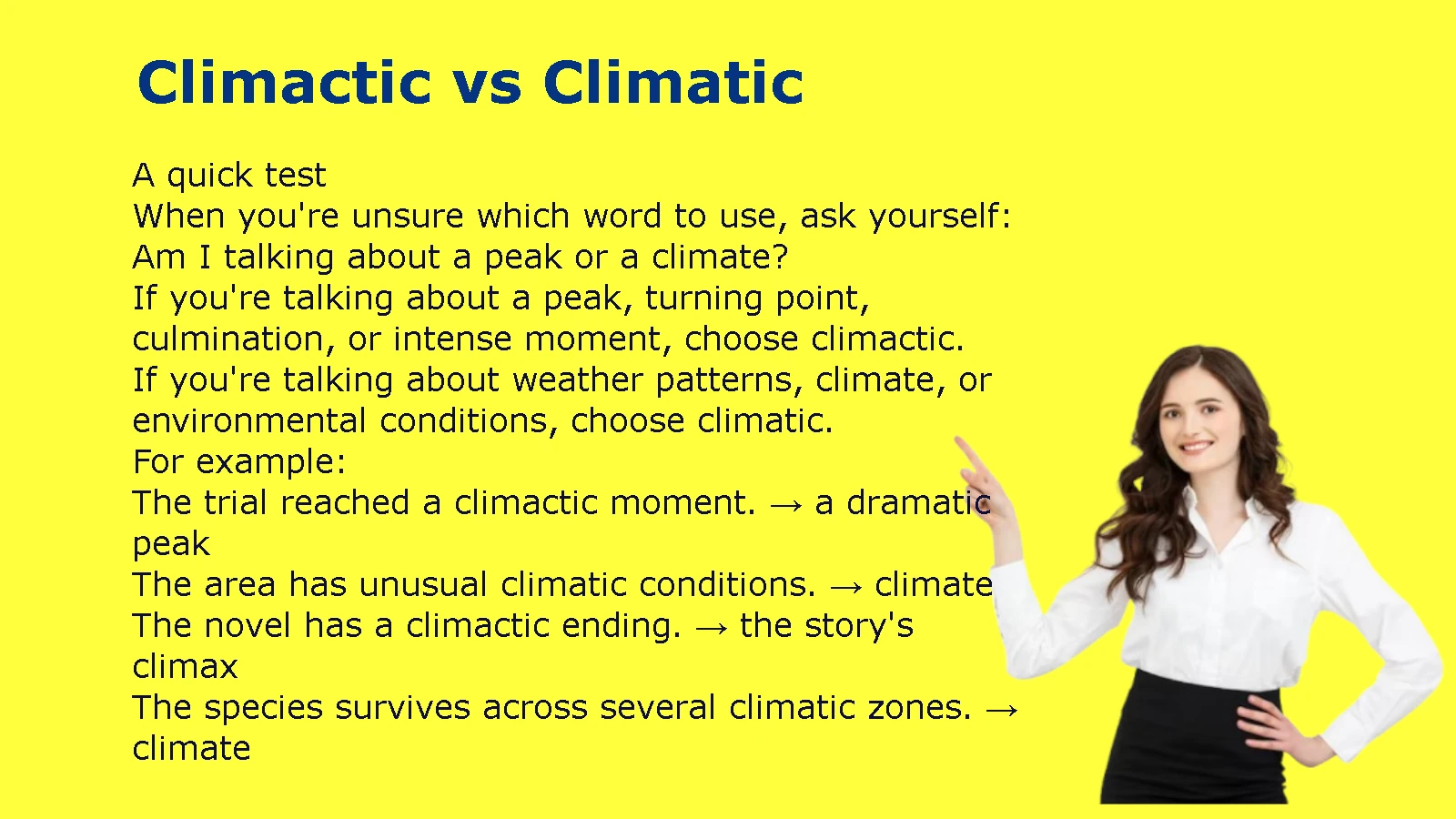
A quick test
When you’re unsure which word to use, ask yourself:
Am I talking about a peak or a climate?
If you’re talking about a peak, turning point, culmination, or intense moment, choose climactic.
If you’re talking about weather patterns, climate, or environmental conditions, choose climatic.
For example:
- The trial reached a climactic moment. → a dramatic peak
- The area has unusual climatic conditions. → climate
- The novel has a climactic ending. → the story’s climax
- The species survives across several climatic zones. → climate
What Does “Climactic” Mean?
Climactic is an adjective that means related to, forming, or constituting a climax.
A climax is the point at which something reaches its highest level of intensity, importance, tension, or development. In a story, the climax often represents the moment when the central conflict reaches its most critical point. In other situations, the word can describe any major peak or decisive stage.
For example:
The climactic scene comes near the end of the film.
The scene is not necessarily the final scene. It is climactic because it represents an important or intense point in the story.
The word also works outside literature and entertainment.
You can have:
- a climactic battle
- a climactic confrontation
- a climactic moment
- a climactic decision
- a climactic speech
- a climactic performance
- a climactic event
- a climactic victory
- a climactic final match
- a climactic ending
Merriam Webster defines climactic as meaning “of, relating to, or constituting a climax.”
Climactic examples
Here are several examples that show how the word works in different settings:
- The climactic scene finally reveals who committed the crime.
- The team’s climactic victory came in the final seconds.
- The debate reached a climactic moment when both candidates challenged each other directly.
- The novel builds toward a climactic confrontation between the two brothers.
- The climactic speech changed the audience’s opinion.
- The symphony ends with a climactic crescendo.
- The final race became the climactic event of the championship.
- The climactic battle determines the fate of the kingdom.
In each example, climactic points to a high point.
Climactic in stories and movies
The word appears especially often when people discuss narrative structure.
A typical story might contain:
- An introduction to the characters and setting
- A conflict or problem
- Rising tension
- A climax
- Falling action
- A resolution
The climax is the central peak of the narrative. Therefore, something connected to that peak is climactic.
For example:
The climactic confrontation between the detective and the killer occurs in the final chapter.
The confrontation is climactic because it represents the story’s major dramatic peak.
Cambridge gives the example of a film ending with a climactic battle scene, which captures this use clearly.
What Does “Climatic” Mean?
Climatic means related to climate.
Climate refers to the general or average weather conditions of a region over a period of years. Those conditions can include temperature, precipitation, humidity, wind, and other atmospheric patterns.
So when something is climatic, it has a connection to climate.
For example:
The plant’s growth depends on several climatic factors.
Here, climatic refers to conditions associated with the climate.
The word frequently appears in scientific, environmental, agricultural, geographic, and ecological writing. Merriam Webster also gives a second sense: something can be climatic when it results from or is influenced by climate rather than soil.
Climatic examples
- The region experiences extreme climatic conditions.
- Farmers must adapt to changing climatic patterns.
- The species can survive across several climatic zones.
- Scientists studied the climatic history of the region.
- Climatic factors influence crop production.
- The building was designed for the area’s climatic conditions.
- Researchers examined climatic changes over several decades.
- The plants evolved in response to local climatic conditions.
Notice what these sentences have in common. None of them involves a dramatic peak or climax.
They all concern climate.
Climatic in science and geography
You will often encounter climatic in technical writing because researchers need a precise adjective for things associated with climate.
Common examples include:
- climatic conditions
- climatic change
- climatic variation
- climatic factors
- climatic patterns
- climatic zones
- climatic effects
- climatic differences
- climatic data
- climatic conditions of a region
For example:
The researchers compared climatic conditions across three agricultural regions.
The adjective works because the researchers are comparing conditions connected with climate.
Climactic vs Climatic Examples Side by Side
The fastest way to see the difference is to place the words next to each other.
| With climactic | With climatic |
| The movie’s climactic scene was unforgettable. | The region has harsh climatic conditions. |
| The novel reaches its climactic moment in the final chapter. | Farmers monitor changing climatic patterns. |
| The championship ended in a climactic final match. | The species thrives in tropical climatic zones. |
| The debate reached a climactic point. | The study examines climatic variation. |
| The hero’s climactic confrontation changes everything. | The crop has specific climatic requirements. |
| The symphony closes with a climactic crescendo. | The area’s climatic conditions limit agriculture. |
The contrast is straightforward:
Climactic describes a peak. Climatic describes climate.
Climactic vs Climatic in Movies and Stories
Movies provide one of the easiest ways to understand climactic.
Imagine a mystery film. The detective spends two hours collecting clues. The tension rises. The suspect is finally cornered. The detective discovers the missing evidence and confronts the culprit.
That final confrontation may be the climactic scene.
It would be incorrect to call it the climatic scene if the intended meaning is that the scene represents the story’s climax.
Correct
The climactic scene reveals the identity of the murderer.
Incorrect for that meaning
The climatic scene reveals the identity of the murderer.
The second sentence suggests a connection to climate rather than a narrative climax.
The same distinction applies to books, plays, television shows, speeches, and other narratives.
Examples
- The climactic chapter resolves the mystery.
- The climactic battle takes place outside the castle.
- The climactic scene changes the protagonist’s future.
- The film’s climactic ending surprised the audience.
- The play builds toward a climactic confrontation.
Climactic vs Climatic in Science and Environmental Writing
Scientific writing often favors climatic because researchers regularly discuss climate related conditions.
Consider this sentence:
Scientists examined the climatic factors affecting the distribution of the species.
The adjective is correct because the factors relate to climate.
Likewise:
The region’s climatic conditions make it suitable for growing certain crops.
Again, the topic is climate.
Merriam Webster lists climatic changes and climatic requirements of a crop among its examples.
A useful distinction between weather and climate
Although climatic relates to climate, it helps to understand what climate means.
Weather describes atmospheric conditions over a short period. You might talk about today’s temperature, tomorrow’s rainfall, or this afternoon’s thunderstorm.
Climate describes longer term patterns.
For example:
- Today’s storm is a weather event.
- The region’s long term rainfall pattern is part of its climate.
- Long term temperature trends can be described as climatic patterns.
Therefore, climatic usually appears when the discussion concerns broader or longer term climate conditions rather than one isolated weather event.
When Should You Use “Climactic”?
Use climactic when something reaches or represents a climax.
The easiest way to decide is to replace the word mentally with “related to the climax.”
If that substitution works, climactic is probably the right choice.
Use “climactic” for:
- The highest point of a story
- A decisive confrontation
- A major turning point
- An intense final scene
- The peak of a competition
- A dramatic conclusion
- A powerful speech
- The most important moment in an event
- A major stage in a conflict
- The culmination of a sequence of events
Examples
The climactic scene occurs just before the final credits.
The climactic match attracted millions of viewers.
Her climactic speech changed the direction of the campaign.
The climactic confrontation between the rivals lasted only five minutes.
In all four examples, the word points toward a peak.
When Should You Use “Climatic”?
Use climatic when something relates to climate.
Try replacing the word with “related to climate.”
If the sentence still makes sense, climatic is likely correct.
Use “climatic” for:
- Climate conditions
- Climate patterns
- Climate zones
- Climate variation
- Climate effects
- Climate data
- Climate related changes
- Agricultural conditions
- Ecological conditions
- Regional climate differences
Examples
The region has unique climatic conditions.
The researchers studied climatic variation across the continent.
The crop requires specific climatic conditions.
Climatic changes can affect ecosystems.
The meaning stays connected to climate, not a dramatic peak.
Common Mistakes With Climactic and Climatic
The most common mistake occurs when writers know the intended meaning but choose the wrong spelling.
Mistake: “climatic scene”
Suppose the intended meaning is the most important scene in a movie.
Incorrect:
The climatic scene shocked everyone.
Correct:
The climactic scene shocked everyone.
Why? Because the scene represents the climax.
Mistake: “climactic conditions”
Suppose you’re discussing the environmental conditions of a region.
Incorrect:
The farm struggles because of harsh climactic conditions.
Correct:
The farm struggles because of harsh climatic conditions.
Here, the word relates to climate.
Mistake: “climatic battle”
If the battle represents the high point of a conflict, use climactic.
Correct:
The climactic battle determines who will control the city.
Mistake: “climactic changes”
If you’re discussing changes in climate, use climatic.
Correct:
Scientists have documented significant climatic changes.
Dictionary sources consistently make this same distinction: climactic refers to a climax, while climatic refers to climate.
Why Are Climactic and Climatic So Easy to Confuse?
The confusion isn’t random. The words have a historical connection.
Merriam Webster explains that climate and climax ultimately trace back to the same Greek noun, klima, associated with ideas such as inclination, latitude, and climate.
That shared history helps explain why the words look so similar today.
Their modern meanings, however, have separated:
- climax → climactic
- climate → climatic
The spelling now provides a useful clue.
The extra C matters
Look at the two words:
climatic
climactic
The extra c in climactic helps connect it visually to climax.
That gives you a practical memory trick:
Climactic has the C of climax.
Meanwhile, climatic stays close to climate.
How to Remember Climactic vs Climatic
You don’t need a complicated mnemonic.
Just remember these two pairs:
Climactic → Climax
Think:
climactic → climax → peak
If you’re talking about the highest point of something, use climactic.
Climatic → Climate
Think:
climatic → climate → weather patterns
If you’re talking about climate or long term atmospheric conditions, use climatic.
The one second test
Ask:
Is this about a peak?
→ Climactic
Is this about climate?
→ Climatic
That’s enough for most situations.
Climactic vs Climatic Pronunciation
The words also have slightly different pronunciations.
In standard US English:
- climactic: /klaɪˈmæk.tɪk/
- climatic: /klaɪˈmæt̬.ɪk/
Cambridge lists climactic with the /klaɪˈmæk.tɪk/ pronunciation and climatic with /klaɪˈmæt̬.ɪk/ in its US English entries.
The important difference occurs in the middle:
- climactic contains a /k/ sound
- climatic contains a /t/ sound
In ordinary conversation, however, the words can still sound close enough to cause confusion. Merriam Webster notes that the confusion is generally more noticeable in spelling and typing than in speech.
That’s one reason proofreading matters.
Climactic vs Climatic: Common Collocations
Learning common word combinations can make the distinction easier because certain nouns naturally pair with each adjective.
Common collocations with “climactic”
- climactic scene
- climactic moment
- climactic battle
- climactic confrontation
- climactic ending
- climactic finale
- climactic event
- climactic point
- climactic speech
- climactic victory
- climactic match
- climactic chapter
These combinations usually involve a peak, culmination, or intense moment.
Common collocations with “climatic”
- climatic conditions
- climatic change
- climatic changes
- climatic factors
- climatic patterns
- climatic zones
- climatic variation
- climatic effects
- climatic differences
- climatic data
- climatic requirements
- climatic regions
These combinations usually concern climate, environmental conditions, or geography.
Climactic vs Climatic: A Practical Case Study
Consider a fictional documentary about a farming community.
The documentary follows farmers dealing with years of changing rainfall patterns. Researchers study temperature trends and water availability. These are climatic issues because they concern climate and environmental conditions.
Near the end, the farmers face a decisive vote about whether to adopt a new farming method. The discussion becomes intense. The vote determines the community’s future.
That meeting could be described as climactic.
So one article or documentary could legitimately use both words:
The documentary explores the region’s changing climatic conditions before building toward a climactic community vote.
That’s a useful example because it shows that the words don’t merely belong to different types of writing. Both can appear in the same sentence when they describe different ideas.
Can Climactic and Climatic Be Used Interchangeably?
No.
Although the words look and sound similar, they have different meanings.
Replacing one with the other can make a sentence inaccurate or change its meaning.
Compare:
The climactic scene was unforgettable.
This means the scene was an important or intense peak.
Now compare:
The climatic conditions were difficult.
This means the climate made conditions difficult.
Switching the adjectives would not preserve the intended meaning.
Compare these pairs
| Meaning | Correct word |
| A movie’s most intense scene | Climactic |
| Weather patterns of a region | Climatic |
| The peak of a conflict | Climactic |
| Climate conditions affecting crops | Climatic |
| A decisive final match | Climactic |
| Long term environmental conditions | Climatic |
| The turning point of a novel | Climactic |
| Climate related variation | Climatic |
The distinction is firm even though the spelling is close.
Climactic vs Climatic vs. Anticlimactic
A related word worth knowing is anticlimactic.
If climactic describes something associated with a climax, anticlimactic describes something that falls short of the expected climax or feels disappointing after expectations have built.
For example:
The movie’s climactic battle was spectacular.
But:
After two hours of suspense, the ending felt anticlimactic.
The second sentence describes a letdown. The expected dramatic payoff didn’t deliver.
Dictionary.com specifically identifies anticlimactic as the opposite idea associated with an anticlimax.
This distinction is useful because writers sometimes confuse climatic with climactic when they actually mean anticlimactic.
Don’t confuse these three
- Climactic → reaches or relates to a climax
- Climatic → relates to climate
- Anticlimactic → disappointing because it falls short of an expected climax
For example:
The story’s climactic confrontation was thrilling.
The region’s climatic conditions are severe.
The supposedly shocking ending was anticlimactic.
Each word has a separate job.
Is “Climactic” Related to “Climax”?
Yes.
This is one of the most useful facts for remembering the spelling.
Climactic comes from climax and describes something related to or constituting a climax. Merriam Webster and Dictionary.com both identify this connection in their dictionary entries.
That relationship explains why the extra c appears in climactic.
So when you see:
climactic scene
Think:
climax → climactic
When you see:
climatic conditions
Think:
climate → climatic
The roots do much of the work for you.
Is “Climatic” Related to “Climate”?
Yes.
Climatic comes from climate and means related to climate. Its uses include discussions of regional weather conditions, environmental effects, agriculture, ecosystems, and climate related changes.
For example:
The region’s climatic conditions support a wide range of plant species.
The adjective simply turns climate into a descriptive form.
This pattern is common in English:
- economy → economic
- history → historic/historical
- climate → climatic
The important point is that climatic stays connected to climate.
Is It “Climactic or Climatic Conditions”?
The correct phrase is:
climatic conditions
Why? Because conditions in this phrase refer to environmental or weather conditions associated with a region.
For example:
The plants survive under harsh climatic conditions.
The building was designed for the area’s hot climatic conditions.
Farmers must account for changing climatic conditions.
Climactic conditions would only make sense in a highly unusual context where “conditions” somehow referred to a climax. In ordinary writing, that isn’t what the phrase means.
Is It “Climactic or Climatic Change”?
When you mean changes related to climate, use:
climatic change
For example:
The researchers investigated climatic change over several centuries.
However, climactic could be correct in a completely different sentence if you mean something connected with a climax.
Compare:
- The study examines climatic change. → change in climate
- The novel’s climactic change in direction shocked readers. → a change occurring at a dramatic peak
The context determines the word, but climatic change is the normal phrase when discussing climate.
Is It “Climactic or Climatic Event”?
This one requires more attention because event can work with either word.
Use “climactic event” when:
The event represents the peak or most important point in a sequence.
The championship final was the climactic event of the season.
Use “climatic” when:
The event itself relates to climate.
The researchers recorded several climatic events during the study period.
The first example is about importance and culmination.
The second is about climate.
So don’t memorize individual noun combinations blindly. Look at the meaning first.
Is It “Climactic or Climatic Moment”?
The correct phrase is usually:
climactic moment
A moment can represent the high point of a story, conversation, competition, or event.
For example:
The climactic moment arrives when the two characters finally meet.
You wouldn’t normally use climatic moment to describe a dramatic turning point.
If you’re talking about climate, you’d need a context where the moment itself has a climate related meaning.
Is It “Climactic or Climatic Scene”?
Use:
climactic scene
when you mean the most important or exciting scene in a story, movie, play, or other narrative.
For example:
The climactic scene takes place on the bridge.
Cambridge specifically uses climactic battle scene as an example of the word’s standard meaning.
Remember:
Scene + climax = climactic scene.
Quick Trick to Choose the Right Word
When you’re writing and hesitate between climactic and climatic, don’t stare at the spelling. Look at the meaning.
Ask: “Does it relate to a climax?”
If yes:
Use climactic.
Examples:
- climactic scene
- climactic battle
- climactic ending
- climactic moment
- climactic confrontation
Ask: “Does it relate to climate?”
If yes:
Use climatic.
Examples:
- climatic conditions
- climatic zones
- climatic factors
- climatic changes
- climatic patterns
The fastest memory rule
Climactic = climax.
Climatic = climate.
That’s the whole trick.
Climactic vs Climatic Comparison Chart
| Feature | Climactic | Climatic |
| Part of speech | Adjective | Adjective |
| Meaning | Related to a climax or peak | Related to climate |
| Root | Climax | Climate |
| Main idea | Highest or most intense point | General climate conditions |
| Common fields | Literature, film, politics, sports, history | Science, geography, agriculture, ecology |
| Common phrase | Climactic scene | Climatic conditions |
| Another example | Climactic battle | Climatic factors |
| Memory clue | C = climax | C = climate |
| Pronunciation | /klaɪˈmæk.tɪk/ | /klaɪˈmæt̬.ɪk/ |
Frequently Asked Questions About Climactic vs Climatic
What is the difference between climactic and climatic?
Climactic means related to a climax or peak. Climatic means related to climate.
The climactic scene was exciting.
The region has unusual climatic conditions.
Is “climactic” related to climax?
Yes. Climactic comes from climax and describes something associated with a climax or highest point.
Is “climatic” related to climate?
Yes. Climatic means related to climate, including general weather conditions and climate influenced effects.
Is it “climactic scene” or “climatic scene”?
Use climactic scene when you mean the most important or exciting scene in a story, movie, or play.
Is it “climactic conditions” or “climatic conditions”?
Use climatic conditions when you mean conditions related to climate.
Is it “climactic moment” or “climatic moment”?
Use climactic moment when the moment represents a peak or turning point.
Is it “climactic battle” or “climatic battle”?
Use climactic battle when the battle represents the high point of a conflict.
Is “climatic” about weather?
Yes, broadly speaking. More precisely, it relates to climate, which concerns general or average atmospheric conditions over time rather than simply the weather at one particular moment.
Can climactic and climatic be used interchangeably?
No. They have different meanings and normally cannot replace each other.
What is an example of climactic?
The climactic confrontation between the hero and villain occurs in the final chapter.
What is an example of climatic?
The region’s climatic conditions make it difficult to grow wheat.
What is the easiest way to remember Climactic vs Climatic?
Remember:
Climactic = climax.
Climatic = climate.
If there’s a peak, choose climactic. If there’s climate, choose climatic.
Final Difference Between Climactic and Climatic
The difference between climactic and climatic becomes easy once you connect each word to its root.
Climactic describes a climax. Use it for a peak, turning point, culmination, or especially intense moment.
Climatic describes climate. Use it for weather patterns, environmental conditions, geographic regions, and other things connected with climate.
The best memory trick is also the simplest:
Climactic = climax.
Climatic = climate.
So write:
- climactic scene
- climactic moment
- climactic battle
- climactic ending
But write:
- climatic conditions
- climatic changes
- climatic factors
- climatic patterns
Once you separate peak from climate, the spelling stops being a guessing game. The meaning tells you which word belongs in the sentence.