Have you ever seen Artifact and Artefact used in different places and wondered which spelling is correct? While Artifact vs Artefact may look like a simple spelling difference, the choice depends mainly on American and British English, as well as the style of writing you’re using.
Artifact and Artefact have the same meaning. Both words refer to an object made or changed by humans, especially one of historical, cultural, or archaeological importance. Artifact is the standard spelling in American English, while Artefact is more common in British English and other varieties of English.
Examples:
- The museum displayed an ancient artifact from Egypt.
- The museum displayed an ancient artefact from Egypt.
The confusion is understandable. People often search for artifact vs artefact, artifact or artefact, artefact meaning, or is artifact or artefact correct because both spellings appear in dictionaries, books, academic writing, and everyday English. And here’s the kicker: neither spelling is wrong. The difference comes down to the variety of English you’re using.
In this guide, you’ll learn the complete Artifact vs Artefact difference, including their meaning, definition, pronunciation, origin, and correct usage. You’ll also discover when to use Artifact or Artefact, which spelling is preferred in American and British English, and how to use both words correctly in sentences.
Artifact vs Artefact: Quick Answer
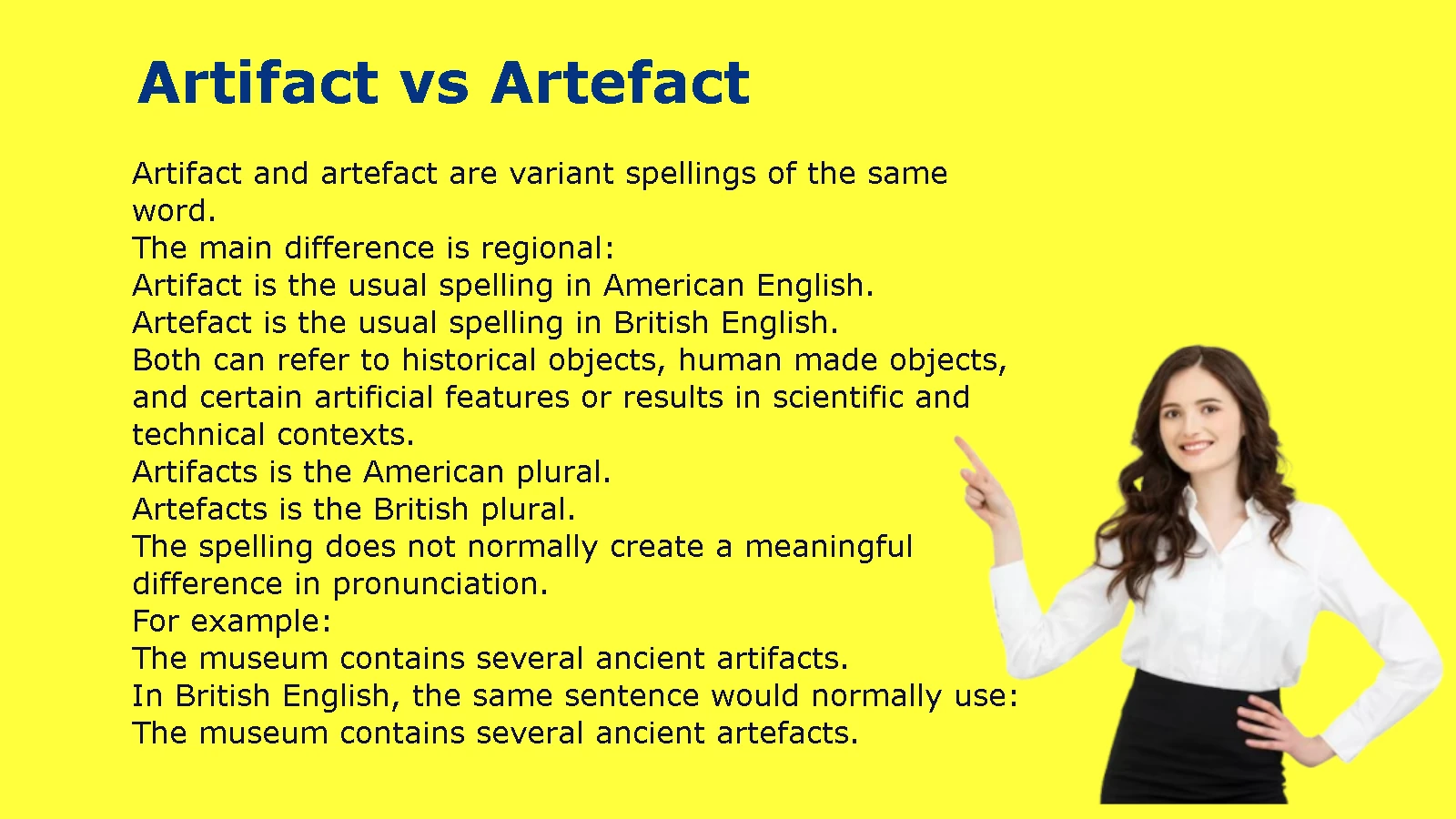
Artifact and artefact are variant spellings of the same word.
The main difference is regional:
- Artifact is the usual spelling in American English.
- Artefact is the usual spelling in British English.
- Both can refer to historical objects, human made objects, and certain artificial features or results in scientific and technical contexts.
- Artifacts is the American plural.
- Artefacts is the British plural.
- The spelling does not normally create a meaningful difference in pronunciation.
For example:
The museum contains several ancient artifacts.
In British English, the same sentence would normally use:
The museum contains several ancient artefacts.
The meaning stays the same. Only the regional spelling changes.
Cambridge describes artefact as the “mainly UK” spelling of artifact, while its American dictionary uses artifact for an object made in the past, such as a tool.
What Is the Difference Between Artifact and Artefact?
The difference between artifact and artefact comes down primarily to spelling conventions rather than meaning.
Artifact Is the American Spelling
In American English, artifact is the standard form.
You’ll commonly see it in:
- American history books
- Archaeology texts
- Museum descriptions
- Scientific writing
- Medical literature
- Technology documentation
- Academic research
- General nonfiction
For example:
- The archaeologists discovered several artifacts near the settlement.
- The scan contains a small imaging artifact.
- The researchers ruled out the apparent pattern as a statistical artifact.
Artefact Is the British Spelling
In British English, artefact is generally preferred.
You might encounter it in:
- British museum publications
- UK academic writing
- British newspapers
- Archaeological reports
- Historical texts
- Scientific publications using British spelling
For example:
- The archaeologists discovered several artefacts near the settlement.
- The scan contains a small imaging artefact.
- The researchers ruled out the apparent pattern as a statistical artefact.
Collins lists artifact as a variant spelling of artefact in British English. It also identifies artefact as the mainly British form in its American English entry.
The Meaning Usually Stays the Same
This is the crucial point.
Artifact does not describe one type of object while artefact describes another. In ordinary usage, they are simply regional spellings.
Think of the relationship between:
- color and colour
- favorite and favourite
- center and centre
- artifact and artefact
The spelling changes according to the variety of English, while the underlying word remains the same.
Is Artifact or Artefact Correct?
Both are correct.
The right choice depends on the English variety you’re using.
If the article, essay, website, report, or publication follows American English, use artifact.
If it follows British English, use artefact.
| Writing context | Recommended spelling |
| American English | artifact |
| British English | artefact |
| American academic writing | artifact |
| British academic writing | artefact |
| US museum description | artifact |
| UK museum description | artefact |
There’s no need to treat one spelling as a misspelling simply because the other is more familiar. Dictionaries recognize both forms and connect them to different regional conventions.
Which Spelling Should You Use in American English?
Use artifact.
Examples:
- ancient artifact
- archaeological artifact
- cultural artifact
- digital artifact
- scientific artifact
- medical artifact
- artifacts from the Bronze Age
The plural is artifacts.
Which Spelling Should You Use in British English?
Use artefact.
Examples:
- ancient artefact
- archaeological artefact
- cultural artefact
- digital artefact
- scientific artefact
- medical artefact
- artefacts from the Bronze Age
The plural is artefacts.
Artifact vs Artefact in American and British English
Regional spelling becomes especially important in formal writing.
A writer might know that artefact is a valid English word but still choose artifact because the rest of the document uses American spelling. Likewise, a British publication may consistently use artefact alongside spellings such as colour, centre, and favourite.
Cambridge directly labels artifact as the US spelling of artefact and artefact as mainly UK.
American English
Artifact is the normal choice.
The museum acquired three ancient artifacts.
British English
Artefact is generally preferred.
The museum acquired three ancient artefacts.
Can Artifact Appear in British English?
Yes.
British English can use artifact, and Collins identifies it as a variant spelling of artefact. That doesn’t make artifact the usual British choice, however.
Can Artefact Appear in American English?
Yes, but it is not the normal American spelling.
Collins lists artefact in American English as a British variant of artifact.
This distinction matters because “correct” doesn’t always mean “preferred.” A spelling can be recognized by a dictionary while still being unusual in a particular variety of English.
What Does Artifact Mean?
The word artifact has several related meanings.
At its most basic level, an artifact is something made by human beings. The word is especially common when discussing objects from earlier periods of history.
Cambridge defines an artifact as an object made by a person, such as a tool, especially one of historical interest.
Artifact as a Historical Object
An artifact can be a physical object that gives researchers information about people who lived in the past.
Examples include:
- Tools
- Pottery
- Weapons
- Coins
- Jewelry
- Sculptures
- Religious objects
- Household items
- Written materials
- Decorative objects
A small object can tell a surprisingly large story.
A fragment of pottery, for example, may reveal information about manufacturing techniques, trade networks, diet, decoration, or daily life. That’s why archaeologists don’t view artifacts merely as old objects. They can serve as evidence of human activity.
Artifact as a Cultural Object
The word can also describe objects that reflect a particular culture or period.
A mass produced product can even become a cultural artifact if it helps researchers understand the society that produced and used it.
For example:
The cassette tape became a cultural artifact of the late 20th century.
Here, the cassette tape doesn’t have to be ancient. It represents a particular period and its technology, habits, and popular culture.
Collins includes mass produced objects that reflect contemporary society or popular culture among its meanings of artifact.
Artifact in Science
In science, artifact has a more technical meaning.
A scientific artifact is something observed during an experiment or study that does not naturally belong to the phenomenon being studied. Instead, the observation may result from the way researchers conducted, prepared, measured, recorded, or analyzed the experiment.
Cambridge describes this specialized sense as something seen in a scientific experiment or study that does not exist naturally but has been caused by the way the experiment or study was performed.
For example:
The apparent pattern was an experimental artifact rather than a property of the material.
The distinction matters. If researchers mistake an artifact for a genuine phenomenon, they can draw the wrong conclusion.
Artifact in Medicine
Medical and biological fields also use artifact for an artificial feature introduced during observation or preparation.
For instance, a laboratory preparation may create a structure that wasn’t actually present in the living tissue. That feature can be described as an artifact.
Collins specifically includes a histological and medical sense involving a structure that appears in tissue because of processes such as fixation or staining rather than being normally present in living tissue.
This use is quite different from an archaeological artifact, but the underlying idea connects them: something has been produced or shaped by human action rather than existing naturally in the form being observed.
Artifact in Technology
Modern technology has expanded the word even further.
You can encounter terms such as:
- Digital artifact
- Image artifact
- Compression artifact
- Rendering artifact
- Software artifact
- Data artifact
- Statistical artifact
A digital artifact may be an unintended feature introduced during the creation, processing, transmission, or display of digital information.
For example, an image compressed too aggressively may develop visible distortions. Those distortions can be described as compression artifacts.
The same general concept applies to other technical contexts: the feature appears because of a process rather than because it belongs naturally to the underlying subject.
What Does Artefact Mean?
Artefact has the same core meanings as artifact.
The main difference is spelling.
In British English, artefact can describe a human made object, particularly one with historical or archaeological importance. It can also describe an artificial feature produced during scientific investigation.
For example:
The museum’s collection contains several ancient artefacts.
And in science:
The unusual result may be an artefact of the testing procedure.
These sentences don’t describe concepts that are fundamentally different from their American English counterparts. The British spelling simply uses e where American English generally uses i.
Artifact vs Artefact Examples
Seeing the two forms side by side makes the distinction much easier.
American English Examples
- The museum displayed several ancient artifacts.
- Archaeologists uncovered a stone artifact near the settlement.
- The pottery is one of the oldest artifacts in the collection.
- The unusual image contained a digital artifact.
- Researchers determined that the result was an experimental artifact.
- The coin is an important historical artifact.
- The photograph contains several compression artifacts.
British English Examples
- The museum displayed several ancient artefacts.
- Archaeologists uncovered a stone artefact near the settlement.
- The pottery is one of the oldest artefacts in the collection.
- The unusual image contained a digital artefact.
- Researchers determined that the result was an experimental artefact.
- The coin is an important historical artefact.
- The photograph contains several compression artefacts.
The pattern is straightforward: artifact → artefact and artifacts → artefacts.
Side by Side Comparison
| American English | British English |
| ancient artifact | ancient artefact |
| historical artifact | historical artefact |
| cultural artifact | cultural artefact |
| archaeological artifact | archaeological artefact |
| scientific artifact | scientific artefact |
| digital artifact | digital artefact |
| artifacts | artefacts |
Artifact vs Artefact in Archaeology
Archaeology is probably the context most closely associated with the word.
An artifact is often a human made object recovered during archaeological investigation. Archaeologists study these objects alongside other evidence to understand past human behavior.
Examples include:
- Stone tools
- Ceramic vessels
- Arrowheads
- Coins
- Beads
- Jewelry
- Weapons
- Figurines
- Building materials
- Household objects
Cambridge specifically uses the example of a tool when defining the word and notes its connection with objects made in the past.
Why Archaeological Artifacts Matter
An artifact rarely tells the entire story by itself.
Its location, material, condition, age, and relationship to other discoveries can all matter.
Suppose archaeologists find a metal object near an ancient settlement. The object itself provides evidence, but its location can provide even more information. If it appears alongside imported pottery, for example, researchers may investigate whether the settlement participated in a wider trade network.
That is why archaeological work depends heavily on context.
An artifact separated from its original context can lose some of its research value. The object remains interesting, but information about where, when, and how it was used may disappear.
Artifact vs Relic
Artifact and relic overlap, but they aren’t perfect synonyms.
An artifact is broadly a human made object, especially one studied because of its historical, cultural, or archaeological significance.
A relic generally refers to something surviving from an earlier period. The word often carries stronger associations with historical survival, religious significance, or remains.
For example:
The archaeologist examined a Bronze Age artifact.
This emphasizes the object as evidence of human activity.
The monastery preserved a religious relic.
This emphasizes its survival and religious significance.
The words can overlap in some contexts, but replacing one with the other can change the emphasis.
Artifact vs Artefact in Science and Research
The scientific meaning deserves attention because it differs sharply from the everyday archaeological sense.
In research, an artifact may be an observation created by the method of investigation.
Imagine that a researcher measures a phenomenon and notices an unexpected pattern. Before declaring a discovery, the researcher must consider whether the measurement process itself produced the pattern.
That possibility is where the term artifact becomes useful.
Experimental Artifacts
An experimental artifact can arise from:
- Equipment
- Sample preparation
- Measurement techniques
- Environmental conditions
- Data collection
- Data processing
- Statistical procedures
- Researcher procedures
For example:
The apparent increase was a statistical artifact caused by the way the data were grouped.
The result may look real, but the underlying phenomenon doesn’t actually behave that way.
Collins defines artifact in scientific contexts as a nonnatural feature or structure introduced through observation or preparation and also includes spurious results arising from investigative procedures.
Why Researchers Care About Artifacts
Calling something an artifact isn’t simply a way to dismiss an inconvenient result.
It can be an important part of scientific reasoning.
Researchers need to distinguish between:
What the subject actually does
and
What the research method makes it appear to do.
That distinction helps prevent false conclusions.
Artifact vs Artefact in Technology and Computing
Technology provides another major area where the word appears.
A technical artifact can be an unintended feature introduced by a digital process.
Image Artifacts
Digital images can develop artifacts because of:
- Compression
- Resizing
- Processing
- Transmission
- Rendering
- Sensor limitations
A compressed image may show blocky areas or other distortions that weren’t present in the original scene.
Those distortions are image artifacts.
Software Artifacts
In software development, the term can have a broader technical meaning.
A software artifact can refer to a tangible output produced during software development, such as a build or another project output. The exact meaning depends on the technical context.
This demonstrates an important feature of the word: its meaning can shift slightly across disciplines while retaining the broader idea of something produced, created, or introduced by a process.
Digital Artifacts
The term can also describe digital objects or unintended features that result from technological processes.
Cambridge’s examples include technical uses involving computer music artifacts, showing that the term extends well beyond archaeology.
Artifact vs Artefact Plural Forms
The plural forms are easy to remember.
Plural of Artifact
The American plural is:
artifacts
Example:
The museum acquired several ancient artifacts.
Plural of Artefact
The British plural is:
artefacts
Example:
The museum acquired several ancient artefacts.
Don’t Mix the Forms
Avoid combinations such as:
- artifactes ❌
- artefacts when the document otherwise follows American spelling
- artifacts when a British publication requires consistent British spelling
The basic pattern is:
| Singular | Plural |
| artifact | artifacts |
| artefact | artefacts |
Artifact vs Artefact Pronunciation
The spelling changes, but the two forms are normally pronounced essentially the same.
Cambridge gives separate US and UK pronunciations, reflecting broader accent differences between American and British English rather than a major lexical difference between the two spellings.
In other words, changing i to e doesn’t create a completely different word in speech.
The pronunciation difference you hear is more likely to come from the speaker’s accent than from the spelling itself.
Artifact vs Artefact Word Origin
The history of the word helps explain why its spelling looks unusual.
Both forms trace back to the Latin phrase arte factum, meaning something made with skill or craft.
Collins gives the origin as a 19th century formation from the Latin phrase arte factum, associated with ars, meaning skill, and facere, meaning to make.
The parts are revealing:
- arte relates to skill or craftsmanship.
- factum relates to something made.
The basic idea, therefore, is remarkably close to the modern meaning: something made through human action or skill.
The American spelling artifact developed as a variant form, while British English retained the spelling artefact more commonly.
Collins dates the American form to the early 19th century and traces it to the Latin phrase arte factum.
Artifact vs Artefact: Which One Should You Use?
Choosing between the two doesn’t have to be complicated.
Use this simple rule:
American audience = artifact. British audience = artefact.
However, audience isn’t the only consideration.
Follow the Required Style Guide
If a university, journal, employer, publisher, or organization specifies a style guide, follow that guide.
Consistency matters more than personal preference.
Consider Your Publication’s English Variety
If an entire article uses American spellings such as:
- color
- center
- organize
- favorite
then artifact fits naturally.
If the article uses British forms such as:
- colour
- centre
- organise
- favourite
then artefact usually fits better.
Keep One Spelling Throughout
Don’t switch between artifact and artefact randomly.
For example, this looks inconsistent:
The museum displays several ancient artifacts. Its collection also contains medieval artefacts.
If the document follows American English, write:
The museum displays several ancient artifacts. Its collection also contains medieval artifacts.
If it follows British English, write:
The museum displays several ancient artefacts. Its collection also contains medieval artefacts.
There can be legitimate reasons for preserving a source’s original spelling in a quotation or title, but ordinary prose should follow one consistent convention.
Artifact vs Artefact: Common Mistakes
Several mistakes appear repeatedly when people compare these words.
Mistake: Assuming One Spelling Is Wrong
Neither word is simply “wrong.”
Artifact is the standard American form.
Artefact is mainly the British form.
Dictionaries recognize the relationship between the two spellings.
Mistake: Thinking They Have Different Meanings
In most ordinary contexts, they don’t.
The distinction is primarily regional spelling.
Mistake: Using the Wrong Plural
Remember:
- artifact → artifacts
- artefact → artefacts
Mistake: Treating Artifact as Only an Archaeology Term
The word has broader uses.
It can describe:
- Historical objects
- Cultural objects
- Scientific observations
- Medical features
- Digital distortions
- Statistical results
- Other features introduced by an external process
Collins documents several of these technical senses.
Mistake: Assuming British English Never Uses Artifact
British English generally prefers artefact, but artifact can appear as a variant. Collins explicitly lists it that way.
Artifact vs Artefact: A Practical Style Guide
| If you’re writing for… | Use |
| United States readers | artifact |
| British readers | artefact |
| American academic publication | artifact |
| British academic publication | artefact |
| US museum | artifact |
| UK museum | artefact |
| American general website | artifact |
| British general website | artefact |
There is one important exception: follow the publication’s established style when it differs from the general regional preference.
A journal may have its own house style. A company may use one spelling across international materials. A quoted historical source may preserve its original wording.
Case Study: Choosing the Right Spelling in a Museum Article
Consider two museum websites.
An American museum publishes:
Our collection includes thousands of artifacts from ancient civilizations.
A British museum publishes:
Our collection includes thousands of artefacts from ancient civilizations.
Neither sentence communicates a different historical concept.
The spelling reflects the publication’s English variety.
Now imagine an international article comparing museums in New York and London. The writer has two reasonable choices.
The article can use one consistent variety throughout, or it can preserve the spelling used in official names and quotations where necessary.
The key is to avoid accidental switching.
Case Study: Artifact in Scientific Research
Consider a study in which researchers observe an unexpected pattern in a sample.
At first glance, the pattern appears significant. However, further testing shows that the preparation method created the feature.
The researchers might describe the feature as an experimental artifact.
Here, artifact doesn’t mean an ancient object.
Instead, it identifies something that arose from the research process rather than from the phenomenon under investigation.
British English can express the same idea with artefact.
The observed effect was an experimental artefact.
The spelling changes. The scientific concept does not.
Artifact vs Artefact: Frequently Asked Questions
Are artifact and artefact the same word?
Yes. Artifact and artefact are variant spellings of the same word. The main distinction is regional: artifact is standard in American English, while artefact is mainly British.
Is artifact the American spelling?
Yes. Artifact is the standard American English spelling. Cambridge identifies it as the US spelling of artefact.
Is artefact the British spelling?
Yes. Artefact is the mainly British spelling. Cambridge labels it “mainly UK,” and Collins lists it as the British form.
Is artefact wrong in American English?
No. It is recognized, but it is not the usual American spelling. In American writing, artifact is the better default.
Is artifact wrong in British English?
No. British English generally favors artefact, but artifact is recognized as a variant spelling.
What is the plural of artifact?
The plural is artifacts.
The archaeologists discovered several artifacts.
What is the plural of artefact?
The plural is artefacts.
The archaeologists discovered several artefacts.
Do artifact and artefact have different meanings?
Usually, no. Both can refer to human made objects and to artificial features or results produced by a process. The spelling is primarily regional.
Which spelling should I use in an American English essay?
Use artifact unless your institution or required style guide specifies another form.
Which spelling should I use in a British English essay?
Use artefact unless the required publication or style guide specifies otherwise.
Is artifact only used for ancient objects?
No.
Although the word is strongly associated with archaeology, it also appears in science, medicine, statistics, computing, imaging, and other technical fields.
Does artifact have the same pronunciation as artefact?
They are normally pronounced essentially alike. Differences you hear generally reflect regional accents rather than a separate pronunciation created by the spelling.
What is the difference between an artifact and a relic?
An artifact is broadly a human made object, especially one studied for historical, cultural, or archaeological reasons. A relic is something that has survived from an earlier period and often carries historical or religious associations.
They overlap in some contexts, but they aren’t interchangeable in every sentence.
Artifact vs Artefact: Final Verdict
The artifact vs artefact difference is much simpler than it first appears.
Artifact is the standard American English spelling.
Artefact is the standard British English spelling.
Both words can describe a human made object, especially one with historical or cultural importance. They can also describe artificial features produced during scientific, medical, statistical, or technological processes.
| Question | Answer |
| American spelling | artifact |
| British spelling | artefact |
| American plural | artifacts |
| British plural | artefacts |
| Same basic meaning? | Yes |
| Different regional spelling? | Yes |
| Is either spelling inherently wrong? | No |
| Best rule | Match your English variety and stay consistent |
The easiest rule to remember is this: if the writing follows American English, choose artifact. If it follows British English, choose artefact.
Once that distinction is clear, there’s little mystery left. The two spellings may look different on the page, but they point to the same word and the same core idea: something made, shaped, or introduced through human action.